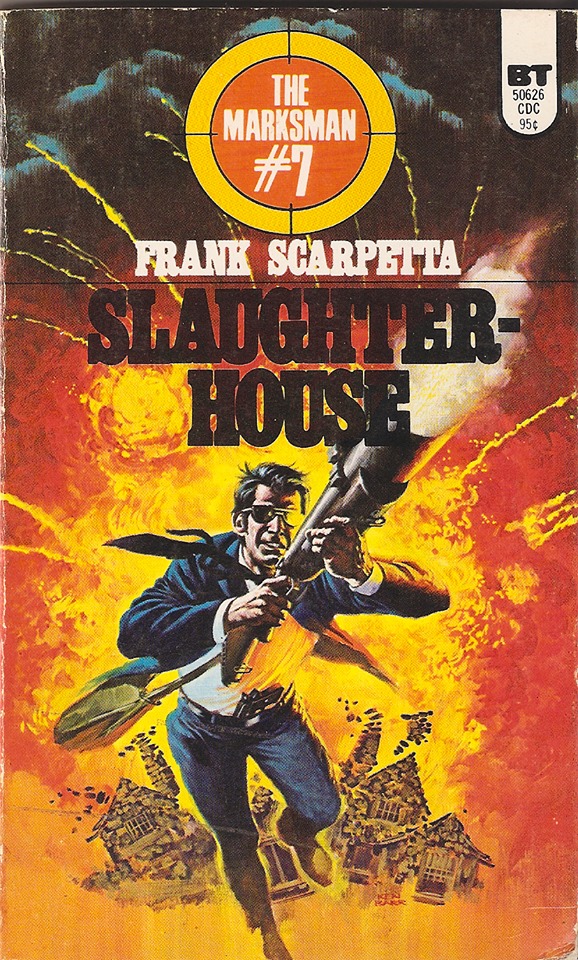
In 1973, artist Ken Barr created the greatest book cover. Gaze on it in all its glory.

In 1973, artist Ken Barr created the greatest book cover. Gaze on it in all its glory.

My first Steam guide is now up. It’s about creating custom units in Nuclear War Simulator. This is, like all internet guides, a work that could very well be updated and/or changed. But I still hope even in its beginning form, it helps players use one of the simulation’s greatest strengths.
The guide can be accessed here.
Battleship has an interesting evolution. It originally meant “line of battle ship”, what we now know as “ships of the line” (big armed sailing ships larger than frigates). In fact, some old battleships in the German Navy were deliberately classified as “Linenschiff” (Line Ships).
In the steam age, battleship eventually meant “the biggest and most armored self-propelled ship.” So far so good. It then shifted to leftover World War II battleships that were very distinct from their later missile-age counterparts. However, the specific term has been slipping. Now “battleship” is often used as a synonym for “warship”. Many people mind this. I don’t.
Imagine a ballistic missile made by as close to as pure a League of Evil as it’s possible to get. Such a missile did not actually (to public knowledge) enter service, but it was worked on by several of the world’s most nefarious regimes. I speak of the Condor II/Badr-2000 (and undoubtedly many more names if it had spread) missile that was worked on by the Falklands-era Argentine junta, Saddam Hussein’s Iraq, and Egypt’s military regime (which has been credibly rumored to have continued development on other long-range missiles based on it in secret by itself.)
In Nuclear War Simulator, if I want a basic strategic missile for a rogue nation I’m giving plausible nuclear weapons, I give them Condors. As a final version of the Condor II was never explicitly built and tested, exact figures cannot be determined. However, range has been stated at 500-1200 kilometers and circular error probable from 500-50 meters, with even the larger number being acceptable for a nuclear warhead aimed at a city. The UNMOVIC report on Iraq’s missile program stated that the Badr-2000 had more modest goals: 1 phase with a range of 620 km and a CEP of 6.2 kilometers, followed by Phase 2 (620 km/620 meters) and Phase 3 (750 km/750 meters). The ballpark is narrow enough for me to use a “considerably longer than INF limits, and not too inaccurate” judgement in individual cases.
The payload was about 300-500 kilograms, and the missile around 80 centimeters in width. This would require a small warhead to work properly, and a light one to push the missile to its intended range. The first-gen Iraqi warhead would have been too big, but it would not have been an insurmountable problem given enough time (or, in my backgrounds, an AQ Khan-style nuclear network providing the materials/documentation to build a ‘standardized’ warhead small enough to fit into a Condor II).
To have every regional nuke-seeker get Condors is still a bit of a stretch. Historically, the foreign components and shaky finances of the developments gave opponents leverage that they used to squash it. But to have some of them slip through is not entirely implausible.
All Union, my alternate history novel project, is coming along very, very nicely. The first volume (yes, it’s grown big and ambitious enough to require multiple volumes) should hopefully release sometime in the spring. I’m very excited.
I’ve long since wanted to write a book like the one I’m making now, and I’m finally doing so. And yes, I’m doing things that the snarker me would have slammed several years ago. Oh well.
The GENFORCE-Mobile organizational chart got the then-still-in-development BTR-90‘s stats wrong. It’s both too light (at 17 metric tons compared to the 21 of the real one), and more importantly has too many dismounts (ten as opposed to seven I’ve seen in every real source). The real BTR-90 was cursed by coming right as the USSR fell, but in many ways it was also just a wheeled BMP-2, so its lack of entry into service is understandable.
But I thought (both for the All Union story and for my own fun) “Well, what if you could get a vehicle with ten dismounts?” The squad would grow to USMC size (two or three in the vehicle plus ten dismounts), and it presents a very tricky puzzle: Get a vehicle that is fit for a mobile corps (so it has to be viable in direct combat, both offensively and defensively), can carry ten dismounted troops as standard, and can’t be too big or heavy. If you want heavier weapons, it basically needs a remote uncrewed turret to not tip the scales. It’s not technologically impossible by a long short, but tradeoffs will have to be made.
Finally, the big squad means I can finally introduce my “eastern fireteam” concept I rejected for the next-gen BMP. Which makes more tactical sense, since doctrinally they’ll be fighting away from their vehicle more often, especially in rough terrain or as part of a tactical heliborne operation. So they need to be (theoretically) better in terms of both equipment and skill.
As for how it works, well, I’m writing right now a chapter where such a motorized rifle unit storms a Romanian town…
I stumbled into this 1920s American training document on building fortifications with the lessons of World War I in mind. The full piece has detailed guides on everything from “the kind of thing you build when you have only a few hours” to “the kind of thing you build when you have a few years”. Both fighting positions and gargantuan medical/residential/command underground dugouts (or “cave shelters” as the document calls them) are there.
There are a couple things I found interesting in particular. The first is that antipersonnel mines, despite becoming a hallmark of later fortifications, are only mentioned very briefly and dismissively. According to it, they take too much effort to emplace for something that’s going to be knocked aside/detonated by the big artillery preparation already. (Antitank mines, including ones rigged to be sensitive, are treated somewhat more favorably.)
The second is that what became known as an overpressure system (ie, higher pressure in the area than out of it, pushing clean air out instead of poisoned air in) is talked about as a counter to poison gas for large bunkers. I didn’t know it was talked about that early, and thought it was a Cold War invention. So that was interesting.
The third is that while machine guns were present, very few of the later infantry support weapons were. Besides indirect mortars, the only thing talked about for forward emplacement is the 37mm infantry support gun. So this was a very interesting time capsule, and some of its TTPs (techniques, tactics, and procedures) are still relevant. After all, artillery hasn’t exactly gotten less lethal since the 1910s.
So first I must say that I owe a lot to the Battle Order website and channel for inspiring me. Go check it out. Anyway, the GENFORCE-Mobile document, while a tour de force overall, has surprisingly little on the absolute smallest unit tactics. It does say that the basic and mobile forces do use very similar tactics (it’s just the latter have more training on them). Anyway, there isn’t much to say for the high-intensity doctrine. Primarily use lines, squads are unitary without teams, the vehicle commander doubles as squad leader, and that’s that.
The table of orders and equipment does (by virtue of looking at quantities of in a platoon), have one RPK variant and one RPG variant (marked as an RPG-29 in that example) per squad in the mobile forces, similar to historical practice. The company weapons platoon has an array of light ATGMs (marked as Metis, but those would probably be superseded) and PKM belt-fed machine guns.

(Strangely, the early 199X OPFOR squad is actually weaker on paper dismounted than its predecessors, with only one magazine machine gun instead of two belt-fed ones).

The legacy regular army, basic forces, or whatever you call them uses this doctrine relatively unchanged. But what about the new ones?
I had the Sovereign Union’s mobile corps using tank-based IFVs. There have been similar attempts in actual history, yet I figured these would be the more interesting. Basically the priorities shift a lot here. The historical BMP-3 is skewed in exactly the wrong direction. Instead of a glass cannon packed with all kinds of boom-makers, the focus is on shielding the newly-important resource with tank-level armor.
So in this timeline the BMP-3 is one of those things that only sees small amounts of use in its home country, but nonetheless achieves success on the export market. The Mobile Corps in All Union primarily rode into Romania with either BMP-2s or IFVs based on existing tank platforms. Whereas the historical T-64 APC proposals were an act of desperation, these have a deliberate goal of more protection and mass production ability, similar to the Israeli tank-APCs of real life.


Two real Soviet surplus IFV proposals are two from Ukraine, the circa 36 ton “Vavilon” on the T-64 chassis and the 46 ton “Berserk” on the T-84 (upgraded T-80) one. Apart from trading protection (the Vavilon was advertised as having STANAG 6 30mm AP protection and being able to withstand a 125mm round from 500 meters, likely against the front) for weight and logistical issues, the armament is pretty standard IFV fare: A 30mm autocannon, various machine guns and grenade launchers, and ATGMs. Crew of both is three for the vehicle itself and up to eight dismounts.
Now for the fun part.
Composition: Squad leader/vehicle commander (rifle/PDW), vehicle driver (PDW), vehicle gunner (PDW), 1-2x machine gunner (LMG), 1x rocket launcher (RPG), 1x assistant (rifle+RPG ammo), 1x rifle grenadier (self explanatory), 2-3x riflemen (rifle). One of the riflemen could be a “deputy leader” who commands dismounts when the commander stays with the vehicle.
This is the smallest and most conservative organization. It’s designed to duplicate the BMP procedure of having one empty paper-strength seat so that platoon/company troops can ride along. It fights like a standard unitary squad.
Composition: Squad leader/vehicle commander (rifle/PDW), vehicle driver (PDW), vehicle gunner (PDW), deputy commander (rifle), 2x machine gunner (LMG), 0-1x marksman (DMR), 1x rocket launcher (RPG), 1x assistant (rifle+RPG ammo), 2-3x riflemen (rifle, possibly one with underbarrel).
This also fights as a unitary squad, although a marksman is moved to squad level and the deputy commander who controls the dismounts is a permanent table position. Still fights as a simple unitary squad. Marksman is optional
Composition: Squad leader/vehicle commander (rifle/PDW), vehicle driver (PDW), vehicle gunner (PDW). Fireteam A: Team leader (rifle), team machine gunner (LMG), team launcher (RPG), rifleman (rifle, ammo for MG/RPG). Fireteam B: Team Leader (rifle), team machine gunner (LMG), team launcher (RPG), rifleman (rifle, ammo)
This is a massive divergence and features the dawn of the fireteam, with two four-man elements and two RPG launchers (with one of the riflemen possibly a marksman). Naturally, more advanced formations and dismounted maneuvers are used.
My personal choice for the sake of the All Union story would be Option B. It’s still similar enough to be comfortable, informal task-organized teams can still easily be formed if need be, but is also more advanced. Not just having a squad marksman but in having a specific dismount commander, which makes it easier for the APC to act as part of a separate “armored group“.
Finding the (ideally) safe landing zone radius for hypothetical VTOL transports is a little hard because there haven’t been that many of them. The first precedent is the ideal landing radius for a V-22.
From a Marine Document, we get:

V-22s are about 84 feet wide at their widest. So that ranges from 2.1 times their width/wingspan to 4.1 times.
The second is an EASA draft regulation on “vertiports”. The “D” value is defined a circle around the aircraft when its thrusters are in takeoff/landing mode.

The draft describes the safe landing area as at least 1.5 times the D-value of the aircraft plus a safety buffer of at least 3 meters or 0.25 times the D-value, whichever is greater. These are of course just guidelines (and keep in mind they’re for constant civilian travel, not military action), but they’re still good rules of thumb.
I’ve decided to kick off the new year on Fuldapocalypse with my current “I justify it by claiming it’s for book research, but really it’s mostly for its own fun sake” obsession. This is the way special forces teams are infiltrated (moved in to their target, almost always with the intention of stealth).
Granted, there are elite teams moving about in All Union (without spoiling any specific element), and the Soviet-Romanian War saw the biggest deployment of special forces in modern history. But it’s still a fascinating topic. So in rough order from least to most complicated…
These are the mundane, usual, “boring” techniques. Now for the “interesting” ones.
It’s important to note that the majority of historical spetsnaz from the 1950s to 1991 were still two-year draftees. The best and most motivated two-year draftees, but still two-year draftees. Infiltrators in the second category in a Soviet-style military would have to be officers or professional volunteers with longer-term contracts to get the time to master such exotic techniques.
A massive number of Soviet, Bulgarian, and Afghan special purpose forces participated in the invasion of Romania. The very first substantial Soviet casualties in the war came when a Romanian MiG-23 shot down a transport carrying SPF for a parachute insertion, killing all eighteen people on board. While those three nations are well known, there have also been rumors of other SPF as well as western mercenaries disguised as employees for humanitarian NGOs.