Cats

I must admit I’ve always been more of a cat person. Me and my family have only had one dog in my life but have had no fewer than eight cats. The stereotype is that dogs are lovable companions, while cats are amoral parasites who have a purely transactional relationship with their human serfs.

This stereotype is often wrong, as I remember one of my cats with a full food bowl literally trying to rip her way through my bedroom door to be with me. I eventually let her in, don’t worry. Still, cats will make it very clear if their wants are not met.

The Pom-Pom turned Bazooka

Having gotten the chance to read a lot of late-WWI and early interwar doctrine pieces, one thing struck me in particular. Not the focus on trench lines or the different communications with no radios, but the presence of “1 pounder guns” like this.

The 1-pounder was described as being meant to hit targets like machine gun nests and armored vehicles. It was almost always intended to be used for direct fire. In other words, it filled the same niche that far less clunky recoilless and rocket launchers did in World War II and beyond. I found that interesting.

(And, of course, the widespread use of light AA guns for ground attack means even the original concept hasn’t gone away. That the pom-pom was also one of the first effective AAA pieces means the connection is even greater).

Formations in the Fog Of War

Two previously speculated-upon formations that have not had much evidence to substantiate their (exact) existence include Iraqi “Special Forces Divisions” and the “Islamic Regiments” of the 1980s Afghan mujaheddin.

The former were depicted as regular army formations containing soldiers with at least some greater training and morale than the bottom-of-the-barrel rabble. They were fairly conventional triangular motorized infantry divisions in terms of structure, operating in either trucks or wheeled APCs. These divisions contained no organic (part of their structure) tanks, but could easily get them cross-attached if need be.

The latter were supposedly black-clad formations of raiders with more organization and standardization than the usual bands, but nothing (usually) heavier than normal crew-served weapons. They consisted of about 600-900 people broken into multiple small battalions. It’s worth noting that their layout does bear a resemblance to the kind of “guerilla regiments” that Mao described in detail in On Guerilla Warfare.

Of course, there is a hint of truth to these formations. There were/are large commando formations in the Iraqi and especially Syrian armies, the Republican Guard did have an unambiguous “Special Forces Division”, and the mujaheddin did occasionally operate in formations the size of the fabled “Islamic Regiments”, as well as deploy better trained and equipped subunits. This is of course is what leads to the inevitable exaggerations.

And also, the joy of generalist wargaming rules and alternate history is that these units can easily be simulated as if genuine. Neither requires much in the way of exotic equipment or modifiers to use.

Veterans Day

Happy Veterans/Armistice/Remembrance Day, on the anniversary of the end of World War I. Often overlooked and forgotten, it killed more Americans than Vietnam. It killed over four percent of France’s population. Even if the nuclear button had not been pushed, the hard-to-predict casualties of a Fuldapocalyptic Third World War would have been enormous. We should be thankful that such a thing never came to pass.

The Big Artillery Lethality Chart

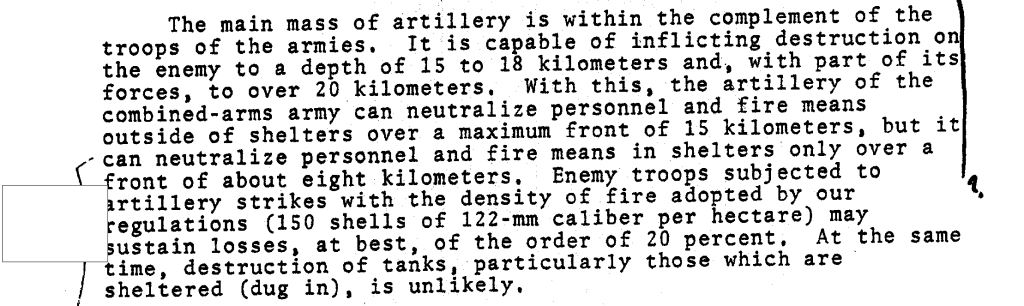
The 1957 edition of FM 6-40, Field Artillery Gunnery, has these projected casualty figures for battery and battalion artillery barrages being fired at vile Circle Trigonist opponents. What makes this interesting is that it’s a time period that has all the calibers: The classic old 75mm, the 105 and 6 inch guns well known to later people, the big 8 inchers, and the really big monsters.

Now it’s important to note that these are in absolutely (to the point of being unrealistic) ideal conditions. There’s no cover whatsoever, the fuzes are proximity ones that will explode at the perfect height, and, for what it’s worth, it was made in an era where infantry body armor was far less prominent than it would later become. That being said, it’s still a great resource.

My First Technothriller

If one counts Clive Cussler (or, in this case, “Clive Cussler’s”) novels as technothrillers, then one called Fire Ice was the first techno-thriller I read. Then it gets weird because well, I honestly can’t remember the next ones I read until reading the The Big One alternate history novels, which is kind of like getting into cinema by watching The Room, Who Killed Captain Alex, and Plan 9 from Outer Space.

My next mainstream technothriller was Dale Brown’s Flight of the Old Dog, a perfectly good choice. My first Tom Clancy was Red Storm Rising. The big crossover was the Survivalist novels, where the tiny thread connecting the po-faced technothrillers I’d read before to the ridiculous action excess that series revealed to me was that both were technically World War III novels.

The Three What-Ifs

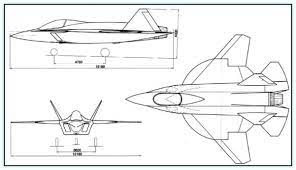
It’s my 600th post on Fuldapocalypse. I’ve gotten a lot of books recently on never-were aircraft. Thus it’s fitting to make this post about a pattern I’ve seen in equipment that never was. From least to most interesting, here are the three big categories I’ve seen.

The first is “a different proposal for the same requirements”. This is often the least interesting, because the different proposals are still designed to meet the same goals. Most of the time you get something that just looks different but has similar (theoretical) performance, and sometimes not even then. There can be real and appreciable differences, but they especially aren’t noticeable on the outside.

The second is kind of related to the first, and that’s “a proposal that lost, and whose reasons for losing are obvious”. For instance, it’s very easy to see why the T-8 design won handily for what would become the Su-25 compared to its competitors-and not just from other bureaus. It faced the anachronistic Il-40/102, and some shoved-in kitbashes of existing aircraft (Yakovlev put forward a variant of its not-exactly-ideal existing designs, Mikoyan used something based off the classic Fishbed, and even Sukhoi itself had a derivative of the Su-15 interceptor that looked very little like its “parent.”).

The third is the real fun part, and that’s stuff made with totally different goals. This is where you get all the giant napkinwaffe planes. But you also stuff that’s knowingly lower-performance for the sake of affordability.

The increased effectiveness of smart bombs firsthand

I decided to indulge my inner VVS target planner and do some (very basic) calculations for air power against opposing targets. What I found made me smile. The methodology is extremely simple-I used a regiment of 36 paper-strength aircraft, carrying 4 PGMs each (a proposed upgrade for the MiG-29 had a targeting pod on the centerline and up to 4 KAB-500L laser bombs). Then I used the 60% hit rate estimated for smart bombs in the Gulf War. Then I had only 25 aircraft actually launched to simulate attrition and realistically low readiness.

So that gets 100 drops and 60 targets plinked. That’s one-two battalions worth, if we’re talking about armored vehicles. And even that’s ideal and doesn’t take stuff like aborts, aircraft getting shot down before reaching their target, and hitting the wrong thing into account. But this is an oversimplified spherical cow exercise anyway.

What makes this more interesting is the 1969 claim that “a fighter-bomber division is capable, in one day of combat with two or three sorties, of inflicting destruction (up to 20% losses) on one to two enemy brigades”. Meaning at the very least, even earlier PGMs can have an air regiment do what used to take a division three times its size.

This was a fun little thought exercise to do.

Weird Wargaming: The Red October

Yesterday I placed a formal Command database request for a hypothetical Soviet submarine. But this wasn’t something like say, a Yankee Notch with conventional missiles. No, this was of a famous literary submarine. The titular undersea ship in The Hunt For Red October. And it made me think of more than just wargame stats.

First, the boring stuff. The Red October in the book isn’t just a re-engined Typhoon. It’s bigger, and has 26 tubes for SS-N-20 missiles instead of the twenty in the original. Weirdly, and this is actually a kind of accidental serendipity, it has only four torpedo tubes compared to the six in real Typhoons. This is probably just getting the not-yet-confirmed details wrong (a sillier example is the even-then biased Clancy portraying the Typhoon as a cramped mess when in fact it famously boasts a gym, arcade, and small swimming pool). But it makes to give up some low-priority torpedo tubes to help make room for the caterpillar drive.

Ah yes, the caterpillar drive. For the database request-in game, I wanted to go the simple route. While in the book it has a combination of the quiet caterpillar-impeller drive and louder normal propellers, I think doing complex mechanics changes for one whimsical hypothetical unit would not be a good cost-benefit. So my suggestion in the real request was just to treat the sub overall as very quiet (at the level of a post-1991 SSBN with advanced propulsion) and leave it at that.

But what got me thinking, especially with full post-USSR hindsight, was how a sub of that nature could be used. Now ballistic missile subs do not have the most complicated or versatile mission structure. But the question (regardless of what the book would say) whether it’d just be used as a more defensible bastion sub or dare to venture out to its quietness would make for interesting study/simulation.

Finally, a part of me views the sub as being something like the ill-fated Komsomolets: A capable and advanced vessel, but one that’s still ultimately a test-bed with additional members of the class unlikely to be built. Especially because the base Typhoon is so big and bulky already.