So I saw a tweet by an offshore sportsbook, in about the 302,122,877th time they’ve done something like this. It declared that Deion Sanders was the favorite to be the next head coach of the Dallas Cowboys and listed odds. Now I was skeptical to put it mildly. As for the actual next one, well, that could be overtaken by events and who knows, maybe it will be Mr. Primetime.
But the point is that sports journalists for the 302,122,877th time took up on these odds and repeated them. Now there’s nothing wrong with repeating genuine futures odds. Just because a chance of something is slim doesn’t mean it won’t happen, and it gives an idea what oddsmakers (including at sharp books) and the market think is the best situation. However…
…This is not the case. The numbers here are basically pulled at random, and instead of letting sharps bet in, they’re from a ‘soft book’ with very low limits. It’s a publicity stunt, and sportswriters ALWAYS fall for it by repeating these things.
Naval forces in All Union’s Soviet Romanian War were bound to play a peripheral role. Romania had a small and weak navy, a relatively short coastline, and massive conventional amphibious landings were geographically dubious and militarily even more so. Constanta was overrun and surrendered almost immediately after the war began. Even Soviet historiography talks very little about what they and the Bulgarians did at sea, mostly just mentioning bombardment, surveillance, transport, and other routine supporting tasks. Most naval infantry units fought on land.
Yet it would be a mistake to assume that the navies did nothing or that there was no drama. Although overshadowed by the crossing of the Danube and the massive deep airborne operations, one of the largest postwar aerial/amphibious landings was conducted in Tulcea County.
Units near Bolhrad would cross/lift/fly over or infiltrate via smaller boat.
Heliborne units from the Black Sea would stage and make large landings in the depths. Black Sea Fleet aircraft and ships would naturally support them.
The Tulcea operation was considered lower priority and was assigned fewer resources and, uncharacteristically, had its commanders given instructions to not try and force it if the initial advance stalled. (In contrast, the Danube Front units tasked with taking the Constana area were told to rightfully treat it as a high-priority one).
Notable events:
September 8-9: Landings. Many inoperable Romanian ships destroyed in port.
September 8: Romanian corvette M290 sunk by SS-N-14 missile. Romanian submarine SC-02 sunk.
September 9: Sole successful Romanian air attack against Soviet Warships. Missile craft Kittivyek sunk by Romanian MiG-21s. Two other unsuccessful attacks. Five aircraft and four ASMs shot down.
September 10: Gunboat PSKR-710 destroyed by mine. Four Romanian craft sunk. Romanian submarines Pastrav, SC-01 sunk.
September 11: Final attempted Romanian air/missile attack on naval targets. Completely unsuccessful. Romanian submarine SC-05 sunk by Soviet submarine S-39 in the first post-WW2 mutually submerged sinking. Soviet landing ship SDK-303 sunk by mine.
September 13: Tulcea operation completed with mutual link-up.
September 14: Final surface engagements of the war, a duel between small boats in the north and Bulgarian ships sinking an attempt to flee southeast into the open ocean, presumably to Turkey.
September 16: Final naval engagement. Romanian submarine Ton sunk.
The main takeaway was that ASW was successful (no Soviet ships lost, no disruption) but it was under ideal circumstances (being able to just smother a small area).
So a while ago I did the obsessively number-crazed Soviets studies on their planned rates of advance. Looking at my descriptions and map games writing in All Union, I’ve thought “hmmm, how could this go in practice? Or at least fictional speculative practice?”
The Theory
Against NATO, 40-60 km a day on average was the goal. Against a weaker opponent (like one based on the Chinese conventional forces at the time), it was even more, around 70-100. By the 1990s GENFORCE (what I patterned the mobile corps off of), it was down to ideally 30-40, albeit against a stronger opponent.
Romania in Practice
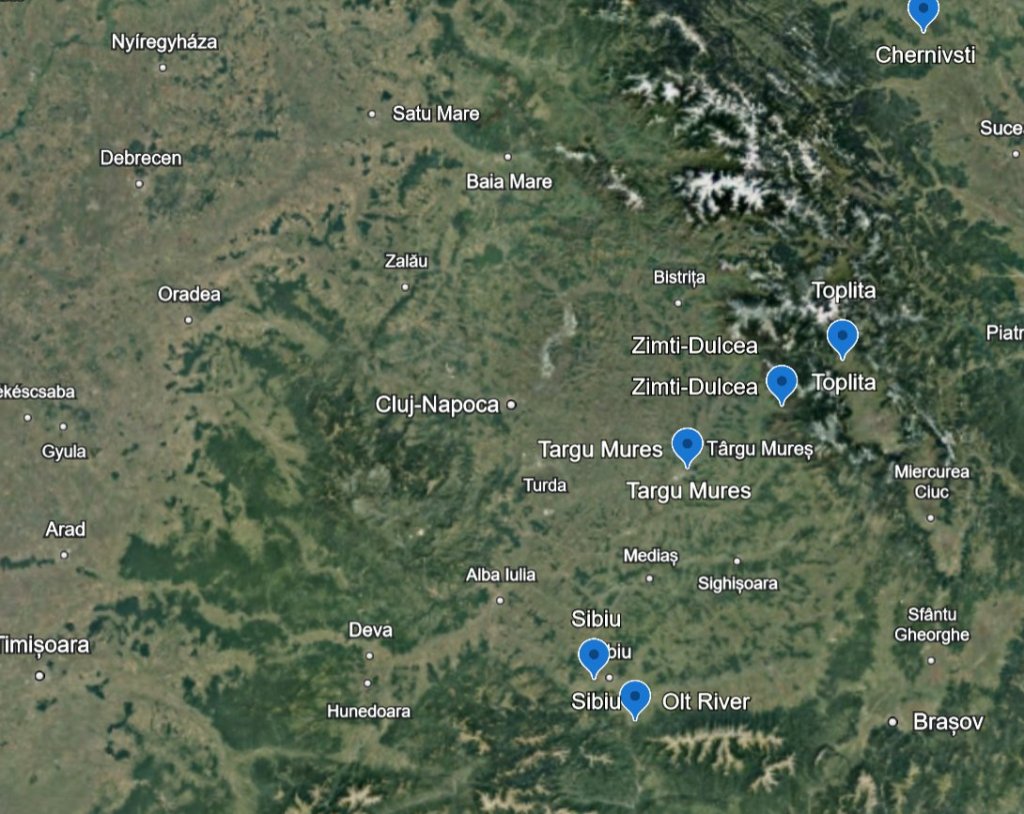
As it stands, I focused mainly on the 17th Mobile Corps, and had a (fairly) detailed route after much Google Mapping. It left a line of departure from near Chernivtsi on September 8, 1998, and came to a final stop around Sibiu on the 16th-17th. On the way it cleared out the important crossroad town of Toplita, crossed the Carpathian mountain roads, and fended off an attack on its bridgehead near Dulcea.
Map is a vague generality. Different subunits progressed around different mountain roads and frontages. Length is hard enough, don’t ask me to do width.. :p
Using a pure napkin calc, this comes to 285 kilometers from the Chernivtsi border region to Sibiu, which leads to 8-9 days of high-intensity fighting, which means a very rough 30-35 kilometers a day. So not bad by GENFORCE standards, especially with a rough terrain making up for a weaker on paper opponent and with the counterattack at Dulcea costing it an entire day.
So not too bad….
The Problem
Of course the definition of “rate of advance” is incredibly arbitrary (does it mean anything in that unit, so can we count a patrol of BRDMs moving far ahead and encountering no resistance before circling and stopping, then the main force reaching that spot without issue later?) and depends a lot, as anyone would admit, on circumstances.
In the same war, many Danube Front formations barely made it past the river, and some that did moved at the equivalent of a brisk walk. But clearly a unit of press-ganged Bulgarians with 1940s equipment having to do an opposed crossing of a very long river and then facing coherent defenders with many fortifications is not the same as a high-tech, high priority force smashing across the plains against a broken foe.
One of my least favorite parts of creative work is the writing lull after something gets finished. And now with The Fuldapocalypse World War III book out, I’m feeling it again. Oh, work on the next All Union. No, work on that other project you wanted. No, work on…
I’ve learned after years of creative writing that it’s very hard to force creativity. I just have to wait and see what inspiration comes to me next. Hopefully it’ll be good and workable.
A collection of essays by me that might have been inspired by blog posts I wanted to elaborate on, inspired by posts I never wrote, and just random inspirations, is now out in ebook and soon in paperback form.
It’s short and is kind of an unconventional stream of conciousness writing exercise, fair warning. But it does explain (partially) why I had fewer blog posts lately. Anyway, it was fun to write and I hope it’s fun to read.
The Amphibious Hook is a type of theoretical maneuver that allows for a naval support of a land offensive. It is either an operational or tactical offensive, with the Heavy OPFOR Operational noting that such ones would never be done outside of extensive air support. The document also argues that it generally would take the form of an amphibious regiment/brigade in the first wave and then normal mechanized troops unloading on the shore after the beach was cleared to continue the push. But of course, depending on shipping, it could easily be more.
(Brief note: Strategic amphibious operations are D-Day and even Inchon. Tactical ones are things like doing a boat raid. Operational ones are, fitting that level, more vague and mean things like ‘land a big enough force to divert their reserves so that the main land push can run more freely’).
The section on amphibious landings (Heavy OPFOR Operational sec. 2-13 to 2-15) also speaks of naval units being an easy way to reinforce airborne ones, assuming the geography works. There’s also, as happened in the Gulf War, the threat of an amphibious hook.
Ironically, one of the best ways for a defender to counter an amphibious hook is to ignore it. Or if not ignore it, recognize that it’s going to have trouble moving inland and can be contained with second-line forces and not divert too much to stop it, leaving the opponent with a small toehold always at risk of being cut off.
Reading Dominion got me thinking about an alternate history setup of a similar nature. Not a plausible one but a way to pit the British Empire against the ex-British Empire/Commonwealth. What got me thinking at first was the British in the book struggling to hold onto India. I’m thinking “hang on, this could be playable.”
So I fired up Command: Modern Operations and saw an opportunity to use many of the low-end WWII-era platforms, including German 1940s ones. I did a sample scenario and fell in love. So I expanded. It may or may not lead to anything more, but it’s something worth telling. Again, historical plausibility is not the main focus, so I’ve probably gotten a lot wrong.
The main forces are the fledgling independent Indian Army along with reinforcements of ANZACs and other volunteers, including American “Flying Tigers” in that animal’s home country. Opposing them are the Collaborationist UK Government and Germans, the latter struggling massively to project power. They still send the now-completed Graf Zeppelin carriers over. (Look, this isn’t a hard AH).
The scenario I did was of a bombing raid on Karachi from Oman-based Anglo-German bombers. (Why Oman? It was in range. Why Karachi? Partition into India and Pakistan hasn’t happened, at least not yet). While this scenario saw the attackers sweep aside the defenders and drop successfully with the loss of only one bomber, circumstances can always change. In any case, it was very interesting and fun to play in an area not typically covered by wargames, and got my imagination flowing.
One of the most overlooked but the single most fatal (in terms of direct casualties) nuclear incident on American soil is the SL-1 disaster. Occuring at the height of the Atoms For Peace phase in 1961 in a remote part of Idaho, it’s understandable that it wasn’t as publicized. But it is an ‘incredible’ story, one that seems to combine the worst parts of Chernobyl and the Byford Dolphin.
The US army was experimenting with small reactors. One such reactor was the SL-1. On January 3, 1961, three men were performing maintenance on the ‘shut down’ reactor. John Byrnes moved a control rod too far, causing the reactor to go prompt critical and immediately explode in a blast of radioactive steam. Byrnes and fellow technicians Richard Legg and Richard McKinley were killed.
That Byrnes’ moving the control rod caused the disaster was well established. But since all with possible knowledge of why he did that died in the explosion, that part remains mysterious. The most likely explanation is simply that the ill-built reactor had a rod get stuck, and while Byrnes pulled he moved it too far. Other theories range from a distraught Byrnes over a failing marriage not paying attention, Legg pulling a prank that caused Byrnes to get startled and yank on the rod, and most infamously the theory that a love triangle involving Byrnes, Legg, and their spouses led him to intentionally cause a murder-suicide.
Rally Racing is a distinctive form of car racing. Cars go down specially cordoned off sections of roads called ‘stages’, which can be all shapes, sizes, and surfaces. They do not directly race against each other but instead compete for the fastest time. Cars have a crew of two with a navigator/co-driver giving rapid directions to ensue the driver has greater reaction time.
Rallying is one of those sports that’s not very big in the US compared to its massive European popularity and it’s easy to see why. Rallying came from small, closed, twisting European roads. Big open American ones were/are more favorable to things like straight-line racing (less popular on the other side of the ocean).
I find it an interesting distance sport, and I don’t mean the length the cars travel. Rather it’s incredibly fascinating at a distance. A rally driving crew and their car has to be a generalist unlike the specialists of other racing disciplines. One has to be a speedster AND a cornerer AND an offroader and so on. Yet it’s also not very photogenic, whether in person or on television. It’s because the cars aren’t directly racing each other. So you see a car go by, then another car go by, and so on.
Still, I like looking at sports from a distance, which is why rallying is my newest fascination. That it’s extremely easy to simulate in BeamNG.Drive doesn’t hurt either.


 Fuldapocalypse Fiction