Review: Inheriting the Bomb

Inheriting The Bomb: The Collapse of the USSR and the Nuclear Disarmament of Ukraine

I’ve looked forward to few nonfiction books as much as I anticipated reading Marina Budjeryn’s Inheriting The Bomb, about how nuclear weapons were removed from Ukraine after the USSR’s breakup (the word choice is deliberate). I was not disappointed. This is an amazing book that can for all intents and purposes clear up the “could Ukraine have kept its nukes” confusion.

I’ve already posted about WMDs and the non-Russian SSRs. Short answer is “They never had control or the necessary pieces to maintain the arsenal of nuclear weapons on their territory, but they nonetheless had the raw technical ability to make an arsenal”. Raw technical ability but little else. Budjeryn doesn’t go into that much detail on counterfactuals (though she does wisely defer to credible experts in that regard and cites them).

She does go into lots and lots of detail on the political twists and turns and not just for Ukraine itself. Yet it was far more reticent than Belarus or Kazakhstan were and viewed itself as a legitimate holder of the weapons. Factors from the fact that Russia was threatening Ukraine almost literally from day one (and by Yeltsin officials and not Zhirinovsky-ist fireeaters) to the desire to preserve jobs in the giant Dnepropetrovsk missile plant are mentioned. This is a great, indispensable book about a very important topic, and I cannot recommend it enough.
Hungary’s Humongous Divisions

In the late 1940s, Hungary, fresh off Soviet conquest and the statistical worst hyperinflation ever recorded, was rebuilding its military. Not surprisingly, the plans reportedly called for a force structured along Soviet lines and doctrine. But surprisingly, the centerpiece was on ridiculously large infantry divisions. How large? Paper strength of at least 25,000 people, but that doesn’t describe all of it.

No, comparing the number of infantry battalions ultimately under divisional control draws this insanity into better perspective. The archetypical triangular infantry division has nine (three in each of three regiments/brigades). The square division largely rejected as too big and clunky had twelve (three in each of four regiments). This had sixteen. Four regiments of four battalions each.

There’s a reason why these actually weren’t made and why, even beyond the impact of the 1956 rebellion and short leash, Hungary’s army in actuality remained conventionally Soviet-styled for the rest of the Cold War.

Review: Hell to Pay

Hell To Pay: Operation Downfall and the Invasion of Japan

With the atomic bombing in the news thanks to the Oppenheimer movie, I figured I’d had to take a look at D.M. Giangreco’s Hell to Pay, an analysis of what would likely happen if the dreaded invasion of Japan was likely launched. Spoiler alert: Hundreds of thousands of Americans and over ten million Japanese would have almost certainly been killed.

With clear and concise arguments that cite primary sources from both sides, Giangreco makes the case very convincingly. With their backs to the wall and years of experience and preparation, the Japanese would face a strung-out American fleet. This book certainly gives credibility to the statement that the atomic bomb was actually the most humane choice.

Those interested in WWII or alternate history should definitely read this book.

Review: Seizing Power

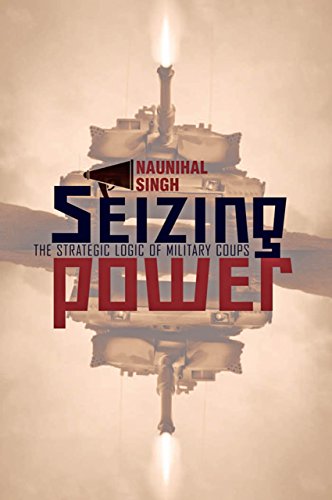
Seizing Power

Naunihal Singh’s Seizing Power is a book about military coups and how they work. The timing of this review is a complete coincidence and has no bearing on recent events whatsoever. Anyway, Singh studies the basic three types of coups and makes an academic argument that they are in essence, “coordination games”-that is to say they have to give the appearance of inevitability instead of actual hard power (in most cases.)

Singh divides coups into three categories. The first is coups from the top, like say, the central party committee imprisoning the president and attempting to seize control. The second is coups from the middle, like say, a division-sized force dashing from its base on the border to the capital and hoping the rest of the army can join it. The third is coups from the bottom, like say, rioters in support of a parliament with no army on its own trying to sway the military and take vital television stations. (Yes, all three examples happened in Russia/The USSR. They were the 1991 August Coup, the recent Wagner uprising, and the 1993 constitutional crisis).

Singh spends most of his time covering all three types of coups that happened in Ghana in its history, and then ends with the August Coup of 1991, a coup from the top that should have effortlessly succeeded but in fact failed miserably. Like most academic histories, it gets a little too pendantic at times. But it’s still a great read.

Review: US Army Doctrine

US Army Doctrine: From The American Revolution to the War on Terror

In his study of published doctrine, Walter Kretchik embarks on the herculean task of reading multiple centuries worth of field-manualese. He looks at the very first to the then latest manuals (the book was published in 2011) and how they were applied in practice. The result is an excellent nonfiction study for field manual nerds like me.

The book is very readable and understandable. I would advise reading the actual manuals themselves if you wanted to know more (they’re all public domain by their very nature and the age of many of them), but as a starting point for both doctrine and warfare, this book is excellent. It’s expensive and niche, but it’s good in addition to being those two.

The Non-Russian SSRs and nuclear weapons

There is one argument, especially after the 2022 invasion, about Ukraine (and the other non-Russian ex-SSRs) and nuclear weapons. This goes: They gave up their nuclear weapons in exchange for largely meaningless and unenforceable diplomatic agreements, which was a mistake that Ukraine paid for and Kazakhstan might have.

Many informed nuclear commentators have pointed out that the launch codes/infrastructure were still in Russian hands, that Ukraine had no actual control, and that the ICBMs in particular were ill-positioned for deterring their former owners. This is all accurate, as is the staggering cost of making a usable nuclear program during a time of massive political and economic upheaval (Ukraine’s implosion in the 1990s made Russia’s look like a modest recession, and Kazakhstan had effectively no army of its own immediately after independence)

But there is another opposite fallacy, which is that the decision was more or less out of their hands. Because all the nuclear weapons were under Russian control, there was no real choice involved. This is also flawed. The nuclear weapons weren’t immediately usable, but to act like there was a Ward Of Russianism on them is wrong. Ukraine had extensive infrastructure and science on its territory (including a missile plant), while Kazakhstan’s uranium industry meant that it was already over the biggest hump for a usable bomb-the materials.

So it was not technically impossible for the non-Russian SSRs to maintain a nuclear weapons program. You can argue that it was politically and economically so, and probably correctly. But it was not a technical issue. The republics had agency, and they likely prevented a far earlier Russian invasion by relenting.

Review: Carrying the Fire

Carrying The Fire: An Astronaut’s Journeys

Long considered one of the two best astronaut memoirs (the other being Mike Mullane’s Riding Rockets), Carrying the Fire is the autobiography of Apollo 1 command module pilot Michael Collins. He got to go to the moon but not walk on it. Collins insisted on writing the book all by himself without assistance, and it paid off. Not only was he a capable pilot and astronaut, but he turned out to be an excellent author as well.

With both humor and majesty, Collins tells the story of flight and the moon program. Anyone interested in outer space should get this. It’s an excellent book and even greater autobiography. While it’s not nearly as fresh as it was in 1974, that’s a small and inevitable “problem” to have. This is a great book.

How Computers Destroyed (And Could Save) Cover Art

I just found this great article called “When Movie Artwork Was Great.” Long story short, the cover was an important part of advertising, and thus was worth the expense even for otherwise low-budget productions. A combination of computer tools making it easy to do a basic cover (Ie, it’s not like “you have to hand-draw it anyway…), and lower production values as the industry got squeezed meant that generic photoshopped mush took over.

It felt very familiar to me because the exact same thing happened concerning book covers for exactly the same reasons. Weirdly enough, otherwise high-profile books tended to have minimalist covers from the get-go. But trashy pulps that couldn’t even keep the main character’s name consistent (I’m not joking) would have spectacular covers from the likes of Gil Cohen and Ken Barr.

Now it’s just-look at the book section of a grocery store and you’ll know.

I mentioned the ability to improve book covers at very little cost as one of the upsides of AI art. Now that I’ve gotten more into it, I can say even more comfortably that something quickly makeable with the least controversial models (closed source, public domain only, etc…) and only small amounts of manual tweaking could leave most contemporary covers in its dust.

So yeah, shed a tear for the running silhouettes and clunkily shopped-in muscle men. I know we’ll all miss them so much.

Review: The Reckoning

The Reckoning

David Halberstam was one of the most legendary historical writers. In The Reckoning, written at the height of the 1980s auto crunch, he turned his eyes on Ford and Nissan, trying to find what made carmakers on both sides of the Pacific go. Halberstam has a talent for writing. Unfortunately, that very skill makes it uneven.

It does a good job describing formative events like Henry Ford’s family drama and the 1953 labor dispute at Nissan that shaped not only it but the entire Japanese auto industry. It also does well when looking at individual workers caught up in the mess. Although I have to say that it’s very hard to write about the auto industry and not make it interesting. The field is just so inherently complex and full of colorful stories.

So what are the problems? Well, it’s dated for one. This isn’t as bad as it could have been. Yes, it’s a more than a little “JAPAN GOOD”, but certainly not to the excess of some other bubble era publications. After all, this shows the Japanese industry warts and all. It also aptly points out in its study of the South Koreans how the rest of Asia was cracking its knuckles and preparing to charge-which came to pass.

No, the biggest obvious problem is that it’s too “Bruce Springsteen”. Which is to say it has the tone of a wealthy suburbanite who idealizes the blue collar worker’s struggle too much. Its slobberingly positive portrayal of UAW head Walter Reuther is the most obvious part of it, with even sympathetic history works on that man being far more critical and full than Halberstam’s hagiography. This also leads Halberstam to idolize the “Manufacturing Men” over the supposed “bean counters” who nickel and dimed every car to pieces. (Not surprisingly, Robert McNamara in his pre SecDef days is there and scorned).

This leads to the next problem that someone with any kind of interest in the auto industry can see: It’s too centered around the capital-N Narrative of the Good Manufacturing Man being brought down by the Evil White Collar Consultant. The “Manufacturing Men” in both continents could get away with running hog wild simply because their industry was in a boom. Once it busted, they simply had to start penny pinching. After all, the first Japanese car company to close a plant and downsize was… Nissan. All this is combined with something that, for all his research, Halberstam didn’t actually have much familiarity with, and it showed. It’s also catnip for the mostly well-off target audience of the book.

Still, for all its problems this is something I’d definitely recommend.

Review: Invisible Armies

Invisible Armies

Author, historian, and (sadly) political commentator Max Boot takes the reader through thousands of years in Invisible Armies, his chronicle of irregular and asymmetric war throughout history. Let’s just say that I’m no fan of either his past or current viewpoints on contemporary politics and leave it at that. Not just because I don’t want to get political here, but because it’s basically irrelevant to the actual book. (Which is a huge point in its favor, I might add.)

Said book is a masterwork of popular history. It has the weaknesses of its format in that by design it can’t go into too much detail, and no doubt there are some inaccuracies that I couldn’t tell but which someone more invested in the subject matter could. But it also has the strengths of it in that the facts are presented in an extremely engaging way.

There’s one central point made throughout the book, which is that contrary to both recent high-profile examples with small sample sizes and “fourth-generation war” thunderers, the default outcome for an insurgency is loss. Most of the time, it either fails completely or can’t progress past its initial strongholds. There’s also the less novel reminder of almost all successful ones having the support of an outside state.

As something that both explains and demystifies unconventional war, I highly recommend this book.