Weird Wargaming: T-64 APCs

When all you have is a hammer, everything looks like a nail. When all you have is a bunch of T-64 tanks, everything looks like it could work with a T-64. As it stood, the independent Ukraine inherited a gargantuan number of those tanks after the breakup of the USSR. As the beginning of the Donbass War showed all too vividly, it had very little else. Since the bureau that designed and the plant that built it were also in Ukraine, then… well, the hammer was even more prominent.

So, there’s the BMP-64, essentially an eastern Bradley on a tank platform. It has similar dimensions and a similar role as the famous American IFV (although a lot more dismounts). Note on the same brochure there’s more vehicles on the T-64 chassis and other tanks fitted with infantry compartments. The latter ones I’ve always envisioned as (at least theoretically) being more suited for a western armored cavalry structure. They can do the same things a tank in armored cav units can do, but they also have a few scouts to dismount when need be.

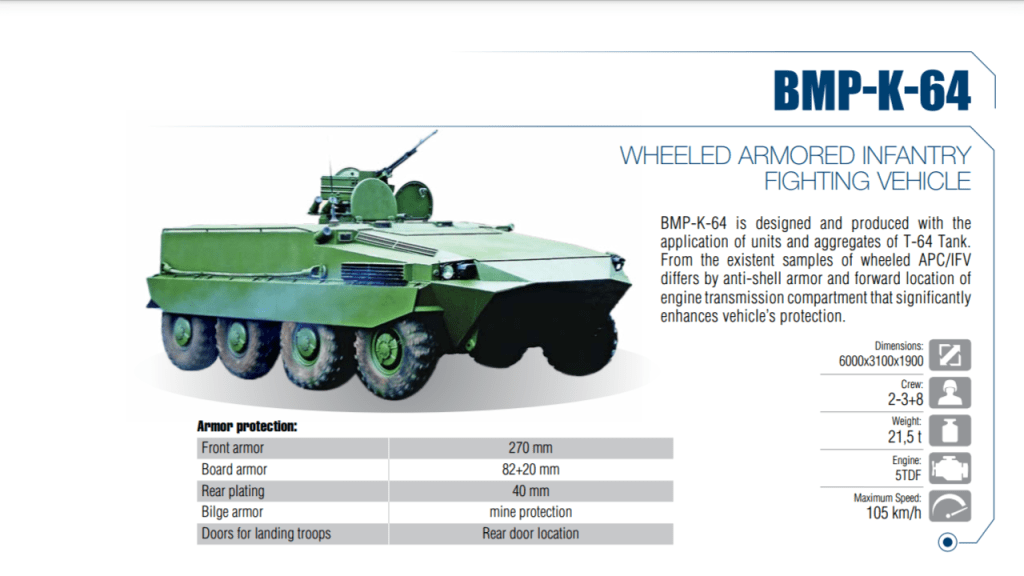
Then there’s the BMP-K-64, using the tank chassis for a wheeled APC. I find it simultaneously weird, interesting, questionable, and somehow impressive. This would be used like any other Stryker/BTR-style wheeled troop carrier, albeit with its thick front armor taken into account.

These desperation-born oddballs are the kind of armored vehicles I have a soft spot for.

The Breach

One of the most difficult military operations (although to be fair, none could be considered truly “easy”), and one I’ve recently been looking at in my armchair studies, is the breaching operation. Requiring firepower and engineering in massive and coordinated amounts, its challenge is emphasized in everything that talks about it. Yet what’s equally interesting is that defending against such an attack requires just as much in the way of perfectly synced combined arms as launching it.

It’s a counterintuitive paradox that fortifications (the official term for preparing them called “survivability” ) are important to manuever war and mobile counterattacks are equally important to positional warfare. For the former, I’ll just say that artillery hasn’t exactly gotten less effective since World War I. For the latter, any position can be eventually reduced and overwhelmed with firepower if the opponent is given the chance.

Review: Vortex (Larry Bond)

Vortex (Larry Bond)

Larry Bond’s Vortex is a tale of war in southern Africa, as a revanchanist South Africa seeks to retake Namibia, with the opposition of Cuba and the Americans drawn into it. My first proper Larry Bond novel in some time, I wanted to see how this, his last pre-Soviet collapse novel went. And the answer, sadly, is “not too well”.

I knew his style, and, starting this blog, thought it was a lot more common than it actually was. I knew it’d have a lot of conference room scenes. I knew it would have a very long opening act to set up the war everyone knows is going to happen. I knew it would hop around viewpoint characters a lot and focus on each and every part of the war. Yet I wasn’t prepared for how excessive all of it would be. This is the longest, clunkiest, and, I hate to say it, worst Larry Bond I’ve read.

It takes over a hundred pages just to get to the conference rooms. The book has this weird “too hot and too cold” feeling where it stays for a while on a low-rate cloak and dagger plot in the first half and then explodes into too many tangled threads in the second. Naturally, all of this makes the ending too contrived and neat.

This is a shame because the premise-expanding on a real conflict with truly interesting participants and tactics in a theater of war genuinely unfamiliar to many Americans-is a very good one. Which makes it being squandered in this huge mess all the worse. Bond has written much better than this, and his other works have similar-level battle scenes without the structural failings here.

The Earliest BTRs

I remember reading through a coffee table book on armored vehicles when I was very young and being strangely intrigued by the BTR-40 and BTR-152 APCs. Yes, they were just armored trucks, but armored trucks still looked so much different and weird than the later purpose-built APCs on both sides of the inter-German border. The contrast between the advanced IFVs I’ve taken to amalgamating as “BMPradleys” couldn’t be any more different.

Perhaps because of their relative lack of capability, at least one field regulation document lists APCs and ordinary motor vehicles interchangeably. And that’s understandable, there’s only so much you can write about an armored truck with a machine gun on top. Yet compared to nothing, an armored truck with a machine gun on top is quite the advance.

Since then, there’s been no shortage of truck-chassis APCs from manufacturers around the world. I guess it’s the next step up from the basic technical/jeep.

Review: Assault By Fire

Assault By Fire

Ripley Rawlings’ Assault By Fire is an invasion novel. It’s an invasion novel that features that common staple of video games-the Teleporting Russians. Yes, via some kind of supercomputer (that’s the explanation given), the Russians can conduct a successful amphibious invasion of the US. This is a “pulpy invasion” book. And it is very, very pulpy.

Everything from a main action in Appalachia to WWII weapons to a knockoff of Vasquez from Aliens is there. And it’s somehow amazing. The rational part of my brain could not comprehend or make sense of how the invasion progressed, with me asking such questions as “where are the stated MiGs staging from?”. The part of me that eagerly read every Survivalist loved every page of it.

Review: The Clone Republic

The Clone Republic

A (comparably) long time ago, before the rise in self-publishing, I read a novel called The Clone Republic, the first in a series of military science fiction books by Steven L. Kent. And in hindsight, it seems kind of impressive in how it nailed a type of story that would later appear in much greater numbers. It’s a strange kind of impressiveness, but impressive nonetheless.

Even at the time, I never thought this story of a futuristic clone army was never more than a merely satisfactory cheap thriller. But it really fits the niche of what I’d call a “spacesuit commando” novel because of its “genericness”, limited technology, and weird touches. For instance, the clones don’t know they’re clones, believe themselves to be genuine orphans, and all but the main character biologically self-destruct (!) if told they’re a clone.

So this book and its series is in the “weird nostalgia segment” for me. Then it may have stood out a little by being so generic (!). Now it wouldn’t diverge from the considerably bigger pack. Still, I had fun with it.

Review: Holy Ground

Holy Ground

As readers of this blog undoubtedly know, I’ve dipped pretty deep into the small field known as [mostly] conventional World War III fiction. So when I saw an actual new release of one, Evan Currie’s Holy Ground, I felt obligated to check it out. The book is a prequel to an extensive science fiction series, and it shows. It centers around the defense of the island of Iwo Jima, on land, sea, and air.

Honestly, the setting image that came to my mind was “Command and Conquer Generals”. Not in the exact form or in it being an exact ripoff of that game-it definitely is not. But in the general (no pun intended) sense of a combination of sci-fi technology and stuff that’s visible in the obvious headlines/popular culture. Despite nominally taking place several decades in the future, there’s a lot of contemporary fighter aircraft designations. There’s also a lot of “cinematic” stuff, like missile-age aircraft using guns far more often than they realistically should.

Because of these limitations, it doesn’t succeed in being a technothriller. At the same time it’s too comparably grounded to be a Wingman-style pulpy thriller. And even judged purely on its own terms, the action isn’t the best. I want to emphasize it’s not the worst either, but I’ve definitely read better. For me it was a little fascinating to see what a technothriller in the style of a popular science fiction book looked like, but that can’t raise the novel above average on its own.

Review: Zulu Hour

Zulu Hour

The second Kirov “Keyholders” spinoff, Zulu Hour takes a look at an alternate Battle of Isandlwana. Like the previous installment at Waterloo, this has an excuse plot that’s really forced and blatant even by Kirov standards. A pair of gambling time travelers use their time-keys to go back and try to change various historical battles for the sake of their rivalry. Don’t worry about the seemingly massive butterflies this would cause, because thanks to the mechanics of time travel, they can always “overwrite” it later.

Yeah, it’s that blatant. But this is the Kirov series, and using time travel to set up all kinds of alternate battles is the exact point of the series. Besides the battle itself and the time travelers trying to persuade Chelmsford and Cetshwayo, this also involves the Fairchild Group, another weird subplot in the series involving an oil heiress and her own personal Type 45 Destroyer. In past Kirovs, several people from that were timeshifted to… the Isandlwana site.

Once the fighting actually starts, what emerges may be one of the most legitimately good things Schettler has written. Maybe it’s just how a one-part spinoff simply has to be more concise than an eight-book series, or maybe it’s just the novelty. Yet it worked.

It could be a change of pace after seeing so many large-scope modern wargames. Or it could be that the late 19th Century is an area of warfare that I haven’t seen that much of, compared to the subject matter of the main series. Whatever it was, the action here felt and looked better than the norm for Kirov.

This long-foreshadowed book was a lot of fun. And the Kirov spinoff concept of just reenacting/changing historical battles via wargaming has a lot of possibilities. Those are taken advantage of here in an enjoyable book.

Review: Field of Glory

Field of Glory

With Field of Glory, the Kirov series shifts into another subplot involving-you guessed it-time travelers changing the outcome of famous battles. In this case it’s a French and British time traveler manipulating history with their time-keys as part of a rivalry, with this book being about changing the outcome of the Battle of Waterloo. This entire “Keyholders Saga” was set up early in the series as a possible direction after the initial arc, shelved as an alternate World War II was focused on, and then revived later on as a way to show off wargames in other time periods.

This book is even more blatant than usual about being little but a lets play/after action report. While anyone crazy enough to make it through the Kirov series wouldn’t be surprised by any of this, this is intended as a spinoff. And for what it is, it’s not too bad.

At first it may be confusing and incomprehensible to have a story shift from the World Wars to the distant past, but once the gimmick is understood, it becomes better. Especially since a problem of some of the other Kirovs is that they linger too long on one certain war/campaign. A one-off book doesn’t have that issue.

Review: Decisively Engaged

Decisively Engaged

It’s been some time since I read a nice, proper spacesuit commando novel. And C. J. Carella’s Decisively Engaged fits the bill. Because boy, is this of the biggest spacesuit commando books ever. It’s Space America vs. The Alien Hordes. Sure there’s a backstory, but all you really need to know is it being (literal) Space America vs. the Alien Hordes.

The military sci-fi cliches are present here in such massive qualities that they stop being annoying and start being oddly endearing. This and the fact that the action is actually decently written-not the best, but at least decently enough-is enough to make the book enjoyable for me. The worst part is overly jumpy perspective shifts, not helped a few clumsy flashback “interludes”.

This is the sort of pulpy cheap thriller that doesn’t feel like “good” would be the right word to describe it. Yet it’s enjoyable, and that’s ultimately what matters more.