Weird Wargaming: The UN Standing Army

An underappreciated and underutilized force for wargaming (particularly as it can be made with existing surplus equipment), the UN standing army as discussed in books like A UN Legion. Unlike some other entries in Weird Wargaming, the nature of this force makes describing it in any exact detail much harder.

On one end, there’s light peacekeepers with nothing but small arms or vaguer proposals. On the other, there’s the incredibly detailed “Vital Force” proposal. The bigger “world army” proposals also tended to be the most vague in terms of equipment. Yet it’s easy to find analogous historical units. Either the entire force or a large chunk of it could easily be structured like existing high-deployability forces. Airborne and amphibious units provide an excellent, well-documented guide.

For “world armies” with more conventional units, there’s plenty of national and/or theoretical inspiration to be drawn, possibly with some inferences (for instance, a priority may be on allowing smaller units to operate as independently as possible). The heavy divisions in the rapid-response units may get prioritization for upgraded equipment. As for that equipment, it can be anything from purpose-built (especially if it’s intended to be airdroppable/amphibious) to surplus.

The proficiency levels of a “small force” should be high, as creating a handpicked, well-trained force over clunkier ad-hoc formations is the entire point of their existence. Bigger “world armies” are going to be inevitably diluted, but should still err on the side of greater skill.

Review: The Weekend Warriors

The Weekend Warriors

Reading James Burke’s The Weekend Warriors means I’ve now read all ten of the alternate history conventional World War III series I’d identified. So how is it?

Telling the story of National Guard soldiers and their families during a 198X Fuldapocalypse, Burke uses some plot devices I’ve thought would have worked, like using fictional unit designations. He also aims for characterization and doesn’t hesitate to show the duller parts of military life. The result is something that tries to be something fuller than just tanks exploding…

…With an emphasis on tries. A lot of the high-level military details are anachronistic and in some cases outright “off”. The most jarring example to me was how the Soviets would focus on NORTHAG (which would be true) and thus do nothing but special forces operations in the American sector at the beginning of the war (which would not be). The action suffers from the same rough prose as the rest of the work and sometimes devolves into listing armaments in full.

Because of this, it comes across as being like a somewhat worse Chieftains-a tale of a conventional World War III that’s ambitious, but erratic and unpolished in execution.

Review: The Man With The Iron Heart

The Man With The Iron Heart

One of my theories about Harry Turtledove is that, for all times he’s been labeled “the master of alternate history”, he never had the most enthusiasm for the genre. It goes like this: Turtledove wanted to write Byzantine/Eastern Roman-themed fantasy, but after Guns of The South, alternate history became the money-making niche that he was stuck in. Turtledove would be neither the first nor last writer to have their most successful fiction be considerably different from the type they actually wanted to write.

Or maybe he did have enthusiasm for the genre, but didn’t have the mindset needed to really take advantage of it. Or maybe the nature of alternate history and needing to appeal to a generalist audience who doesn’t have the most knowledge of history forced him into a corner. Whatever the reason, The Man With The Iron Heart symbolizes the weaknesses of his style vividly.

The plot is simple. Reinhard Heydrich survives, gets the Werwolf resistance movement up and running, and launches a horrifically hamfisted/anachronistic Iraq War analogy. In reality, the German populace at large had no stomach for continued resistance, and the Allies, who came close to turning Germany into a giant farm, were prepared to crack the whip. The Werwolf plan was doomed from the get-go by the scarce resources and infighting that was baked into the Nazi regime from day one.

The execution of the book is done just as clumsily and clunkily as the setup. Much of Turtledove’s writing has the problem of what I frequently call the “technothriller without technology or thrills”, and this is no exception. It uses the “alternate history as a genre format” where there’s a big-picture, broad-viewpoint look at the situation and changed world. However, if the changed world is nothing but an unrealistic and worse, uninteresting analogy, that format is the worst possible.

Alternate history is a very divided genre. There are a lot of reasons for this, from the vague nature of what it even is to the different desires of different fandoms to how it’s frequently not considered advantageous to label a work as such. But that the “mainstream” end often consists of books like this doesn’t help.

Maybe there’d be more overlap if someone really did extensive research, made it more character focused, and kept it feeling substantially different while providing still noticeable but far more subtle commentary. Instead, Turtledove wrote this book, which I do not recommend.

Review: A UN Legion

A UN ‘Legion’: Between Utopia and Reality

Stephen Kinloch Pichat’s A UN ‘Legion’: Between Utopia and Reality is a very inconsistent book. This may be due to its subject matter, which involves the various proposals for a UN standing army, proposals made since before the formal United Nations Organization even existed.

About half the book, at least figuratively, is written in a particularly bad form of “academic-ese”. I had trouble getting through it and I read long dissertations for fun (seriously). Even if unintentional, the problem is that the political obstacles to such a force are so obvious and so easily explained that any long statement will become unfulfilling.

That being said, the other half of the book is a concise, well-written, and well-sourced example of various proposals. They come in two categories. The first is a gigantic “World Army”. The earliest proposals, made during World War II, fit this category, with numbers that seem big to a modern reader but weren’t back then. “World Armies” frequently were capped by a standing high-readiness force (think the 18th Airborne Corps or maybe the USMC/VDV).

The second is a smaller and more theoretically practical “UN Army”, a comparably small force designed for specific contingencies. One of the most detailed examples, which Pinchat describes, is the ‘Vital Force’/’UN Legion’ proposal amounting to several brigades of light to medium troops. Others amount to similar versions of the same thing-something that can conduct most normal peacekeeping missions, but without the ad hoc nature of existing setups.

I’m a little reluctant to recommend a book that sinks to such lows, but it’s still a good resource. It’s just a bit of a shame it’s not better laid out, but this is an academic history and the text is still good when it counts.

Review: Edison’s Conquest of Mars

Edison’s Conquest of Mars

From energy guns to ancient aliens building ancient civilization megastructures, a lot of sci-fi tropes originated in Edison’s Conquest of Mars. Besides that, this book is fascinating because of how min-max it is. A sequel to War of the Worlds bootlegs (it’s a bit of a long story), author Garrett Serviss made-something.

On one hand, the prose is terrible and flat even by 19th Century standards. It’s a self-promoting effort by the title character/famous person. The plot goes against Wells’ theme to a ridiculous extent. The most ridiculous elements seem mundane when actually described. It was originally a short-form serial and it shows in the writing.

And yet so much of the sci-fi cheap thriller was started, or at least popularized here. This, is very much like seeing a video game or movie that’s at the very, very beginning of its genre. It looks horrifically crude in comparison to its later successors, but you have to start somewhere.

Using Paratroopers

One of the biggest problems with using paratroopers besides the limit on airlift, and why they’ve just been high-readiness/at-least-theoretically higher skill infantry in real practice, is the cost-benefit with their operations. This is very tricky.

The Practical Reasons

Apart from situations where there just is no other way to move in quicker (ie, over bodies of water/other gaps), airborne landings, particularly on a very large scale, have faced the issue of either being unnecessarily risky and complicated for the task at hand or simply being too weak to accomplish anything (especially in a situation where everyone has a lot of heavy forces).

The impression I’ve gotten is that anything bigger than a company-sized landing force is dicey, and anything bigger than a battalion is really, really dicey. Yes, if everyone had giant Mi-26 sized helicopters and/or the landing forces had mechanized equipment of their own (ie, BMDs/Sheridans) it would help, but only somewhat.

The Literary Reasons

On the other hand, the literary reasons for big airborne operations are obvious. Just look at Band of Brothers, to say nothing of considerably more obscure works of fiction that range from Marching Through Georgia to Northern Fury H-Hour.

  • They’re big and dramatic all by themselves.
  • Because they’re often centered around (seemingly) important targets, it makes the actions of the protagonists look bigger.
  • Because airborne forces are inherently limited, it means drama can be maintained against a seemingly weaker opponent (a pretty extreme example of this is Marching Through Georgia, where the Draka are otherwise utterly superior to their opponents and paratroopers against a panzer force are the only way to have something even slightly even).

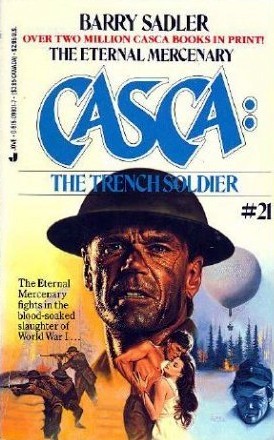
Review: The Trench Soldier

The Trench Soldier

cascatrenchcover

This is the 250th post on Fuldapocalypse. I could write about the undeniable fear living a hundred miles from a pandemic epicenter. I could write about how the blog has been one of the few high points during an unsatisfying life ridden with mental health issues even before the crisis,

But instead, since there’s enough gloom out there already, I’m going to write about a bad Casca book. And The Trench Soldier is very bad. And unlike The Samurai, which had Casca just plopped inside an essentially unrelated adventure, this has him front and center. It’s bad in a criticize-able way. While trying to find the true authorship of the Sadler-fronted Cascas is essentially impossible, the talk has been that he did not personally write this. Whoever did, well, they failed-but failed amusingly.

The Casca Formula I saw after just a few books is in rigid force here. Take a historical period-World War I, in this case. Plop Casca in it and subject him to the most stereotypical pop culture set pieces of that era, from charges into machine guns to poison gas. Have him meet the appropriate historical figures, in this case Immelman and a young Herman Goering. Utterly fail to explore any element of his character, or I should say any potential element of his character, because his character doesn’t really exist or stay consistent at all.

What makes The Trench Soldier special is that it goes above and beyond the usual. Events that took place throughout the war are stuffed into a few months in 1914. There’s a ridiculous scene where Casca battles a Zeppelin. If the whole series was full of this over-the-top craziness, I’d think a lot more highly of it. Sadly, it’s not. The historical inaccuracy can be summed up by him defending the Maginot Line at Verdun in 1914.

It’s not a good book, and it’s rare that even a bad example in a series puts every single one of its flaws in the forefront. But this is what The Trench Soldier does. It somehow manages to take all the Casca weaknesses and amplify them while keeping the very small number of strengths. And that’s strangely impressive.

Review: 38 North Yankee

38 North Yankee

Ed Ruggero’s debut novel, 38 North Yankee, tells the story of an American infantry company in a Second Korean War. It has its issues, but works a lot better than his later book, Firefall. That had a ridiculous setup it didn’t need. This is more grounded and plausible.

Ruggero’s legitimate veteran status both gives the book a degree of verisimilitude and makes it diverge too often into Herman Melville territory.  Most of the “box checking” elements are done right. There are viewpoint characters but not too many. There are things that realistically go wrong. Unlike John Antal’s significantly worse Proud Legions, he doesn’t overemphasize the important of the main character’s unit. This is one of the most grounded “big war thrillers” I’ve read.

However, it also has the weaknesses of being grounded. The viewpoint jumps and the over-detail (including maps) clashes with the fog of war inherent in such thing. And by aiming for the plausibility it does, it sometimes stumbles into the trap of “military action can be written in a plausible or engaging/exciting way , but it’s very hard to do both.” It’s a problem that neither writers of truly serious fiction nor Mack Maloney have, but which something of this nature does.

That being said, none of these are deal-breakers and the book is very much worth a read. It might be the best Second Korean War novel I’ve read, even more than Red Phoenix.

Another (but similar) opinion can be found on the Books That Time Forgot blog.

Review: Red Phoenix

Red Phoenix

redphoenixcover

Larry Bond’s Red Phoenix, telling the story of a second Korean War, is something I’ve struggled with for a while but now, after a lot of other books read, have the words to successfully describe. In short, it’s the Marine Force One of “big war thrillers”.

Every archetype of the small genre is there. The shifting viewpoints from top to bottom. Going into every part of the theater. And so on. And they’re executed with enough skill to not be bad, but not enough to be truly memorable or standing out.

What does stand out, and which I also have a more nuanced view of than I used to, is the long intro setting up the war. I’ve thought it, from a literary perspective, to be less than ideal. It’s taking a huge amount of effort to set up something the reader already knows will happen.

But from a plausibility perspective, given the massive unlikelihood of a Second Korean War even at the height of the north’s power, I can forgive it for putting in the effort to set up a situation where it could happen. It’s certainly better and less ridiculous than Cauldron at any rate.

And what else is there to say? This is very much a “if you like the genre, you’ll like this book. If you don’t, you won’t” kind of novel.

Snippet Reviews: January 2020

New year, new set of snippet reviews.

Return of the Ottomans

Return Of The Ottomans is a clunky “Big war thriller” only distinguished by its premise. Turkey invading Bulgaria is more conceptually interesting and the action isn’t the worst in a nuts and bolts way, but jumping viewpoints and Steel Panthers Characterization at its worst bring it down.

The Fires Of Midnight

The Fires of Midnight is the last of the classic Blaine McCrackens, before Dead Simple knocked the series off course. While I now knew the formula in great detail, it doesn’t change that the formula is a good one-and that it includes an excellent finale in an excellent place.

Sword Point

I wanted Sword Point, Harold Coyle’s second novel, to be good, and it still ultimately is. Yet it has this awkward feeling of a one-hit wonder musician trying to make lightning strike twice. The same formula and theme is there, and it’s not bad. But it just doesn’t have the kick the initial installment has.

It’s still tanks going boom in a solid, flowing way. And the Middle Eastern setting is distinct. But it’s just missing something.