Review: Weapons and Tactics of the Soviet Army

Weapons and Tactics of the Soviet Army

David Isby’s 1988 edition of Weapons and Tactics of the Soviet Army is perhaps the missing link in the OPFOR puzzle. I have to give the obligatory “this is a Cold War western source” to get it out of the way. That being said, once basic prudence is applied, this is an amazing compendium.

It covers every single major weapons system in the 198X Soviet army detailing not just the paper specs but also the intended doctrinal use and actual combat experience in Afghanistan or with foreign armies. This comprehensive look at the whole and not just the sum of the parts is sadly too rare and is very welcome here.

This is a rare, expensive, and massive book. But it is well worth it to any scholar of the Fuldapocalypse.

Review: Trial By Fire

Harold Coyle’s Trial by Fire is about a…. second Mexican-American war? Uhh? Oh, it was published in 1992. That explains everything. Besides the (long) setup and (shorter) conflict, we get one of the most controversial cheap thriller characters beginning here: Female infantry commander Nancy Kozak, who has a less than ideal reputation among Coyle’s readers.

Sadly, the book once against reinforces my view of Coyle as a one-hit wonder whose Team Yankee, magisterial as it was, could not be exceeded or equaled by any other book by the same author. It’s a weird anti-Goldilocks mixture of either too fast or too slow, and the understandable but contrived background does it no favors. Hate to say it, but… just read Team Yankee again, IMO.

BTR-92 Squad

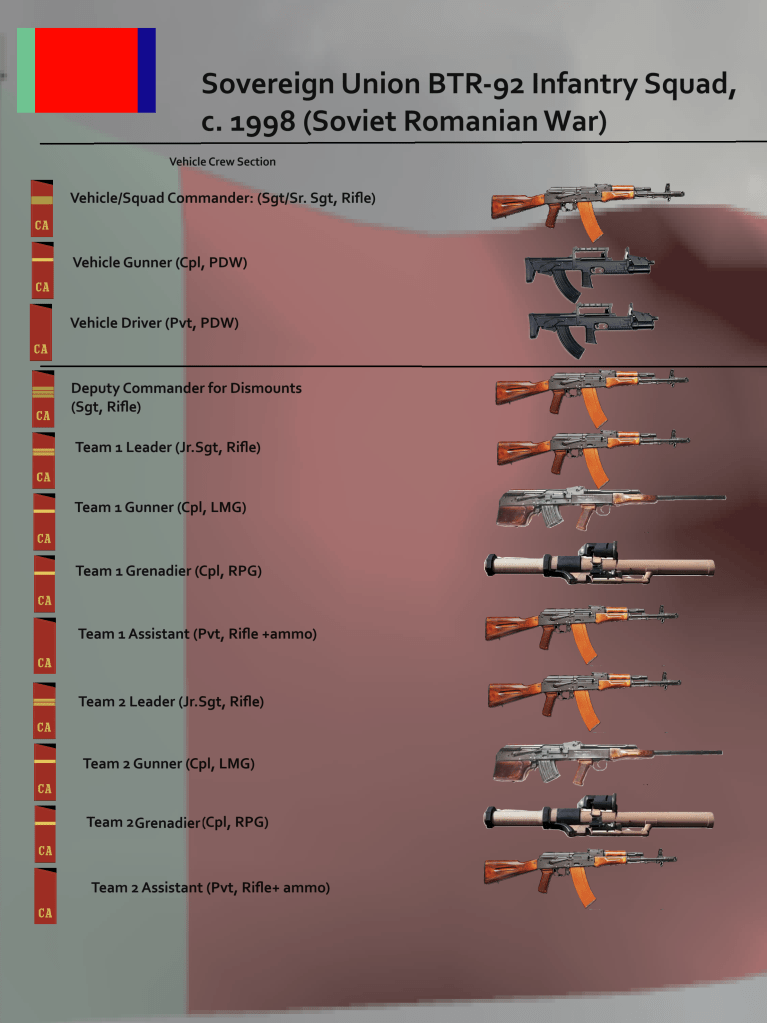
First I did my past piece on Mobile Corps squads, then came the BTR-92. Now the most ahistorically Soviet part of All Union’s military can be made with the two mixed together. In-universe, the creation of this squad was an extremely involved and controversial process.

  • Unlike previous examples, including the mobile corps own BMP/IFV squads, this operates two organizational fireteams. With lots of teeth-gritting, the doctrine emphasizes that “if necessary”, it can operate as a unitary squad or simple overall fire/overall maneuver element. In the Soviet-Romanian War, many did.
  • This has a full-time deputy squad leader for dismounts, whose job is pretty obvious. An emphasis was put on out-of-vehicle operations as these units were designed to spend more time outside.
  • The PDW is the A-91M. The LMG is the “Vepr”, one of many bullpup RPK proposals. The light RPG is in real life the South African (!) Denel FT5 (since a post-apartheid government would be very close to a surviving USSR, and since a post-apartheid arms industry would be very desperate, a license deal for this Goldilocks Rocket Launcher is not impossible).
  • This can be detailed in the Kestrel Publishing entry: Clash: Soviet BTR vs. Romanian TAB . Despite the name, about 80% of that book is just devoted to the Mobile Corps BTR reformation. The pieces on the Romanians basically amounted, cruelly but not inaccurately to “They just followed 196X BTR doctrine, had the equipment to match, and lost”.

Review: Blood of the Ancients

Blood of the Ancients

Like Jerry Ahern, John Schettler decided to take the Kirov series into outright science fiction. Gone are the purely terrestrial squabbles, replaced with sci-fi spaceship battles against aliens and, in this case, an attempt at a John Carter of Mars Homage in Blood of the Ancients. Although much of the book takes place on Earth as the ancient “Sons of Ares” change the past in secret alternate history, this is obviously John Carter through and through.

The issue is that Schettler is not the most inherently suited to write this kind of flowery planetary romance. It would be like a fluffy romance author writing a technothriller. Despite this, it’s a sincere and well-appreciated effort. Who knows, maybe Kirov will turn to nonviolent romantic drama next…

The BTR-92

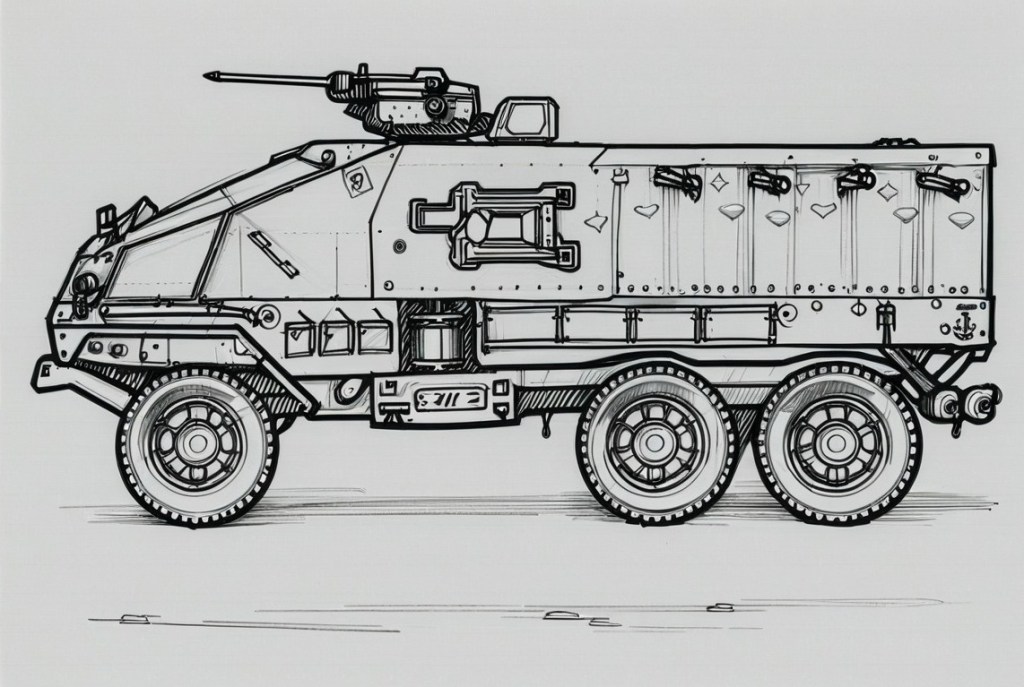
Stable Diffusion has given me the chance to bring a vehicle from All Union to life. Now I had a vision of what the “BTR-92”, the wheeled mainstay of the Mobile Corps, looked like, but on the pages it was described only as “blocky” (and wheeled).

So how I made it: I first smushed some elements together externally. The top and turret came from other APCs, while the bottom (possibly meant to symbolize it being built on that truck’s chassis) came from a Ural-4320. Then I used it as the outline for a controlnet to avoid the “AI doesn’t know what shape to make it” issue.

It’s of course not perfect and with some nitpicking/hindsight, I’d probaby make something that looks less like a low-end APC/MRAP and more like a futuristic advanced one. But it’s still the general shape I wanted, and it was still very fun to make.

Review: Tiger Chair

Tiger Chair

The recent Tiger Chair is the Max Brooks short story of the Chinese invasion of the American West Coast. Told in the form of a letter back home from a Chinese, it mentions how all the high-tech contraptions that were supposed to win were countered by know-how.

I’ll be blunt, this is not a good story. It’s told entirely through less-than-ideal exposition, and is loaded with both references that are bound to age like antimatter (mentioning some minor celebrity controversy from four years before this post that a normal person like the narrator would almost certainly not even know about) and older ones (there’s a ton of Iraq War lingo that makes me think at least part of this was originally written back in the 2000s).

But the real problem (at least for a military nerd like myself) is that Brooks’ Pentagon Reformerism is on every page. Obvious from as early as the Zombie Survival Guide (where he praised the AK and scorned the M16), this goes from “there are counters to high-tech contraptions” to “they make high-tech contraptions useless”. This is hammered home in a hamfisted manner continually.

Don’t get this.

Review: Only War Core

Only War Core Rulebook

Deciding to look back at the Warhammer 40k tabletop RPGs whose mechanics ended up adapted to Rogue Trader, the choice of Imperial Guard RPG Only War was not exactly a hard decision. Since that army has been my absolute favorite faction by a parsec from the moment I found out about the franchise, I was eager to see how playing them in a character game as opposed to a wargame worked out.

You can practically see the writers trying desperately to make the experience both true to the Guard’s limitations and playable/fun. I trust I don’t need to go into that much detail that an individual guardsman, even an elite one, is at or near the absolute bottom of the galactic food chain. There’s also the reason why Twilight 2000 was set in a scramble rather than in a war-their life is a very regimented existence with little chance for straying beyond orders.

Thankfully, the solutions are fun and interesting. Characters are part of a beginning chosen/created regiment that has set base gear and characteristics. NPC “comrades” are present to act as additional laser sponges-I mean, partners in war. More can be achieved, but only at the cost of chancing the logistics system (as unreliable and risky as it sounds). The regimental system itself allows for everyone from Tempestus Scion commandos to primitive worlders with swords and animal hides.

So yes, I recommend Only War to anyone who wants to be real serious and face the grim darkness of the far future without the need for power armor or super-enhancements.

Review: Small Arms For Urban Combat

Small Arms For Urban Combat

Russell Tilstra’s Small Arms For Urban Combat seems at first glance to be just what the title says. It’s a nonfiction reference book about various small arms and their usefulness in urban war. However, it turns out to be a lot more shallow than that.

Sadly, this is less an analysis and more of a “Basic first guide to small arms”. While not bad by itself, it would have been a lot better with a more honest title. The urban warfare part feels like an afterthought.

Review: The Occupation

The Occupation: A John Warren Novel

My Amazon recommended reading list is filled with all kinds of postapocalyptic wilderness guerilla commando survival books. And none are portrayed as pulpy as Jerry Ahern’s Survivalist. While I generally had little interest in such novels, it got to the point where I figured I might as well try one out. So I chose WJ Lundy’s The Occupation.

Starting with a boilerplate Evil Woke Corporate Dystopia (complete with Evil Foreign UN Peacekeepers to round out the League of Evil), it of course ends up with rural guerilla resistance. And in what I suspect is a common theme even though I’ve only read a little of the genre, it’s very heavy on the tactical maneuver minutia. Like it’s mercifully restrained in detailing the various models of guns involved, but in terms of execution it’s rather different. Which isn’t the worst thing.

And neither is this book. It could be better, but in terms of 51% entertainment, you could certainly do a lot worse.

One Neat Trick to Lessen Supply Requirements

What if I was to say that in certain theaters, your supply requirements can be lessened significantly? One only need compare built-up Iraq and not-so-built-up Afghanistan to see the different challenges. Or Vietnam vs. the Fulda Gap. But this is one that can best be used by an OPFOR against a wealthier foe-although rising global standards of living allow this to be applicable more and more.

Ok, so the US Army ranks different supply types by “Classes”. Now Class I, the one we’re focused on, is in short, food. Now one field manual, based on WWII experience, has it being about 7 pounds per person per day. Add that to a 20,000 strong division slice and you get 71 tons per division per day. But more room can be saved for other supplies if you adjust the Class I supply to a different amount, like say…

nothing.

Beyond what they have on their basic loads, the troops are to loot, plunder, and “requisition” food completely. Entirely. And remember: This is not neglecting enough food. This is a completely deliberate choice. What could go wrong?

(Answer: A lot.)