My Amazon recommended reading list is filled with all kinds of postapocalyptic wilderness guerilla commando survival books. And none are portrayed as pulpy as Jerry Ahern’s Survivalist. While I generally had little interest in such novels, it got to the point where I figured I might as well try one out. So I chose WJ Lundy’s The Occupation.
Starting with a boilerplate Evil Woke Corporate Dystopia (complete with Evil Foreign UN Peacekeepers to round out the League of Evil), it of course ends up with rural guerilla resistance. And in what I suspect is a common theme even though I’ve only read a little of the genre, it’s very heavy on the tactical maneuver minutia. Like it’s mercifully restrained in detailing the various models of guns involved, but in terms of execution it’s rather different. Which isn’t the worst thing.
And neither is this book. It could be better, but in terms of 51% entertainment, you could certainly do a lot worse.
What if I was to say that in certain theaters, your supply requirements can be lessened significantly? One only need compare built-up Iraq and not-so-built-up Afghanistan to see the different challenges. Or Vietnam vs. the Fulda Gap. But this is one that can best be used by an OPFOR against a wealthier foe-although rising global standards of living allow this to be applicable more and more.
Ok, so the US Army ranks different supply types by “Classes”. Now Class I, the one we’re focused on, is in short, food. Now one field manual, based on WWII experience, has it being about 7 pounds per person per day. Add that to a 20,000 strong division slice and you get 71 tons per division per day. But more room can be saved for other supplies if you adjust the Class I supply to a different amount, like say…
nothing.
Beyond what they have on their basic loads, the troops are to loot, plunder, and “requisition” food completely. Entirely. And remember: This is not neglecting enough food. This is a completely deliberate choice. What could go wrong?
Then-major George Patton in 1932 made a long essay about the ideal army for the “war of the future”. Most importantly, it had order of battle charts. The whole thing is well worth a read, but some thoughts/highlights:
Underestimated motorization, saying you can have agility (professional army) or mass (conscript army) but not both. This was true in WWII (even for the Americans to an extent), but postwar motorization rendered that largely (if not entirely) moot. He proposed nationalizing civilian trucks for motorization in wartime.
Proposed a standing army of about 315,000 people. Which uh, isn’t actually that much less than the post-Vietnam volunteer army. Especially adjusted for national population size.
Patton is extremely Pattonesque. Believing his higher-trained army can always beat a numerically superior qualitative one (uh, not always the case), and being a grandfather of manueverism (not surprising). To his credit he does acknowledge the problem of keeping an elite army elite after attrition (and showing knowledge of how pre-gunpowder, almost all casualties were in the rout, whereas firearms made large losses inevitable against peer opponents)
The most unusual part is at the smallest level, which consists of a “section” built around a tripod-mounted belt-fed machine gun and has 19-20 men at paper strength. It’s divided into a rifle squad (fairly plain ten rifles) and an LMG squad (one LMG gunner, several assistants for it with pistols, and four riflemen) . Two such sections form a platoon.
Above that it’s a now-familiar triangular division. Three line platoons in a company, three line companies in a battalion, three line battalions in a brigade, three brigades in a division, a divisional tank battalion. Aka, by and large the standard post-WWII division.
Brigades would have a company of heavy machine guns (at the time an anti-tank weapon) and a battalion of three 75mm batteries (two field guns and one howitzer). Of note is no apparent organic division artillery, with it either being the brigade artillery or handed down by corps (the WWII Soviet prioritization taken to even greater extremes)
The 39-strong divisional tank battalion is mentioned as having tanks of the “Vickers-Armstrong or modified Christie type”. Tank platoons are a fairly unusual “vanilla and Firefly” type of having three “normal” tanks and one tank chassis with a larger-caliber cannon. At the time, this wasn’t unusual. Everything above platoon for tanks is conventional.
An infantry division has an organic paper strength of around 8,000 people.
All in all a very fascinating document. Patton may have been prescient in making a modern army, but I still wouldn’t want him commanding it (he would have been a good armored division commander, but deserved nothing higher). And of course, this army is easy to make and wargame in the underappreciated interwar period.
(Special thanks to the Tactical Notebook for its own analysis of Patton’s proposal which brought it to my attention)
Capcom’s Warriors of Fate is a Final Fight-type beat em up set in ancient China. Err.. except the American translation set it in a fictional place that just happened to resemble ancient China. And the simple and easy Chinese names got turned into complex Mongolian-inspired names. Yeah, it was a little weird.
That being said, it’s a Final Fight successor that plays like a Final Fight successor and has the fun of a Final Fight successor. Unlike Captain Commando, mounts (horses in this case, not mechs) actually are useful and usable. It doesn’t quite reach the heights of Battle Circuit in terms of pure technical ability, but there is a lot more depth than many other games of its ilk and it makes up for it in terms of spectacle.
Today is Veterans Day, or Armistice Day at the end of World War I. Now I’ve said many times-I’m a soft sheltered civilian who could do absolutely nothing in a real fight except get killed. I also have no immediate family who have served in the military. That being said, even though all my knowledge comes from secondary sources, I feel pretty confident in saying one thing, which I think today is as good a time as any to say it.
Veterans simply cannot be lumped into any one category.
And I’m not even talking about different countries, different wars, different branches, different specific units (of course an administrator in the back who faced only the occasional rocket, be it a V-2 or Type 63, is going to have quite a different experience from the tip of the spear). Seriously, the accounts from people in very similar places and roles at the same time can be totally different, as do their beliefs on everything from politics to military doctrine.
Granted, I think part of the problem is pop culture having a tendency to treat the military with the two extremes of either “John Wayne” or “Oliver Stone”. Which is at least understandable, I mean I can give a lot of it the benefit of the doubt. It’s just that “Yeah this isn’t like Hollywood” just makes me go “uh, and? Yes? Fish live underwater? The New York Knicks are not a good basketball team?”
Bringing this to my own writing, there’s not much precedent for how to describe the experiences of a female forward nurse from Kyrgyzstan fighting in the most intense nine days of battle since 1973. So with regards to All Union’s Cholpon, I guess I have to hope I did my best.
And yes I know a lot of you hate it when we say that but to all veterans who served honorably, thank you today.
Have you ever wished that you could just throw two armies against each other? Have your playthroughs of Command: Modern Operations or other wargames largely just consisted of setting up artificial jousts in the level editor? Don’t want any of that pesky “tactics” or “detail”? Then Ultimate Epic Battle Simulator 2 is the game for you!
There’s a campaign mode and the ability to play it as a makeshift real-time-strategy game, but the true meat of UEBS is to just line up a pair of armies on a map, like a literal million ancient soldiers against an artillery brigade with a contemporary infantry company screen, and watch as they charge at it. It’s not exactly deep but it is very fun.
In fact, it’s weirdly informative about actual battlefield dynamics, because taking away any kind of tactical management means you can see the other factors at play. I was pleasantly surprised to see a small number of melee units I put in making an outsize difference as they fixed the opposition and let the ranged units fire on them more freely. You can see terrain effects as your giant hordes struggle to make it through bottlenecks.
So there are a lot worse things to get than UEBS2, especially since mods mean you make even more fantastical clashes.
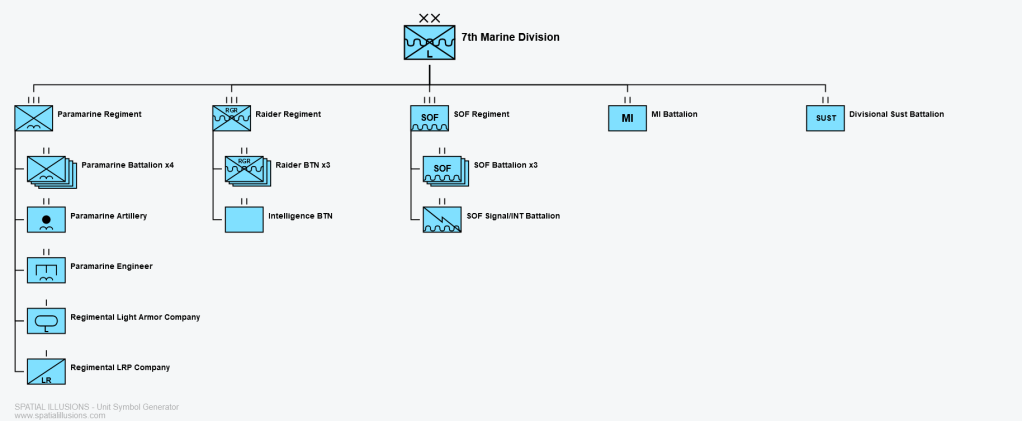
I talked about my fictional 7th Marine Division before. Now I have a more detailed personal organization (though still undoubtedly rough and with inaccuracies). Here it goes. ORBAT chart courtesy of the Spatial Illusion Unit Symbol Generator.
Paramarine Regiment
The Paramarine Regiment is like many other light airborne units, with the exception that it has four battalions instead of the usual three and its artillery battalion has thus been increased to four cannon batteries likewise, along with the other regimental support units similarly beefed up. This is to allow each battalion to serve as an independent combined arms unit to hold ground if necessary (ie around a battery in a fire support base with a battalion of infantry and an LRP platoon and light AFV platoon).
The actual battalions are largely standard triangular airborne infantry battalions.
Raider Regiment
A lighter force with less organic capability, the raider regiment is simple, with three battalions, each of three raider companies and a heavy weapons company. A regimental intelligence battalion is included because of the importance of intelligence and planning to their missions. It’s meant as a direct action-slanted commando force ie the classic Rangers.
SOF Regiment
The SOF regiment has three SOF battalions, below which any formal organization would be varied and inexact by nature (each has a number of teams, varied as you’d think, but around 10-15 each). Its communications/intelligence battalion is there similar to the ranger regiment.
Divisional Assets
Divisional assets are just more support and administrative elements, there because the 7th is not intended to be a “field” organization.
Logos
Some Stable Diffusion concepts for the logo of either the division itself or one of its subunits. You’ll notice a theme of black birds. Yes, I know crows are already the mascot animal for electronic warfare units, but oh well.
Usage
It goes without saying that in All Union, the 7th Marine Division was formed and saw action, including the 2002-2009 conflict in Western Sahara that marked the largest and bloodiest war the US military fought in that TL. If I ever need a fictional American commando force in my writing, I can always use it.
Michael Knights’ 25 Days to Aden is one of the best nonfiction military histories I’ve read recently. As of this post it’s also very timely. Diving deep into the crucial but obscure in the outside world battle for the city of Aden in the early stages of the latest Yemeni civil war, it tells of how a coalition of the UAE, putting its petrodollars to effective use, and local Yemenis ousted the Houthis from the vital port city.
The biggest problem with this book is very obvious from the first page. Knights clearly relied completely on UAE sources, and thus the book is about as biased towards them as Arrian was towards Alexander. It’s not so much the exact facts (Kenneth Pollack, no fan of the Arab militaries, has praised the smaller, well-resourced Emirati army as a big exception), so much the tone that, along with the usual issues in war reporting, leaves one feeling inherently suspicious.
However, this insiders look also has great advantages. It shows a skillful campaign conducted with limited resources and the quirks and compromises that had to be made when dealing with a low-education local army. The two things that accurately jumped out at me were A: It was calculated that 20% of all ammunition would be wasted with random ‘celebratory’ gunfire, and B: Chewing khat was so vital and important that one simply did not fight battles in Yemen during chew time. It also shows that tanks still are very important even in an age of drones and smart weapons, but that kind of goes without saying.
Finally and most importantly, Knights is unbiased in a crucial way in that he has no illusions about treating the temporary victory as more than what it was. The political context of Yemen in its entire history can be summed up by me saying “latest civil war”, and Knights mentions the effectively unsolvable political context.
So keeping its biases and flaws in mind, this is a highly recommended read.
Edited by Elspeth Ritchie, Women at War is a collection of academic essays about the massive expansion of women in the US military through the years of war in the 21st century.
Now there’s a few things I’d like to say about the controversial topic of women in the military. The first is that in the “yes or no” arguments, my armchair opinion is “we don’t really have a choice”. As the current crunch shows, topping up a big volunteer military is tough already. There simply are not 200,000 ready gigachads who would join the military instead. The second is that I hate the term “combat roles” to refer to the controversy of infantry/armor/etc…, because it implies a false dichotomy between never intended to be in harms way and full inclusion in fields where you could raise legit objections. The third is that the worst thing that could happen to women in the military (or minorities in any field, basically) is the kind of identity-politics obsessed person who thinks that any disproportionately small amount of _____ in _____ must be due entirely to the Bias of the System.
Anyway, this actual book is a mixed bag. There are a lot of understandably dry but very thorough and cited articles on various effects that are done with proper hard-science rigor. Then there’s the fluffy pretentious ones that feel very out of place. Like I understand getting figures on how many women have been “naughty” on overseas deployments is going to be hard, but you could at least try instead of engaging in theorizing that ranges from the obvious to the silly. And that at least you can justify the theoretical with the difficulty in getting solid figures. There are other topics where instead of examining say, how the cultural differences in another country make the incorporation of women into the military better or worse, the writer just gives out marshmallow talc.
Stuff like this is why I just can’t recommend the book fully, even though it has many excellent articles and resources. Then again, that and its high price is just the nature of academic publishing. Of course, the other side of the coin is that you can get lots of relevant facts, figures, and stories about the topic, which is also the nature of academic publishing. So its your call.
So the conventional forces of the United States in All Union, unlike its superpower counterparts, have not been the most central to any of my drafts (yet…). Therefore I figure I should infodump some of my musings on it right now.
Background
The reformation of the USSR brought about a period of aimlessness among the US Army. With the fall of the Berlin Wall and the former Warsaw Pact states forming an independent de facto buffer, priorities became much lower. Going from all of Germany to the northern tip of Norway and Thrace is somewhat of a downgrade.
That being said, there has been a shift of forces to the south. The US 9th Infantry Division is in Turkish Thrace to, in the event of a Thraciapocalypse, serve as a mobile counterattack force. The lighter 51st Infantry is in Northeastern Greece near the triple border to make sure the rival NATO countries play nice serve as a tripwire for any Soviet-Bulgarian push south.
The need for “Americi-BTRs” that historically was filled by the Strykers came in the form of LAVs, both the LAV-25/Piranha of real life USMC fame for that branch and the unrelated but similarly named LAV-300/600 series for the Army.
The medium-ization of the Army came as followed: Two brigades in existing heavy divisions with their Bradley mech inf brigades replaced with LAV mech inf brigades ie BMP-BTR mixes, two “medium-heavy” divisions based around LAV-300s with a divisional tank battalion that would stay behind on lower-intensity deployments, and one “medium-light” division with the LAV-300 series, more uparmored HMMVs as the infantry carrier, and no organic tanks. For the USMC, the Seventh Marine Division came into being, along with Combined Arms Regiments (mixes of tanks and LAV-Bisons proposed in real life) for the three active USMC divisions.




 Fuldapocalypse Fiction