Review: The ISIS Solution

Released at the height of the 2010s anti-ISIS campaign, The ISIS Solution is a short book by several SOFRep authors, which include such familiar names as Jack Murphy and Peter Nealen. It offers critique and recommendations, and since I knew their books well, I wondered how their nonfiction commentary would go. As commentators, they’re pretty good novelists.

As the saga of “Mean” Joe Greene’s transformation from the best defensive lineman to the worst football commentator ever attests, being good in one field doesn’t translate to being successful in another. Granted, some of this is due to the book being short and aimed at a much broader audience than actual security analysts. But more of it is due to a phenomenon I’ve seen sadly too often.

I call this Fire Joe Morgan-ism (not surprisingly, Morgan was another athlete who went from brilliant player to dubious commentator). There a group of spicy screenwriters (seriously) who dabbled in baseball analytics took pride in dogpiling on all the old crusty baseball hacks who didn’t know any stat beyond batting average. It basically amounts to going ahead of the absolute worst baseline (sportswriters in that case, network talking heads in this one) by showing that you do have genuine knowledge of it (military operations/baseball stats), and then doing a little dance and a victory lap because you’ve overcome such an easy target.

Granted, this probably wasn’t as surprising as I’d thought. Murphy’s books ranged from “blatantly political even when good” to “unironic Metal Gear Solid plotline”, while Nealen’s commentary attempts in Maelstrom Rising sank it a lot compared to the far more apolitical Blackhearts series. But it’s still disappointing, and there are a lot better sources out there.

Review: PROMIS

PROMIS

Jack Murphy’s PROMIS series tells the story of wandering mercenary Sean Deckard as he makes his way around Cold War battlefields. A collection of short, action-packed novellas, it kind of reminded me of, well, Barry Sadler’s Casca of all things. Just replace the immortality curse with a super-prediction computer equation thingy in the background (the titular PROMIS system) and you have these books-kind of.

It’s like Casca in that it was created and written by a genuine special forces veteran, and like Casca in that it sets out a justification to plop the main character in action set pieces. The three published locations are Vietnam, Rhodesia, and South Africa. Not that it’s much worse than any other cheap thriller in practice, but I’d prefer a slightly less iffy location than both of those two. Even Central America would be better…

…Especially because, unlike Casca, there’s no real attempt at creating the surrounding scene outside of action sequences at all. While Casca had theme parks and parades of famous historical figures, this doesn’t even have that. Even by cheap thriller standards the characterization is really, really, really bare. The action is at least decent, even if it has the “try to have its cake and eat it too by trying to be both semi-grounded and spectacular” problem. But that’s not enough to raise the series to even a “51%” level.

Thankfully, I know that Murphy can do a lot better. Go read the far superior and awesomely titled Gray Matter Splatter instead of these.

Review: Gray Matter Splatter

Gray Matter Splatter

gmscover

The path to opening Gray Matter Splatter was a little offbeat. I thought Jack Murphy’s debut in the Deckard series, Reflexive Fire, was wildly uneven, the kind of book that’s “Mean 51%” instead of the consistently middling “Mode 51%”. I also, similar to my experience with spacesuit commandos last winter, was getting a little worn on middling action books after reading so many of them.

So I figured, having heard that this was the craziest out of the four Deckard books, that this book with a great title was worth a shot to leap out. And so I leapfrogged over the other two and headed straight for the fourth. It was a good decision.

Now this book still has many of the problems that plagued Reflexive Fire-the political soapboxing that got in the way of the plot, the not-unusual but still irritating long descriptions of weapons, the jumpy perspectives, and the less-than-developed characters. But it’s improved to a considerable degree with the fundamentals, and the mega-conspiracy behind everything is at least tamer than the mega-conspiracy in Reflexive Fire. So there’s a little less dissonance there.

But in terms of what matters, the action is excellent and challenging as Deckard and his mercs fight their way across the entire Arctic Circle. While the sustained action may be a little more implausible than the low-level action in Reflexive Fire, I’m certainly not complaining in that sense.

This is still a cheap thriller for all its pretensions. But it’s a good cheap thriller.

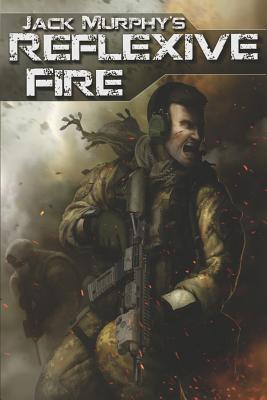
Review: Reflexive Fire

Reflexive Fire

reflexivefirecover

Special Forces veteran Jack Murphy’s Reflexive Fire is a very strange kind of thriller. The low-level action is very well done, gritty and gory with almost the right amount of “semi-plausibility” and “exaggeration” (I learned about Murphy’s books from Peter Nealen’s posts on them, and could see the similarities in the action immediately). The high-level plot is this huge mega-stakes mix of ancient conspiracy theories, and to say it doesn’t fit the best with the low-level action is a huge understatement. It’s like a video game with ARMA’s mechanics but Metal Gear Solid’s plot. There are Blaine McCrackens that have less ridiculous plots and MacGuffins than this.

The pacing is very jumpy, with lots of viewpoint characters (it’s a rare instance of “just a name and nationality” Steel Panthers Characterization in a small-unit action book) and a very long “Herman Melville’s Guide To Building And Training Your Dream Army With The Help Of A Super-Conspiracy” section. There’s some hamfisted politics that don’t really add anything and are ruined by the presence of the super-conspiracy.

That being said, this was Murphy’s first novel in the series, and he demonstrated enough legitimate strengths for me to be forgiving of its many weaknesses. Plus, if I have to choose between a bland middling book that doesn’t stand out from the pack or a zigzagging, “really good in one way, bad in others, and quirky to boot” book that does, I’m choosing the latter instantly.