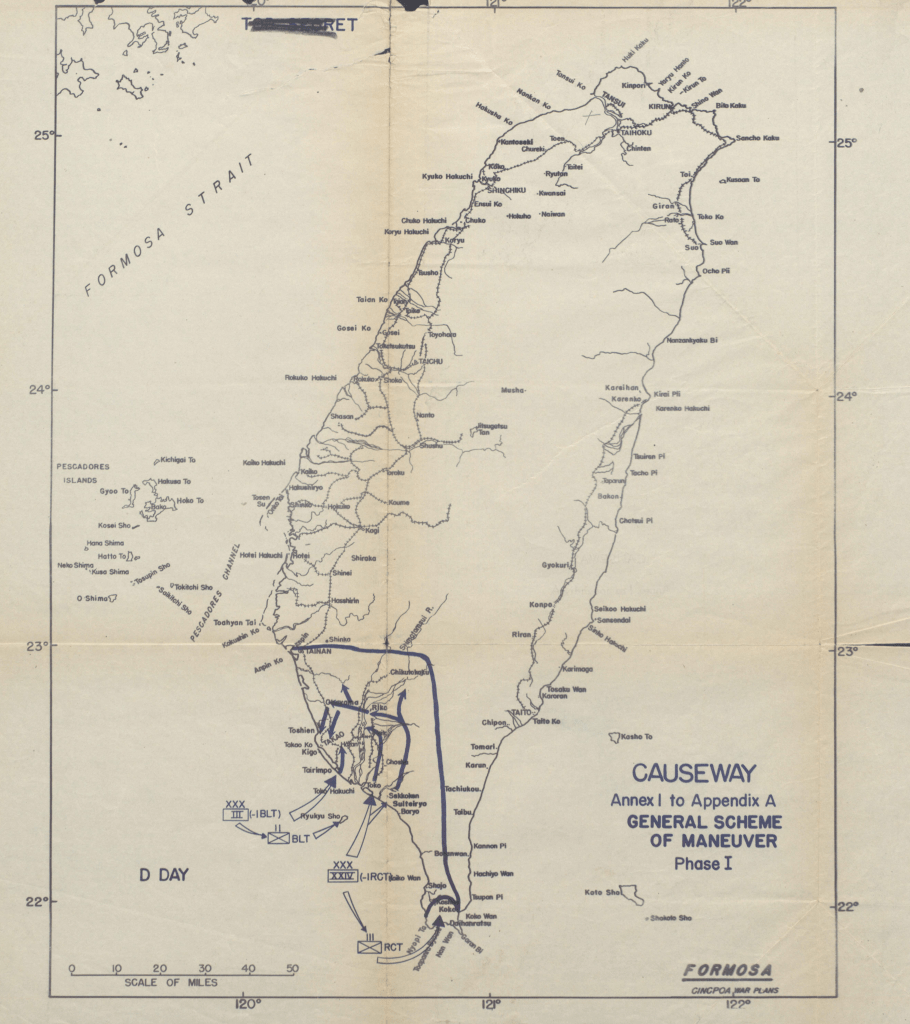
Operation Causeway

Operation Causeway was a proposed plan by the US military in World War II to land on Taiwan. It would have been a massive high risk, high cost, and high reward operation. In actual history, Causeway was shelved in favor of landing in Luzon.

The initial landing sites for Causeway would be in the south.

The Causeway documents are useful not just as an alternate historical reference, but also as a general guide to what a large amphibious invasion of Taiwan would entail (something that, for some mysterious reason, has remained relevant postwar).

A Thousand Words: SpringSharp

SpringSharp

Want to design a physically capable steam-age (1850-1950) warship? Then Springsharp is the game/program for you! Designing anything from coast defense ironclads with low freeboard to ridiculous twenty turret monsters, it works very well for any alternate shipbuilder.

Some caveats are in order. First, it’s just a weight simulator. This is why it doesn’t really work for volume-dependent missile age ships. Second, it works better for large (by the standards of the time) ships than small ones. Third, you have to know the basics of naval design and ship dimensions to really put in the right numbers for a viable ship.

But with this in mind, it’s an excellent simulation that can create the fleets of your dreams.

Weird Wargaming: Missile Iowas

The Command database now has many more hypothetical proposed missile upgrades of the Iowa-class battleships, including adding a ramp for fixed-wing aircraft in one entry (!). These ships bring a very strange feeling to me. Because they inspire equal parts awe, horror, and disgust.

See, the problem is that missile launchers intended for long-distance operations render the 16 inch guns nothing but a heavy explosive risk. This has been known in real life too. There was a serious consideration during the reactivation of the Iowas (primarily to have tons of box launchers for Tomahawks) of just leaving the guns closed up and inoperable. They’d be unlikely to fire in a fleet action, and if they did fire, it couldn’t be good for any sensitive machinery in the rest of the ship.

So my head regards the Missile Iowas with derision. But my heart adores them. Simply because of how crazy and audacious they are. Do I really need to explain this?

Anyway, for the boring details, they’d likely be used in a way similar to how the real 1980s reactivated Iowas were. As the centerpiece of surface action groups. If you wanted to be cold-hearted, you could treat them as expendable sunk costs. But you can also revel in the absurdity.

Arthur Hailey: Technothriller Writer?

Generally speaking, alternate history questions about how some creative artist’s career could have gone differently are not my favorite thing. There are just too many inputs and inspirations, and one would be hard pressed to find something more volatile than popular culture tastes. That being said, I’ve found one author who I can definitely see sliding into a different genre if he’d come to fame 10-15 years later.

That author is Arthur Hailey, most famous for his novel Airport, which inspired the movie that spawned the entire disaster genre (and its parody in Airplane!). Hailey loved to write books that examined a complex thing (be it banks, airports, car factories, or what not) in amazing detail, before climaxing in some kind of crisis. He also loved technology to the point of taking too many futurists at face value (Passenger pods loaded into planes on conveyor belts!)

Hmmm, massively researched technical detail? A love of technology? That sounds like he’d be right at home with technothrillers.

In fact, I can so easily imagine Arthur Hailey’s Aircraft Carrier. The carrier and everything from the catapults to the air tasking order is described in minute detail. As is the drama surrounding members of the crew, which will consist of at least two middle-class Americans committing adultery. Then, in the final chapters of the book, the carrier will sail into action! But it won’t be a full on Fuldapocalyptic world war with the carrier fending off a hundred Tu-22s in the GIUK Gap while a nuclear sword of Damocles hangs over everyone’s head. Hailey just wasn’t that high stakes a writer, and his target audience probably wouldn’t go for something as tense as that. It would probably be something like El Dorado Canyon, probably against a fictional OPFOR country. The carrier accomplishes its mission, but not before a million more “I know the exact designation of a Scud TEL” infodumps are launched and at least one of the adulterers is blown up.

Look, I didn’t say it was going to be a good technothriller.

Indeed, as much as Clancy and Bond’s books may have been dated and rendered less potent by their technology becoming considerably less novel, Hailey’s have aged far worse. And I’m not (just) talking about their culture and characterization. Their entire gimmick is “this is a thing.” And if you already have the slightest familiarity with that thing in ways that audiences in the 1960s and 1970s did not, the books become empty clunkfests.

Still, it’s very easy to see the success of someone who wrote in a very similar style (Airport is basically a peacetime technothriller, after all) translating to something else down the road. That’s the fun of alternate history.

Review: Marque And Reprisal

Marque and Reprisal

I eagerly awaited the newest Brannigan’s Blackhearts book, Marque and Reprisal. After devouring it, I figured I had to review it. And it’s slightly disappointing. But only slightly. The issue isn’t the action or plotting (even if one “twist” of them getting betrayed is rather obvious). The issue is the setting.

Without going into spoiler-ish details, the villains feel like well, how do I put it? They feel like the kind of antagonists a mainstream action thriller would have. Which means the book fails to take advantage of both ends the series can go to-either gritty third-world mud fights or giant spectacles. They’re too out-there for the former and too mundane for the latter.

This is still my favorite thriller series ever, and it’s only a “disappointment” by the previous books massively high standards. But a part of it felt lacking nonetheless.

Review: Red Front

Red Front

The conventional Fuldapocalypse begins in earnest with Red Front, the second book in the Iron Crucible series. After the Yugoslav opening act in the previous entry , this follows the war everywhere from the Atlantic to… outer space. Author T. K Blackwood continues a solid Bond/Red Storm Rising style narrative in this installment.

This has the issues that a big perspective WWIII has, but it also has the strengths, and Blackwood succeeds in a genre that’s incredibly difficult to write well. The book ends on a cliffhanger, but it’s not an unsatsifying one. With a ton of varied battles in a type of novel that doesn’t come along very often, I can say that I highly recommend this to fans of the “conventional WW3” genre.

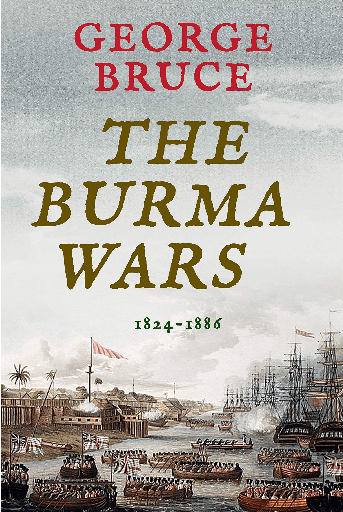
Review: The Burma Wars

The Burma Wars

Because Myanmar/Burma features so prominently in my current novel draft, I figure I’d look at George Bruce’s The Burma Wars , a history of the British conquest. There were three large Anglo-Burmese wars, but Bruce mostly concentrates on the first. This is understandable, as the latter two were uninteresting squashes.

Bruce is every bit the Empire fan you’d expect a British pop-historian of the 1970s to be, but he still gives the Burmese credit when due. They were comparably armed, had a knack for building fortifications quickly, and the Anglo-Indian force that went against them was logistically troubled and questionably led. And yet, the British still eventually won, and it only got better/worse from there.

I wouldn’t make an old piece of popular history the sole source on any big historical event, but this at least made for a good starting point. I’m glad I read it.

Review: Journey’s End

Journey’s End

Amazingly, surprisingly, the Kirov series has gotten a formal conclusion with Journey’s End. I’d predicted that there was no way for the series to end gracefully after 64 clunky volumes. And my prediction turned out to be accurate. A lot of this is de facto flashbacks to each ill-developed member of the crew. The final battle is just a wargamed clash like the hundreds before it. The hanging threats of Volkov and the aliens are dealt with hurriedly and contrivedly.

The conclusion is “a generally happy ending is stuffed in at the last second due to yet more time travel technobabble.” Schettler was clearly desperate to finish Kirov so he could write a fantasy novel series (which are no stranger to giant, bloated, sagas), and it shows. Still, that a 64 book epic with millions of words was completed at all is no small accomplishment.

Review: British Cruisers

British Cruisers

Norman Friedman turns his knowledgeable eye to one of the most arbitrary ship classes in British Cruisers. Going from the early 20th Century to the Cold War, he covers the enigmatic ship type that can best be summed up as “bigger than a contemporary destroyer, but not too big”. From wartime workhorses to unusual goofy designs, Friedman leaves few Royal Navy stones unturned.

The final desperate attempts at large capital ships after 1945 are the most interesting to me. The large “escort cruisers” started off as ASW helicopter ships, then grew into the famed de facto light carriers they became and were later used as. Everything else was rightly shelved. But this is a typically excellent technical history of cruisers in all eras.