
My review/overview of the Kirov series on Sea Lion Press is up. I had a lot of fun writing it. It’s one of those series where it’s hard to give your opinion on it because of how strange it is. But I managed.
Tag: Naval
Review: Altered States
Altered States
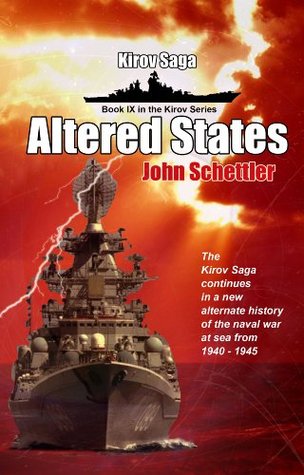
The ninth Kirov book, Altered States, is where the series really starts to hit its stride. By Schettler’s own admission, the response to the question of “should I write about the missile cruiser’s later adventures or an alternate World War II where the German surface fleet was bigger?” was “Yes.” And he was glad to oblige, combining the cruiser soap opera with a huge naval battle in a location I haven’t seen in a while-the GIUK gap.
(There’s a Kirov, but there’s not any Backfires or Aegis cruisers or F-14s. It’s like my original vision of Fuldapocalypse mixed with what the blog later became)
This sets the stage for the giant wargame sandbox/time travel soap opera that the rest of the series would become. Not quickly or even the most effectively, but it still does. I’ll admit that the “alternate sandbox” approach is my own favorite way of wargaming, which is why I’ve grown fonder of the series. I’ve found later, similar installments in a series hard to review, and this is one of them. But still, this is where it really clicks into place.
Review: Pacific Storm
Pacific Storm
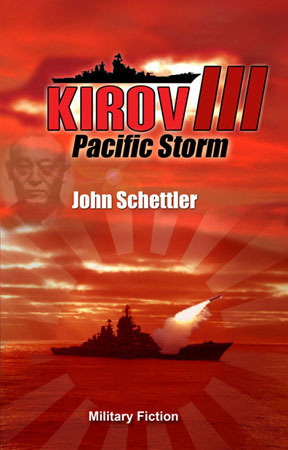
The Kirov series is over fifty books long and counting. But the third entry, Pacific Storm, was planned as a potential stopping point, according to the introduction of a later entry. And while I normally criticize series from Jack Ryan to the Survivalist for passing good opportunities to conclude, it’s for the best that this one sailed right by it.
After having fought through the Mediterranean in the second book, the missile cruiser battles in the Pacific in the third. Besides the issues with the prose, the encounters fall short because the disparity between World War II ships that don’t know what they’re dealing with and a futuristic warship that does means that all the battles have to be contrived in some fashion. Pretty much the only things that work are various surprise gimmicks, close range, and pure numbers, and that’s barely enough to sustain a three-book series.
The ending still involves sequel hooks, but features the ship going back to its present with its crew having realized they started the (nuclear) World War III by firing on an American submarine. When they see the submarine after their “excursion”, they avoid attacking it. Meanwhile, their experiences have changed the “past” significantly. This would be a perfectly good conclusion that still gave room to continue, but it would have concluded three stilted, modestly out-there books. Instead, the series got bigger, more complicated, and, yes, better.
Weird Wargaming: Independent Scotland
The subject of what military an independent Scotland might have has gathered a lot of attention. One of the most serious and definitive reports on the matter comes from the respected Royal United Services Institute, a piece entitled “A’ the Blue Bonnets.“
The RUSI piece in short depicts a small and light land force not too dissimilar from Ireland’s, unsurprising in light of their similar geography. However it does assume a more capable air/naval element. The report shows a comparably strong navy and an air force with hand-me-down BAE Hawks as its fixed-wing fighters.
Assuming no political issues, something like the KAI Golden Eagle might also work as a basic air defense fighter, an heir to the F-5 of the past. That’s the only real quibble I have with the report, which is otherwise well worth a read.
As for the possible opponents of this Scottish military, far and away the most realistic is, like Ireland, whoever they’d face on foreign peacekeeping operations. For more out-there ones, you have Russia (especially at sea), and if you want to be really out there, you could do a “Kobayashi Maru” situation where the Scots have to inflict as much damage on the invading English/British invaders as possible.
And of course, this assumes a commitment to plausibility-if you strip-mined Scotland’s entire military age population and had an outsider equip and train it, then you could end up with something completely gigantic. But the “Ireland on land and another North Sea state on sea and air” option is the most logical.
Review: Eagle Rising
Eagle Rising

The Kirov series, of which Eagle Rising is the 47th (!) installment, is strange. If I’d read it three years ago, I’d probably have unfairly denounced it as the worst series of all time. In my more recent reviews, I’d sort of wavered from criticizing the individual books to admiring the ridiculous (in a good way!) plot and premise of the setting.
Now I have this weird feeling that’s settled. I unironically love the craziness and excess that the series gets into, while remaining just as critical of the many flaws of the individual books. I’ll take this flawed excess standout over a hundred “51% books” any day.
That being said, this book itself has essentially two set pieces spread out of over many pages and takes place in an entire arc with a forgone conclusion stated as early as the first book in the series. Whatever the author’s intention, the impression I got of this arc, with this particular WWIII having long since been established as ending in a nuclear fireball (hence the time travel and changing it in the first place…), was that it served mainly to show off wargaming set pieces.
The set pieces are a big Russo-NATO showdown in Eastern Europe and the shenanigans of the ship and its crew. The former is a strangely intriguing example of what happens when you rely on wargame simulations to an incredible and unprecedented degree. Besides the obvious issues with such a stilted de facto let’s play, there’s also problems when the simulations produce an undramatic (however realistic) result and there’s not much “cushion” of characterization or low-level danger to balance them. Another issue is that this particular conflict setup is not exactly undergamed.
The latter, a far more out there plot, involves the use of a time travel MacGuffin and some of the crew going onto an island and fighting a pack of wolves (it’s a bit of a long story). It also involves long scenes of clunky dialogue, which is less fun.
In a way, this book, with time travel shenanigans and wargame AARs, is its own series in a nutshell. Is this a good or bad thing? Well, it depends on what you want and/or like.
Review: The Hunt For Red October
The Hunt For Red October
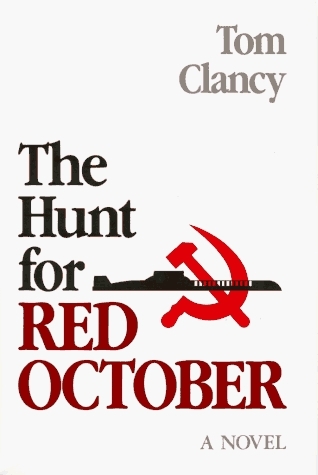
This is it. The book that started it all. The book that turned Tom Clancy into a juggernaut. It’s time to review The Hunt For Red October. How is it? In short, it’s well-ok?
What I can say about this tale of a loose super-submarine is that it doesn’t really pass the “if this had been published a year or two later by a different author, would it still be as popular as it was?” test. Many works of fiction are so good on their own terms that they’d succeed in that goal. This isn’t. If it had been written by someone else later on, it’d probably be barely remembered as a middle-of-the-road technothriller.
The novel itself isn’t bad by any standards, but it still has all of the issues that would drag Tom Clancy down later on. It’s just those are in a smaller and more manageable form. There’s some bloat, but it’s manageable here. There’s a few too many subplots, but they’re manageable here. There’s the bias, but it’s manageable here. You get the idea. It’s easy to see why it could be a success in its time, but with hindsight, and with me having read other technothrillers before it, I don’t find it that impressive.
It’s also a little dated. Some of it is technical issues that are understandable and minor (for instance, a western author could be forgiven for getting the type of reactor in an Alfa-class wrong). But some of it is the general “wow” factor, again that would have made them a lot more impressive to someone at the time than to a post-Gulf War reader for whom advanced military technology is familiar. This is of course an issue with all of his books and with technothrillers in general. However, it is not an issue with the lavishly-produced, well-filmed movie.
I would say that, like Red Storm Rising, The Hunt For Red October is more of a historical book than an enduring technothriller that can really stand on its own. However, Red October comes across slightly worse in that regard due to being in a bigger niche. While also smaller than I originally thought, the number of technothrillers is still considerably larger than the number of conventional World War III novels.
Review: Kirov
Kirov

Having started later in John Schettler’s massive series, it’s taken me quite a while to actually pick up the original book. I had very low expectations and somehow managed to still be disappointed by Kirov. This might seem strange, but it makes sense.
The book stars a “Frankenstein-Kirov” assembled from the rest of the class on a live fire exercise during a period of heightened tension before it’s timeshifted back to World War II. I’d heard this book was a tinny Final Countdown/Axis of Time knockoff. I suspected this book would be a tinny Final Countdown/Axis of Time knockoff. I was right.
So why the extra disappointment? Well, the structural issues from later in the series I saw were there from the start. The descriptions are over-detailed, the action scenes are too precisely described, and the dialogue is still extremely clunky. Worse, it’s more concentrated, for lack of a better word, instead of being incredibly spread out. The plot has the main characters acting in ways intended to set up battles in a forced way.
Finally, though the timeshifting, feuding and cosmic changes are there from the start, the main scenario of “modern ship fights a 1940s fleet” just isn’t as interesting as the the places the later books go. So even knowing what I was getting into, I found the first Kirov book to be a letdown.
Review: The Kamikaze Legacy
The Kamikaze Legacy

A sequel to The Yakusa Tattoo, The Kamikaze Legacy continues to follow hardboiled Ed Mulvaney as he moves to foil another international plot in a stereotypical Japan, this one concerning a deep-sea expedition with sinister motives. This is less the “crazy Jerry Ahern novel mixed with technothriller” of its predecessor and more “crazy Jerry Ahern novel mixed with Clive Cussler-esque technology/ secret history thriller.”
While it still has the strengths and weaknesses of The Yakusa Tattoo (strengths: good ridiculous action and an even more ridiculous plot-weaknesses: blocky prose and a million weapon descriptions), I found that this has a MacGuffin that by all means should belong in a boring “shoot the terrorist” novel, but ends up being just as crazy as the rest of the book. This emphasizes that, especially for cheap thrillers, execution is more important than concepts by far. As for what it is, it shouldn’t be too hard to guess.
This is a very stupid-fun Jerry Ahern book. It’s the kind of book where the mountains of technical inaccuracy and implausibility actually add to the appeal of it all. While it’s not quite as bizarre as its predecessor, it’s still a very fun cheap thriller.
Review: HMS Ulysses
HMS Ulysses
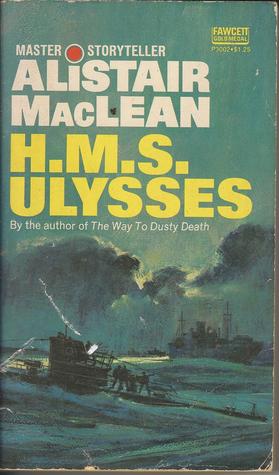
A rightful classic, HMS Ulysses is, in my opinion, the greatest naval action novel of all time. Author Alistair MacLean, a veteran of the Royal Navy in World War II, could draw on a lot of personal experience, and it shows in this masterpiece. People who know their naval history can look at the obvious parallels between the actions of the book and the ill-fated Convoy PQ-17 (which MacLean served on), but that doesn’t change its effectiveness.
The way MacLean sets a tone is hard to describe, but he succeeds brilliantly. The travails of the convoy, in no small part thanks to the PQ-17 historical experience, are both dramatic and plausible-seeming. The feat of squaring the circle cannot be applauded enough. Historical military fiction, at least to me, has had the issue of “it’s going to be either realistically dull and un-dramatic, in which case I’ll read a history book that makes no pretense at narrative, or it’s going to be exaggerated, in which case I’ll read a cheap thriller that doesn’t have to be bound to an existing war.”
This avoids both of them by throwing one (plausible) German threat after another at the convoy and emphasizing the wear and tear the climate and stress imposes on the sailors. I cannot recommend this book enough.
Review: Operation Sea Lion
Operation Sea Lion
The most infamous invasion that never was, Operation Sea Lion holds a special place in the annals of alternate history. Richard Cox’s book takes a 1974 wargame of it at Sandhurst and turns it into a Hackett-esque big picture tale. This can be described as a World War II version of The War That Never Was, taking simple wargame results and giving them a tiny fig leaf of “plot” via various vignettes.
Not surprisingly to anyone knowledgeable about alternate history, the wargame, despite deliberately going easy on the first wave (to have a substantive ground element at all) ends with the Royal Navy cutting the lines and the Germans defeated. It’s not Cox’s fault, but something with the outcome never in doubt is hard to make exciting for someone who knows the context.
That being said, this remains an amusing little historical alternate history footnote. It’s aimed at a popular audience who wouldn’t necessarily know the context, and is at least more literary than a rote after action report of the wargame itself would have been.
 Fuldapocalypse Fiction