Review: Aircraft Projects of the Commonwealth Aircraft Corporation

Aircraft Projects of the Commonwealth Aircraft Corporation

I’m a sucker for big historical reference books, so I got Aircraft Projects of the Commonwealth Aircraft Corporation, a detailed look at Australia’s aviation company from WWII to its buyout postwar. Everything from the semi-improvised military aircraft of the war to their license-built airplanes designed by other firms (ie Sabres and Mirages) to their ambitious designs is covered.

The last segment includes some pretty crazy things like a trainer/low-end ground attacker that’s swing-winged and an interceptor powered by four very small engines. The latter is a good example of how much the designs had to fit the parts rather than the other way around. This book is a well written, well-laid out treat and I highly recommend it.

The Cluster Debate

So the Americans have provided cluster weapons to Ukraine. Unsurprisingly, the internet debates around them have not been the most fruitful or productive. The consistent opponents are one thing in that I find their arguments as flawed as they are understandable. Yes, it’s perfectly fine to be concerned about unexploded ordnance and collateral damage-as if there wasn’t plenty of that already, most of it caused by…. someone other than Ukraine.

But the more interesting thing to me has been the talk, largely from OSINT accounts, of treating clusters as an unstoppable superweapon. Between this and the Bayraktar TB2 slobbering of days past, it’s as big a sign as Michael Jordan’s baseball career that excellent talent in one area doesn’t equal having it in another. Anyway,

  • Concern about unexploded bomblets, and not just for collateral reasons, is valid.
  • Clusters are situational and even in the past before “normal” shells got better designed, had many situations where they were worse. They also had some where they were better.
  • Cluster shells will still be extremely useful, if only because they’re a fresh source of things that things that go boom.

Review: North Korea’s Hidden Assets

North Korea’s Hidden Assets

H. John Poole returns to Fuldapocalypse with North Korea’s Hidden Assets, a warning about how North Korea may be stronger than anticipated. Or rather, that’s a central message in a meandering book. The content here ranges from loooong descriptions of Iwo Jima fortifications (because as a country occupied by Japan, they were undeniably influenced by its doctrine. Legit link, but not worth the obsession he shows) to constant tirades against the clunky, idiotic American doctrine and how the North Koreans have so much better military culture and small unit tactics.

Some of the book’s arguments are good. Poole spends a lot of time legitimately arguing against mirror-imaging a Second Korean War as being a repeat of the mechanized charge to take the entire peninsula that was the first. He argues and reasonably so that the north would be more likely to bite, hold, and wear the Americans and southerners down to win at the peace table. And the fortifications and tactics from the first Korean War are at least more relevant. So are the surprisingly few times he looks at contemporary North Korea (the nominal point of the whole thing)

But this book is mostly axe-grinding. It’s also hypocritical in that Poole portrays it as some kind of secret hidden source when almost all of its analysis comes from official US government documents-showing at least someone else already there knows of a worst-case perspective on North Korea. There are much better serious studies of that opponent out there.

Review: Seizing Power

Seizing Power

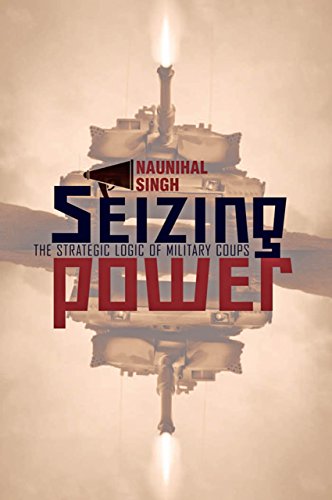
Naunihal Singh’s Seizing Power is a book about military coups and how they work. The timing of this review is a complete coincidence and has no bearing on recent events whatsoever. Anyway, Singh studies the basic three types of coups and makes an academic argument that they are in essence, “coordination games”-that is to say they have to give the appearance of inevitability instead of actual hard power (in most cases.)

Singh divides coups into three categories. The first is coups from the top, like say, the central party committee imprisoning the president and attempting to seize control. The second is coups from the middle, like say, a division-sized force dashing from its base on the border to the capital and hoping the rest of the army can join it. The third is coups from the bottom, like say, rioters in support of a parliament with no army on its own trying to sway the military and take vital television stations. (Yes, all three examples happened in Russia/The USSR. They were the 1991 August Coup, the recent Wagner uprising, and the 1993 constitutional crisis).

Singh spends most of his time covering all three types of coups that happened in Ghana in its history, and then ends with the August Coup of 1991, a coup from the top that should have effortlessly succeeded but in fact failed miserably. Like most academic histories, it gets a little too pendantic at times. But it’s still a great read.

A Thousand Words: Dave’s Redistricting

Dave’s Redistricting

One of my internet hobbies has been using the Dave’s Redistricting site. It allows you to draw up hypothetical legislative districts and see their demographics. I’m currently using it to make hypothetical seats for a vastly expanded US House of Representatives. It’s both fun and illuminating to see how you have to balance various challenges.

It’s very illustrative of showing how it’s actually harder to make “fair” districts than you might think. You can get a nice sensitive block of counties-that are safe seats. Or you can take half of those counties, balance it with half of a large city, and then you can make an evenly bipartisan district-but how “representative” really is an obvious artificial creation like that?

If you like politics in any form, you have to check this out. It’s simple, easy, and is great for both counterfactuals and actual debate.

Review: The ISIS Solution

Released at the height of the 2010s anti-ISIS campaign, The ISIS Solution is a short book by several SOFRep authors, which include such familiar names as Jack Murphy and Peter Nealen. It offers critique and recommendations, and since I knew their books well, I wondered how their nonfiction commentary would go. As commentators, they’re pretty good novelists.

As the saga of “Mean” Joe Greene’s transformation from the best defensive lineman to the worst football commentator ever attests, being good in one field doesn’t translate to being successful in another. Granted, some of this is due to the book being short and aimed at a much broader audience than actual security analysts. But more of it is due to a phenomenon I’ve seen sadly too often.

I call this Fire Joe Morgan-ism (not surprisingly, Morgan was another athlete who went from brilliant player to dubious commentator). There a group of spicy screenwriters (seriously) who dabbled in baseball analytics took pride in dogpiling on all the old crusty baseball hacks who didn’t know any stat beyond batting average. It basically amounts to going ahead of the absolute worst baseline (sportswriters in that case, network talking heads in this one) by showing that you do have genuine knowledge of it (military operations/baseball stats), and then doing a little dance and a victory lap because you’ve overcome such an easy target.

Granted, this probably wasn’t as surprising as I’d thought. Murphy’s books ranged from “blatantly political even when good” to “unironic Metal Gear Solid plotline”, while Nealen’s commentary attempts in Maelstrom Rising sank it a lot compared to the far more apolitical Blackhearts series. But it’s still disappointing, and there are a lot better sources out there.

Review: US Army Doctrine

US Army Doctrine: From The American Revolution to the War on Terror

In his study of published doctrine, Walter Kretchik embarks on the herculean task of reading multiple centuries worth of field-manualese. He looks at the very first to the then latest manuals (the book was published in 2011) and how they were applied in practice. The result is an excellent nonfiction study for field manual nerds like me.

The book is very readable and understandable. I would advise reading the actual manuals themselves if you wanted to know more (they’re all public domain by their very nature and the age of many of them), but as a starting point for both doctrine and warfare, this book is excellent. It’s expensive and niche, but it’s good in addition to being those two.

Review: C3

C3: Nuclear Command, Control, Cooperation

Written by former Strategic Rocket Forces officer Valery Yarynich, 2003’s C3 is an in-depth look at Cold War (and beyond) nuclear war command systems and their hazards. Although having access to then-secret info in Soviet times, Yarynich was no Viktor Suvorov and did not sensationalize (in fact, he provided one of the first detailed and level-headed descriptions of the infamous Perimetr/Dead Hand system). The result is one of the best nonfiction books on nuclear war that I’ve read.

As it is written by a former Soviet officer, you do get waves and waves of charts and equations that attempt to quantify something relating to military technology. But you also get lots of clear, simple explanations that make a layperson able to understand this well. In terms of everything from organizational charts to what the “nuclear briefcase” even is to why scissors were found to be a weak link in the command chain (seriously), it’s incredibly illuminating.

If you have any interest in nuclear war or command systems whatsoever, I highly recommend this book. I’ll also just say that it’s an excellent research resource…

Review: Carrying the Fire

Carrying The Fire: An Astronaut’s Journeys

Long considered one of the two best astronaut memoirs (the other being Mike Mullane’s Riding Rockets), Carrying the Fire is the autobiography of Apollo 1 command module pilot Michael Collins. He got to go to the moon but not walk on it. Collins insisted on writing the book all by himself without assistance, and it paid off. Not only was he a capable pilot and astronaut, but he turned out to be an excellent author as well.

With both humor and majesty, Collins tells the story of flight and the moon program. Anyone interested in outer space should get this. It’s an excellent book and even greater autobiography. While it’s not nearly as fresh as it was in 1974, that’s a small and inevitable “problem” to have. This is a great book.

Review: The Reckoning

The Reckoning

David Halberstam was one of the most legendary historical writers. In The Reckoning, written at the height of the 1980s auto crunch, he turned his eyes on Ford and Nissan, trying to find what made carmakers on both sides of the Pacific go. Halberstam has a talent for writing. Unfortunately, that very skill makes it uneven.

It does a good job describing formative events like Henry Ford’s family drama and the 1953 labor dispute at Nissan that shaped not only it but the entire Japanese auto industry. It also does well when looking at individual workers caught up in the mess. Although I have to say that it’s very hard to write about the auto industry and not make it interesting. The field is just so inherently complex and full of colorful stories.

So what are the problems? Well, it’s dated for one. This isn’t as bad as it could have been. Yes, it’s a more than a little “JAPAN GOOD”, but certainly not to the excess of some other bubble era publications. After all, this shows the Japanese industry warts and all. It also aptly points out in its study of the South Koreans how the rest of Asia was cracking its knuckles and preparing to charge-which came to pass.

No, the biggest obvious problem is that it’s too “Bruce Springsteen”. Which is to say it has the tone of a wealthy suburbanite who idealizes the blue collar worker’s struggle too much. Its slobberingly positive portrayal of UAW head Walter Reuther is the most obvious part of it, with even sympathetic history works on that man being far more critical and full than Halberstam’s hagiography. This also leads Halberstam to idolize the “Manufacturing Men” over the supposed “bean counters” who nickel and dimed every car to pieces. (Not surprisingly, Robert McNamara in his pre SecDef days is there and scorned).

This leads to the next problem that someone with any kind of interest in the auto industry can see: It’s too centered around the capital-N Narrative of the Good Manufacturing Man being brought down by the Evil White Collar Consultant. The “Manufacturing Men” in both continents could get away with running hog wild simply because their industry was in a boom. Once it busted, they simply had to start penny pinching. After all, the first Japanese car company to close a plant and downsize was… Nissan. All this is combined with something that, for all his research, Halberstam didn’t actually have much familiarity with, and it showed. It’s also catnip for the mostly well-off target audience of the book.

Still, for all its problems this is something I’d definitely recommend.