Unclear Physics: Why Iraq and Libya Failed to Build Nuclear Weapons
In Unclear Physics, Malfrid Braut-Hegghammer takes a look at the ultimately unsuccessful nuclear weapons programs of Saddam’s Iraq and Libya. Instead of a technical perspective, she looks at them from a political/organizational one, showing how poor state structures (in the case of Iraq) and nonexistent ones (in the case of Libya) hampered them. From the outside, there aren’t any shocking revelations: Iraq could have had a bomb by the mid-late 1990s without the Gulf War or a similar catastrophe, while Libya’s was going nowhere by 2003.
But from the inside, it’s a detailed look at human failure,in terms of dealing with low technology, dictator paranoia, dictators not understanding, and disorganized factionalism. Some of it comes across as legitimately fun to read.
Unclear Physics has two big apparent weaknesses. The first is its academese tone. The second and worse one along the similar nature is that she writes in a kind of inside baseball tone as if this an argument among nonproliferation academics, saying “the conventional wisdom says ______” when she means the previous conventional wisdom among people in that very small niche. It’s arguments that I’ve never even heard, for better or worse, as someone who’s for an amateur read up a lot about nuclear proliferation.
But this is still a great book at showing the soft human side of an otherwise hard technical issue.
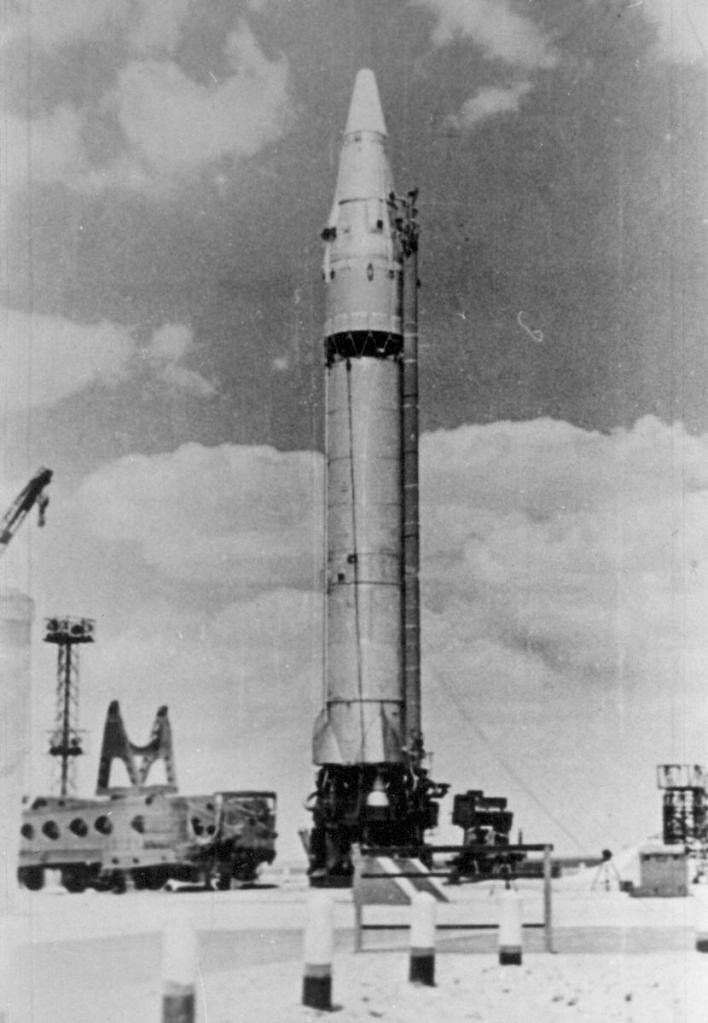
Readiness issues with liquid oxygen rockets historically retired them from the ICBM role once alternatives became practical (be it storable liquid or solid fuels). Yet one technological curiosity was an attempt to work around the issue.
A variant of the R-9/SS-8 ICBM with the typically obtuse Soviet industrial designation of 8K77 had the vacuum flask principle applied to its oxygen tanks. At least in theory, it would keep the liquid oxygen cold long enough for a fueled missile to wait on alert in a crisis. Vacuum flasks are of course better known in the capitalist west by their brand name turned generic name, the thermos.
Nuclear Safeguards, Security, and Nonproliferation
Every so often I get a textbook that is not really the best to conventionally review at all, much less amongst cheap thrillers. Nuclear Safeguards, Security, and Nonproliferation is one of those books. I feel a little guilty reviewing it because the target audience is scientists and the like who know the math, physics, and engineering subject matter a loooooooooooooooooooooot more than an armchair enthusiast like myself. So yeah, a lot of this goes over my head. And that’s fine.
If the “Type 1 Academese” was understandable and inevitable, the “Type 2” is a legit point of criticism. Despite the fact that anyone who’s read a single piece on the modern history of South Africa would instantly grasp why the post-apartheid government gave up the nuclear weapons, the book explains this in a long and pretentious way. Where I think this is more than a stylistic issue is how it wouldn’t be easy to get its points across to a non-scientist, whereas other similarly dense works on the same topic are still more understandable.
When I saw the words “A nuclear forensics thriller”, I knew I absolutely had to read Atomic Peril. That it’s about nuclear terrorism and involves a scratch-built bomb (a rarity in such cases) made me more eager to finish it. Given the legitimate qualifications of author Sidney Niemeyer, that was even more of a reason to keep going.
The issue is that I know too much. The bomb is a realistic but simple gun type, which is not particularly novel to anyone who knows anything about nuclear weapons beyond the basics. And as a thriller author, its writer is a pretty good nuclear forensics expert. Which is to say the book is a lot more Herman Melville than Tom Clancy. Unsurprisingly, it definitely goes into the “too realistic for its own good if judged as a cheap thriller” category, and even more unsurprisingly, this makes the attempt at a conventional action climax even more dissonant and clumsy.
While I sound like I don’t like this book, I’m actually a lot softer on it than my writing might indicate. Niemeyer had a story he wanted to tell, knowledge that he knew, and was earnest in telling it. And that is to be commended, however many stumbles there are. Besides, if I want a conventional cheap thriller there’s no shortage of “shoot the terrorist before he blows the nuke” books out there.
The ninth Survivalist book and end of the de facto first arc is Earth Fire. It takes the “western Fist of the North Star” theme to its climax as John Rourke prepares his shelter for the firestorm engulfing the world and moves to stop the main Soviet antagonist from using the other suspended animation shelter in Cheyenne Mountain.
I’ve mentioned many times that this was an ideal stopping point for the series. Take this perfectly fine arc and the beginning of Book 10 where Rourke wakes up after the timeskip and sees the Eden Project spaceship lifeboat return and you have an excellent self-contained narrative. As it stood, the series kind of meandered on, becoming first a pet sci-fi setting and then hurriedly sputtering out after 1991.
In fact, later arcs would render this much less important via retcons. Here the Soviet Politburo is shot down as they attempt to reach Cheyenne Mountain because they don’t have a viable shelter of their own. Later on it turns out that the Soviets indeed had an underground city after all! And the Argentines, and the Icelanders, and pretty much everyone! How about that!
Still, this is a fine piece of ridiculous 80s excessive men’s adventure, and can be appreciated for what it is. The later sourness doesn’t make this any less sweet.
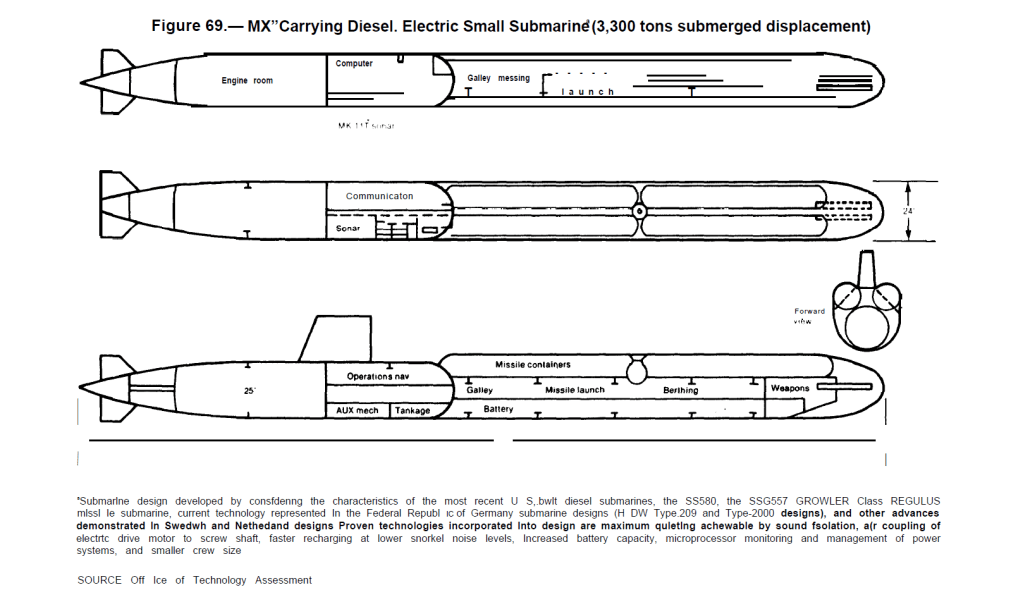
I’m torn with submarine names for the MX-SSB class, a real proposed design that I’m using in All Union
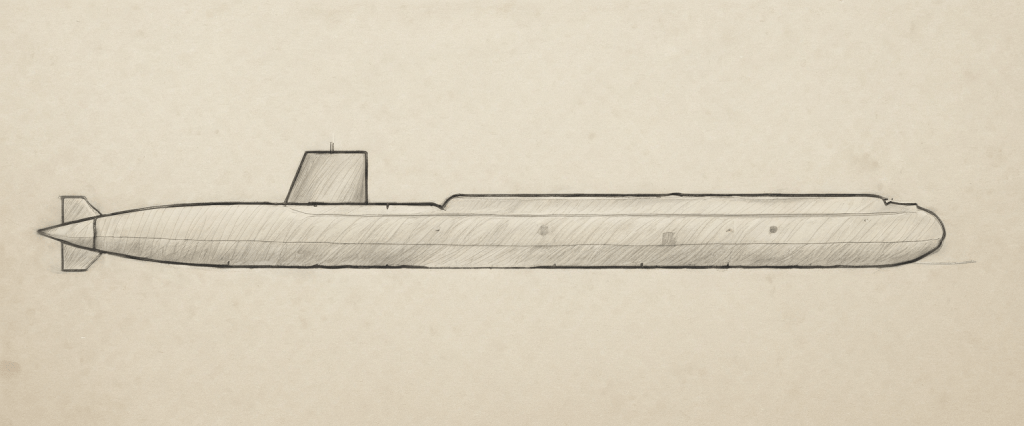
(Bottom picture made in Stable Diffusion from the outline of the sub above)
The problems are:
The class is large at circa 50 boats, so the naming scheme needs to support such a large class.
There is no historical precedent since the US never used diesel missile subs, much less in large numbers.
Both fish and people just don’t seem right to me (subjective I know)
I’m leaning towards lakes (ie, the Lake Tahoe class with some/all of the Great Lakes thrown in), but am wondering if there’s something that just can click. Thoughts?
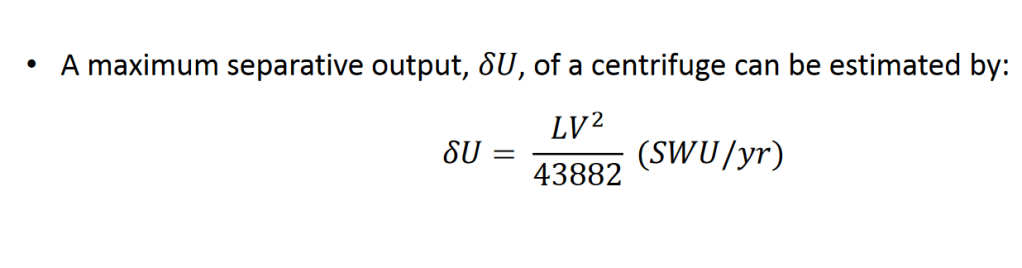
The Holzer Centrifuge is a uranium enrichment centrifuge I’ve used as a Macguffin in various settings of mine. It is one of the smallest viable centrifuges and a simpler yet less effective design compared to its contemporaries. It has a maximum capacity of around 0.9 separative work units per centrifuge[1]. In practice with inevitable inefficiences and losses this leads to a mere 0.5-.6 in practice, one of the weakest individual centrifuges to ever spin in its hideous mission.
In All Union, the Polish Holzer centrifuge (named after the ethnic German scientist who led the program), served as one of the primary enrichment sources for the nation’s uranium path. The goal was ease of assembly with just domestic resources, hence why Holzer centrifuges were around 40-50 years behind their contemporaries and low-powered even by the standards of other first-gen designs. Nonetheless, they accomplished their goal.
[1]A napkin calc is as follows, with L being length in meters and V velocity in meters per second. Don’t really ask me to explain what an SWU exactly is.
Poland produced at least 50,000 Holzer centrifuges and operated 25,000 of them. Using an enrichment calculator and going by 0.6, the fully functional cascades would produce 77 kilograms of weapons grade uranium a year if working with natural ore to start, or 270 kilograms if working with reactor-grade LEU.
Now that the focus has changed (a little), I figured I’d do an infodump of something in my mind that I probably wouldn’t get to and honestly shouldn’t elaborate on in the next All Union installment. Enjoy.
In All Union’s timeline, Poland has the world’s fifth or fourth-largest nuclear arsenal.
Plutonium Production Reactor: 2x H-250 (PL) reactors: Nowe-Vistula
On May 20, 1992, Poland detonated a 1.1 kiloton plutonium “physics package” at the Opole Test Site. This was a rushed, improvised device of essentially no practical usability. The bomb was cobbled-together from reactor-grade plutonium taken from the Ignalina power plant in nearby, friendly Lithuania. It was intentionally fizzled to prevent the explosion from being too big, and was controversially detonated above ground to ensure the world knew. But a frenzied construction of nuclear arms and infrastructure began.
The fuel cycle starts at the processing plants. The main and largest by far is the redox chemical plant by Gdansk. The process there is inherently proliferation-resistant due to the fact that it takes a long time to make LEU, and an impossibly-long time to make weapons-level material (as in, over a decade). Low enriched uranium is taken from Gdansk and assembled into fuel rods for reactors home and abroad.
Poland in-universe has seven civilian reactors in two plants. One has three units of 300mw reactors and is located about 30 kilometers northeast of Bydgoszcz. The other has four 600mw reactors and is located near the German border slightly south of Szczecin. All are pressurized water reactors, although the Szczecin plant is of a substantially more advanced design.
However the uranium can also go into the three centrifuge collections, where it is enriched to weapons-grade levels. This makes up one half of their nuclear weapon path. Using LEU enables them to work more effectively than they could with raw uranium.
While the first proper plutonium bombs were made from “goosing” the Ignalina reactor, it was not a sustainable long-term solution. The Poles responded by building two Hanford-style graphite-pile production reactors near Nowe.
HEU and weapons-grade plutonium is taken to the highly classified Powidz assembly facilities (home to a historical/real air base) where the actual warheads are made. Every remnant is taken to the gigantic reprocessing/separation center at Ostroda, known as Nowa Energia (New Energy). There everything from MOX fuel systems for export to depleted uranium bullets are made (the Polish nuclear program makes a lot of DU, so they incorporate it into their arms industry).
For the finished products, Poland is believed to possess around two hundred warheads. It uses a dyad of aircraft/air-launched missiles and ground-based TELs. Naval deployment has been considered but is not believed to be practical as of the setting present.
With the B-1(A) cancelled, Rockwell took a look at a variety of bombers that ranged from “deliberately low technology for the sake of development time and risk” to “LASER GUNS” (seriously). The bomber needed to have a payload of 50,000 pounds, mostly in the form of sixteen nuclear-capable cruise missiles. It needed a strategic mission range of about 5,200 nautical miles with said payload.
The five main examples were:
Subsonic, low technology/cost
Subsonic, lowest weight
Supersonic
Stealth
LASER GUN
The resulting report makes for very interesting reading. One of the more interesting proposals that’s mentioned but not elaborated on there is the modular plane that could be a bomber, an AWACS, a transport, and more.
What implied stats emerge (I’m not an aviation engineer) show the cargo version of the bomber as having neither the raw payload capacity of a heavy airlifter (the payload charts only went up to about 40 tons/80,000 pounds) nor the ruggedness of a light one (the takeoff distance, though impressive for a heavy bomber, is less than a dedicated airlifter). And that’s even before considering the issues with a modular pod (there’s a reason why very few transporters like it have been built). Still fun to think about.
Stealing The Atom Bomb: How Deception and Denial Armed Israel:
I want to say that Roger Mattson’s Stealing the Atom Bomb does the story of a critical and underreported part of nuclear history justice. In the mid-1960s, Israeli agents swiped enough highly enriched uranium to make multiple first-generation warheads from an enrichment plant in Pennsylvania. As the subject matter is incredibly secret, Mattson had to wade through a massive jungle to find out more. To his credit, the book is well-researched and detailed.
The problem is that so much of the book is about how the investigations went. That could be interesting in and of itself, but it’s told in such a stilted, dry way. So I regretfully have to say that what could have been a great resource has become a niche topic for nuclear weapons historians.



 Fuldapocalypse Fiction