Big Vs. Little Targeteering

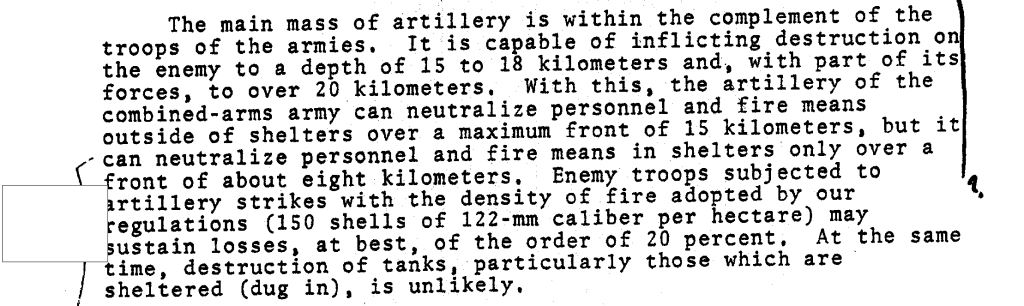
With regards to unguided bombs, one of those things that’s still a little iffy to me is what’s more suited for a few big bombs and what’s for a bunch of little ones. I can guess, with something like a strongpoint or large building being viewed as worthy of a giant demolisher while a group of enemy infantry/soft-skins is better suited for a large stick of small fragmentation ones.

I also have this suspicion that general purpose bombs are acceptable for most aerial targets. This is backed up by the data from the Gulf Wars showing the bulk of dropped bombs being Mk82s and derivatives. And of course, anything that can explode is not useless. Both of these below have uses and both can be deadly.

The Artillery Growth Spurt

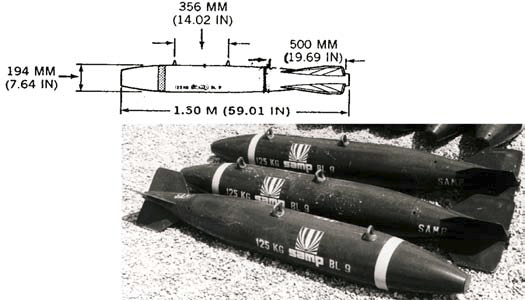
I was looking through my old planning documents and noticed something very interesting. In a 1969 piece on conventional-only operations that was one of the first of its kind, the Soviet planners estimated their artillery could inflict a maximum of 20% enemy losses in the opening fire strike.

By 1974, just five years later, when their conventional balance was arguably at its height, it had grown to the more familiar OPFOR ratio of 30-40% in a similar document.

I’m thinking (pure idle speculation), various combinations of bigger guns, more mobile guns, more accurate guns, better shells (cluster warheads that make conventional SSMs more than just a nuisance are mentioned in the same document), and probably stuff I missed.

What I find extra-fascinating is that the Azeri’s Nagorno-Karabakh opening half-hour mega-strike apparently destroyed 40% of the Armenian artillery-which is in line with the previous estimates, especially if you take into account technical superiority and massive, massive advancements in smart weapons. (Also, though, for all that, the war still lasted a month and a half and claimed around Azeri 3,000 KIA by its own admission.)

Soviet Planned Rates Of Advance

This covers a variety of ideal/aimed for Soviet advance rates, citing translated primary sources when possible. The actual ability to meet these rates in practice would depend greatly on circumstances. All figures are in kilometers per day.

_ _ _ _ _ _

Late 1940-mid 1950s (conventional): 25-35 infantry, 40-50 tank armies [Front Offensive Operation, 1974]

Late 1950s (nuclear): 45-60 [Front Offensive Operation, 1974]

1960s (nuclear) 60-70 [Front Offensive Operation, 1974]

Late 1960s (conventional): 35-40 [Front Offensive Operation With Conventional Weapons, 1969]

1970s-80s (Europe): 40-60, 30 (Southwest Theater, Mountainous) [Voroshilov Lectures, Front Offensive Operation, 1977 ,  Heavy OPFOR Operational]

1970s-80s (China, other weaker opponent): 70-100 [Voroshilov Lectures]

1990s-2000s (conventional, GENFORCE-Mobile): 30-40 (optimistic), 20-30 (optimistic, poor terrain) 15-20 (modest) [Generic Enemy: Mobile Forces]