Rates of Advance in (Fictional) Practice

So a while ago I did the obsessively number-crazed Soviets studies on their planned rates of advance. Looking at my descriptions and map games writing in All Union, I’ve thought “hmmm, how could this go in practice? Or at least fictional speculative practice?”

The Theory

Against NATO, 40-60 km a day on average was the goal. Against a weaker opponent (like one based on the Chinese conventional forces at the time), it was even more, around 70-100. By the 1990s GENFORCE (what I patterned the mobile corps off of), it was down to ideally 30-40, albeit against a stronger opponent.

Romania in Practice

As it stands, I focused mainly on the 17th Mobile Corps, and had a (fairly) detailed route after much Google Mapping. It left a line of departure from near Chernivtsi on September 8, 1998, and came to a final stop around Sibiu on the 16th-17th. On the way it cleared out the important crossroad town of Toplita, crossed the Carpathian mountain roads, and fended off an attack on its bridgehead near Dulcea.
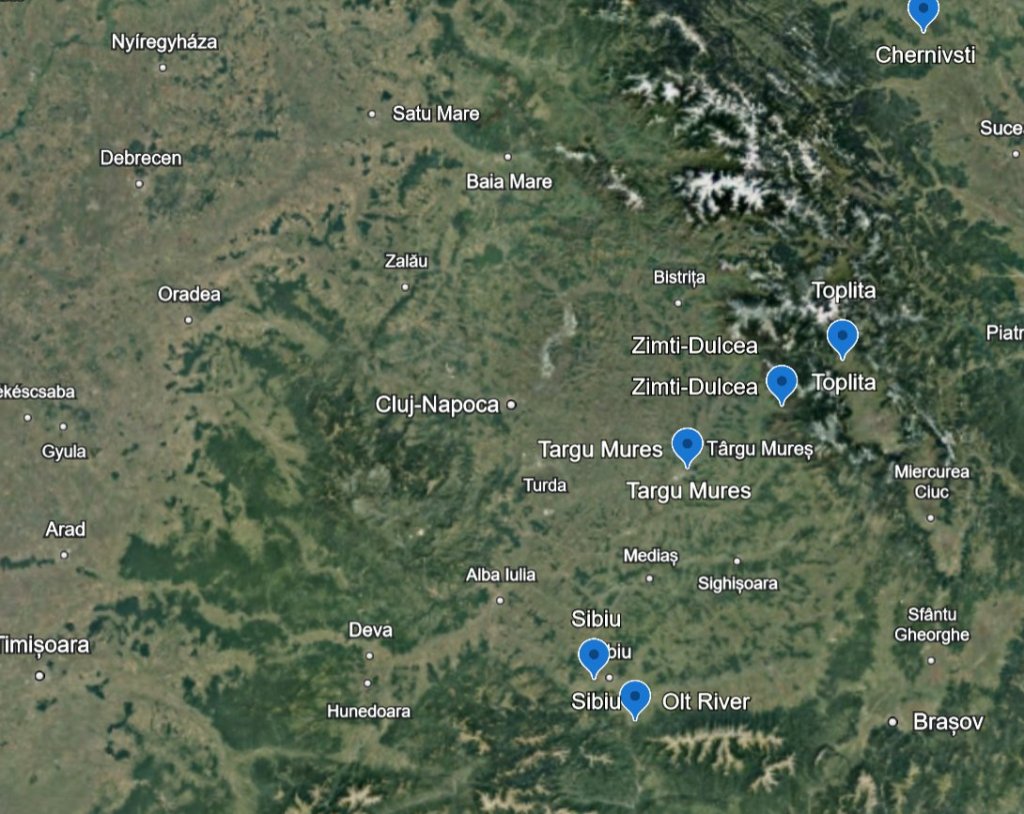
Map is a vague generality. Different subunits progressed around different mountain roads and frontages. Length is hard enough, don’t ask me to do width.. :p

Using a pure napkin calc, this comes to 285 kilometers from the Chernivtsi border region to Sibiu, which leads to 8-9 days of high-intensity fighting, which means a very rough 30-35 kilometers a day. So not bad by GENFORCE standards, especially with a rough terrain making up for a weaker on paper opponent and with the counterattack at Dulcea costing it an entire day.

So not too bad….

The Problem

Of course the definition of “rate of advance” is incredibly arbitrary (does it mean anything in that unit, so can we count a patrol of BRDMs moving far ahead and encountering no resistance before circling and stopping, then the main force reaching that spot without issue later?) and depends a lot, as anyone would admit, on circumstances.

In the same war, many Danube Front formations barely made it past the river, and some that did moved at the equivalent of a brisk walk. But clearly a unit of press-ganged Bulgarians with 1940s equipment having to do an opposed crossing of a very long river and then facing coherent defenders with many fortifications is not the same as a high-tech, high priority force smashing across the plains against a broken foe.

The Second Soviet-Finnish War

Based on various general doctrine goals and precedents in similar regional conflicts, I’ve put together a hypothetical Second Soviet-Finnish War. No direct external intervention on behalf of the Finns, no other conflict it’s in the middle of to distract them.

I haven’t done any formal wargaming, but still came up with this outcome:

  1. The Soviets overrunning all of Finland in around a week, maybe a little more. I’m using their best-case on-paper rates of advance against China, which, though not a perfect analogy, was also underequipped, had lighter infantry and a doctrine focused around them, and had rough terrain in the border regions.
  2. Low/mid single-digit thousands killed (assuming a gigantic invasion force, the Finns standing and fighting, and the Soviets willing to press the attack, all of which are reasonable).
  3. Tank losses in the mid-high hundreds, with a similar amount of other AFVs. How many aren’t repairable is an open question.
  4. I want to say around mid-double digits for aircraft. That’s the biggest question mark.

The Finnish armed forces are, of course, wiped out, at least conventionally.

I’m sure this can and will be disputed. For instance, using a 30 km/day advance rate (rough terrain, NATO opponent) means it’ll take almost three weeks to reach the western coast from the eastern border. Of course, the Soviets can withstand three weeks of vicious attrition a lot better than the Finns can. They also likely wouldn’t need to overrun the entire country to accomplish their political goals, but this is a spherical cow scenario.

Soviet Planned Rates Of Advance

This covers a variety of ideal/aimed for Soviet advance rates, citing translated primary sources when possible. The actual ability to meet these rates in practice would depend greatly on circumstances. All figures are in kilometers per day.

_ _ _ _ _ _

Late 1940-mid 1950s (conventional): 25-35 infantry, 40-50 tank armies [Front Offensive Operation, 1974]

Late 1950s (nuclear): 45-60 [Front Offensive Operation, 1974]

1960s (nuclear) 60-70 [Front Offensive Operation, 1974]

Late 1960s (conventional): 35-40 [Front Offensive Operation With Conventional Weapons, 1969]

1970s-80s (Europe): 40-60, 30 (Southwest Theater, Mountainous) [Voroshilov Lectures, Front Offensive Operation, 1977 ,  Heavy OPFOR Operational]

1970s-80s (China, other weaker opponent): 70-100 [Voroshilov Lectures]

1990s-2000s (conventional, GENFORCE-Mobile): 30-40 (optimistic), 20-30 (optimistic, poor terrain) 15-20 (modest) [Generic Enemy: Mobile Forces]