Review: Inheriting the Bomb

Inheriting The Bomb: The Collapse of the USSR and the Nuclear Disarmament of Ukraine

I’ve looked forward to few nonfiction books as much as I anticipated reading Marina Budjeryn’s Inheriting The Bomb, about how nuclear weapons were removed from Ukraine after the USSR’s breakup (the word choice is deliberate). I was not disappointed. This is an amazing book that can for all intents and purposes clear up the “could Ukraine have kept its nukes” confusion.

I’ve already posted about WMDs and the non-Russian SSRs. Short answer is “They never had control or the necessary pieces to maintain the arsenal of nuclear weapons on their territory, but they nonetheless had the raw technical ability to make an arsenal”. Raw technical ability but little else. Budjeryn doesn’t go into that much detail on counterfactuals (though she does wisely defer to credible experts in that regard and cites them).

She does go into lots and lots of detail on the political twists and turns and not just for Ukraine itself. Yet it was far more reticent than Belarus or Kazakhstan were and viewed itself as a legitimate holder of the weapons. Factors from the fact that Russia was threatening Ukraine almost literally from day one (and by Yeltsin officials and not Zhirinovsky-ist fireeaters) to the desire to preserve jobs in the giant Dnepropetrovsk missile plant are mentioned. This is a great, indispensable book about a very important topic, and I cannot recommend it enough.
A Thousand Words: Fat Man And Little Boy

Fat Man And Little Boy

Before there was Oppenheimer, there was 1989’s Fat Man and Little Boy, a far less well received movie about the development of the nuclear bomb starring Paul Newman as Leslie Groves and Dwight Schultz as Robert Oppenheimer. Knowing its reputation and knowing my interest in the subject matter, I felt I had to check it out.

Most of the critiques are accurate. The movie does treat the making of the nuclear bomb as a hokey war movie with Newman and Schultz as the cliche general and scientist right out of central casting. The movie is VERY clear on what side its makers are taking in the debate about nuclear weapons (it’s uh, not that of Curtis Lemay) and is not subtle in its points. And yes, it’s historically inaccurate in many ways.

Yet it’s still better than I thought it would be. For all those legitimate issues, it’s a technically well made movie. It may be a hokey war movie, but its direction and (especially) sets are solid. Even the final scene when the bomb finally detonates (spoiler) is interesting in that the filmakers obviously knew they couldn’t do the explosion justice with the effects of the time so they chose an indirect vision that’s surprisingly effective.

It’s not the best film ever, but it doesn’t quite deserve the scorn its gotten. Plus Ennio Morricone’s score is typically amazing.

Review: Crimson Snow

(Warning: This review contains many uses of the words ‘tanks exploding’. It’s a sort of contest to see how often I can fit that phrase in. So let the tanks explode!)

Ryan Aslesen’s Crimson Snow is a science fiction novel about tank battles. It is nothing but tanks exploding. And the occasional cliched angst, but mostly tanks exploding. When tanks are not exploding, the book is not very good. When tanks are exploding, it is mostly adequate. There are actually so many scenes of tanks exploding that they kind of blend in, and the scenes in between the tanks exploding (including one bizarre played-straight scene where the main heroine uses a ‘pleasure bot’), do nothing to add to the coherence.

Because of this, this book depends on whether or not you like tanks exploding enough to look past its flaws. If you really, really like tanks exploding, go ahead and read it. If you don’t, there are better books out there featuring tanks exploding.

(Final “Tanks Exploding” count: 8, not including this sentence)

Review: Grant’s War

Grant’s War

Eric Meyer is one of those authors who just writes a ton and ton of ultra-cheap thrillers. I’ll even admit that I had to check to see if he was a real person and not just an obvious pen name shared by multiple actual writers (the answer is “yes, he is a real person as far as I can tell”, by the way). This is the kind of book I’m dealing with when I read Grant’s War.

The premise is simple. It’s a war novel where protagonist Jack Grant, after being (mostly) falsely convicted, faces the stereotypical “army or jail” choice. He chooses the army just in time for 9/11 and the war in Afghanistan. And he gets there just in time for a scene where he grabs a red-hot AK by the barrel and throws it aside before dispatching its wielder in a fistfight. So, in other words a lot more Jon Land than Jon Le Carre.

While this book is not exactly one that contains deep characterization or excellent literary fundamentals, it’s nonetheless good by the standards of the assembly-line slop that makes up its genre. And that alone is enough for me to recommend it.

A Thousand Words: The Natural

The Natural (Movie)

There are several things that are all true about the Robert Redford movie The Natural, the baseball story that “adapts” Bernard Malamud’s novel of the same name to the screen.

  • It is a shallow and sugary but well-shot and well-made movie.
  • It is about as faithful to the original novel as a Minnesota politician is to her husband.
  • It’s perhaps the most prominent sports alternate history ever made.

The first part needs the least explanation, except to highlight how amazing Randy Newman’s score is. The second part is the more interesting to explain. See, the novel is in many ways just as shallow as the movie, while being far more mean spirited and, frankly, dull. One great inherent part about filmmaking is that via the trick of “the ball hits something which goes boom”, you can see what awesome thing Roy Hobbs did instead of just having someone say “he lead the league in homers and triples and hit lots of home runs until his character brought him down.”

The final point needs some attention. See, Roy Hobbs and the New York Knights obviously did not actually exist, much less win the 1939 National League pennant. But a more important thing is that instead of taking place in a vague “sometime in the past” the way the book did, this has a specific date (1939), and said date is several decades before the filming and release of the movie. If that’s not alternate history, than what is?

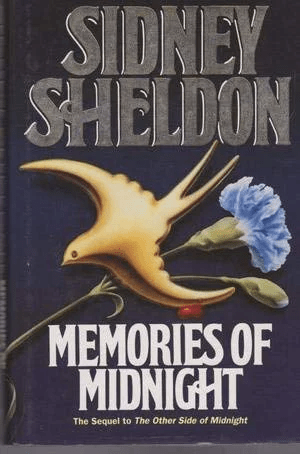
Review: Memories of Midnight

Memories of Midnight

Sidney Sheldon’s The Other Side of Midnight was his breakout mega-successful novel. It is also by far the worst he’s written in hindsight. So you can guess why I was less than enthusiastic about reading its sequel, Memories of Midnight. The least interesting book and setting getting an expansion?

Thankfully, I could see from the first few dozen pages that this was better. The Sidney Sheldon formula he developed after Midnight was obvious, and that’s not a bad thing. Young Constanin Demiris is more interesting as he heads to Saudi Arabia, and Sheldon’s research into both the mechanics of oil drills and the “desert queen” phenomenon where scarce western women become fifty times more attractive in such an environment is a lot better than “here’s Aristotle Onassis”.

Sadly, we had to return to Catherine The Dull, the “heroine” of the last book before she got amnesia (long story). Which leads to a pattern in this book: When it goes back to its wretched predecessor, it doesn’t often work (although shipping tycoon Demiris is far better an antagonist than the two in Midnight, or even the past version of himself). When it stretches its legs into the world of the pop epic Sheldon excelled at so much, it works. There’s even an eerily prophetic courtroom scene where a super-defense lawyer in a high profile case uses a physical prop (I won’t spoil it) in a way that reminded me of the later OJ Simpson trial to get his client acquitted.

This weird trend makes it below average by Sheldon’s standards. But below average is still better than “bottom of the barrel”. It’s far better than its direct predecessor and in isolation is perfectly readable, but I still wouldn’t recommend it as anyone’s first Sidney Sheldon book. Even an excellent conclusion that involves a million double crosses and Chekov’s Heating Boiler (seriously, it was foreshadowed in a way that made me smile) can’t totally redeem it. But it can make for a massive improvement….

Not that that’s saying much.

Review: Hell to Pay

Hell To Pay: Operation Downfall and the Invasion of Japan

With the atomic bombing in the news thanks to the Oppenheimer movie, I figured I’d had to take a look at D.M. Giangreco’s Hell to Pay, an analysis of what would likely happen if the dreaded invasion of Japan was likely launched. Spoiler alert: Hundreds of thousands of Americans and over ten million Japanese would have almost certainly been killed.

With clear and concise arguments that cite primary sources from both sides, Giangreco makes the case very convincingly. With their backs to the wall and years of experience and preparation, the Japanese would face a strung-out American fleet. This book certainly gives credibility to the statement that the atomic bomb was actually the most humane choice.

Those interested in WWII or alternate history should definitely read this book.

Review: Vortex (Catherine Coulter)

Vortex (Catherine Coulter)

This is the third book with the title of Vortex I’ve reviewed at Fuldapocalypse, after Jon Land’s and Larry Bond’s. It doesn’t exactly measure up to either of them. I got it in a grocery store, which was probably a bad omen because this is a perfect “grocery store thriller” mushy book. It’s not 51%, it’s 49%, which makes more of a difference than you might think.

About the only thing that makes this tale of a female agent stand out is an extremely bizarre narrative device at the beginning. She’s recovering in a hospital after a hairy field mission in Iran. Instead of actually describing the mission in a third-person narrative, the author instead has the character watching film footage of it and narrating what goes on in first person for the entire chapter. It’s strange.

But it’s the only strange part of a dull book.

A Thousand Words: Action PC Football

Action PC Football

From the same company as Action PC Baseball comes [American] Football. It’s a season simulator that can offer both historical and (my favorite) draft seasons. It has a similar minimal visual interface (that can be enhanced by the player if they add more stuff into the folders) and a similar statistical crunchiness. This later part makes it more interesting than Baseball.

See, in baseball, each plate appearance is basically its own thing. It’s a high variance sport where even having a great shortstop and centerfielder on the other team just makes getting hits a little less likely. But in football, if you have two excellent safeties, a good pass is a lot less likely. Both Action PC games simulate this well.

So Action PC Baseball is more a relaxing “see what happens” game. Action PC Football is a more cerebral and demanding game. They’re apples and oranges, but both are tasty.

Review: Aircraft Projects of the Commonwealth Aircraft Corporation

Aircraft Projects of the Commonwealth Aircraft Corporation

I’m a sucker for big historical reference books, so I got Aircraft Projects of the Commonwealth Aircraft Corporation, a detailed look at Australia’s aviation company from WWII to its buyout postwar. Everything from the semi-improvised military aircraft of the war to their license-built airplanes designed by other firms (ie Sabres and Mirages) to their ambitious designs is covered.

The last segment includes some pretty crazy things like a trainer/low-end ground attacker that’s swing-winged and an interceptor powered by four very small engines. The latter is a good example of how much the designs had to fit the parts rather than the other way around. This book is a well written, well-laid out treat and I highly recommend it.