Review: Star Eagles

Having loved Starmada, I eagerly embraced Star Eagles as a fighter equivalent. I wanted a small unit space fighter game that balanced customization with play-ability and am happy to note that it succeeded in sating that desire. Star Eagles is based on movement templates, activation dice, and special playing cards that a player can use.

It’s not perfect, but I’ve been able to do viable battles with a lot of ships adapted from a lot of different ideas, and that’s what matters. I recommend it to tabletop space battle enthusiasts.

Review: Xeelee Redemption

Xeelee Redemption

Stephen Baxter’s Xeelee Redemption is not one of his finest literary moments. What it offers in both theory and practice isn’t any better than his other, better books. And it’d have to be to make up for the huge retcon that ranks as one of my least favorite of all time. Not that the rest of the book is anything special, given that the plot consists entirely of worldbuilding opportunities.

Anyway, after the Baxterian infodumps and excuse plots, the reader finally gets the chance to view a semi-retconned[1] actual physical Xeelee. And it’s just a space bug. Not Exultant’s so totally beyond lesser comprehension beings that effectively are whatever piece of technology they put their Clarketech spirits into, but just a slightly unconventional space bug.

Disapoint.

[1]The term “retcon” is hard when time travelers in universe are constantly changing everything, but it is a distinction.

Review: Blood of the Ancients

Blood of the Ancients

Like Jerry Ahern, John Schettler decided to take the Kirov series into outright science fiction. Gone are the purely terrestrial squabbles, replaced with sci-fi spaceship battles against aliens and, in this case, an attempt at a John Carter of Mars Homage in Blood of the Ancients. Although much of the book takes place on Earth as the ancient “Sons of Ares” change the past in secret alternate history, this is obviously John Carter through and through.

The issue is that Schettler is not the most inherently suited to write this kind of flowery planetary romance. It would be like a fluffy romance author writing a technothriller. Despite this, it’s a sincere and well-appreciated effort. Who knows, maybe Kirov will turn to nonviolent romantic drama next…

Review: Resplendent

Resplendent

A collection of previously published short stories, Resplendent is Stephen Baxter at both his best and worst. It covers the Xeelee universe from start to finish, in every time and every era. The good news is that Baxter gets to show off his worldbuilding. The bad news is that Baxter gets… to…. show… off… his… exposition.

Besides the infodumps, one big problem is that what the main characters do has to be ‘relevant’ somehow. You can’t just have Bill the monopole gunner getting killed, he has to fire the shot which changes the tide somehow. This Great Man-ism is at odds with the weaving larger than life scope of the settings.

Also Baxter is terrible at naming characters and keeps reusing names. So yeah, this book is a mixed bag.

On Star Wars

Now I want to say that I’ve liked a lot of Star Wars stuff. I don’t mind the setting, I’ve seen 2/3s of the official movies. Like any big setting it has its ups and downs. But I definitely don’t hate this.

However, I feel obligated to say one thing about Star Wars that I believe. It is the most overrated work of modern fiction, and this overrating has made it impossible to judge. What you have is first a trio of fun sci-fi pulp movies that get treated as if they were more than fun sci-fi pulp movies, because they were a breath of fresh air in the pretentious dark tone of 1970s science fiction. Then you have a giant franchise.

Next you have the prequels, which are basically what happens when a Dunning-Krugered director gets free reign to run amuck. People nowadays are swinging towards defending the prequels in a dose of inevitable “defend midsize sedan cars the minute they stop being popular” hipsterism. Although I don’t blame them, because…

Then George Lucas cashed out and the Mouse Machine made the sequel trilogy. Now I had little desire to see them in full personally, and everything I saw and heard reinforced that desire. When I finally, recently looked at them in more depth, I was even gladder. At least the first six were works of genuine artistic imagination. These are just rehashed play it too safe mush piles that don’t understand the feel of their setting.

(Not so small side note: Devereaux’s excellent blog has the point in a review of fellow cash grab Rings of Power that authors are obsessed with winning battles via an unrealistic One Neat Trick. That plus “why didn’t they fly in on the eagles” ”’rationalism”’ leads to the infamous hyperspace ram.)

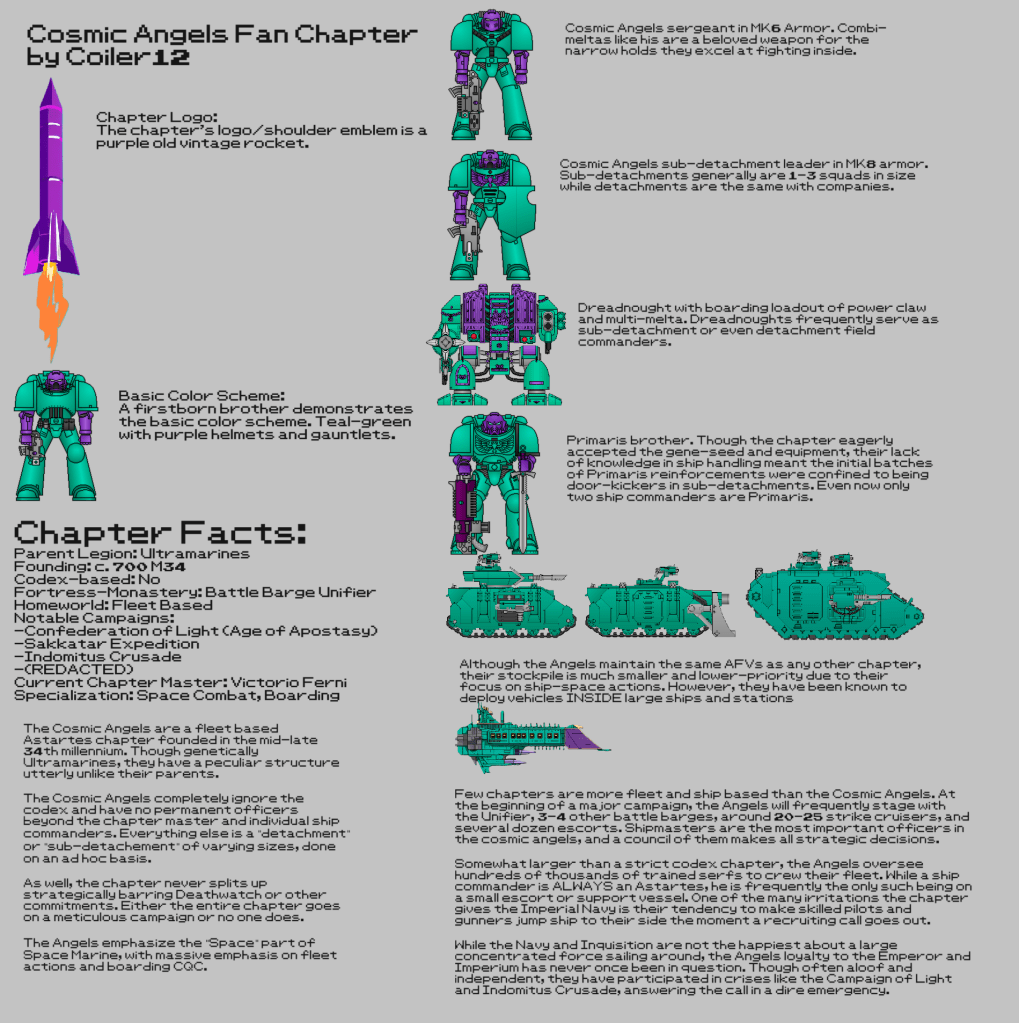
The Cosmic Angels

When it comes to Warhammer 40k, I do not have the highest opinion of or interest in the setting’s mascots. I’ve been an Imperial Guard fanatic (no not that kind) since day one of my interest in the setting, and this also applies to their spacefaring counterparts in their humongous flying cathedrals. However, I have made several fan Space Marine chapters (as every 40k fan is obligated to do), and the one with the most detail is the Cosmic Angels. With the aid of Stable Diffusion and some online “marine coloring tools” I made this infographic on them.

(And yes, it is definitely, totally a coincidence that my interest in Starmada and constant setting crossover battles coincides with me elevating an extreme fleet based chapter. Totally. A. Coincidence.)

Review: Vacuum Diagrams

Vacuum Diagrams

Stephen Baxter’s Vacuum Diagrams is a series of linked stories intended to tell the Xeelee from cradle to grave. I mentioned before that like Harry Turtledove, his writing style is a lot more suited for that. And like Turtledove, this is still uneven. There’s attempts at coherent arcs, including a later one where primitive humans have to escape their stone age prison the Xeelee built for them (it makes sense in context), but those really don’t work so well.

Others are basically just “here is a thing. Here is a description of a thing. Here is a character who exists as a camera to show you the thing.” Baxter has managed a sense of wonder and splendor a lot better. Here the scope is so big that it feels tiny. Going billions of light years to a megastructure/portal is done so often that it feels like running an errand (and I’m talking about the human characters, not the aliens).

Some of this has been retconned by later books, although “retcon” isn’t really the best word when time travel exists in universe. Either way, this is not one of Baxter’s biggest hits.

Review: Xeelee Vengeance

Xeelee: Vengeance

I wanted to like Stephen Baxter’s Xeelee: Vengeance, a tale of time travel, Clarketech, and the most alien aliens that ever aliened.

Unfortunately, this book has one problem. One central problem that is common to all extreme setting-first stories. One central problem that it does absolutely nothing to try and fix: Namely it’s mostly exposition about worldbuilding and speculative physics and whatever. So we get a ton of detail on this futuristic Earth (and Baxter’s other stories), the aliens (and Baxters other stories), every little quirk and thingy (and Baxter’s other stories) and even… Baxter’s other stories. The problem is that if you’ve read a decent amount of the other stories, none of the twists or mysteries work.

When we finally get to the showdown between protagonist Michael Poole and the time-warped Xeelee nightfighter, the book has already dragged on forever and even that drags on forever as well. It’s conceptually interesting but the execution is just terrible. Like “have a detour of padding to reference the John Carter of Mars books” terrible.

Thing is, as an eager worldbuilder myself, I can understand why Baxter did what he did. But as a reader it becomes hard to like it. You have to balance, and this was intentionally unbalanced.

Review: Starmada

Starmada 30th Anniversary Edition

I was looking for something to scratch my spaceship wargaming itch. A set of generalist rules that you could apply to basically any setting and have a semi-reasonable approximation of things. Enter Starmada. Now its newest 30th anniversary edition, it lets you build and battle on the tabletop whatever ships you can imagine.

Naturally as a generalist set it lacks specific gimmicks, with anything offensive having to be translated into weapon qualities (ie a big area blast would be “proximity”, and a powerful kinetic cannon shell would be “crushing”) and anything defensive being translated to either “screens” (roll above X or the attack fails) or “shields” (takes a hit before anything else). You get the idea.

It requires some imagination. But if you have imagination and a willingness to abstract, well let me just say that even my initial crude playtesting sessions had me beaming bright. Want to play as a cumbersome pure brute force fleet going against an agile but brittle rapier? This lets you do all that and then some.

A Thousand Words: Jodorowsky’s Dune

Jodorowsky’s Dune

In the early-mid 1970s, arthouse filmmaker Alejandro Jodorowsky ended up helming an “adaptation” of Dune. The quotes are deliberate as the movie and its tone would have been Starship Troopers/The Natural levels of intentionally different from the book. In 2013, the story of the most extravagant and absurd movie that never was was finally told in the titular documentary.

This is a great production. Everyone is clearly enjoying themselves as they talk about how the production got more and more crazy. Jodorowsky had his own son play a major role, and of course the son talks about it decades later. The art and effects brought together such figures as Jean “Moebius” Giraud, Dan O’Bannon, and H. R. Giger, the latter two of whom would make a monster movie that was a little successful. Yet the all-star cast was the craziest, featuring Orson Welles (paid in free food) as Baron Harkonnen, Salvador Dali, and Mick Jagger.

What makes the documentary shine is its soundtrack, with Kurt Stenzel’s minimalist electronic score being both a perfect accent and a great piece of music in its own right. (Although I’m biased because I like minimal electronic music, fair warning). The cinematography is also effective.

If I had to have one quibble, it’s that the documentary didn’t have the necessary devil’s advocate/reactor scram button to bring things down to earth. The movie is mentioned as being impossible, but in the sense it was too ambitious for Hollywood. In actuality, it would have been unreleasably bizzare, bound to burn money in its production, and simply strange. (There are scenes in at least some versions of Jodorowsky’s Dune that the documentary doesn’t mention, likely because they’re too weird and/or gross). If it actually got out the door, Jodorowsky’s Dune would probably just have been a bloated mess like Marlon Brando’s The Island of Dr. Moreau.

Still, this is a great documentary about a great story, even if it wouldn’t have been a great movie.