Review: Events

Events

The debut published work of Sea Lion Press author Charles E. P. Murphy, Events tells the story of alternate British prime ministers as they deal with the economy, other familiar problems, and, uh, alien invasions. The book is told in a deadpan pseudo-historical fashion, complete with footnotes that reference made-up history books. Anyone who knows internet alternate history will see the style being poked at instantly.

And this is the novella’s biggest issue: You need to be in an extremely small, insular community to really appreciate it. Otherwise, the obvious joke will just get repeated. “Oh, this prime minister dealt with an alien attack and then (insert mundane historical political problem here). And then this prime minister did (___)….” Even though it’s very short, the gag wears out its welcome by the third alien invasion.

But if you do know internet alternate history, the joke becomes better. A genre with a frequent rivet-counting “how many B-52s can dance on the head of a pin” obesssion and which cares absolutely nothing for conventional plot or characters gets skewered by Murphy treating made-up nonsense as if it was a meticulously researched order of battle for 1863/1942/1985.

Of course, the book also gets soured a bit by Poe’s Law (there is no parody of something that cannot be equaled in extremes by a sincere expression of the same). Since many internet alternate history timelines often portray events rivaling flying saucer wars in terms of divergence unironically, this can feel like just a handwaved in timeline that happens to be tongue in cheek. And (thankfully) without wikiboxes.

This is a first novel, so I can forgive its flaws. But it’s still made by and for those who follow a specific niche.

A Thousand Words: Scanners

Scanners

The 1981 David Cronenberg film Scanners, about people with psychic powers, is a perfect movie to review in October. It’s also an underappreciated movie. See, it has Cronenberg’s trademark twisted body horror done in a way that’s suspenseful and not overexaggerated. It also manages to be excellently paced and creepy.

However, most people only know Scanners for the scene where a man’s head explodes. While that is well-done, there’s so much more to the movie than that. It’s well worth a watch.

Review: The Hunger Games

The Hunger Games

Ok, so after I read Battle Royale, I knew I couldn’t just not read the other famous “teenagers in a death game” book. So despite not being in the demographic, despite having little interest in it when it first came out, and despite so much else, I read through Suzanne Collins’ The Hunger Games.

What’s interesting is that it’s flawed in the exact opposite way of Battle Royale. That was too broad, focusing on the adventures of countless doomed students away from the main characters. This is too narrow, focused entirely on a first-person narrative from protagonist Katniss.

Especially because, to be frank, she comes across as a dullard. The kind of person who’d be bland trailer trash in anything but the post-apocalyptic semi-sci fi setting she’s written in. I’ve long thought that first person is one of the hardest perspectives to write action novels in, and this did not exactly convince me otherwise.

I don’t want to be too hard on this, since I’m obviously not really the target audience. It’s written well for what it is, but it’s an orange read by someone who likes apples.

Review: The Last Great Death Stunt

The Last Great Death Stunt

Clark Howard’s The Last Great Death Stunt is perhaps the strangest and most bizarre book about a man deciding to jump off the Golden Gate Bridge imaginable. Written in the 1970s, it’s basically to Evel Knievel-style feats what the movie Rollerball was to football and other physical sports. It’s a future where the world is so peaceful that conventional sports with winners and losers are so boring and out of focus, they’ve gone under.

Instead, the public’s eye is on ever-crazier “Death Stunts”. However, there is a backlash against even this, and the book begins with the government planning to outlaw them. Before they do, legendary Death Stuntman Nick Bell aims to do one mega-stunt on the final day of legality-leap off the Golden Gate Bridge and survive! The book centers around him, rival Jerry Fallon, and the authorities trying to stop the stunt from taking place.

The execution is only adequate, with prose and plotting worthy of a 51% cheap thriller. There are sleazy secenes you’d expect from a 1970s mass market novel. There are a few too many padding infodumps in a short book.

But the concept, taken completely seriously, is so great that adequate execution still makes for an excellent, if weird book. But I like weird. So I loved The Last Great Death Stunt.

Review: The City, The Village

The City, The Village….

Libyan dictator Muammar Gaddafi fancied himself a writer and authored a collection of “short stories” that were translated and complied under various names. The stories (if one can call them that) are extremely bizarre, an example of the depths to which dictators can sink in terms of writing. First, there is “The City”, a tirade against urban cities where such horrible things as music and sports interest people, as compared to the glory of “The Village” (where people are nice and so on…)

The most famous story in the collection is “The Suicide Of The Astronaut”, where an astronaut returns from a bare moon to the earth, where he cannot find a job due to not having the right skills. After trying and failing to impress a farmer with his knowledge of outer space, the astronaut kills himself (SPOILER ALERT).

The “Escape To Hell” story is only interesting in that Gaddafi seems to foreshadow his own later fate (not exactly a surprising one) by bringing up the execution of Mussolini. Other than that, it’s rambling incomprehensible gibberish, as is “The Blessed Herb and the Cursed Tree” and the navel-gazy “Death”. There’s a pseudo-environmentalist screed in “The Earth”, and finally a reversion to talking about Abrahamic figures in “The Cursed Family of Jacob and the Blessed Caravan”.

This is, well, something… It’s just not a good something. But you probably expected that.

Review: PROMIS

PROMIS

Jack Murphy’s PROMIS series tells the story of wandering mercenary Sean Deckard as he makes his way around Cold War battlefields. A collection of short, action-packed novellas, it kind of reminded me of, well, Barry Sadler’s Casca of all things. Just replace the immortality curse with a super-prediction computer equation thingy in the background (the titular PROMIS system) and you have these books-kind of.

It’s like Casca in that it was created and written by a genuine special forces veteran, and like Casca in that it sets out a justification to plop the main character in action set pieces. The three published locations are Vietnam, Rhodesia, and South Africa. Not that it’s much worse than any other cheap thriller in practice, but I’d prefer a slightly less iffy location than both of those two. Even Central America would be better…

…Especially because, unlike Casca, there’s no real attempt at creating the surrounding scene outside of action sequences at all. While Casca had theme parks and parades of famous historical figures, this doesn’t even have that. Even by cheap thriller standards the characterization is really, really, really bare. The action is at least decent, even if it has the “try to have its cake and eat it too by trying to be both semi-grounded and spectacular” problem. But that’s not enough to raise the series to even a “51%” level.

Thankfully, I know that Murphy can do a lot better. Go read the far superior and awesomely titled Gray Matter Splatter instead of these.

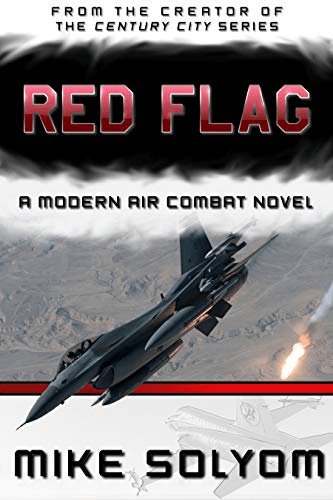
Review: Red Flag

Red Flag

I was intrigued by Mike Solyom’s Red Flag, a novel set around the titular air combat exercise. After reading it, I found it rather underwhelming. There’s actually more than one main plot. There’s the air combat exercise, there’s the backdrop of the author’s other books and ridiculous geopolitics with a de facto WWIII against a “Caliphate” armed with Cold War surplus stuff, and there’s a boilerplate science fiction UFO thriller.

The book isn’t bad at all. The author has genuine expertise, and it shows, even if sometimes it falls into the twin banes of Herman Melville Exposition and “Let me tell you how it really is, unlike on that TV” statements. What it does feel is dissonant. Because of the details and what’s supposed to be grounding, whenever there’s iffy geopolitics and/or weapons choices, it feels extra-off. And when there’s alien spider robots, it feels off even more.

I feel like truly weird, alien, Stephen Baxter-esque beasts would work better with a more grounded novel like it tries to be in air combat. I also feel like the aliens in this story would work fine in a more bombastic, Mack Maloney-type tale. But together they just don’t feel right.

Still, this is still a cheap thriller, and since when do cheap thrillers care about “dissonance”? As a cheap thriller, it may be a “mean 51%” book of varying degrees of quality instead of a “median 51%” book of consistent adequacy, but it still works.

Review: In The Balance

Worldwar: In The Balance

In 1994, Harry Turtledove decided to run with what can rationally and scientifically be called one of the most awesome fictional concepts ever: Aliens invade during World War II. The opening book, In The Balance, starts things off with a bang.

A group of lizard-aliens known only as “The Race” with juuust the right amount of technological balancing to make for a great story attack a humanity that’s stronger and more advanced than anticipated. While the issues Turtledove has with long series (pacing, repetition, etc…) appear even during this book, they’re not deal-breakers. And the weaknesses are more than made up for by the amazing first impression the book makes.

If you like alternate history, science fiction, World War II, or just strange concepts in general, this is worth checking out.

A Thousand Words: Camera Obscura

Camera Obscura

One of many indie platformers, Camera Obscura is the story of a photographer-woman trying to climb to the top of an ancient clockwork tower. The big gameplay gimmick is that you can take photos, and the “afterimages” will move for a bit before freezing. This creates temporary platforms.

A (mostly) slow-paced puzzle game, this is not an easy finish. The excellent (I’d recommend the game for the soundtrack alone) original music kind of fits with each area. The story, which is a combination of exposition about the tower builders and a really pretentious, almost stereotypical love story plot involving the photographer, doesn’t really do so. But it’s a small part.

As far as indie games go, you could do a lot worse. Did I mention the music is amazing?

Review: Act of Justice

Act of Justice

Former SEAL Dick Couch’s Act of Justice is a thriller with one of the most distinct premises I’ve read. If it can even be called a thriller, for most of the book amounts to one strange plotline. When I saw the tagline of “alternate history”, I was intrigued. Though this book really tiptoes on the line between alternate and “secret history”, where there are divergences that didn’t change the results of history as we know it. Taking place in the War on Terror, this book offers an alternate/secret story for how the government managed to find Osama bin Laden. It starts with a Herman Melville-level description of the Abbotabad raid, and then goes… places.

First, Couch uses this as an opportunity to plug his previous books, taking the super secret special hired “Intervention Force” and making them central. While I haven’t read any of them, their inclusion and the references were still kind of glaring and gave the impression of “look at my Mary Sues”. Second, the bulk of the book is, well… it could be called “They Saved bin Laden’s Kidneys” for accuracy. The plan involves using superscience listening devices implanted in a set of fresh kidneys, making bin Laden more useful alive than dead. Most of the effort is devoted to the ways the operation is set up and finally conducted.

It’s fanciful, especially because all the parts of the plan fall into their lap. Thus while different, that’s really all that it is. But it still has the qualities of a 51% book, and I’ll gladly take a Dark Rose-style 51% book with a weird premise over a 51% book without one.