A short story centered around one of the most realistic and sensible Warhammer Astartes chapters, The Shot That Kills You is about the Raptors. As it’s short and explody, one shouldn’t expect it to be anything except short and explody. Which it succeeds massively at.
It’s good enough to wash away the internet cruft surrounding the Raptors, who are the poster child for what I like to call the “Gothic-style Halo” ‘fans’ of Warhammer 40k, where the setting is tried to be made respectable and its exaggerated elements downplayed in a manner that annoys me. Thankfully it’s not the case here-an Astartes seemingly flees and lures the overconfident xenos into a trap, not uplinking to his servo-skull drone and calling down a Whirlwind missile strike that obliterates the melee duelists.
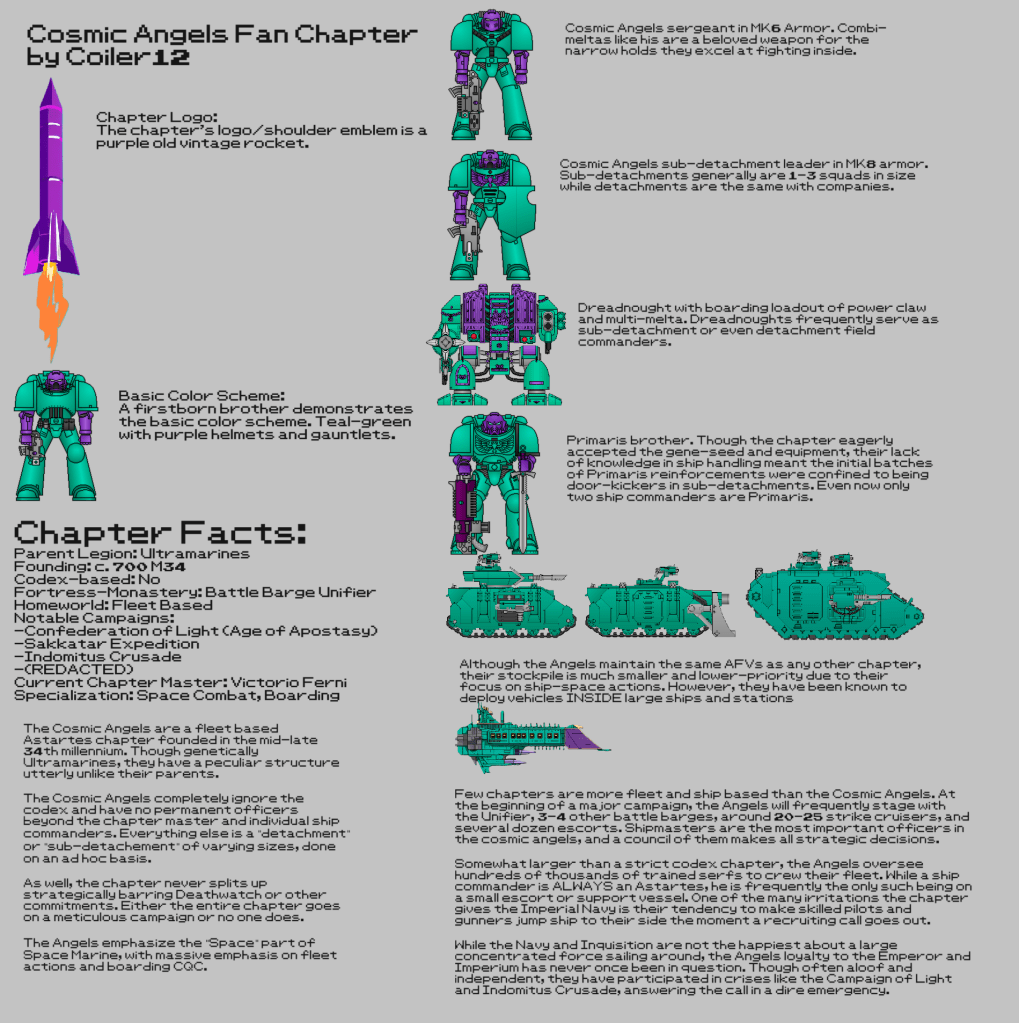
When it comes to Warhammer 40k, I do not have the highest opinion of or interest in the setting’s mascots. I’ve been an Imperial Guard fanatic (no not that kind) since day one of my interest in the setting, and this also applies to their spacefaring counterparts in their humongous flying cathedrals. However, I have made several fan Space Marine chapters (as every 40k fan is obligated to do), and the one with the most detail is the Cosmic Angels. With the aid of Stable Diffusion and some online “marine coloring tools” I made this infographic on them.
(And yes, it is definitely, totally a coincidence that my interest in Starmada and constant setting crossover battles coincides with me elevating an extreme fleet based chapter. Totally. A. Coincidence.)
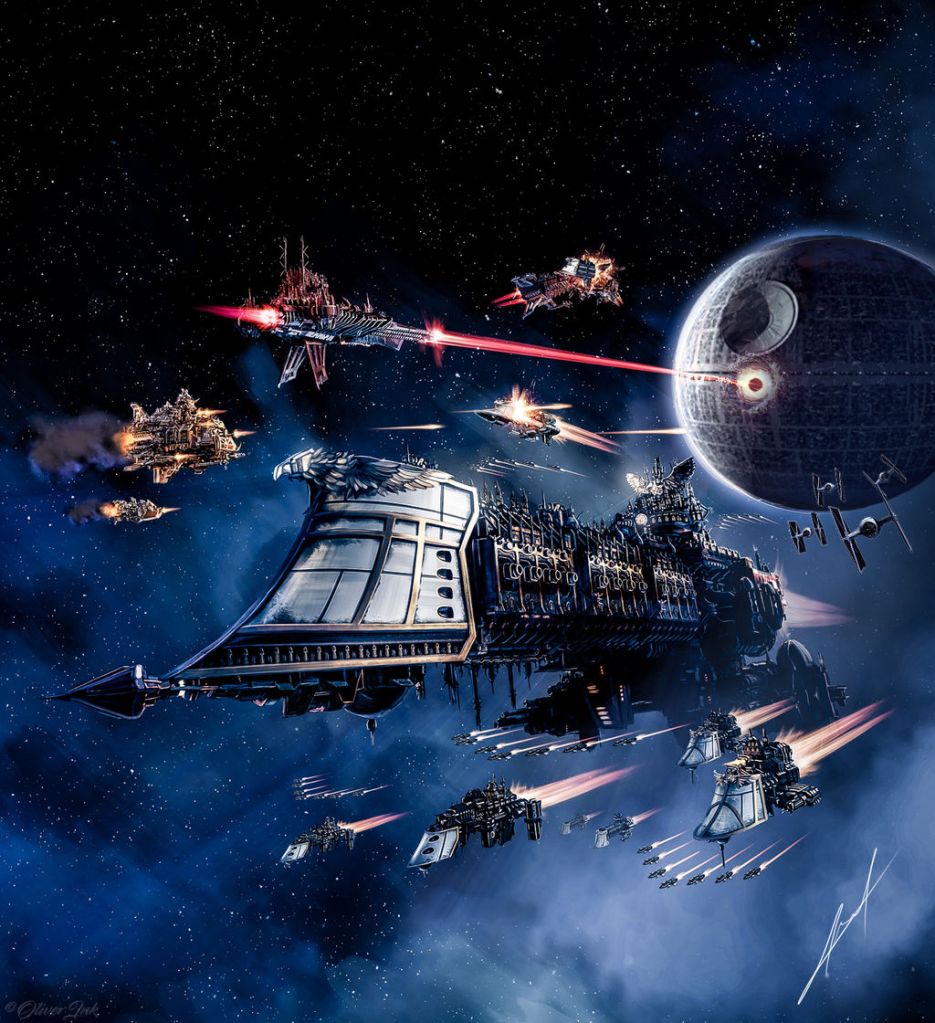
A Star Wars/Warhammer 40k crossover has to include the battles of evil vs. slightly more justified evil and feature a large Imperial Navy cathedral armada going up against the Death Star (presumably with its own array of Star Destroyers). Now I have put some actual thought into this.
The Imperium is not likely to be terribly fazed by the Death Star, thanks to confrontations with giant horrific superweapons being known as “Wednesday” over there.
If they cannot overpower it via masses of lances, nova cannons, and whatever other exotic tricks they’d undoubtedly pull out (ie psychic lashes, vortex torpedoes to just shunt it into the warp, etc…), for the main Imperial Navy it would be difficult to duplicate what the Rebel Alliance did. The reason simply is because Warhammer 40k space fighters are substantially larger than their Star Wars counterparts, and their ordnance is the same.
However, moving in for a pinpoint strike on a difficult but decisive target is the exact thing that Astartes were made for. So trench runs of Thunderhawks, vacuum chainsword fights, and tossing a melta bomb down the port would make for a fitting story.
Deciding to look back at the Warhammer 40k tabletop RPGs whose mechanics ended up adapted to Rogue Trader, the choice of Imperial Guard RPG Only War was not exactly a hard decision. Since that army has been my absolute favorite faction by a parsec from the moment I found out about the franchise, I was eager to see how playing them in a character game as opposed to a wargame worked out.
You can practically see the writers trying desperately to make the experience both true to the Guard’s limitations and playable/fun. I trust I don’t need to go into that much detail that an individual guardsman, even an elite one, is at or near the absolute bottom of the galactic food chain. There’s also the reason why Twilight 2000 was set in a scramble rather than in a war-their life is a very regimented existence with little chance for straying beyond orders.
Thankfully, the solutions are fun and interesting. Characters are part of a beginning chosen/created regiment that has set base gear and characteristics. NPC “comrades” are present to act as additional laser sponges-I mean, partners in war. More can be achieved, but only at the cost of chancing the logistics system (as unreliable and risky as it sounds). The regimental system itself allows for everyone from Tempestus Scion commandos to primitive worlders with swords and animal hides.
So yes, I recommend Only War to anyone who wants to be real serious and face the grim darkness of the far future without the need for power armor or super-enhancements.
William W. Johnstone said that of all his many, many writings, The Last of the Dog Team was his proudest work. This is yet more proof that his ability to judge what made a “good” book was lacking. As if the dozens and dozens of terrible slop on paper wasn’t enough evidence.
Anyway, The Last of the Dog Team is about Terry Kovak, a poor boy turned supercommando. Or rather, it’s mostly about his, uh, “love life”. See, he has the magic power of making women want him desperately. If he really was a secret agent, he’d be perfect for Romeo Gambits. The plot, such as it is, is of a violent lunatic (ie, Kovak) killing people in his hometown, in Southeast Asia, and in Africa before returning to a reluctant retirement and then dying of natural causes.
The prose is bad and erratic even by Johnstone’s standards, veering between Exclamation Points!, long syrupy purple prose, and lines like “He felt drained-which he was. He felt sick”. And yet the key factor is its pretentiousness. It’s clear that Johnstone wanted to write some sweeping epic saga of a man’s life yet had simply no idea how to do so without throwing in another sex or killing scene. This sort of overreach (much of the Ashes series is a redneck convinced he’s Larry Bond) is something WWJ had and many other bottom-feeder thrillers (including the later “William W. Johnstone’s” did not.
Since this was an early book of his, I could forgive Johnstone if he got better. He didn’t.
Since I’ve just gotten (and am enjoying) the new Warhammer 40k Rogue Trader game, I figured I’d review a book (series) from that setting. An old set of Space Marine novels, the Soul Drinkers Omnibus covers the titular chapter. Is it good? Uh… not really.
The biggest problem is the characterization. It’s not that they’re one-dimensional bolter shooters. No, it’s that they’re worse. Namely, that these ancient super-warriors come across as ridiculously dumb and naive for people in their position. The plot involving the Soul Drinkers and their fall from grace involves a lot of contrivances and bad judgement to the point where I frankly felt they deserved to get wiped out.
There’s better 40k books around, so I don’t recommend these.
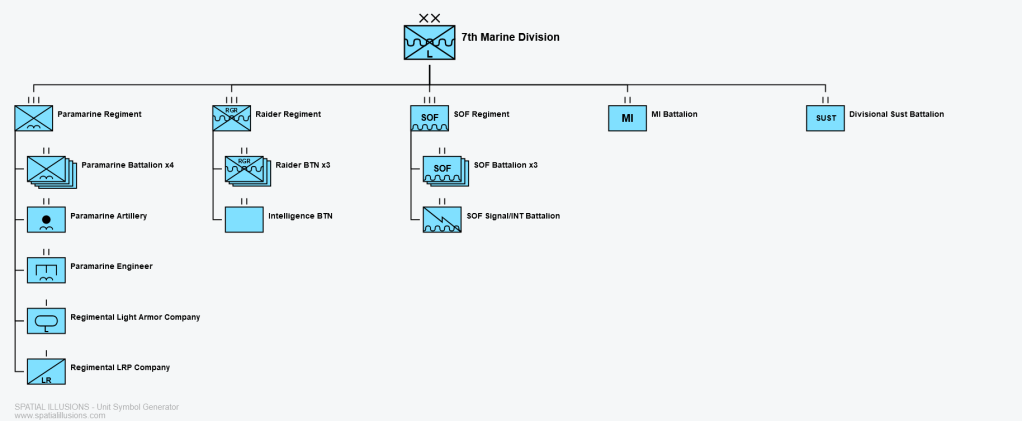
I talked about my fictional 7th Marine Division before. Now I have a more detailed personal organization (though still undoubtedly rough and with inaccuracies). Here it goes. ORBAT chart courtesy of the Spatial Illusion Unit Symbol Generator.
Paramarine Regiment
The Paramarine Regiment is like many other light airborne units, with the exception that it has four battalions instead of the usual three and its artillery battalion has thus been increased to four cannon batteries likewise, along with the other regimental support units similarly beefed up. This is to allow each battalion to serve as an independent combined arms unit to hold ground if necessary (ie around a battery in a fire support base with a battalion of infantry and an LRP platoon and light AFV platoon).
The actual battalions are largely standard triangular airborne infantry battalions.
Raider Regiment
A lighter force with less organic capability, the raider regiment is simple, with three battalions, each of three raider companies and a heavy weapons company. A regimental intelligence battalion is included because of the importance of intelligence and planning to their missions. It’s meant as a direct action-slanted commando force ie the classic Rangers.
SOF Regiment
The SOF regiment has three SOF battalions, below which any formal organization would be varied and inexact by nature (each has a number of teams, varied as you’d think, but around 10-15 each). Its communications/intelligence battalion is there similar to the ranger regiment.
Divisional Assets
Divisional assets are just more support and administrative elements, there because the 7th is not intended to be a “field” organization.
Logos
Some Stable Diffusion concepts for the logo of either the division itself or one of its subunits. You’ll notice a theme of black birds. Yes, I know crows are already the mascot animal for electronic warfare units, but oh well.
Usage
It goes without saying that in All Union, the 7th Marine Division was formed and saw action, including the 2002-2009 conflict in Western Sahara that marked the largest and bloodiest war the US military fought in that TL. If I ever need a fictional American commando force in my writing, I can always use it.
Michael Knights’ 25 Days to Aden is one of the best nonfiction military histories I’ve read recently. As of this post it’s also very timely. Diving deep into the crucial but obscure in the outside world battle for the city of Aden in the early stages of the latest Yemeni civil war, it tells of how a coalition of the UAE, putting its petrodollars to effective use, and local Yemenis ousted the Houthis from the vital port city.
The biggest problem with this book is very obvious from the first page. Knights clearly relied completely on UAE sources, and thus the book is about as biased towards them as Arrian was towards Alexander. It’s not so much the exact facts (Kenneth Pollack, no fan of the Arab militaries, has praised the smaller, well-resourced Emirati army as a big exception), so much the tone that, along with the usual issues in war reporting, leaves one feeling inherently suspicious.
However, this insiders look also has great advantages. It shows a skillful campaign conducted with limited resources and the quirks and compromises that had to be made when dealing with a low-education local army. The two things that accurately jumped out at me were A: It was calculated that 20% of all ammunition would be wasted with random ‘celebratory’ gunfire, and B: Chewing khat was so vital and important that one simply did not fight battles in Yemen during chew time. It also shows that tanks still are very important even in an age of drones and smart weapons, but that kind of goes without saying.
Finally and most importantly, Knights is unbiased in a crucial way in that he has no illusions about treating the temporary victory as more than what it was. The political context of Yemen in its entire history can be summed up by me saying “latest civil war”, and Knights mentions the effectively unsolvable political context.
So keeping its biases and flaws in mind, this is a highly recommended read.
Back to my “hypothetical nuclear terrorism” reading, and some of the analyses have given me this impression.
So there are some ifs beyond the norm that actually make it more likely. Besides the usual “if you have the resources and personnel for the job”, there’s two things that make the job of the would-be nuclear terrorist easier and their opponents harder.
Being willing to take the hit of large and likely fatal amounts of radiation during transportation and construction. This is pretty self-explanatory, especially when using comparably “fresh” (and thus high radiation) spent power reactor fuel as an input.
Being willing to detonate the bomb in a target area closer to the assembly site, even if it’s less damaging and/or prestigious.
However, this narrows the personnel pool even more. It may be a slight narrowing, but it’s still a narrowing. It’s also worth noting that the first point makes a “factory accident” a lot more likely, perhaps countering the advantage of fanaticism.





 Fuldapocalypse Fiction