Review: Grant’s War

Grant’s War

Eric Meyer is one of those authors who just writes a ton and ton of ultra-cheap thrillers. I’ll even admit that I had to check to see if he was a real person and not just an obvious pen name shared by multiple actual writers (the answer is “yes, he is a real person as far as I can tell”, by the way). This is the kind of book I’m dealing with when I read Grant’s War.

The premise is simple. It’s a war novel where protagonist Jack Grant, after being (mostly) falsely convicted, faces the stereotypical “army or jail” choice. He chooses the army just in time for 9/11 and the war in Afghanistan. And he gets there just in time for a scene where he grabs a red-hot AK by the barrel and throws it aside before dispatching its wielder in a fistfight. So, in other words a lot more Jon Land than Jon Le Carre.

While this book is not exactly one that contains deep characterization or excellent literary fundamentals, it’s nonetheless good by the standards of the assembly-line slop that makes up its genre. And that alone is enough for me to recommend it.

Review: Vortex (Catherine Coulter)

Vortex (Catherine Coulter)

This is the third book with the title of Vortex I’ve reviewed at Fuldapocalypse, after Jon Land’s and Larry Bond’s. It doesn’t exactly measure up to either of them. I got it in a grocery store, which was probably a bad omen because this is a perfect “grocery store thriller” mushy book. It’s not 51%, it’s 49%, which makes more of a difference than you might think.

About the only thing that makes this tale of a female agent stand out is an extremely bizarre narrative device at the beginning. She’s recovering in a hospital after a hairy field mission in Iran. Instead of actually describing the mission in a third-person narrative, the author instead has the character watching film footage of it and narrating what goes on in first person for the entire chapter. It’s strange.

But it’s the only strange part of a dull book.

Review: North Korea’s Hidden Assets

North Korea’s Hidden Assets

H. John Poole returns to Fuldapocalypse with North Korea’s Hidden Assets, a warning about how North Korea may be stronger than anticipated. Or rather, that’s a central message in a meandering book. The content here ranges from loooong descriptions of Iwo Jima fortifications (because as a country occupied by Japan, they were undeniably influenced by its doctrine. Legit link, but not worth the obsession he shows) to constant tirades against the clunky, idiotic American doctrine and how the North Koreans have so much better military culture and small unit tactics.

Some of the book’s arguments are good. Poole spends a lot of time legitimately arguing against mirror-imaging a Second Korean War as being a repeat of the mechanized charge to take the entire peninsula that was the first. He argues and reasonably so that the north would be more likely to bite, hold, and wear the Americans and southerners down to win at the peace table. And the fortifications and tactics from the first Korean War are at least more relevant. So are the surprisingly few times he looks at contemporary North Korea (the nominal point of the whole thing)

But this book is mostly axe-grinding. It’s also hypocritical in that Poole portrays it as some kind of secret hidden source when almost all of its analysis comes from official US government documents-showing at least someone else already there knows of a worst-case perspective on North Korea. There are much better serious studies of that opponent out there.

Review: The ISIS Solution

Released at the height of the 2010s anti-ISIS campaign, The ISIS Solution is a short book by several SOFRep authors, which include such familiar names as Jack Murphy and Peter Nealen. It offers critique and recommendations, and since I knew their books well, I wondered how their nonfiction commentary would go. As commentators, they’re pretty good novelists.

As the saga of “Mean” Joe Greene’s transformation from the best defensive lineman to the worst football commentator ever attests, being good in one field doesn’t translate to being successful in another. Granted, some of this is due to the book being short and aimed at a much broader audience than actual security analysts. But more of it is due to a phenomenon I’ve seen sadly too often.

I call this Fire Joe Morgan-ism (not surprisingly, Morgan was another athlete who went from brilliant player to dubious commentator). There a group of spicy screenwriters (seriously) who dabbled in baseball analytics took pride in dogpiling on all the old crusty baseball hacks who didn’t know any stat beyond batting average. It basically amounts to going ahead of the absolute worst baseline (sportswriters in that case, network talking heads in this one) by showing that you do have genuine knowledge of it (military operations/baseball stats), and then doing a little dance and a victory lap because you’ve overcome such an easy target.

Granted, this probably wasn’t as surprising as I’d thought. Murphy’s books ranged from “blatantly political even when good” to “unironic Metal Gear Solid plotline”, while Nealen’s commentary attempts in Maelstrom Rising sank it a lot compared to the far more apolitical Blackhearts series. But it’s still disappointing, and there are a lot better sources out there.

Seleucian Special Forces APC

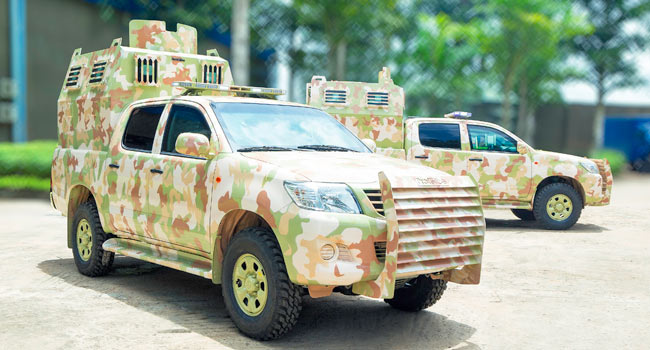
Stable Diffusion gave me a chance to make something I’ve long imagined: A truck-APC belonging to a Seleucian (one of my OPFOR countries) Motorized Special Forces unit. First, the picture itself.

There are many existing heavy-duty pickup conversions like this: An armored pickup with the bed replaced by a capsule that’s even more fortified.

(You get the idea)

Now for their organization: Seleucia’s large “Special Forces” components are motorized to varying degrees. The quotation marks are because few of them are what NATO would consider “special forces”, with many being simply conventional troops with better training and motivation than the other ragged masses of that country’s huge army. Still, Seleucian motorized SF have shown their capability.

A Seleucian motorized SOF battalion is similar to a light infantry one, only with armored personnel carriers. As the mere “transport” capacity is prioritized, motorized SOF often ride in older and/or cheaper vehicles-like armored pickup trucks. APCs frequently hide after dropping off their dismounts. A common defensive tactic for Seleucian commandos is to drive close to an ambush site, conduct the ambush on foot, then scramble back to their carrier and move to another one later on.

However, it is not uncommon for Seleucian motorized SOF to accompany heavy units of tanks and SPGs in conventional operations. Here they fight similarly to Stryker/BTR style infantry in faster wheeled APCs of other countries. In conventional defensive operations, motorized SOF have a somewhat unusual role as mobile antitank detachments. Thanks to their skill, mobility, and flexible organization, SOF battalions with large amounts of of anti-armor weapons can be used similarly to the tank destroyers of other nations.

The Saxon and BTR-152 are examples of the basic style of APCs frequently found in Seleucian motor SOF units. Tracked vehicles, mostly basic ones like M113s and MTLBs, are rarer but not unheard of, especially where the terrain suits them.

Review: The Cold Hand of Death

The Cold Hand of Death

Brent Towns’ latest Team Reaper thriller as of this post is The Cold Hand of Death. It can basically be described as the technothriller equivalent of gulping down an energy drink in a distorted physics chamber where time moves faster. It’s like the book never goes more than two pages without a shot being fired or something blowing up. There’s the usual world-in-crisis technothriller plot, but even this is warped up to ludicrous speed.

I’ve mentioned the previous installments as being fast-paced, but this takes them to a totally different level. It’s like comparing a fast propeller plane to an SR-71.

It just feels excessive. The writing is not bad. It aces the action scenes, and that’s what a thriller needs to get right. But the best action writers of all time would struggle to keep any book interesting if it had as many battles as this one. This is like a deep fried gummy candy. It’s not inedible, but it’s just not the sort of thing you’d want to eat/read lots of.

Review: Invisible Armies

Invisible Armies

Author, historian, and (sadly) political commentator Max Boot takes the reader through thousands of years in Invisible Armies, his chronicle of irregular and asymmetric war throughout history. Let’s just say that I’m no fan of either his past or current viewpoints on contemporary politics and leave it at that. Not just because I don’t want to get political here, but because it’s basically irrelevant to the actual book. (Which is a huge point in its favor, I might add.)

Said book is a masterwork of popular history. It has the weaknesses of its format in that by design it can’t go into too much detail, and no doubt there are some inaccuracies that I couldn’t tell but which someone more invested in the subject matter could. But it also has the strengths of it in that the facts are presented in an extremely engaging way.

There’s one central point made throughout the book, which is that contrary to both recent high-profile examples with small sample sizes and “fourth-generation war” thunderers, the default outcome for an insurgency is loss. Most of the time, it either fails completely or can’t progress past its initial strongholds. There’s also the less novel reminder of almost all successful ones having the support of an outside state.

As something that both explains and demystifies unconventional war, I highly recommend this book.

Review: Wet Work

Wet Work

Mark Hewitt’s Hunter series continues its crazy in Wet Work, the fifth installment. It gets harder to review a later book in a long series unless the quality changes massively in either direction. This is not the case here. Like most of its predecessors, it’s a sprawling technothriller with a ridiculous main character who makes John Rourke look like an everyman in comparison.

Thankfully, one thing about this book is different and better. The final action set piece is actually tense and well written. But even that can’t break it out of the pack of “I love reading them, but don’t really recommend them for other people” that the first four established.

SOF Infiltration Techniques

I’ve decided to kick off the new year on Fuldapocalypse with my current “I justify it by claiming it’s for book research, but really it’s mostly for its own fun sake” obsession. This is the way special forces teams are infiltrated (moved in to their target, almost always with the intention of stealth).

Granted, there are elite teams moving about in All Union (without spoiling any specific element), and the Soviet-Romanian War saw the biggest deployment of special forces in modern history. But it’s still a fascinating topic. So in rough order from least to most complicated…

  • On Foot. This is the most basic type, with very obvious limitations. In this case the borders are already packed with conventional troops (including recon ones), so very few to no SPF teams would go in that way.
  • Helicopter/VTOL. This needs little explanation. Both its strengths and weaknesses are pretty obvious to those with basic military knowledge.
  • Boat. This also doesn’t need much explanation. In this specific case, it’s hindered by Romania having only a small amount of coastline suitable for amphibious landings. One 1970 CIA analysis put it at only nine miles (page 10), but this admittedly would be far less a problem for small SOF craft as opposed to large landers.
  • Ground Vehicle. AKA the Desert Rats. This gives the force a lot more mobility once in the target area, but it also makes it more noticeable and adds to their logistical areas. And especially for the more prosaic role of most spetsnaz, this also overlaps to a large extent with the horde of BRDMs and long-range patrols in “conventional” units.
  • Static Line Parachute. This is less precise than helicopters but can take advantage of (often) longer range or higher-performing aircraft. The type of aircraft also differs-I have a soft spot for planes like the An-2 and C-145 Skytrucks that are small for mass paradrops but quite able to release small teams.
  • Infiltration in Peacetime. This uses secret agents and other “peaceful” means to help bring the SPF in before the fighting starts. The problem is that you need a good network of secret agents to succeed this way.

These are the mundane, usual, “boring” techniques. Now for the “interesting” ones.

  • Free fall parachute jumps. Requiring more skill and risk, this is further divided into the “easier” HALO (High Altitude, Low Opening) and “harder” (High Altitude High Opening) jumps. The former is mostly intended for unconventional war to keep the drop plane hidden (in a visual and sound sense) and less vulnerable, while the latter is an extreme jump that involves the parachutists gliding a considerable distance.
  • Ultralight aircraft and paramotors. Mentioned in both the GENFORCE-Mobile and TC 7-100.2 manuals for special forces insertion, these seemingly silly devices have been considered a serious way of moving in. The performance of motorized paragliders and ultralight planes varies, but can be “increased” if only a one way trip in is needed.
  • Wingsuits. The most exotic yet, these are mentioned in TC 7-100.2 and the various Worldwide Equipment Guides. Still conceptual as of this writing and the absolute hardest to use, these squirrel-gliders are nonetheless, well, awesome. Especially the powered ones.

It’s important to note that the majority of historical spetsnaz from the 1950s to 1991 were still two-year draftees. The best and most motivated two-year draftees, but still two-year draftees. Infiltrators in the second category in a Soviet-style military would have to be officers or professional volunteers with longer-term contracts to get the time to master such exotic techniques.

A massive number of Soviet, Bulgarian, and Afghan special purpose forces participated in the invasion of Romania. The very first substantial Soviet casualties in the war came when a Romanian MiG-23 shot down a transport carrying SPF for a parachute insertion, killing all eighteen people on board. While those three nations are well known, there have also been rumors of other SPF as well as western mercenaries disguised as employees for humanitarian NGOs.