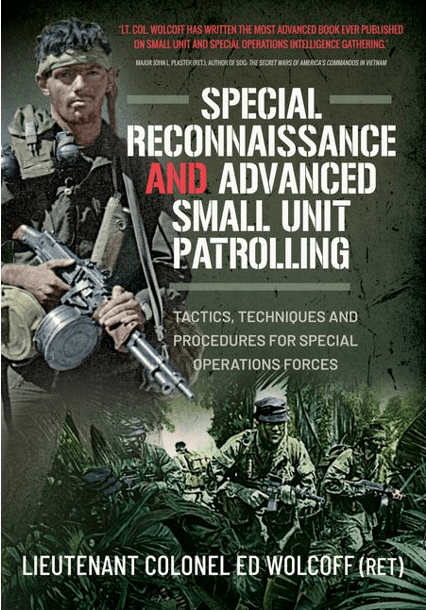
Review: Special Reconnaissance and Advanced Small Unit Patrolling

Special Forces (specifically MACV-SOG) veteran Edward Wolcoff has created a masterpiece in Special Reconnaissance and Advanced Small Unit Patrolling. Despite the long and clunky title, the book itself is very accessible. The goal was to create a list of tactics, techniques, and procedures determined by both theory and practice. It was also to present them in a way that was easily accessible and not written in field manualese (indeed, taking issue with official doctrine is stated in the introduction as a big motivation for the entire book). Wolcoff succeeds admirably in both parts.

This is not just for people who actually do light infantry patrols. Even armchair writers like me will find it very useful for both research and curiosity. Few stones are left unturned. This aims to be comprehensive and it succeeds. It does arguably focus a little too much on the past, but given the author’s Vietnam service, this is quite understandable. While “tone” isn’t the most relevant for a book like this, I enjoy how this comes across as being critical of official doctrine and often greatly so, but not in a bitter or axe-grinding way (Wolcoff has said that he submitted this book to a security review and cooperated with the Pentagon in its publication, FWIW).

What I particularly like is how Wolcoff makes it very clear that failure is as big a teacher (if not more) as success. Survivorship bias can skew things massively, so it’s important to look at what didn’t work as well as what did. This is a great resource for well, anyone, and well worth a purchase.

Review: Spetsnaz The Inside Story

Spetsnaz: The Inside Story

There are few Cold War authors who I have less respect for than defector Viktor Suvorov (pen name), nor are there more who’ve influenced the thought and discourse around Fuldapocalypses in a such a negative way. Since Suvorov was one of the biggest popularizers of the mega-super Spetsnaz , I felt that his Spetsnaz: The Inside Story would be an excellent first book to review.

Now defectors, confidential informants, and the like are generally not the best or most reliable people. Some may be and have been deliberate double agent sneaks to muddle the waters. But more have had mundane issues. Issues like exaggerating their own importance and telling their new handlers what they want to hear. There’s a reason why American military officers in the cold war considered intelligence defectors not noble dissidents but unreliable weasels while having far more respect for enemy field commanders who stayed loyal until December 1991. Suvorov fits this negative stereotype to a T (and I’m not the only one to say this).

The story begins with a description of shovels. Yes, military entrenching tools are important for digging in, other utilities, and make for a good enough melee weapon. Then Suvorov dives deep and talks about how spetsnaz train with their shovels as weapons and that it involves putting one alone with only a shovel against a crazed dog. Woof.

So yeah. If Suvorov says that a bicycle has two wheels, walk around and count them. There’s accurate points here and there, but remember what they say about a broken clock (or that he just grabbed it from an accessible source that others would soon do with less embellishment, or took information that wasn’t that controversial). Suvorov also introduces the “Icebreaker Theory” where he states that Stalin was going to invade west and Germany simply preempted him. (You know who else said that?). The Icebreaker Theory, which he would later expand into a full book, goes from “questionable” to outright uncomfortable in my eyes given how it echoes the Germans own justifications for Barbarossa.

Then there are the psychologically iffy parts. Perhaps the least credible sentence in the book is “In the spetsnaz soldier’s opinion the most dangerous thing he can do is put faith in his comrade, who may at the most critical moment turn out to be a beast.” It’s not like successful war has always relied about trusting one’s colleagues in crisis, and that demanding special operations would demand more of that. I can believe them to be ultra-cynical, cold, and hard-edged (to say nothing of having grown up in an autocratic society), but Suvorov generalizes every single one of them to be those mixed with (in another dubious quote) “A spetsnaz soldier knows that he is invincible.” This strikes me as playing to the crowd, because it’s what an armchair observer with little knowledge of actual battle dynamics would think the ultimate warrior mindset would be like. Even some of the accurate statements come across as being aimed too low: For instance, his (correct) emphasis that a safehouse keeper/secret agent should be someone who blends in and doesn’t have any profile to attract attention is accompanied by a swipe at the likes of James Bond, with Suvorov apparently figuring that most of his audience gets their knowledge of spycraft from that.

Even leaving plausibility issues aside, Suvorov’s writing is rambling, pretentious, and sensationalist to the extreme. This is not aimed at people who would actually have to make a serious plan about dealing with the serious, legitimate threat of opposing special forces. This is giving a general audience the treasured “inside peek” that Bill James recognized and criticized. It’s the Cold War equivalent of someone from the Pakistani intelligence services talking about Osama bin Laden’s giant mountain fortress and his army of countless infiltrators throughout the world in the early 2000s.

The biggest problem is that there’s now basically no point to read this for solid information. In an age where you have western analysis done with much greater access and info (ie, Heavy OPFOR/GENFORCE-Mobile) and translated real primary sources (ie, Voroshilov Lectures), including those on the spetsnaz themselves, having a dated “I WAS THERE” “expose” like this is basically worthless as a practical source. One of my biggest pet peeves is that Suvorov has been cited far too often by Cold War wargamers despite better sources having long been available now.

What it does show is the tone of the times, and of the kind of sensationalist book that appears to stoke every zeitgeist. In this sense, it (and Suvorov’s other books) are surprisingly close to the stereotypical true crime paranoia book. Except with spetsnaz instead of serial killers or whoever.

Review: No Need to Know

No Need to Know

The third in Hewitt’s Hunter series, No Need to Know is every bit as out-there as the first two (if not more). Once again, I’m in the somewhat unusual position of not recommending them for other people while having a blast reading them myself. The conspiracies don’t stop in this book, and neither do the set-pieces.

In fact, this is actually better paced if anything than the second and especially the first book. While it’s still overly long, it feels like it flows better and doesn’t have that many outright dull moments. Ok, except those involving the details of operation the YO-3 airplane, which is obsessed over throughout the series.)

That sounds like faint praise. And the inherent flaws of the first two are still there. But still it’s nice to see an author’s craft get genuinely better.

Review: Shoot Down

Shoot Down

The second of Mark Hewitt’s Hunter thrillers, Shoot Down is somewhat different from the first in terms of setup. Almost the entire W.E.B. Griffin style pop epic is gone in favor of just a then-contemporary cheap thriller. Unfortunately, this just means we get a thriller twice as long as it should be. And with all the issues and then some.

And yet, I have not just finished this book with its “shoot the terrorist” plot, I’ve even moved on to the third installment. Because this is flawed in an interesting way, and I want to see how uh, “interesting” it becomes. But I still don’t recommend this series for “normal” readers.

Review: Advance To Contact 1980 (Ronsone/Aaronson)

Advance To Contact 1980

The time has come to finally return to the starting theme of this blog. A 1980s World War III book is being reviewed here, Advance to Contact by James Ronsone and Alex Aaronson. This is a very Larry Bond-esque book taking place at an unusual time (beginning of the decade, or as I like to call it NATO Hard Mode) and in unusual places like Iran and Central America. Operation Eagle Claw succeeds-and things spiral from there.

Of course, I have an obligatory rivet-counting nitpick. Eagle Claw was more or less completely unworkable and it was probably for the best that it failed as early as it did. Reaching the city itself would just lead to massive collateral damage and the deaths of the hostages. Eagle Claw succeeding is like Operation Sea Lion succeeding in terms of plausibility.

But for the sake of the story, I’ll gladly it slide. Different theaters certainly beats Germany and the North Atlantic. Especially when the geography leads to different types of battles than giant mechanized blasts in the Fulda Gap.

As far as literary quality, this is a little rough but very forgivable. While at times it gets clunky, this is an extremely hard genre to write well. It certainly did not stop me from enjoying this book, and I look forward to the next installment.

Review: Special Access

Special Access

The first in the Duncan Hunter series of aviation thrillers is Special Access. This book is very right-wing and very bad. It’s not terrible because it’s right wing, if that was the case 4/5ths of Fuldapocalypse review subjects if not more would be bad. There’s only a little overlap between “slant” and “reason why I didn’t like it”, but even that little is more than most trash fiction.

Special Access starts off being obviously inspired by W.E.B. Griffin. In fact, it apes his structure so much that despite only reading one unconventional Griffin novel in full, I still saw the resemblance immediately. It’s a long progressive stride through years and years. Only with stalling on a short period and then racing ahead with clumsy timeskips. The main character is a total Mary Sue, but that’s the least of this book’s problems.

Once in the “present”, the politics reach the level of the posthumous “William W. Johnstone’s” novels. The president (the novel was released in 2013) is a foreign-born terrorist agent. Muslim terrorists have thoroughly infiltrated the government. You get the idea. Not only is the tone like those “literary masterpieces”, but so is the structure. It’s a clunky cheap thriller, and even though the action set pieces are better than any posthumous “Johnstone” novel I’ve read, that’s not saying much.

So this is basically two books in similar but not exact genres, both of which have massive flaws, jammed together. It’s like those times when people try to combine sporting events and concerts and they both fail. With bad athletes and worse musicians. I would even go so far as to say that this is the worst book I’ve read in some time.

Review: Primary Target (Jack Mars)

Primary Target: The Forging Of Luke Stone

A prequel to the Luke Stone adventure novel series, Primary Target is one of those books that somehow manages to hit every single genre cliche and then some. Reading this gets the most cookie-cutter action hero imaginable, almost literally every single type of cheap thriller villain showing up at some point, and 51% action.

In other words, I loved it. This is the best kind of 51% book, and it’s the perfect type of novel to relax one’s mind in between deeper and more fulfilling books. I recommend this as silly fun.

Review: Punk’s Fight

Punk’s Fight

Former F-14 RIO Ward Caroll’s Punk’s Fight is actually the third book in his series starring an F-14 pilot (write what you know, I guess). I nonetheless chose it as my starting point because it takes place during the beginnings of Enduring Freedom and I was fresh off reading about the Afghan air wars. Maybe the first two books were better. Because this one was not very good.

Do you want Herman Melville’s Overdescriptive F-14 Ride followed by a contrived way to get his main character to the ground war and lots of self-aggrandizing? If so, then this is the book for you. To be fair, its technical realism is an arguable selling point, but it squanders it on unlikeable and axe-grinding characters, mixed with the protagonist’s not-exactly-ideal adventure on the ground when his Tomcat goes down.

I can see why some people would like this book and series, but I didn’t.

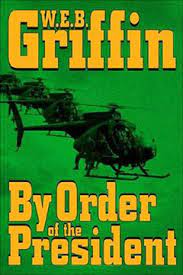
Review: By Order of the President

By Order Of The President

Despite being one of the most prolific and successful military fiction writers, it’s taken me a very long time to read W. E. B. Griffin. I started with By Order of the President. And well, I sure hope the rest of his books aren’t like it. The story of the search for a stolen Boeing 727 and the sinister plot behind it, it doesn’t exactly fly through the skies gracefully.

Although to be fair it does seem like the wrong genre for its author’s writing style. Viewed one way, it’s just a stylistic misfit. All the detail, the flashbacks to the past, and the grounded way of writing all feel much more fit for historical fiction (which most of Griffin’s famous work is) than a contemporary thriller (which this is). As for the parade of meetings and travel that makes up nearly all of the book, it arguably fits into the “too realistic for its own good” category. At the very least, it’s an orange read by someone who prefers apples. But I could all this the benefit of the doubt…

…If the main character was someone other than a half rich German, half rich Texan (Griffin famously said outright that “rich people are more interesting than poor people”) super-agent who hit my suspension of disbelief hard. Or if the story, regardless of realism or style, was better paced. As it stands, it just clunks along and then rushes when it’s near its conclusion.

Finally, I got the impression that this was aimed for the people for whom reading about something is interesting in and of itself. The technical descriptions and organizational procedures made it seem that way. It’s either a flaw or another orange compared to my favored apples.

I can still see Griffin’s appeal, and he was successful and famous for a reason. This isn’t something inexplicably popular and published like William W. Johnstone. But I still see him striking out at the first at-bat I noticed.

Cold War Kitona

The Fuldapocalypse has traditionally been opened with a vast set of Soviet special operations that involve varying degrees of risk, realism, and audacity. Red Storm Rising famously had one such jury-rigged gamble resulting in the capture of Iceland. I’ve found another possibility that would involve my two obsessions of past and present: Conventional World War IIIs and commercial airplanes.

While the Second Congo War is about as far in terms of tone and nature from a Fuldapocalypse as it’s possible to get, its opening act nonetheless could have been lifted from the pages of a technothriller. In Operation Kitona, Rwandan and Ugandan troops seized four airliners and flew west to sever the DRC’s links to the outside world. The initial landing worked, but external support for the Congolese government doomed the offensive, plunging central and southern Africa into a long, bloody, and horrific war.

So it’s not too terribly farfetched to imagine planes being filled with “unruly passengers” happening to land at important dual-purpose airports at the worst possible prewar time…