Review: Operation Siberia

Operation: Siberia

William Meikle’s Operation Siberia is not deep fiction. But it is very fun fiction. With a recommendation from The Sci-Fi Fantasy Reviewer and a love of prehistoric megafauna that stretches back to David Macaulay’s The Way Things Work, I knew I had to read this book. And I was not disappointed.

The plot is basically a Jurassic Park knockoff that descends into what’s essentially “Scotsmen vs. Yetis”. Done with solid execution, it’s a great cheap thriller to pass the time. While not deep even by genre fiction standards, I enjoyed it a lot. Meikle takes a great premise and applies it well.

Review: Olympus Rises

Olympus Rises

After reading a novel dragged down by trivialities like “technical realism”, it was an amazing experience reading one that threw all that aside in favor of crazy action. The first entry in the Code of War Series, Jim Roberts’ Olympus Rises is such a story, dealing with a supervillain sci-fi mercenary army and the modern soldiers who end up fighting it. Like the Black Eagle Force series before it, this is not the most fundamentally sound book. And while this goes without saying, anyone bothered by a lack of plausibility probably won’t like this.

However, that doesn’t matter. This is a very, very fun book and I had a great time reading it. Sometimes you just need jetpacks and mecha-ninjas. The many cliches and references I saw actually enhanced the experience in my views. It’s that kind of book, and that’s the kind I frequently take to reading.

Review: Tier One

Tier One

Brian Andrews and Jeffrey Wilson’s Tier One is the first installment in a series that, like a surprisingly high number of Fuldapocalypse review entries, I learned about via negative comments. I’ve been pleasantly surprised by such books before, so I decided to give this tale of a SEAL turned super secret super commando a try. Of course, I’ve also often found them to be just as bad as they said.

This is not a good book, but it was a strangely enjoyable one. The action was passable but not the best. The main character comes across as a ‘difficult’, unlikable person. And the plot-well, the plot seemed like it was trying to check each and every box of what a stereotypical modern thriller would contain. This was enough to make it swing all the way around from “cliche and bland” to “weirdly interesting”. Thus Tier One is the kind of work I cannot recommend but did not mind reading.

Review: Deadly Intent

Deadly Intent

The second book in Brent Towns’ Team Reaper series, Deadly Intent is one of the best thrillers I’ve read in some time. The action here is almost literally non-stop as the titular force battles against a seemingly never-ending stream of enemies in a battle that spans multiple continents.

The constant action, team-based protagonists, vast geographic setting, and more out-there elements of the plot (to put it mildly) reminded me of one of the Stony Man Gold Eagles. The difference though is that this is done better than the Stony Man/Able Team/Phoenix Force entries I’ve read. The action and narrative flows a lot more smoothly, and the characters feel more developed (in a small sense, but still).

There are times when a book, even a cheap thriller, benefits from slowing down and having lots of buildup. But there are other times when one, like this, benefits from just welding the gas pedal to the floor. This is quite the experience and I highly recommend it.

A Thousand Words: Unmasking The Idol

Unmasking The Idol

The film Unmasking the Idol may be the most 1980s action movie ever. And one of the most ridiculous, whatever the decade. The film has ninjas, a trained baboon, “homages” to nearly every popular film of the time, a super-lair, and, as the icing on the cake, a flying pickup truck that looks as “majestic” as it sounds. And an incredibly 80s soundtrack, but you could have probably guessed that already.

Besides being very dumb fun in its own right, this movie has special resonance for this blog. It illustrates how by this point, visual media could provide cheap thrills just as well as, if not better than, any book. Stuff like this was the “Tecmo Bowl” compared to the “electric football” of men’s adventure novels. And the “Madden” was yet to come.

Review: Target Response

Target Response

Somehow my mind said “you know what you really need to read next? Another ‘William W. Johnstone’s’ book.” And thus I decided to try and roll the boulder up the hill yet again with Target Response. I mean, maybe it could be a serviceable cheap thriller? Maybe one of the anonymous, carefully-hidden authors behind what’s become a house name worked well this time?

Or not. But really, what did I expect?

There’s two barely connected plots that only stay together by virtue of sharing a common villain and “theme” of the Dog Team assassins being targeted for death by said villains. The first is a paint-by-numbers set piece in Nigeria that takes up the opening act. This at least doesn’t have very far to sink. But the second is another Dog Team member back home having to fight off a literal family of assassins, and it’s something that a better thriller writer could have done just so much better. The potential is lost and it falls flat, like the writing.

The writing style is extremely sparse and flat. It’s meant as a basic reading thriller, but comes across as just rote and artificial-which makes sense given what the series is. And yet I couldn’t help but think that in some ways this was actually, at least in context, better than many of the “rival” later Gold Eagles. The weapon descriptions aren’t quite as blocky and overstuffed. And while the plot is just as erratic and wrapped-up too quickly, there’s less outright obvious padding.

Now, there are so many more deserving books by both big and small name authors that I’d recommend over these literary clunkers. They still share the same basic and deep flaws. And as I said in the last Dog Team book review, going from “distinctively, memorably bad” to “forgettably mediocre” in many ways works against it. So this is kind of like saying one old-design, tiny cheap subcompact car is “better” than another old, cheap subcompact car. But I still need to give a bit of credit where it’s due.

Review: Magic Ops

Magic Ops

The book Magic Ops by T.R. Cameron, Michael Anderle, and Martha Carr is a secret agent urban fantasy action thriller. If this sounds like a big jumble, it is. And it’s a lightweight book even by cheap thriller standards. But there’s nothing wrong with that.

The action works surprisingly well. There’s a few wince-inducing moments like agents “shooting to subdue”, but other than that it feels good and manages to integrate the supernatural elements in a non-jarring way. The non-action parts of this still flow well also.

This is sort of a “51%” book, but it’s a good kind of 51% book. It’s never really slow or dull, and even if it rarely goes above “adequate”, it also more importantly never goes below it either. This and how it succeeds at bringing its different genres together when it could have failed makes me recommend it.

A Thousand Words: Metal Slug

Metal Slug

SNK’s classic series Metal Slug takes the Contra-type “side scrolling shooter” game and adds an unforgettable art style to it. The excuse plot is you controlling a member of the elite “Peregrine Falcons” against the “Rebel Army”-and more weird enemies.

The art, from the goofy yet legitimately detailed sprites to the lavish backgrounds to the smooth animations, is consistently amazing. The music isn’t as standout (with a few exceptions), but is always at least serviceable. As for the gameplay, it’s both very good and inherently limited.

The action, weapon combinations, and controls are all excellent with the exception of a few clumsy platforming sections. The issue is the games are very short and were originally for arcades. So it’s either “be good enough at this very hard game to avoid deaths or just brute-force your way through with credits”. This probably couldn’t have been avoided, but it’s still a little bitter. That being said, this series is a classic for a reason and the games are well worth playing.

Review: The Suriname Job

The Suriname Job

Vince Milam’s The Suriname Job is the first book in the Case Lee series of thrillers. In a very crowded field, it only stands out in a few ways. The first is its very format. This is told in a first-person, “hardboiled” narrative style. It’s different than a lot of cheap thrillers, but I’m not sure it’s for the better.

The second is a bigger issue, and that’s that the action isn’t very good. It’s basically flat, which isn’t what you want to feel when you read a cheap thriller. The third is that the plot is a little too mundane, which isn’t necessarily a bad thing in and of itself but drags it down even more when combined with the poor action. With these issues in mind, I’m not exactly eager to read the later books in the series.

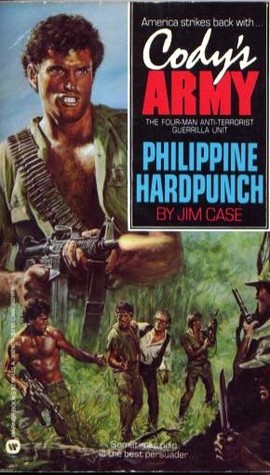
Review: Philippine Hardpunch

Philippine Hardpunch

Of all the books in the Cody’s Army series, Philippine Hardpunch may be the most middling. Given the nature of 1980s “men’s adventure” fiction, that’s very forgivable. It could easily have been something worse than “middling”, and can still succeed as a time-passer. John Cody and his “army” of three other people still fight, and the result is still a competent cheap thriller.

That being said, in hindsight it falls particularly short. The later Hellfire in Haiti takes its basic premise (associate of a recently ousted, headline-grabbing dictator tries to retake the country, the “army” opposes him) and has a spectacularly better execution. Thus, this becomes one of those books that I’d put in the “only for genre ultra-enthusiasts” category. Not because it’s bad, but because it’s in a genre where there’s just so much available that it has to be really good to stand out. And sadly, this isn’t.