Review: Star Wars Incredible Cross Sections

Star Wars: Incredible Cross Sections

In the late 1990s and early 2000s, as the Star Wars prequels and their merchandise machine rolled into action, an interesting reference book series emerged. This was Dorling Kindersley’s Incredible Cross Sections. I remembered (and loved) similar books as a child showing real things ranging from Boeing 747s to T-34/85 tanks to old age of sail warships. So the art is beautifully done, even if there are issues like the Millennium Falcon being impossible to square totally with its interior and exterior differences.

So these are beautiful books. Unfortunately, the later ones were marred by a controversial author, Curtis Saxton. Saxton’s story is a nerd’s dream come true: An astrophysicist and Star Wars fan who became the writer of a site called the Star Wars Technical Commentaries. Getting to write official material would have been something.

There were two main issues with Saxton. The first is that he was a maximalist who tried to squish the incredibly soft space fantasy of Star Wars into a Stephen Baxterian hard plausible mold. Yes he gives technically accurate numbers for a galactic scale civilization-but it just doesn’t mesh with the actual movies. The second was his fixation on the “Endor Holocaust” (no really he used the exact name) where the debris from the Death Star would have wiped out the Ewok species. Imagine if a Star Trek fan was absolutely adamant that transporters were ‘destructive teleportation’ (ie killing/destroying the original subject and making a copy on the other side). (Ironically the Warhammer 40k fandom has a section like this in the opposite direction, where every Imperial Guardsman is a special forces equivalent elite soldier and most of the human population lives on advanced peaceful civilized worlds).

So not for the first or last time, it was someone plopping their fanfiction into “canon” in a way that didn’t quite fit. But at least the pictures were and are incredible.
On Star Wars

Now I want to say that I’ve liked a lot of Star Wars stuff. I don’t mind the setting, I’ve seen 2/3s of the official movies. Like any big setting it has its ups and downs. But I definitely don’t hate this.

However, I feel obligated to say one thing about Star Wars that I believe. It is the most overrated work of modern fiction, and this overrating has made it impossible to judge. What you have is first a trio of fun sci-fi pulp movies that get treated as if they were more than fun sci-fi pulp movies, because they were a breath of fresh air in the pretentious dark tone of 1970s science fiction. Then you have a giant franchise.

Next you have the prequels, which are basically what happens when a Dunning-Krugered director gets free reign to run amuck. People nowadays are swinging towards defending the prequels in a dose of inevitable “defend midsize sedan cars the minute they stop being popular” hipsterism. Although I don’t blame them, because…

Then George Lucas cashed out and the Mouse Machine made the sequel trilogy. Now I had little desire to see them in full personally, and everything I saw and heard reinforced that desire. When I finally, recently looked at them in more depth, I was even gladder. At least the first six were works of genuine artistic imagination. These are just rehashed play it too safe mush piles that don’t understand the feel of their setting.

(Not so small side note: Devereaux’s excellent blog has the point in a review of fellow cash grab Rings of Power that authors are obsessed with winning battles via an unrealistic One Neat Trick. That plus “why didn’t they fly in on the eagles” ”’rationalism”’ leads to the infamous hyperspace ram.)

Weird Wargaming: The SW40k Project

I’m delighted to announce the initial release of a Starmada project of mine: The Star Wars vs. 40k fleet lists. Based on the fanfic, it aims to bring the battles from said fic to the generalist wargame. So far initial Imperial Navy and Republic fleets have been made. More, including Astartes, Separatists, and whatever else my brain thinks up, is planned.

Notes:

  • Ships are judged based on absolute and not relative size. This means the 40k ships are usually gigantic with the HP to match.
  • The Republic is a swarm fleet whose ships are almost always pound for pound inferior, just like in the fic itself.

Weird Wargaming AAR: Starmada Star Wars/40k

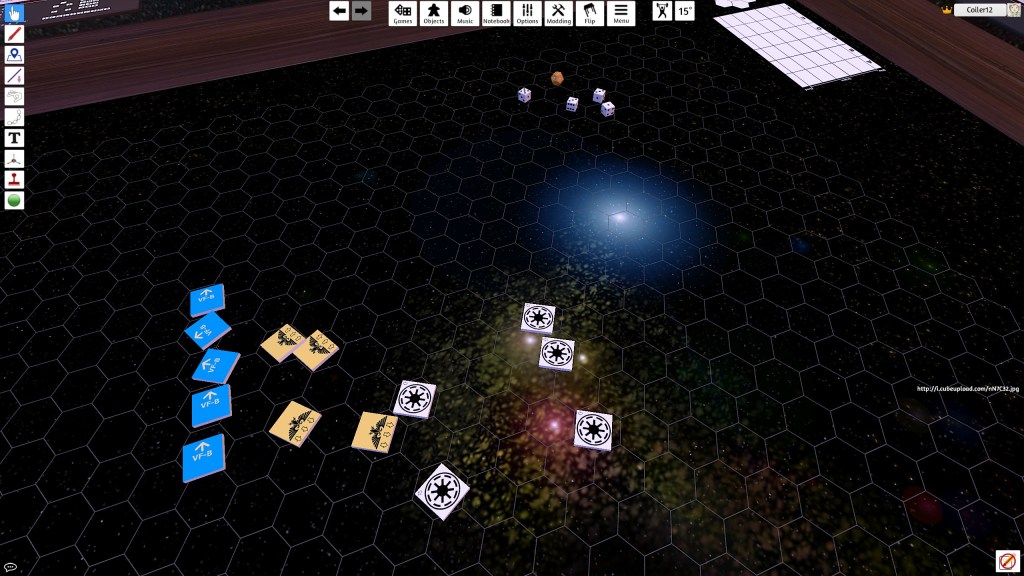
So inspired by the Star Wars vs. Warhammer 40k web serial, I made crossover fleet lists for Starmada. Then using Tabletop Simulator for a convenient hex map and making some quick counters in its editor, I ran a small fleet engagement of four Imperial frigates vs. five Republic ones.

The fleet lists are still subject to major revision but suffice to say the Star Wars side is about accuracy and fighters and the 40k one about brute power and durability. In this case brute force won out as the Imperium destroyed four Republic vessels for the loss of only one of their own.

The Imperium Vs. The Death Star

So the question has to be asked: What about this?

Original source

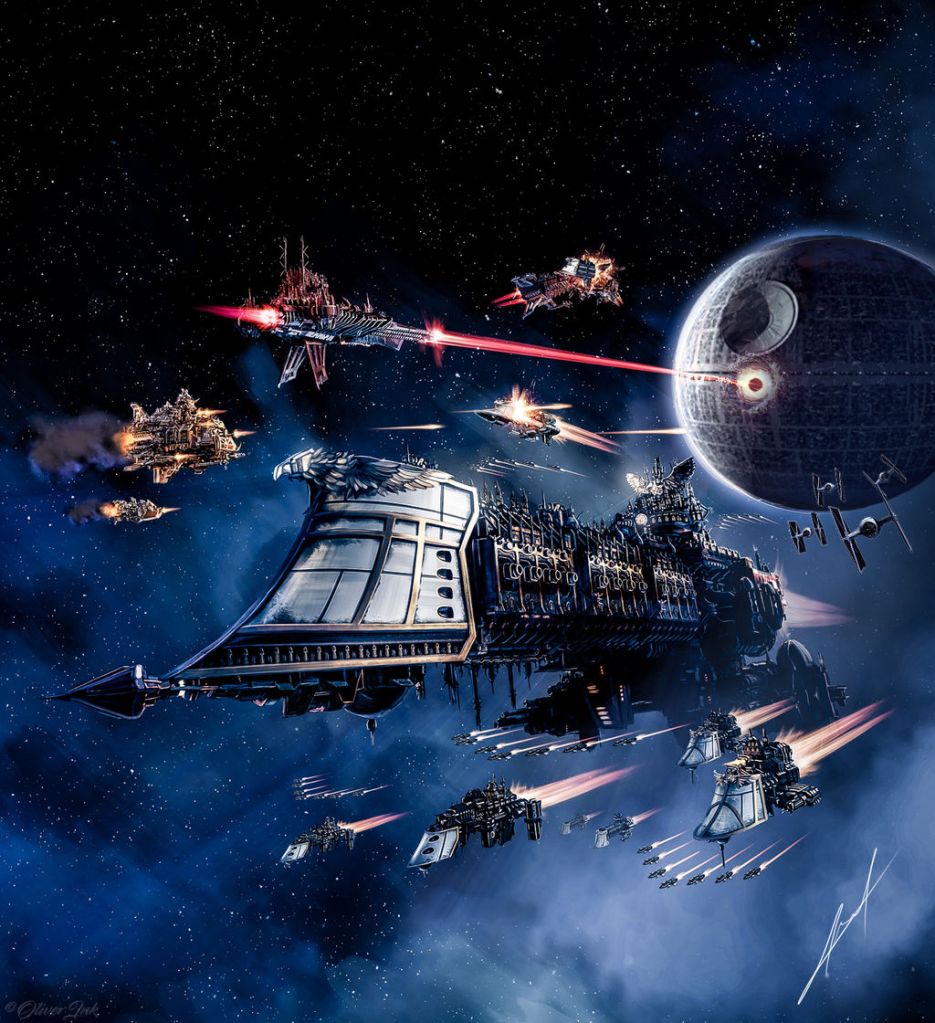
A Star Wars/Warhammer 40k crossover has to include the battles of evil vs. slightly more justified evil and feature a large Imperial Navy cathedral armada going up against the Death Star (presumably with its own array of Star Destroyers). Now I have put some actual thought into this.

  • The Imperium is not likely to be terribly fazed by the Death Star, thanks to confrontations with giant horrific superweapons being known as “Wednesday” over there.
  • If they cannot overpower it via masses of lances, nova cannons, and whatever other exotic tricks they’d undoubtedly pull out (ie psychic lashes, vortex torpedoes to just shunt it into the warp, etc…), for the main Imperial Navy it would be difficult to duplicate what the Rebel Alliance did. The reason simply is because Warhammer 40k space fighters are substantially larger than their Star Wars counterparts, and their ordnance is the same.
  • However, moving in for a pinpoint strike on a difficult but decisive target is the exact thing that Astartes were made for. So trench runs of Thunderhawks, vacuum chainsword fights, and tossing a melta bomb down the port would make for a fitting story.

Review: Shadows of the Empire

Star Wars: Shadows of the Empire

In the mid-1990s, an unusual multimedia product occurred. George Lucas and company released Shadows of the Empire, a Star Wars side story set between The Empire Strikes Back and Return of the Jedi. The results for Steve Perry’s primary novel were… interesting. First off, the book itself is not so bad that it falls into the tier of “horrible tie-ins”, but is nowhere near good enough to overcome the problems which every anime fan would know.

Yes, I said anime fan. Because this is like one of those movies that are based off a sequential anime (which is itself based on a sequential manga). In other words, everything has to be completely self-contained, every loose end has to be either tied up or cut loose, and the status quo for the series overall can’t really change. That every major character introduced in this book is killed off at the end shows the limitations it was working under, and Perry could not write his way past such a major obstacle.

I supposed it works if you just want Star Wars filler, but there’s better choices even in that regard.

Review: The Han Solo Adventures

The Han Solo Adventures

Originally published in three installments from 1979 to 1980, the Han Solo Adventures by Brian Daley were the first books in what would become the Star Wars expanded universe. Star Wars fans tend to love them, and I’m one of them. Without restrictions or a desire to one-up the movies (I’m looking at you, Kevin J. Anderson), the books are a fresh fun romp through the Corporate Sector.

Daley can write everything from prison breaks to starfighter bouts to duelists well, and he does in these books. Every Star Wars fan, science fiction fan, or just fiction fan should read these.

Review: Star Wars vs. Warhammer 40k Season 2

Star Wars vs. Warhammer 40k, Season 2

My voracious consumption of the Star Wars vs. Warhammer 40k fan audio drama continues apace. Having finished the self-declared second season, I feel like I should give my thoughts on it. The planet Axum is the site of the first gargantuan Imperium-Republic slugfest, and no stone is left unturned.

The pace does slow as seemingly everyone from top to bottom gets a viewpoint treatment. Clones, guardsmen, marines, admirals, Jedi, you name it. I will sadly say that a few times it does feel like the story focuses too much on individual trees and not enough on the forest, and that I’d like to see more post-Axum installments where more time and events pass in one episode.

However, this also has the virtues of such an approach, and it shows as well. A lot of the set pieces are excellent to the point where it feels like Larry Bond decided to take up writing crossover fanfiction. The culture clash as the tamer Star Wars universe is exposed to the gonzo craziness of 40k is still there and still well done. And it has one of my personal favorite plausible moments: When Republic clone troopers see Guard Ogryns, look at the huge humanoids, and think they’re Astartes/Space Marines. It’s very much a “the Panzer IV looks like a Tiger” situation, and I smiled.

For all my minor critiques, I’m majorly enjoying this drama.

Review: Star Wars vs. Warhammer 40k Season 1

Star Wars Vs Warhammer 40k, Season 1

Star Wars and Warhammer 40,000 combine science fiction with mystical fantasy, albeit the latter to a much larger degree. So it came as little surprise that one self proclaimed “fan with too much time” made an elaborate crossover audio drama of Era Indomitus 40k and prequel-era Star Wars. A large fleet from the Imperium of Man gets blown into the Star Wars galaxy at the height of the Clone Wars. Stuff then ensues.

An open-ended fanfic is always hard to review exactly, so I’m sticking with the first season in this review. And it’s excellent. First, the audio drama has some great written and voiced scenes, like describing what it’s like to be on the receiving end of an Astartes/Space Marine attack (hint: not very pleasant). Second, it manages to balance the factions well. The clash of Astartes vs. Jedi is balanced in an apples vs. oranges way, as they’re not symmetric superhumans the way that say, Astartes and SPARTANs from Halo would be. Finally the culture clash (as in, what happens when a sane universe meets a crazed one) is handled great as well.

This reminded me of Worldwar, with the Imperium as the lizard-race. It’s been a very fun way to pass the time.

Review: I Jedi

I, Jedi

Michael Stackpole’s I, Jedi may be my favorite Star Wars novel ever. It’s also a book that has absolutely no business being as good as it is. After all, Stackpole is a writer who isn’t the best prose-wise and tends to take game mechanics literally. Corran Horn, his protagonist, is the ur-example of someone parachuting their own Mary Sue into an existing franchise. The first part of the book uses the same plot as a book by the infamously subpar Kevin J. Anderson.

And yet, it somehow works brilliantly. Part of it is that Stackpole’s writing is in better form than usual, in everything from starfighter battles where Corran fights his old teammates and can sense their thought processes to everyday life on a backwater world. Another part of it is that by being small-scale and comparably low-stakes, it manages to actually make the universe look bigger and more wondrous.

Stackpole’s epic might be helped along by the other books of the time, which tended to have a random ex-Imperial using the superweapon of the week and an inappropiately small number of Star Destroyers to threaten the entire galaxy. But even on its own, it works. It embodies the “distant vista” principle, restores a sense of awe, and just succeeds as a story in its own right.