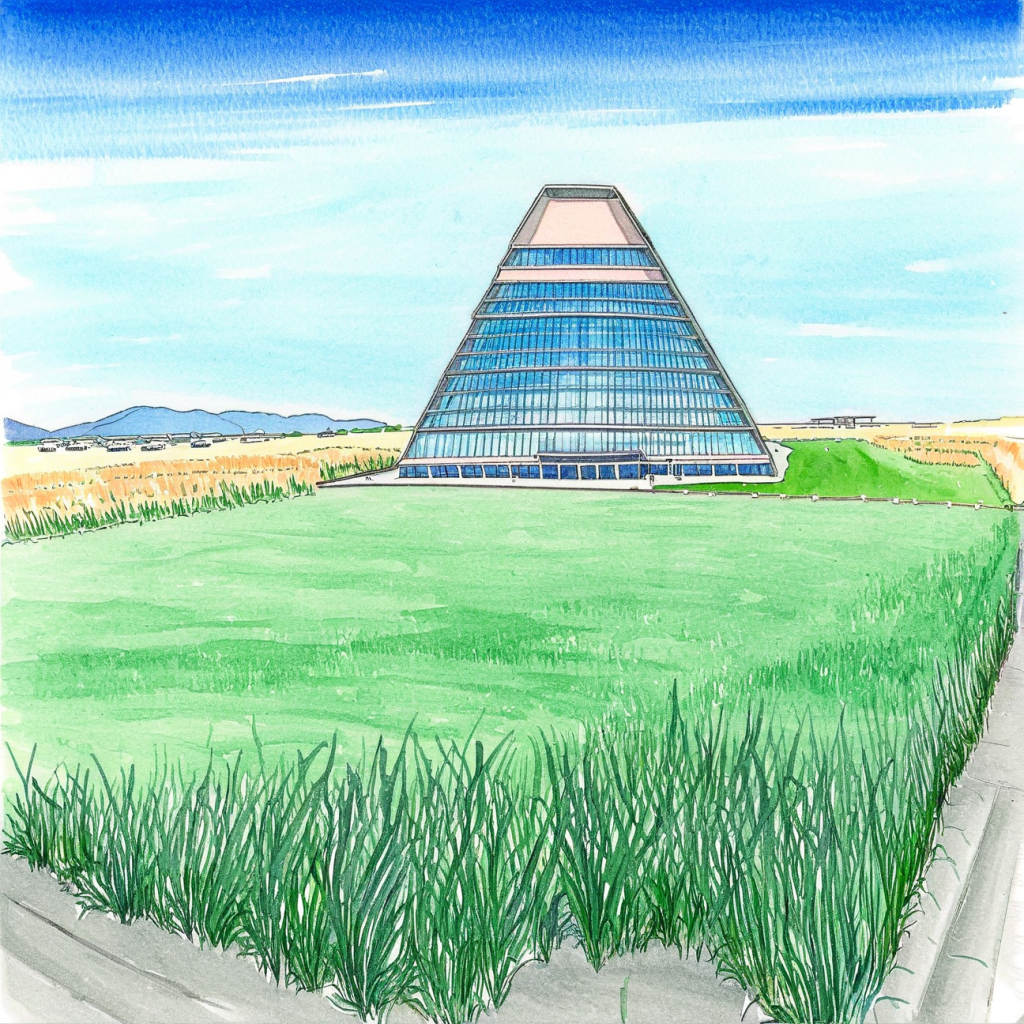
Created using Stable Diffusion and manual outlining, an under construction casino complex.

Created using Stable Diffusion and manual outlining, an under construction casino complex.
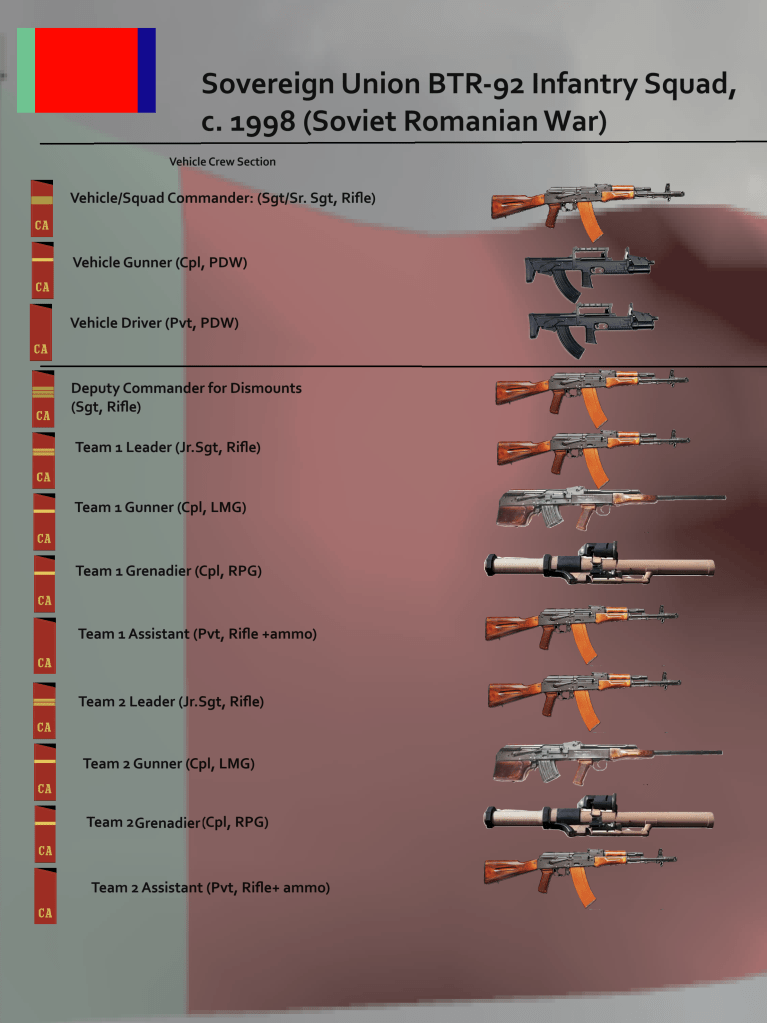
First I did my past piece on Mobile Corps squads, then came the BTR-92. Now the most ahistorically Soviet part of All Union’s military can be made with the two mixed together. In-universe, the creation of this squad was an extremely involved and controversial process.
It can be fun to put an alternate airliner into service, but unless it’s really big, really fast, or both, a lot of people wouldn’t notice much difference. That being said, the same can be said about a lot of things and it’s never stopped alternate history writers before.
I’ve even made a couple “formal” tiers:


Planes like these (in this case the MD-XX and the An-218 “777ski”), are going to be barely noticeable to non-aviation afficiandos, however different they may be on the inside.

The dreaded propfan is one instance of these airplanes having one obvious standout in addition to their other more subtle features. Others include a distinct shape like the 747 fuselage or even a “four engines all in the back” like the VC-10/Il-62
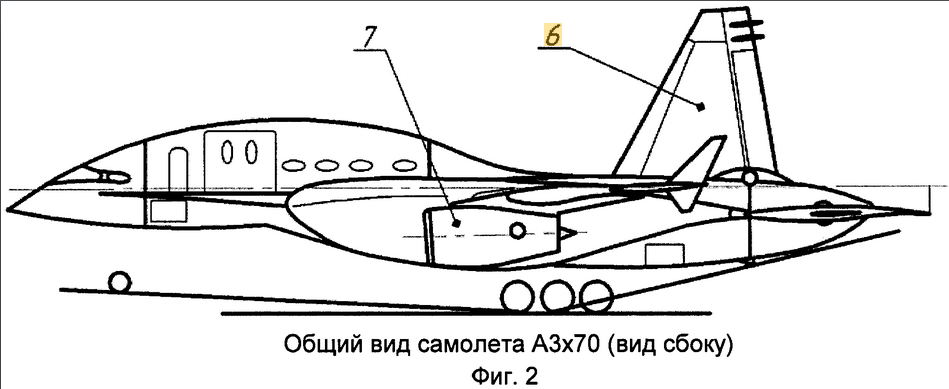

These involve strange but technically plausible shapes like lifting bodies or circular hulls of various nature. Their mere appearance makes them stand-out. This ironically applies to delta wings and civilianized early jet bombers.
These are the ones that ascend into pure science fiction.
Then-major George Patton in 1932 made a long essay about the ideal army for the “war of the future”. Most importantly, it had order of battle charts. The whole thing is well worth a read, but some thoughts/highlights:
All in all a very fascinating document. Patton may have been prescient in making a modern army, but I still wouldn’t want him commanding it (he would have been a good armored division commander, but deserved nothing higher). And of course, this army is easy to make and wargame in the underappreciated interwar period.
(Special thanks to the Tactical Notebook for its own analysis of Patton’s proposal which brought it to my attention)
The Holzer Centrifuge is a uranium enrichment centrifuge I’ve used as a Macguffin in various settings of mine. It is one of the smallest viable centrifuges and a simpler yet less effective design compared to its contemporaries. It has a maximum capacity of around 0.9 separative work units per centrifuge[1]. In practice with inevitable inefficiences and losses this leads to a mere 0.5-.6 in practice, one of the weakest individual centrifuges to ever spin in its hideous mission.
In All Union, the Polish Holzer centrifuge (named after the ethnic German scientist who led the program), served as one of the primary enrichment sources for the nation’s uranium path. The goal was ease of assembly with just domestic resources, hence why Holzer centrifuges were around 40-50 years behind their contemporaries and low-powered even by the standards of other first-gen designs. Nonetheless, they accomplished their goal.
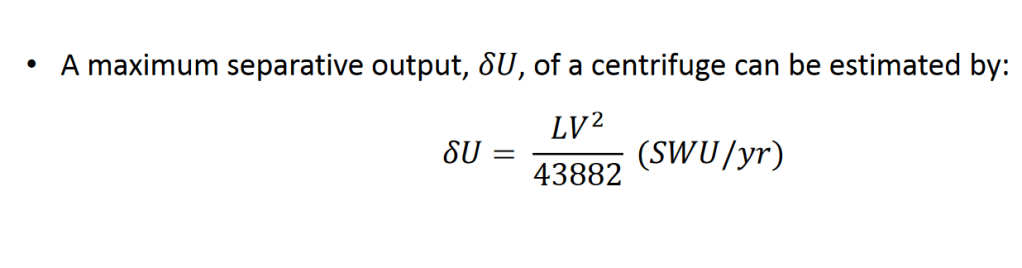
[1]A napkin calc is as follows, with L being length in meters and V velocity in meters per second. Don’t really ask me to explain what an SWU exactly is.
Poland produced at least 50,000 Holzer centrifuges and operated 25,000 of them. Using an enrichment calculator and going by 0.6, the fully functional cascades would produce 77 kilograms of weapons grade uranium a year if working with natural ore to start, or 270 kilograms if working with reactor-grade LEU.
I talked about my fictional 7th Marine Division before. Now I have a more detailed personal organization (though still undoubtedly rough and with inaccuracies). Here it goes. ORBAT chart courtesy of the Spatial Illusion Unit Symbol Generator.
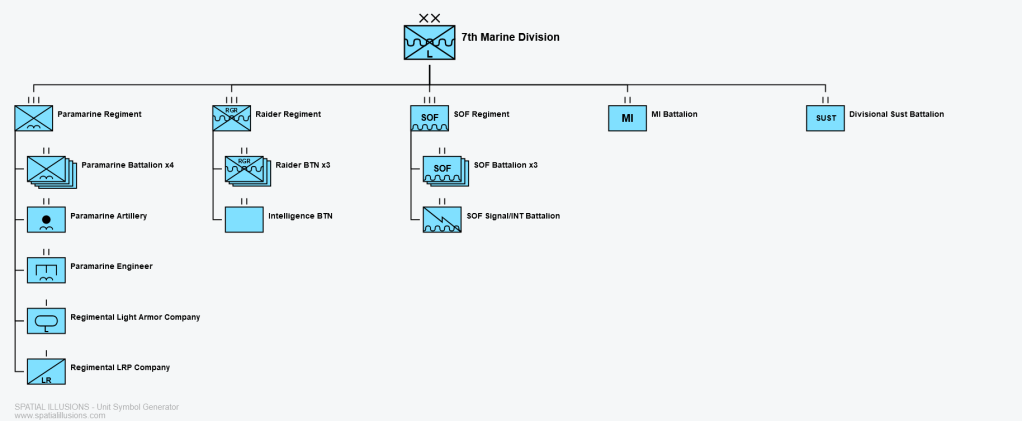
The Paramarine Regiment is like many other light airborne units, with the exception that it has four battalions instead of the usual three and its artillery battalion has thus been increased to four cannon batteries likewise, along with the other regimental support units similarly beefed up. This is to allow each battalion to serve as an independent combined arms unit to hold ground if necessary (ie around a battery in a fire support base with a battalion of infantry and an LRP platoon and light AFV platoon).
The actual battalions are largely standard triangular airborne infantry battalions.
A lighter force with less organic capability, the raider regiment is simple, with three battalions, each of three raider companies and a heavy weapons company. A regimental intelligence battalion is included because of the importance of intelligence and planning to their missions. It’s meant as a direct action-slanted commando force ie the classic Rangers.
The SOF regiment has three SOF battalions, below which any formal organization would be varied and inexact by nature (each has a number of teams, varied as you’d think, but around 10-15 each). Its communications/intelligence battalion is there similar to the ranger regiment.
Divisional assets are just more support and administrative elements, there because the 7th is not intended to be a “field” organization.



Some Stable Diffusion concepts for the logo of either the division itself or one of its subunits. You’ll notice a theme of black birds. Yes, I know crows are already the mascot animal for electronic warfare units, but oh well.
It goes without saying that in All Union, the 7th Marine Division was formed and saw action, including the 2002-2009 conflict in Western Sahara that marked the largest and bloodiest war the US military fought in that TL. If I ever need a fictional American commando force in my writing, I can always use it.
You have:
All of these are important (and the I can be added to the others). But how many Cs is truly sufficient?
So the conventional forces of the United States in All Union, unlike its superpower counterparts, have not been the most central to any of my drafts (yet…). Therefore I figure I should infodump some of my musings on it right now.
The reformation of the USSR brought about a period of aimlessness among the US Army. With the fall of the Berlin Wall and the former Warsaw Pact states forming an independent de facto buffer, priorities became much lower. Going from all of Germany to the northern tip of Norway and Thrace is somewhat of a downgrade.
That being said, there has been a shift of forces to the south. The US 9th Infantry Division is in Turkish Thrace to, in the event of a Thraciapocalypse, serve as a mobile counterattack force. The lighter 51st Infantry is in Northeastern Greece near the triple border to make sure the rival NATO countries play nice serve as a tripwire for any Soviet-Bulgarian push south.
The need for “Americi-BTRs” that historically was filled by the Strykers came in the form of LAVs, both the LAV-25/Piranha of real life USMC fame for that branch and the unrelated but similarly named LAV-300/600 series for the Army.
The medium-ization of the Army came as followed: Two brigades in existing heavy divisions with their Bradley mech inf brigades replaced with LAV mech inf brigades ie BMP-BTR mixes, two “medium-heavy” divisions based around LAV-300s with a divisional tank battalion that would stay behind on lower-intensity deployments, and one “medium-light” division with the LAV-300 series, more uparmored HMMVs as the infantry carrier, and no organic tanks. For the USMC, the Seventh Marine Division came into being, along with Combined Arms Regiments (mixes of tanks and LAV-Bisons proposed in real life) for the three active USMC divisions.
More to come…
In the late 1940s, Hungary, fresh off Soviet conquest and the statistical worst hyperinflation ever recorded, was rebuilding its military. Not surprisingly, the plans reportedly called for a force structured along Soviet lines and doctrine. But surprisingly, the centerpiece was on ridiculously large infantry divisions. How large? Paper strength of at least 25,000 people, but that doesn’t describe all of it.
No, comparing the number of infantry battalions ultimately under divisional control draws this insanity into better perspective. The archetypical triangular infantry division has nine (three in each of three regiments/brigades). The square division largely rejected as too big and clunky had twelve (three in each of four regiments). This had sixteen. Four regiments of four battalions each.
There’s a reason why these actually weren’t made and why, even beyond the impact of the 1956 rebellion and short leash, Hungary’s army in actuality remained conventionally Soviet-styled for the rest of the Cold War.
How much nuke-metal can you get out of Reactor X? As it turned out, nuclear proliferation scholar David Albright came up with an oversimplified rough formula, which he wrote in a briefing.

You need:

(Again, do not quote me on this. The very presentation says “this is for production not adapted reactors”, but oh well.)
So:
200mw production reactor: 200×0.6x365x.85=37kg of weapons grade plutonium in a year.
Adapted LWR power reactor: 1,400 mwth, wastage: 1400×0.35x365x.51= 91.2 kg of weapons grade plutonium in a year.
A Fat Man-level warhead is estimated to need anything from 6.5 kg (very low technology, used in said bomb itself) to 3kg. See here and here.
 Fuldapocalypse Fiction