A pop culture history, Selling the 90s is a book about one man’s life in a comic store in the bubble era. This goes through 90s crazes such as the Death of Superman and Magic The Gathering. For someone like me who was a child in the 1990s, it was a fun nostalgia hit.
Unfortunately, it could have been more. The book is very much a set of lists and events. It’s just “here’s this. Now here’s this. Now here’s this. Oh, and this happened too. So did this!” It still has enough to be interesting, but its setup does it no favors.
Still, there are worse books to look back at retro fun.
Harry Turtledove’s 2008 After The Downfall is not an alternate history per se. Rather it is an example of the dreaded “isekai” that started with Mark Twain’s A Connecticut Yankee In King Arthur’s Court. A German soldier gets warped from the Battle of Berlin to a fantasy world and then stuff happens. A lot of stuff. A lot of predictable stuff.
This is not one of Turtledove’s better books. Take a ridiculously obvious and unsubtle plot/message, writing that can’t make up for it, and one of the fastest intro-to-sex-scene ratios I’ve ever read. And the “payoff” of that isn’t worth it, trust me.
The best I can say about this is that it’s a sincere attempt at something different and not a series installment stretched out over a long time to get more money. But that doesn’t make the actual book any better.
Anyone who’s seen my retweets knows how much I like tacticute. And Stable Diffusion gives me the chance to make tacticute in a variety of styles, clothes, and poses. The styles of these military women trend away from the fluffy model and more towards the semi-practical. I tend to give them shorter hair, and in the more photorealistic models, a rougher, harsh edge to their appearance. They may be tigresses worn down by the horrors of what they serve in, but they still have a kitten on the inside. But I digress..
Anyway, for the sake of fiction (obviously real life policy is complex and depends on so many factors), I must admit towards having my military females tending to be something other than armored infantry grunts. (All Union’s Cholpon is a medic, something women have done in battlefield support for thousands of years). Besides that, there’s vehicle crews, agents, even things like the descendants of the WWII Soviet scout-snipers. It’s not keeping them in the back and it’s definitely still putting them in harms way.
Even if there’s a mitigating factor in-setting (ie power armor,magic,even just the tone of things), I still have this bias. And I don’t mind if it’s done right, nor do I think it’s impossible to do right. I guess it’s just a partially subconcious reaction to the trend of “strong female girlboss who’s 5 foot 2 and scrawny and can do the most stereotypically masculine things better than the men can”.
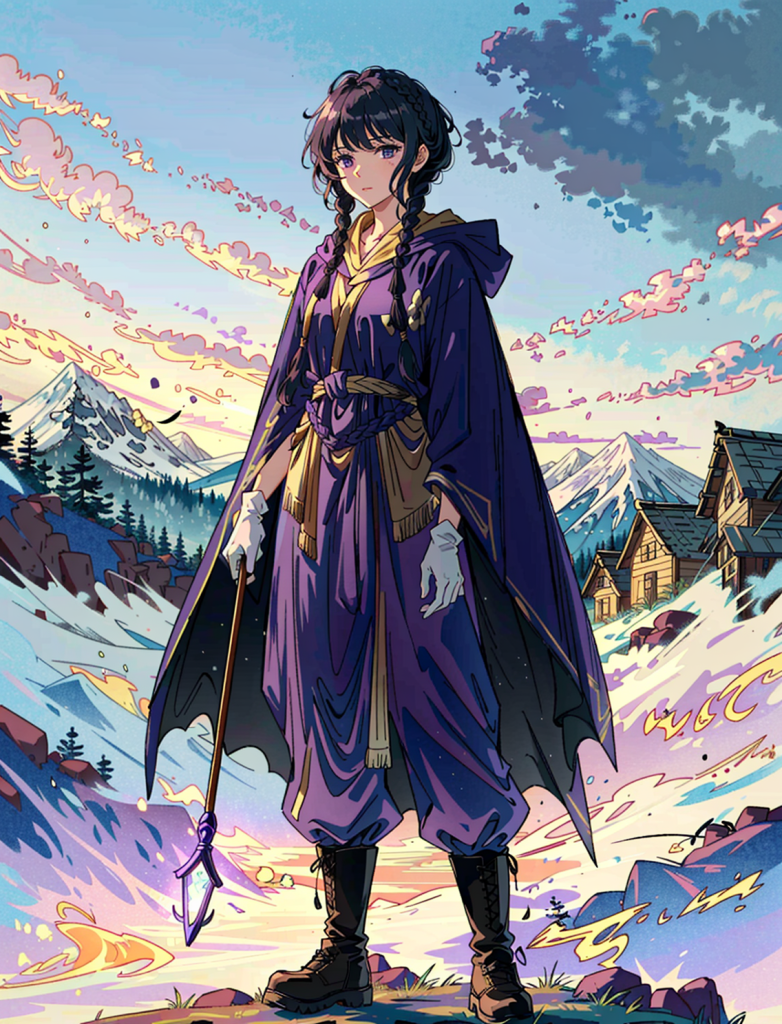
The protagonist of the Noita game, known as “Mina” (which essentially just means ‘you’ in Finnish), or “The Noita” (witch) is a deliberately ambiguous figure wearing covering purple robes. So I felt I needed to do a theoretical unmasked version in Stable Diffusion. This “Mina” is female, with hair in traditional Scandinavian braids.
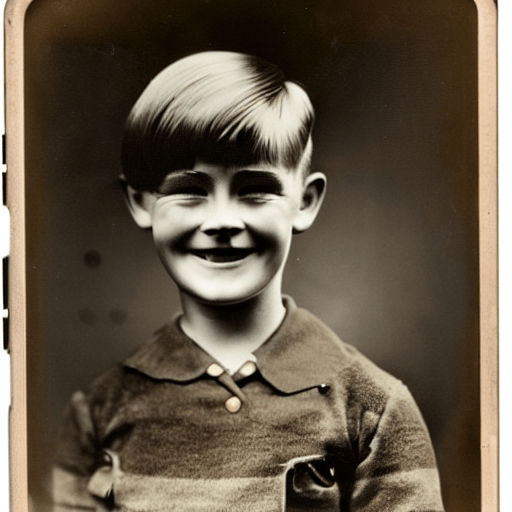
Some Stable Diffusion pseudo-photographs of the Undertale main humans. Chara is the black and white one with the single stripe, Frisk the color one with the two stripes. (The black and white one is partially because I made it in inspiration from a fanfic where Chara fell in 1926, so I chose one that fit the time period.)
Of all the Warhammer 40K factions, my absolute favorite by absolute far is the Imperial Guard (or as they’re supposedly called now, the Astra Militarum). So I had to read Cadia Stands, about the 13th Black Crusade (definitely) and one guardswoman’s struggle to survive and escape-supposedly. I mean, the saying correctly went “Cadia Broke Before The Guard Did”, meaning that the forces of Chaos had to literally destroy the world to win.
The book is kind of disjointed. There’s a lot of battle vignettes. Minka Lesk, the young guardswoman in question, is supposedly the main low-level character. But she’s mostly just basically there and little different from all the other Imperial viewpoint figures. So, did I not like it?
NO! HERESY! There’s little wrong with a bunch of battle vignettes, and this is the kind of subgenre that’s incredibly hard to get exactly right. So while it’s not the best, this is a perfectly serviceable action novel.
You might think that a classic video game with a plot of “run around, shoot monsters” would be hard to novelize. Yet a writer by the name of Dafydd ab Hugh (which is the most Welsh name ever) gave it a try in Knee Deep in the Dead. This could have very easily been a low-effort potboiler. The author would just type out the blandest adherence to the and some filler, submit it, collect the money, and never look back. This has happened with many other visual media adaptations.
But not here.
Knee Deep In The Dead has a lot of running around and shooting monsters. But it also has this very bizarre style (that grew even more bizarre in its sequels, from what I’ve heard) that is nothing short of endearing. It’s one of those books that kind of has to be read to be believed.
Is it “good”? Not really. Is it readable? Yes. Is it fun? Oh yeah. Should you check it out? In my eyes, you betcha.
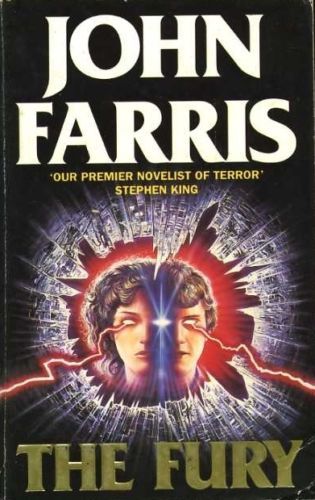
John Farris’ psychic horror thriller The Fury is an extremely 1970s novel. The horror story of psychic heiress Gillian Bellaver and the Sandza family consisting of father/agent Peter and psychic son Robin, it manages to have both the good and bad of its genre in full, making it a very “mean 51%” book.
The Fury has genuinely atmospheric tension, excellent body horror, and a serviceable plot that anyone who’s seen Carrie and/or Scanners can get into. It also has horrendously purple smut scenes and incredible pretentiousness. For every “good icky” scene like horror powers manifesting, there’s a “bad icky” scene like-well, pretty much all of the “naughty” there is.
Beyond that, it just has too much missed potential. There’s an entire metaphysical world described past the immediate characters that reminds me of the Warp from Warhammer 40,000, but instead of exploring that and the emergence of superhumans, Farris spends way too much time on middling action and not-so-middling character scenes.
Still, this is unique enough and good enough that I’d at least recommend giving it a shot. I can see different readers having different tolerances for its weaknesses.
My voracious consumption of the Star Wars vs. Warhammer 40k fan audio drama continues apace. Having finished the self-declared second season, I feel like I should give my thoughts on it. The planet Axum is the site of the first gargantuan Imperium-Republic slugfest, and no stone is left unturned.
The pace does slow as seemingly everyone from top to bottom gets a viewpoint treatment. Clones, guardsmen, marines, admirals, Jedi, you name it. I will sadly say that a few times it does feel like the story focuses too much on individual trees and not enough on the forest, and that I’d like to see more post-Axum installments where more time and events pass in one episode.
However, this also has the virtues of such an approach, and it shows as well. A lot of the set pieces are excellent to the point where it feels like Larry Bond decided to take up writing crossover fanfiction. The culture clash as the tamer Star Wars universe is exposed to the gonzo craziness of 40k is still there and still well done. And it has one of my personal favorite plausible moments: When Republic clone troopers see Guard Ogryns, look at the huge humanoids, and think they’re Astartes/Space Marines. It’s very much a “the Panzer IV looks like a Tiger” situation, and I smiled.
For all my minor critiques, I’m majorly enjoying this drama.
Star Wars and Warhammer 40,000 combine science fiction with mystical fantasy, albeit the latter to a much larger degree. So it came as little surprise that one self proclaimed “fan with too much time” made an elaborate crossover audio drama of Era Indomitus 40k and prequel-era Star Wars. A large fleet from the Imperium of Man gets blown into the Star Wars galaxy at the height of the Clone Wars. Stuff then ensues.
An open-ended fanfic is always hard to review exactly, so I’m sticking with the first season in this review. And it’s excellent. First, the audio drama has some great written and voiced scenes, like describing what it’s like to be on the receiving end of an Astartes/Space Marine attack (hint: not very pleasant). Second, it manages to balance the factions well. The clash of Astartes vs. Jedi is balanced in an apples vs. oranges way, as they’re not symmetric superhumans the way that say, Astartes and SPARTANs from Halo would be. Finally the culture clash (as in, what happens when a sane universe meets a crazed one) is handled great as well.
This reminded me of Worldwar, with the Imperium as the lizard-race. It’s been a very fun way to pass the time.