Mobile Corps Artillery

Indirect fire assets available to a GENFORCE mobile corps. As expected, they have a lot of them. The basic forces are largely equipped and organized with 1990-era Soviet equipment.

Battalion

Combined arms battalions have a…. something of 24 2S31 120mm gun-mortars at paper strengths. Why the “something”? It’s because it’s called a battalion in the document, but feels a little awkward to have a battalion under the command of a battalion. It’s just as confusing in Russian, where it’s a variant of the word “division” equivalent to a western battalion of artillery or missiles-yet a different variant of “division” is a classical multi-regiment/brigade division. Anyway, the battalion’s battalion/division-whatever takes the place of the classic regimental 2S1 formation.

The other indirect-capable (if clumsy) asset is the four 2A45 Sprut 125mm AT guns in the battalion’s anti-tank battery. While the USSR used towed anti-tank guns in the classic TD role throughout its existence, it also used everything for indirect fire. Although firing tank ammunition and only having a max elevation of 25 degrees, a big cannon is a big cannon is a big cannon.

Light motor rifle battalions used for infantry-dominant areas and heliborne operations have 8 towed 82mm 2B14 mortars and just as many 2B16 Nona-K 120mm towed gun/mortars.

Brigade

Intended to be treated similarly the Basic Forces division, combined arms brigades have an organic artillery regiment. This consists of 54 six-inch SPHs (the 2S19 Msta is the default) and 18 light multiple rocket launchers (the default is the “Prima”, a version of the BM-21 with 50 tubes per truck instead of 40). The artillery regiment has its own set of organic spotter drones.

Light motor rifle brigades, which are used for a similar role as the battalions mentioned above, only larger, have 18 MRLs, 36 towed 2A65 Msta-Bs, and 18 2A61 light 152mms (Think a smaller, lighter 152mm gun with muzzle brake on a three-pronged D-30 carriage).

Corps

The combined arms corps has two missile brigades with eighteen surface-to-surface missile TELs each (Tochka/SS-21 in the document, but anything in that category could be used). It also has a multiple rocket launcher brigade with 72 medium MRLs (default is BM-27, but again, anything in that ballpark). Rounding it out is an artillery brigade of Giatsints- 48 towed and 48 self-propelled.

The corps air assault battalion has eight 2S9 Nonas.

Front/Strategic Grouping

Fronts will have brigades/regiments, usually lumped into one administrative artillery division of the weapons mentioned above and 2S7 eight-inch SPHs. They will also usually have a rocket brigade of the 9A52/BM-30 Smerch or something similar (bigger than a BM-27, that’s for sure), as well as longer-ranged ballistic and cruise missiles.

The guns and multiple rocket launchers are almost always pushed down to army and corps-level artillery groups in battle.
Mobile Corps Order Of Battle

So my book project now has a name: All Union. To celebrate this milestone and excellent progress on it, I figured I should share the rivet-counting infodump of very little actual relevance to the plot (or is it…) but which is fun to do: An Order of Battle chart of the Mobile Corps (of GENFORCE-Mobile inspiration) of the Union of Soviet Sovereign Republics, most famous for their actions in the invasion of Romania.

The methodology is simple: For the number of corps and locations, I went with this analysis, which predicted eight total by the turn of the millennium and theorized their number by district. In actual history, only one was created, the 5th Guards Army Corps stationed in Belarus. For their numbering, I went with the invaluable ww2.dk and looked for defunct/easily disbandable corps HQs in the general area (HQ cities here NOT always correspond to historical bases). So on with the fun exercise/sneak preview-oops, did I say too much??

General Notes

Mobile Corps have adopted a degree of heraldry beyond previous divisions. All save one have a geographic semi-nickname, and all have a “mascot” creature displayed prominently on all unit patches and symbols. The “Sovereign Guards” honorific was made to reward units for the Romanian war without worrying about legacy “guards” titles from long ago.

Western TVD

5th Guards Mobile Combined Arms Corps “Neman” (bison): First (and in actual history only) mobile corps created. Peacetime garrison Minsk, Belarusian SSR, served in Romanian invasion under Dniester Front.

7th Sovereign Guards Mobile Combined Arms “Vena” (elk): Peacetime garrison Vitebsk, Belarusian SSR. Served in Romanian invasion under Dniester Front, given sovereign guards status postwar.

28th Mobile Combined Arms Corps “Buh” (medieval lion): Peacetime garrison Lviv, Ukrainian SSR. Served in Romanian invasion under Dniester Front. Considered one of the primary frontline units against independent, hostile Poland.

Northwestern TVD

26th Mobile Combined Arms Corps “Lagoda” (Karelian Bear Dog): Peacetime garrison Petrozavodsk, Russian SSR. Did not participate in Romanian invasion but was on high alert and was earmarked for a proposed second large offensive operation that never had to be conducted.

Southern TVD

17th Sovereign Guards Mobile Combined Arms Corps “Fergana” (Huma bird): Peacetime garrison Tashkent, Uzbek SSR. Participated in Romanian invasion under Dniester Front. Given sovereign guards status postwar. Its base in the otherwise remote area makes it the closest thing to a strategic reserve mobile corps, and it is poised to always go either west, east, or south. One of the main characters in All Union, Cholpon Murad-Kyzy, served in the 17th Corps during the war in a forward medical station.

Southwestern TVD

64th Sovereign Guards Mobile Combined Arms Corps “Donets” (nightingale): Peacetime garrison Luhansk, Ukrainian SSR. Participated in Romanian invasion under Dniester Front. Given sovereign guards status postwar. Its base in the birthplace of All-Union president and legendary leader Anton Yatchenko is widely believed to not exactly be the most coincidential, as is it receiving sovereign guards status and massive accolades.

32nd Mobile Combined Arms Corps “Roman-Kosh” (mythical hippocampus mermaid-horse): Peacetime garrison Sevastopol, Russian SSR [not a typo]. Participated in Romanian invasion under Danube Front, the only mobile corps to do so. Is believed to be the mobile corps with the most focus on amphibious invasions and operations in extreme terrain. There are even rumors that detachments from it are earmarked for the seizure of Iceland should it come to that.

Far Eastern TVD

57th Mobile Combined Arms Corps “Kisilyakh” (lynx): Peacetime garrison Ulan-Ude, Russian SSR. Did not participate in the Romanian invasion but was earmarked and prepared as part of the ultimately unnecessary second offensive operation.

43rd Mobile Combined Arms Corps “Amur” (mosquito): Peacetime garrison Khabarovsk, Russian SSR. High-priority unit for potential war with China. Because of this and its distance did not participate in the Romanian invasion and was never considered for doing so, even as part of the hypothetical second wave.

VNG/Efir Group

“VNG Elite Corps”/”Efir Group Corps”/”Phantom Corps” (ghost): Peacetime garrison Gorky, Russian SSR. Formed after the Romanian invasion, exact strength still unclear. Under the control of KGB successor VNG (based on an acronym that can translate to “All Union Monitoring Group”). Part of the mysterious and nominally private “Efir [Aether] Group, which officially is nothing but a small real estate firm registered in Pune, India. It is said that the corps is haunted and anyone who gazes at its facilities without approval is immediately flung out of a tall window by poltergeists.

The Armored Group

Looking at the 1990s OPFOR documents, a “new” (well, newer in a formal sense) type of formation arises: The “armored group” (bronegruppa). It’s important to note the history of Soviet-style doctrine beforehand. The stereotype, often true, is of formations operating as entire units for a certain task. Thus a formation (generally a company as the smallest) will as an entire unit operate as one arm of an attack or another. In defense one formation will sit and fire behind fortifications while another will act as the counterattack/reserve.

The armored group is ad hoc by nature. Formed with a number of armored vehicles usually equivalent to slightly more than a platoon (although GENFORCE-Mobile mentions ones slightly smaller than a company if the parent unit is big enough to handle it), the key is the following:

  • The tanks operate away from their parent unit.
  • More crucially and importantly, the IFVs operate “empty”, with their infantry having already dismounted.

The use of an armored group depends on the situation, of course. Examples given in the GENFORCE-Mobile and Heavy OPFOR Tactical documents are:

  • Sweeping around to hit the side while the dismounted infantry and main force attacks from a different axis.
  • Serving as the base of fire while the dismounted infantry and supporting arms do the sweep.
  • Acting as a reserve/pursuit force, especially one that can quickly roar in and (however temporarily) block off a route from a retreating foe.
  • Acting as a counterattack force on the defensive.

The armored group’s origins come from the Soviet war in Afghanistan, where such formations were used in an irregular, nonlinear, frequently rough-terrain war.

How Big Would The Mobile Forces Have Been?

The GENFORCE concept featured an eastern OPFOR divided into legacy “Basic” and more advanced, mixed, “Mobile” forces. Yet how many formations of the latter would plausibly exist in a nation the size of the USSR?

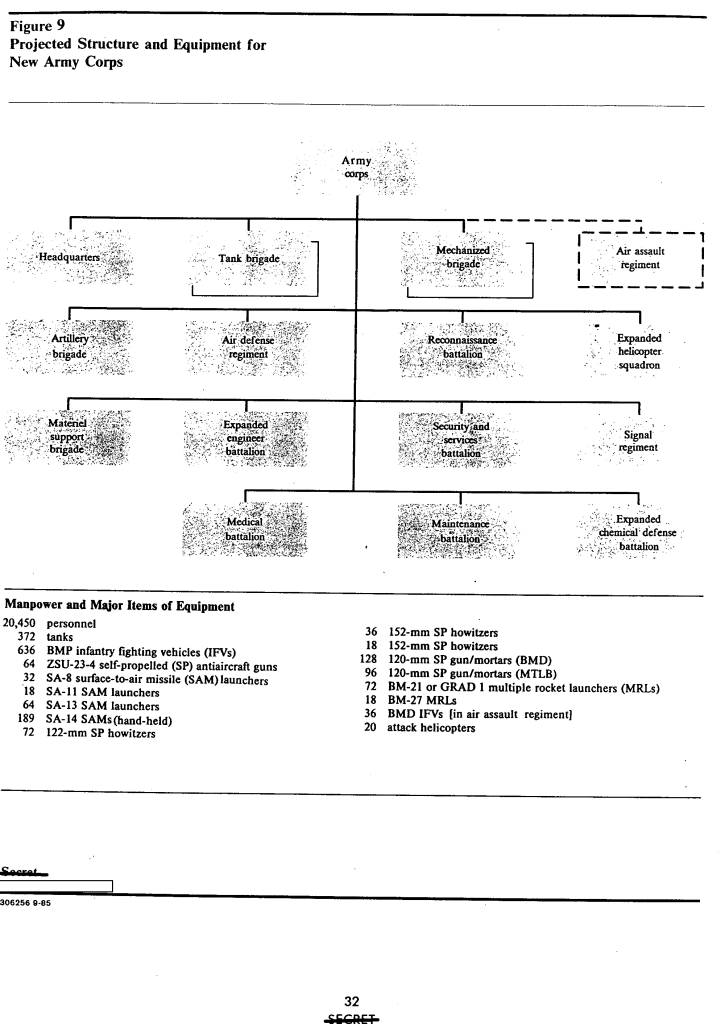
I found a possible answer in a 1985 CIA analysis called “Trends And Developments in Warsaw Pact Theater Forces, 1985-2000” (a great source for a continued Cold War in its own right). The mobile combined arms corps, effectively a big division, is mentioned.

Obviously assuming a surviving USSR and Warsaw Pact, the document estimated that nine such corps would be ready by 2000. Three of these would be in the western theater, two in the southwestern, and one on in the northwest. Two would be in the Far East and one in the south/middle east.

180,000 personnel would be needed from a napkin calc of corps numbers x paper strength of each corps. It’s actually closer to the actual number than most because existing tail assets could be used to support them. However, there will be undoubtedly more people than that necessary, especially to have them achieve their full potential.

The problem isn’t getting that many soldiers. It’s getting that many good soldiers, especially because these mobile corps are specifically designed to be better and more complex tactically than previous line formations. And because they have to compete with the airborne and naval infantry for the best inductees.

Interestingly, the document itself also mentions the possibility of the tank divergences continuing, with the basic forces (word choice deliberate) getting a less exotic model and the mobile corps getting a more out-there one. This would also coincidentally make two bureaus/plants very happy instead of one, so I can see it happening.

It’s an interesting document in any case.

Weird Wargaming: Conventional Bush War

The Rhodesian Bush War passed without a decisive 1975-style conventional campaign. Of the two main guerilla organizations, it was the Ndebele, Soviet-favored ZIPRA that placed more of an emphasis on conventional operations, compared to the majority Shona, China-favored ZANLA’s “people’s war”. A combination of largely successful preemptive strikes by the Rhodesian military and a (smart) focus on inherent strengths than weaknesses by the opposition meant that the large battle never came.

The common wisdom about such an operation “Zero Hour” (as one code name for it was) is that it would be stopped with ease (although it does not help that most surviving prominent sources are either from the ZANLA-veteran regime or former Rhodesians, neither of which has an incentive to talk up their opponent). But even if the first such offensive was stopped with ease, the rebels definitely had the people and enough hand-me-down aid to try multiple times.

Such an offensive would feature the fairly light Rhodesian military against an opposition that would have at least T-34/85s, BTR-152s, appropriate artillery, and even rumors of fighter aircraft. (If said fighter aircraft could disrupt the deployment of the infamous Fire Forces, it would not be good for the Rhodesians). It can obviously be played with any kind of wargaming ruleset that can handle early/mid Cold War equipment and formations.

The Eternal Death (And Life) Of The Tank

The year is 1916. Someone peers through his binoculars and sees an artillery shell smashing into one of these new tracked machines called “tanks”, destroying it. Shaking his head, he goes “These can’t amount to anything, they can be destroyed so easily.” (Even with modern tanks, if a big artillery shell hits it, it’s gonna hurt.)

The year is 2022. Someone looks on the internet and sees a drone launching a smart munition and destroying a tank. Shaking his head, he goes “these must be obsolete, they can be destroyed so easily.” Some things never change.

I could point to 1918 and heavy machine guns (really, the M2 Browning was considered a prime antitank gun at its introduction), 1944 and bazookas, 1973 and ATGMs, 1991 and laser-guided bombs, 2003 and smart cluster shells-you get the idea. Many others have said with far more knowledge and eloquence than me about the importance of armor, mobility, and firepower, regardless of its destructibility. So I’ll take another route.

Imagine something that is objectively less well armed and less armored than a tank. Now imagine that it, vulnerable to everything a tank is and so much more, is nonetheless not obsolete but remains totally indispensable. I’m talking of course about the classic basic box-APC, proof against small arms and some shrapnel. There’s a reason why Ukraine in the current war has been so eager to receive any kind of vehicle with an engine and armor plating, and why released footage of its current offensive in Kherson has shown them being put to good use.

There’s a reason why, especially on any kind of open terrain, armored forces are so much more accomplished than unarmored ones. And no amount of anti-tank gadgets can change that.

Review: Red Front

Red Front

The conventional Fuldapocalypse begins in earnest with Red Front, the second book in the Iron Crucible series. After the Yugoslav opening act in the previous entry , this follows the war everywhere from the Atlantic to… outer space. Author T. K Blackwood continues a solid Bond/Red Storm Rising style narrative in this installment.

This has the issues that a big perspective WWIII has, but it also has the strengths, and Blackwood succeeds in a genre that’s incredibly difficult to write well. The book ends on a cliffhanger, but it’s not an unsatsifying one. With a ton of varied battles in a type of novel that doesn’t come along very often, I can say that I highly recommend this to fans of the “conventional WW3” genre.

Weird Wargaming: The Axis Contraptions

After World War II, various veterans of the vanquished (to put it that way) offered to design and make various military platforms. Only a few actually entered production. Kurt Tank designed the HF-24 Marut and sputtered-out Pulqui jet fighters. An Italian submachine gun, the TZ-45, found its way into the Burmese Army. Most fell victim to the same culprits: A combination of Cold War military aid and cheap Allied surplus sweeping them aside, while not being high-performance enough to beat them that way.

Yet for alternate historians/wargamers/writers wanting to add various wunderwaffe to their scenarios, it’s not that implausible that a few could slip through here and there. They’d mostly be out of the way unless history moved to that region (for instance, the Willy Messerschmidt-designed HA-300 would undoubtedly see service in the Arab-Israeli Wars if it entered mass production.) But they could still be done.

What would be most interesting would be the really exotic and large Luft 46 aircraft and wunderpanzer tanks. Those would probably need veto-able foreign engines (or other less obvious components) and would be no picnic to design. But they would be the most fun to play.

Review: Africa Burning

Africa Burning

Back when I was young, I made a horrendously negative review of Gavin Parmar’s Africa Burning, talking about how little sense the tale of a giant army of T-90s and M113s (really) appearing in the Chadian desert to charge up into the modernized, reformed, opened Libya made. (Boy did that “prediction”, made pre-2011, about the direction of the country, age poorly).

Now, well, I have a soft spot for this amateur Ian Slater/technothriller/shoot the terrorist-wannabe novel. It reads like someone acting out their action hero fantasies after seeing and reading a lot of relevant fiction, and the earnest, genuine quality of it has made me smile. I may not recommend actually reading it, but at least I don’t have a bad feeling towards it anymore.