Review: Quantifying Counterfactual Military History

Readers of Fuldapocalypse should not be surprised to learn that when I saw a book called “Quantifying Counterfactual Military History“, I instantly bought and read it. The premise is simple: The authors use the Approximate Bayesian Computation method to get a large sample size in their various simulations-much, much larger than conventional wargames.

Starting off with one of the easiest and most popular ones, Jutland, that chapter made me go “a-ha! They got it.” My favorite quote is “but unlike in a wargame, our goal is to simply understand what is plausible and what is not.” This “War of the Spreadsheets” has its roles provided one knows its limitations, which the authors do. Then comes the Battle of Britain (where the goal is temporary German air superiority, along with a controversial conclusion. There’s Vietnam where the authors actually remember the large northern conventional forces that were always there. It concludes with Cold War game theory.

There’s some technical topics that are beyond me, but this is overall an excellent book whose authors know their own limitations. As someone who loves these kinds of simulations, I was delighted to read this.

Coiler’s Culmination Calculator

As a fun side project, I made my first (intentionally abstracted) wargaming tool. The goal is to see the culmination point of an offensive.

Assumptions: The attacker is consistently advancing, however, the defender is fighting back hard throughout. The units of the attacker participating in the campaign are not going to be rotated out, hence they will only receive small and piecemeal reinforcements/replacements throughout.

This simple tool works as follows:

  • The attacker starts with a point total of 100.
  • For each objective, roll 1d10. 1 means the objective is taken unopposed and the force suffers no meaningful losses. 2-6 is a minor engagement where the unit suffers a point loss equal to 1d6 points. 7-10 is a major engagement where the unit suffers a point loss equal to 1d6+10.
  • After every turn, the faction regains 3 points.
  • The offensive will have culminated when the point total reaches zero or less.

Example:

  • Objective 1: 9: 16 points lost. 3 regenerated. 87 points.
  • Objective 2: 8: 12 points lost, 3 regenerated. 78 points.
  • Objective 3: 6: 1 point lost, 3 regenerated. 79 points
  • Objective 4: 6: 6 points lost, 3 regenerated. 76 points.
  • Objective 5: 1: No losses, 3 points regenerated. 79 points.
  • Objective 6: 3: 5 losses, 3 regenerated. 77 points
  • Objective 7: 10: 11 losses, 3 regenerated. 69 points

Etc….

Figures of course can be changed depending on context.

Review: Starmada

Starmada 30th Anniversary Edition

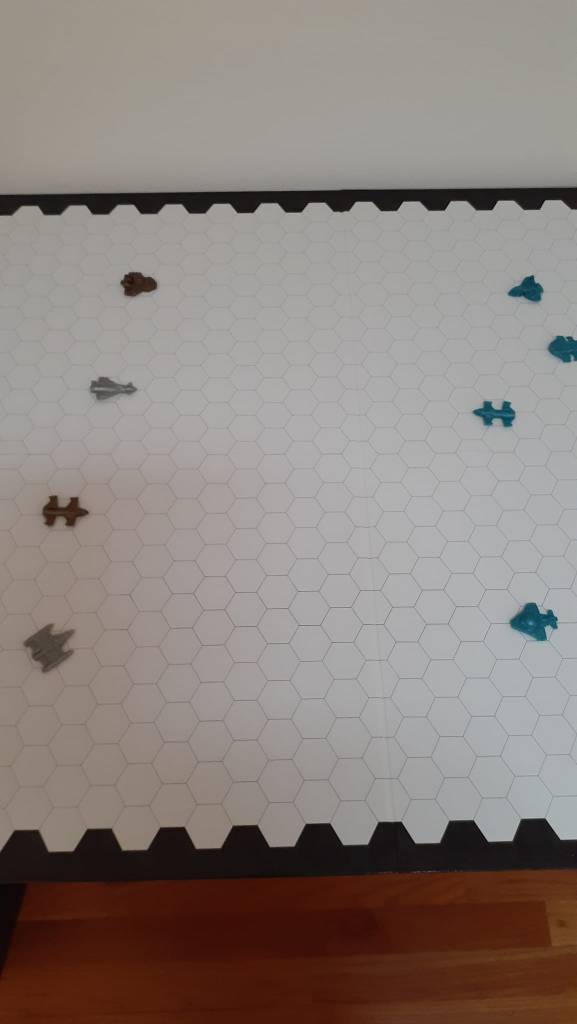
I was looking for something to scratch my spaceship wargaming itch. A set of generalist rules that you could apply to basically any setting and have a semi-reasonable approximation of things. Enter Starmada. Now its newest 30th anniversary edition, it lets you build and battle on the tabletop whatever ships you can imagine.

Naturally as a generalist set it lacks specific gimmicks, with anything offensive having to be translated into weapon qualities (ie a big area blast would be “proximity”, and a powerful kinetic cannon shell would be “crushing”) and anything defensive being translated to either “screens” (roll above X or the attack fails) or “shields” (takes a hit before anything else). You get the idea.

It requires some imagination. But if you have imagination and a willingness to abstract, well let me just say that even my initial crude playtesting sessions had me beaming bright. Want to play as a cumbersome pure brute force fleet going against an agile but brittle rapier? This lets you do all that and then some.

AI Art and Wargaming

So I’ve fallen to the dark side and have begun making prompt-generated pieces of AI art. This is a very controversial subject with a lot of undeniably talented artists who I respect being furious about it, and understandably so. If I had to sum up my opinion on the controversy (beyond specific technical issues like how to treat stuff like training images for the sake of copyright and licensing), it’d be condensed to this:

  • AI art is here and isn’t going away. It also has undeniable advantages as well as issues. The economic concerns of traditional artists are real.
  • Many AI artists have done their medium no favors by just spamming out low-effort prompts and/or deliberately copying obscure internet artist styles, either by model-making or just plain image-to-image.
  • The backlash, while understandable, is a Canute-ian endeavor (sorry, had to be a little pretentious). The same thing was said about Photoshop and similar tools. And online self-publishing. And recorded music. And photography. And pipe organs (seriously-the 17th century equivalent of “tech-bros” was applied to the stereotype of organ players back then). Like when free agency became a thing in sports, you have to learn to understand it and see if you can use it to your advantage.
  • There’s more to good AI art than just typing in “anime girl trending on artstation”, even if a lot of people only see that (see point 2 above)

But as a hobby, since I can write much better than I can draw, AI prompt tools have let me explore visual media in a delightful way. Yet what struck me when I really started getting into was how natural it seemed to me. And then it occurred to me: I’d done something similar before. Many, many times before. In wargames and simulators like Command, Nuclear War Simulator, Title Bout Boxing, and WMMA, I’d enjoyed simply creating a situation, allowing the RNG to add the needed element of chance to it, and then witnessing the result. And yes, frequently getting inspired by the result.

AI prompt tools allow me to do something similar with art and pictures. Yes, it can be an end. But a casualty list after a wargame scenario or results screen after a sports simulation can also be the beginning of a very human story.

As for AI writing, which is a thing, I’m strangely unfazed by it. I’m an artisanal sculptor, so seeing the metal casting factory rev up means little to my specific work. If that makes sense. Also, I’ve had the warped perspective of reading so many bad and mediocre books that I’m sincerely convinced that a computer can’t really do much worse.

Weird Wargaming: The Emperor of Bombs

In Nuclear War Simulator, one of my favorite creations to use and drop is something I’ve called the “Huangdi Bomb”. The name, after Chinese for “Emperor”, is a pun on Tsar Bomba. Only this has a bigger boom at 75 megatons. It’s also, in the backstory, a lot more advanced and sophisticated. Unlike the publicity stunt that was the Tsar, the Huangdi is a mass-produced, deployable weapon capable of fitting inside either an H-6 or large ICBM without issue.

It’s also, judging by the maximum payload of the Badger and its yield (the classic yield-weight calculation), the most efficient nuclear weapon ever made. As it has a multi-decade lead on the other megabombs, this isn’t surprising. As for how and why such a beast is used, the theories for the gargantuan warhead are hitting extremely large targets, making accuracy issues irrelevant for simple countervalue operations, improving warhead efficiency in a big design before trying to apply it to smaller ones, and contributing to deterrence by intimidating would-be-opponents with its yield.

In various NWS scenarios, I have about twenty Huangdis made overall, in both air-dropped and missile carried versions.

Simulating the Arc Light Approach

First, a primer on nuclear war terms. Counterforce means military targets, countervalue means civilian ones. That being said, on with the post.

Eric Harry’s novel Arc Light, one of the first reviewed on Fuldapocalypse, has a way to get a large but survivable nuclear exchange. This is to have both sides aiming for an incredibly counterforce-centered approach. Doing such approaches in Nuclear War Simulator (and there are official scenarios that show such focuses being done) generally means something similar to the novel: Around a few million dead on both sides (especially depending on which way the fallout blows), but most “important” stuff still intact, as the damage is concentrated in remote bases.

Besides the obvious “but what if it goes beyond missile silos in the middle of nowhere” objection, there’s also context that the US and Russia/USSR are very big, which makes it more possible to have “remote” areas at all. Have a big fallout wave anywhere near the dense massively populated belt of eastern China and the toll rises dramatically. Do it basically anywhere across India’s generally “spread out” (for lack of a better word) populace or in a smaller country and the result is similar.

I have to repeat that the Arc Light approach is something I find a lot more acceptable (not plausible, I use acceptable as a better term) than the Hackett’s WW3 approach. The strategic exchange is aimed purely at military targets? All right, I can believe that. Tac nukes are used but nothing more? I can also accept that. But just a small number of countervalue targets (ie the infamous Birmingham and Minsk?) That’s harder for me to accept.

Nuclear War Simulator is Out

Nuclear War Simulator, a detailed simulation of nuclear war (obviously 😀 ) on any scale from “one missile” to “one destroyed world”, of any type from “meticulously placed real units and real locations” to “hypothetical custom clashes between two countries that never historically developed nukes at all” is now out.

It can be gotten here.

Weird Wargaming: Conventional Bush War

The Rhodesian Bush War passed without a decisive 1975-style conventional campaign. Of the two main guerilla organizations, it was the Ndebele, Soviet-favored ZIPRA that placed more of an emphasis on conventional operations, compared to the majority Shona, China-favored ZANLA’s “people’s war”. A combination of largely successful preemptive strikes by the Rhodesian military and a (smart) focus on inherent strengths than weaknesses by the opposition meant that the large battle never came.

The common wisdom about such an operation “Zero Hour” (as one code name for it was) is that it would be stopped with ease (although it does not help that most surviving prominent sources are either from the ZANLA-veteran regime or former Rhodesians, neither of which has an incentive to talk up their opponent). But even if the first such offensive was stopped with ease, the rebels definitely had the people and enough hand-me-down aid to try multiple times.

Such an offensive would feature the fairly light Rhodesian military against an opposition that would have at least T-34/85s, BTR-152s, appropriate artillery, and even rumors of fighter aircraft. (If said fighter aircraft could disrupt the deployment of the infamous Fire Forces, it would not be good for the Rhodesians). It can obviously be played with any kind of wargaming ruleset that can handle early/mid Cold War equipment and formations.