Weird Wargaming: The All Union US Military Part 2: Air Force(s)

Part two of this alternate history series.

Background/USAF

Until September 9, 1998, the US Air Force and Navy was mostly in a holding pattern. About the only large procurement decision was going ahead with the A-6F and F-14E Super Tomcat programs due to the continued USSR, leaving the Super Hornet as a paper plane in this timeline.

Then the Sovereign Union destroyed 80% of Romania’s air force on the ground in minutes, and panic set in. V/STOL research and dispersed operations immediately began taking the highest priority, and as an interim measure, the first major foreign-built fighter in American service since the AV-8A was made in the form of the F-21 Griffin, aka the Gripen. A huge fight ensued over whether to phase out the F-16 or keep it. The results were mixed.

US Naval Aviation

The US Navy and Marine Corps have a mixture of Super Tomcats, F/A-18A-Cs, Sea Gripens, F-24 NATFs, and A-6Fs in a support role. The Intruders and Hornets are being phased out. No, this is not just an excuse to run scenarios in CMO.

5th Gen/Updates

A lot of helicopters, high-performance VTOLs, and the F-24 being “Phantomed” into the Air Force as well. The equivalent of the F-35 is just the F-35 B/C equivalent, since a pathological fear of normal air bases exists. (Ironically the Sovereign Union does NOT have quite a fear despite knowing what it can dish out, but that’s another story).
The Empire Vs. The Commonwealth

Reading Dominion got me thinking about an alternate history setup of a similar nature. Not a plausible one but a way to pit the British Empire against the ex-British Empire/Commonwealth. What got me thinking at first was the British in the book struggling to hold onto India. I’m thinking “hang on, this could be playable.”

So I fired up Command: Modern Operations and saw an opportunity to use many of the low-end WWII-era platforms, including German 1940s ones. I did a sample scenario and fell in love. So I expanded. It may or may not lead to anything more, but it’s something worth telling. Again, historical plausibility is not the main focus, so I’ve probably gotten a lot wrong.

The main forces are the fledgling independent Indian Army along with reinforcements of ANZACs and other volunteers, including American “Flying Tigers” in that animal’s home country. Opposing them are the Collaborationist UK Government and Germans, the latter struggling massively to project power. They still send the now-completed Graf Zeppelin carriers over. (Look, this isn’t a hard AH).

The scenario I did was of a bombing raid on Karachi from Oman-based Anglo-German bombers. (Why Oman? It was in range. Why Karachi? Partition into India and Pakistan hasn’t happened, at least not yet). While this scenario saw the attackers sweep aside the defenders and drop successfully with the loss of only one bomber, circumstances can always change. In any case, it was very interesting and fun to play in an area not typically covered by wargames, and got my imagination flowing.

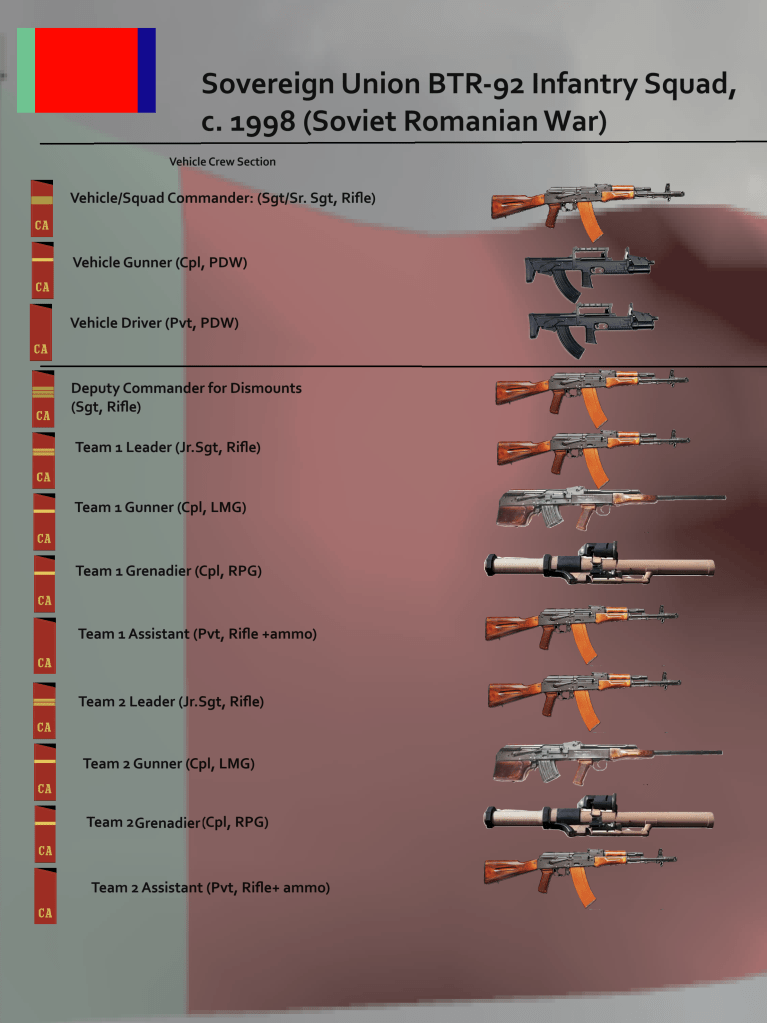
BTR-92 Squad

First I did my past piece on Mobile Corps squads, then came the BTR-92. Now the most ahistorically Soviet part of All Union’s military can be made with the two mixed together. In-universe, the creation of this squad was an extremely involved and controversial process.

  • Unlike previous examples, including the mobile corps own BMP/IFV squads, this operates two organizational fireteams. With lots of teeth-gritting, the doctrine emphasizes that “if necessary”, it can operate as a unitary squad or simple overall fire/overall maneuver element. In the Soviet-Romanian War, many did.
  • This has a full-time deputy squad leader for dismounts, whose job is pretty obvious. An emphasis was put on out-of-vehicle operations as these units were designed to spend more time outside.
  • The PDW is the A-91M. The LMG is the “Vepr”, one of many bullpup RPK proposals. The light RPG is in real life the South African (!) Denel FT5 (since a post-apartheid government would be very close to a surviving USSR, and since a post-apartheid arms industry would be very desperate, a license deal for this Goldilocks Rocket Launcher is not impossible).
  • This can be detailed in the Kestrel Publishing entry: Clash: Soviet BTR vs. Romanian TAB . Despite the name, about 80% of that book is just devoted to the Mobile Corps BTR reformation. The pieces on the Romanians basically amounted, cruelly but not inaccurately to “They just followed 196X BTR doctrine, had the equipment to match, and lost”.

Coiler’s Culmination Calculator

As a fun side project, I made my first (intentionally abstracted) wargaming tool. The goal is to see the culmination point of an offensive.

Assumptions: The attacker is consistently advancing, however, the defender is fighting back hard throughout. The units of the attacker participating in the campaign are not going to be rotated out, hence they will only receive small and piecemeal reinforcements/replacements throughout.

This simple tool works as follows:

  • The attacker starts with a point total of 100.
  • For each objective, roll 1d10. 1 means the objective is taken unopposed and the force suffers no meaningful losses. 2-6 is a minor engagement where the unit suffers a point loss equal to 1d6 points. 7-10 is a major engagement where the unit suffers a point loss equal to 1d6+10.
  • After every turn, the faction regains 3 points.
  • The offensive will have culminated when the point total reaches zero or less.

Example:

  • Objective 1: 9: 16 points lost. 3 regenerated. 87 points.
  • Objective 2: 8: 12 points lost, 3 regenerated. 78 points.
  • Objective 3: 6: 1 point lost, 3 regenerated. 79 points
  • Objective 4: 6: 6 points lost, 3 regenerated. 76 points.
  • Objective 5: 1: No losses, 3 points regenerated. 79 points.
  • Objective 6: 3: 5 losses, 3 regenerated. 77 points
  • Objective 7: 10: 11 losses, 3 regenerated. 69 points

Etc….

Figures of course can be changed depending on context.

Weird Wargaming: The SW40k Project

I’m delighted to announce the initial release of a Starmada project of mine: The Star Wars vs. 40k fleet lists. Based on the fanfic, it aims to bring the battles from said fic to the generalist wargame. So far initial Imperial Navy and Republic fleets have been made. More, including Astartes, Separatists, and whatever else my brain thinks up, is planned.

Notes:

  • Ships are judged based on absolute and not relative size. This means the 40k ships are usually gigantic with the HP to match.
  • The Republic is a swarm fleet whose ships are almost always pound for pound inferior, just like in the fic itself.

Weird Wargaming: The Realistic Space Warship

In the late 1970s, the BDM Corporation did a study for what a plausible space warship could look like (thanks to the invaluable Atomic Rockets for its analysis).

It has a spin-gravity crew quarters, is powered by nuclear reactors, and its armament consists of a laser in a de facto turret, a forward facing railgun, and a rear-facing particle beam (because the radioactive particles can’t risk hitting the ship).

The Space Shuttle in the picture is for scale-the whole thing is about two hundred meters long!

Weird Wargaming AAR: Starmada Star Wars/40k

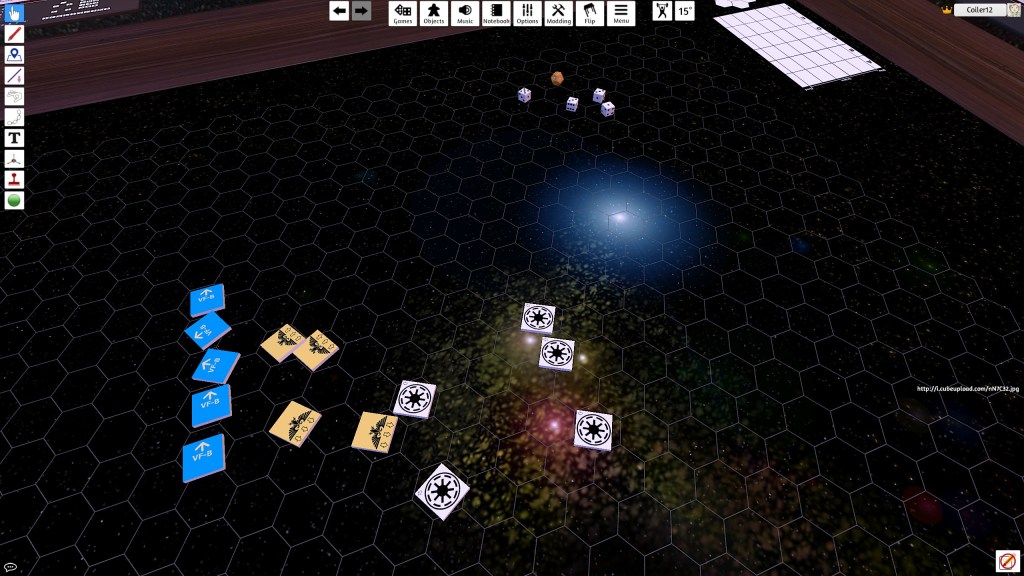
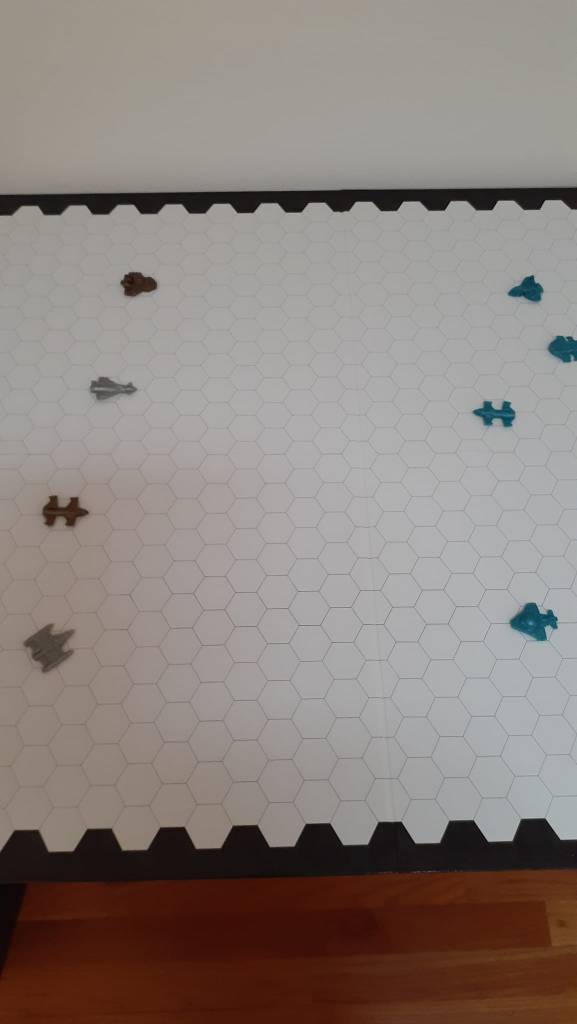
So inspired by the Star Wars vs. Warhammer 40k web serial, I made crossover fleet lists for Starmada. Then using Tabletop Simulator for a convenient hex map and making some quick counters in its editor, I ran a small fleet engagement of four Imperial frigates vs. five Republic ones.

The fleet lists are still subject to major revision but suffice to say the Star Wars side is about accuracy and fighters and the 40k one about brute power and durability. In this case brute force won out as the Imperium destroyed four Republic vessels for the loss of only one of their own.

Naming a Submarine Class

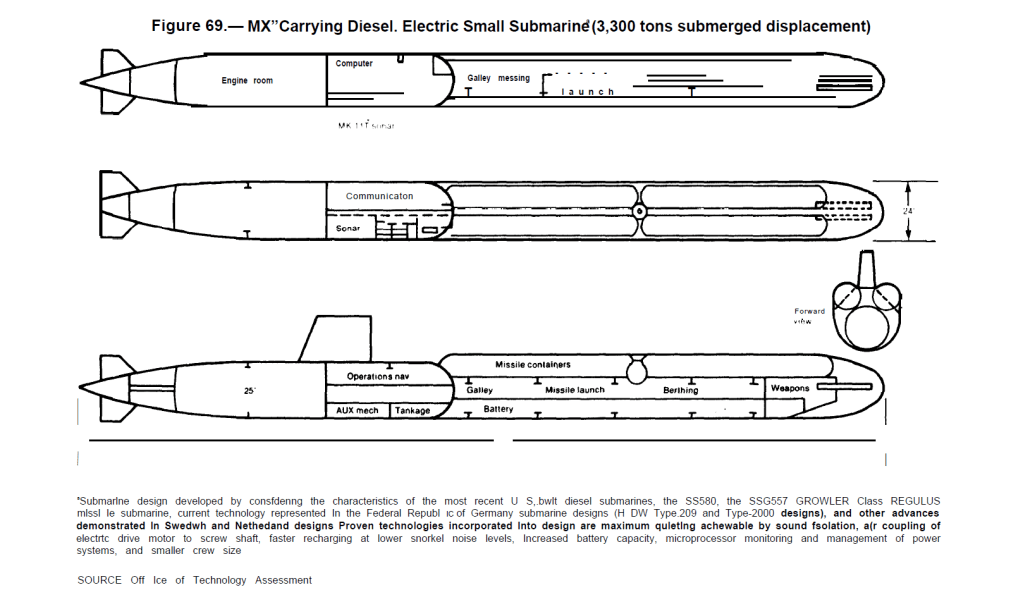
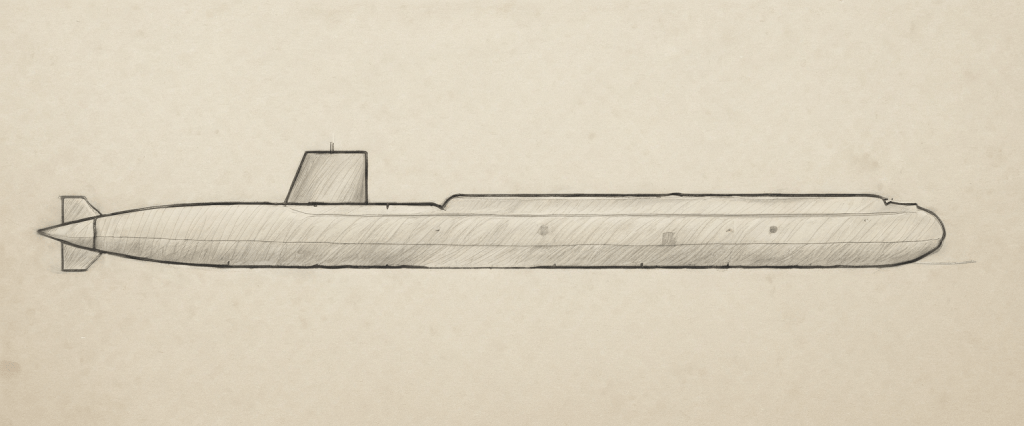
I’m torn with submarine names for the MX-SSB class, a real proposed design that I’m using in All Union

(Bottom picture made in Stable Diffusion from the outline of the sub above)

The problems are:

  • The class is large at circa 50 boats, so the naming scheme needs to support such a large class.
  • There is no historical precedent since the US never used diesel missile subs, much less in large numbers.
  • Both fish and people just don’t seem right to me (subjective I know)

I’m leaning towards lakes (ie, the Lake Tahoe class with some/all of the Great Lakes thrown in), but am wondering if there’s something that just can click. Thoughts?

Weird Wargaming: Patton’s Division of the Future (of 1932)

Then-major George Patton in 1932 made a long essay about the ideal army for the “war of the future”. Most importantly, it had order of battle charts. The whole thing is well worth a read, but some thoughts/highlights:

  • Underestimated motorization, saying you can have agility (professional army) or mass (conscript army) but not both. This was true in WWII (even for the Americans to an extent), but postwar motorization rendered that largely (if not entirely) moot. He proposed nationalizing civilian trucks for motorization in wartime.
  • Proposed a standing army of about 315,000 people. Which uh, isn’t actually that much less than the post-Vietnam volunteer army. Especially adjusted for national population size.
  • Patton is extremely Pattonesque. Believing his higher-trained army can always beat a numerically superior qualitative one (uh, not always the case), and being a grandfather of manueverism (not surprising). To his credit he does acknowledge the problem of keeping an elite army elite after attrition (and showing knowledge of how pre-gunpowder, almost all casualties were in the rout, whereas firearms made large losses inevitable against peer opponents)
  • The most unusual part is at the smallest level, which consists of a “section” built around a tripod-mounted belt-fed machine gun and has 19-20 men at paper strength. It’s divided into a rifle squad (fairly plain ten rifles) and an LMG squad (one LMG gunner, several assistants for it with pistols, and four riflemen) . Two such sections form a platoon.
  • Above that it’s a now-familiar triangular division. Three line platoons in a company, three line companies in a battalion, three line battalions in a brigade, three brigades in a division, a divisional tank battalion. Aka, by and large the standard post-WWII division.
  • Brigades would have a company of heavy machine guns (at the time an anti-tank weapon) and a battalion of three 75mm batteries (two field guns and one howitzer). Of note is no apparent organic division artillery, with it either being the brigade artillery or handed down by corps (the WWII Soviet prioritization taken to even greater extremes)
  • The 39-strong divisional tank battalion is mentioned as having tanks of the “Vickers-Armstrong or modified Christie type”. Tank platoons are a fairly unusual “vanilla and Firefly” type of having three “normal” tanks and one tank chassis with a larger-caliber cannon. At the time, this wasn’t unusual. Everything above platoon for tanks is conventional.
  • An infantry division has an organic paper strength of around 8,000 people.

All in all a very fascinating document. Patton may have been prescient in making a modern army, but I still wouldn’t want him commanding it (he would have been a good armored division commander, but deserved nothing higher). And of course, this army is easy to make and wargame in the underappreciated interwar period.

(Special thanks to the Tactical Notebook for its own analysis of Patton’s proposal which brought it to my attention)