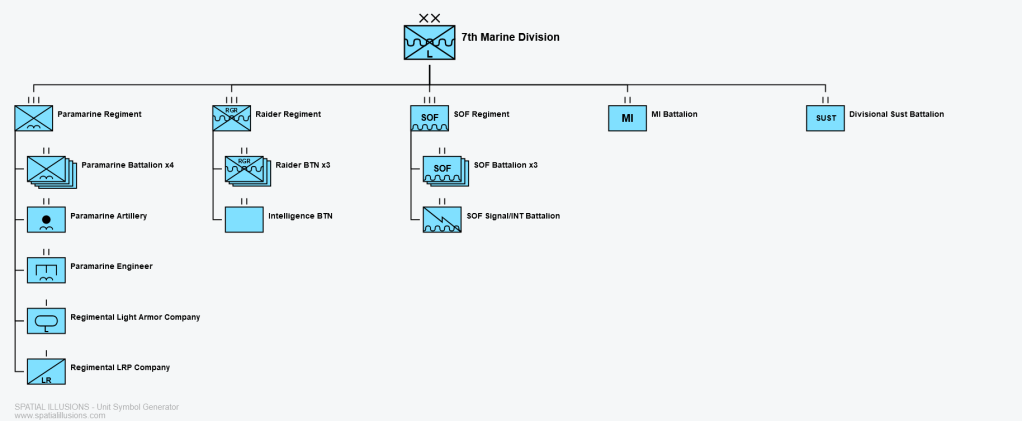
I talked about my fictional 7th Marine Division before. Now I have a more detailed personal organization (though still undoubtedly rough and with inaccuracies). Here it goes. ORBAT chart courtesy of the Spatial Illusion Unit Symbol Generator.
Paramarine Regiment
The Paramarine Regiment is like many other light airborne units, with the exception that it has four battalions instead of the usual three and its artillery battalion has thus been increased to four cannon batteries likewise, along with the other regimental support units similarly beefed up. This is to allow each battalion to serve as an independent combined arms unit to hold ground if necessary (ie around a battery in a fire support base with a battalion of infantry and an LRP platoon and light AFV platoon).
The actual battalions are largely standard triangular airborne infantry battalions.
Raider Regiment
A lighter force with less organic capability, the raider regiment is simple, with three battalions, each of three raider companies and a heavy weapons company. A regimental intelligence battalion is included because of the importance of intelligence and planning to their missions. It’s meant as a direct action-slanted commando force ie the classic Rangers.
SOF Regiment
The SOF regiment has three SOF battalions, below which any formal organization would be varied and inexact by nature (each has a number of teams, varied as you’d think, but around 10-15 each). Its communications/intelligence battalion is there similar to the ranger regiment.
Divisional Assets
Divisional assets are just more support and administrative elements, there because the 7th is not intended to be a “field” organization.
Logos
Some Stable Diffusion concepts for the logo of either the division itself or one of its subunits. You’ll notice a theme of black birds. Yes, I know crows are already the mascot animal for electronic warfare units, but oh well.
Usage
It goes without saying that in All Union, the 7th Marine Division was formed and saw action, including the 2002-2009 conflict in Western Sahara that marked the largest and bloodiest war the US military fought in that TL. If I ever need a fictional American commando force in my writing, I can always use it.
So the conventional forces of the United States in All Union, unlike its superpower counterparts, have not been the most central to any of my drafts (yet…). Therefore I figure I should infodump some of my musings on it right now.
Background
The reformation of the USSR brought about a period of aimlessness among the US Army. With the fall of the Berlin Wall and the former Warsaw Pact states forming an independent de facto buffer, priorities became much lower. Going from all of Germany to the northern tip of Norway and Thrace is somewhat of a downgrade.
That being said, there has been a shift of forces to the south. The US 9th Infantry Division is in Turkish Thrace to, in the event of a Thraciapocalypse, serve as a mobile counterattack force. The lighter 51st Infantry is in Northeastern Greece near the triple border to make sure the rival NATO countries play nice serve as a tripwire for any Soviet-Bulgarian push south.
The need for “Americi-BTRs” that historically was filled by the Strykers came in the form of LAVs, both the LAV-25/Piranha of real life USMC fame for that branch and the unrelated but similarly named LAV-300/600 series for the Army.
The medium-ization of the Army came as followed: Two brigades in existing heavy divisions with their Bradley mech inf brigades replaced with LAV mech inf brigades ie BMP-BTR mixes, two “medium-heavy” divisions based around LAV-300s with a divisional tank battalion that would stay behind on lower-intensity deployments, and one “medium-light” division with the LAV-300 series, more uparmored HMMVs as the infantry carrier, and no organic tanks. For the USMC, the Seventh Marine Division came into being, along with Combined Arms Regiments (mixes of tanks and LAV-Bisons proposed in real life) for the three active USMC divisions.
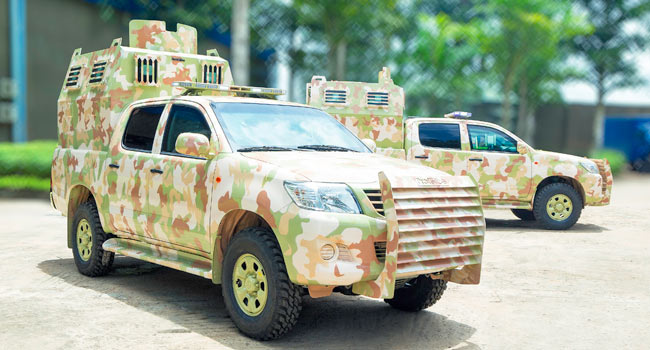
Stable Diffusion gave me a chance to make something I’ve long imagined: A truck-APC belonging to a Seleucian (one of my OPFOR countries) Motorized Special Forces unit. First, the picture itself.
There are many existing heavy-duty pickup conversions like this: An armored pickup with the bed replaced by a capsule that’s even more fortified.
(You get the idea)
Now for their organization: Seleucia’s large “Special Forces” components are motorized to varying degrees. The quotation marks are because few of them are what NATO would consider “special forces”, with many being simply conventional troops with better training and motivation than the other ragged masses of that country’s huge army. Still, Seleucian motorized SF have shown their capability.
A Seleucian motorized SOF battalion is similar to a light infantry one, only with armored personnel carriers. As the mere “transport” capacity is prioritized, motorized SOF often ride in older and/or cheaper vehicles-like armored pickup trucks. APCs frequently hide after dropping off their dismounts. A common defensive tactic for Seleucian commandos is to drive close to an ambush site, conduct the ambush on foot, then scramble back to their carrier and move to another one later on.
However, it is not uncommon for Seleucian motorized SOF to accompany heavy units of tanks and SPGs in conventional operations. Here they fight similarly to Stryker/BTR style infantry in faster wheeled APCs of other countries. In conventional defensive operations, motorized SOF have a somewhat unusual role as mobile antitank detachments. Thanks to their skill, mobility, and flexible organization, SOF battalions with large amounts of of anti-armor weapons can be used similarly to the tank destroyers of other nations.
The Saxon and BTR-152 are examples of the basic style of APCs frequently found in Seleucian motor SOF units. Tracked vehicles, mostly basic ones like M113s and MTLBs, are rarer but not unheard of, especially where the terrain suits them.
Using a ballistics calculator, I came up with a 185mm artillery piece with the following performance. Why that? Because few/no real guns have the caliber, and I wanted something between 152/155mm and 203mm. When not obtained via the calculator, results are extrapolated from the S-23, the closest real life equivalent, with some enhancements like faster loading and lighter weight to simulate better technology:
185mm Artillery:
Maximum range: 27-41 km, depending on ammunition.
Rate of fire: 2 rounds/minute
Average shell weight: 70-75 kilograms
Approximate Mass: 13,700 kg
The artillery piece is usually self-propelled on a tracked mount, but towed variants do exist. It tends to serve as a corps/army level weapon whose primary goal (and largest shell portion) is counter-battery and other missions where range is more important than size, although it can do anything a big gun can. Advanced users have developed nuclear shells for it, and the usual conventional ammunition types (regular HE, cluster, etc…) have been made.
In Nuclear War Simulator, one of my favorite creations to use and drop is something I’ve called the “Huangdi Bomb”. The name, after Chinese for “Emperor”, is a pun on Tsar Bomba. Only this has a bigger boom at 75 megatons. It’s also, in the backstory, a lot more advanced and sophisticated. Unlike the publicity stunt that was the Tsar, the Huangdi is a mass-produced, deployable weapon capable of fitting inside either an H-6 or large ICBM without issue.
It’s also, judging by the maximum payload of the Badger and its yield (the classic yield-weight calculation), the most efficient nuclear weapon ever made. As it has a multi-decade lead on the other megabombs, this isn’t surprising. As for how and why such a beast is used, the theories for the gargantuan warhead are hitting extremely large targets, making accuracy issues irrelevant for simple countervalue operations, improving warhead efficiency in a big design before trying to apply it to smaller ones, and contributing to deterrence by intimidating would-be-opponents with its yield.
In various NWS scenarios, I have about twenty Huangdis made overall, in both air-dropped and missile carried versions.
Imagine a ballistic missile made by as close to as pure a League of Evil as it’s possible to get. Such a missile did not actually (to public knowledge) enter service, but it was worked on by several of the world’s most nefarious regimes. I speak of the Condor II/Badr-2000 (and undoubtedly many more names if it had spread) missile that was worked on by the Falklands-era Argentine junta, Saddam Hussein’s Iraq, and Egypt’s military regime (which has been credibly rumored to have continued development on other long-range missiles based on it in secret by itself.)
In Nuclear War Simulator, if I want a basic strategic missile for a rogue nation I’m giving plausible nuclear weapons, I give them Condors. As a final version of the Condor II was never explicitly built and tested, exact figures cannot be determined. However, range has been stated at 500-1200 kilometers and circular error probable from 500-50 meters, with even the larger number being acceptable for a nuclear warhead aimed at a city. The UNMOVIC report on Iraq’s missile program stated that the Badr-2000 had more modest goals: 1 phase with a range of 620 km and a CEP of 6.2 kilometers, followed by Phase 2 (620 km/620 meters) and Phase 3 (750 km/750 meters). The ballpark is narrow enough for me to use a “considerably longer than INF limits, and not too inaccurate” judgement in individual cases.
The payload was about 300-500 kilograms, and the missile around 80 centimeters in width. This would require a small warhead to work properly, and a light one to push the missile to its intended range. The first-gen Iraqi warhead would have been too big, but it would not have been an insurmountable problem given enough time (or, in my backgrounds, an AQ Khan-style nuclear network providing the materials/documentation to build a ‘standardized’ warhead small enough to fit into a Condor II).
To have every regional nuke-seeker get Condors is still a bit of a stretch. Historically, the foreign components and shaky finances of the developments gave opponents leverage that they used to squash it. But to have some of them slip through is not entirely implausible.
So first I must say that I owe a lot to the Battle Order website and channel for inspiring me. Go check it out. Anyway, the GENFORCE-Mobile document, while a tour de force overall, has surprisingly little on the absolute smallest unit tactics. It does say that the basic and mobile forces do use very similar tactics (it’s just the latter have more training on them). Anyway, there isn’t much to say for the high-intensity doctrine. Primarily use lines, squads are unitary without teams, the vehicle commander doubles as squad leader, and that’s that.
The table of orders and equipment does (by virtue of looking at quantities of in a platoon), have one RPK variant and one RPG variant (marked as an RPG-29 in that example) per squad in the mobile forces, similar to historical practice. The company weapons platoon has an array of light ATGMs (marked as Metis, but those would probably be superseded) and PKM belt-fed machine guns.
(Strangely, the early 199X OPFOR squad is actually weaker on paper dismounted than its predecessors, with only one magazine machine gun instead of two belt-fed ones).
Soviet unitary squad line. From DDI-1100-7-776, The Soviet Motor Rifle Company, 1976
The legacy regular army, basic forces, or whatever you call them uses this doctrine relatively unchanged. But what about the new ones?
I had the Sovereign Union’s mobile corps using tank-based IFVs. There have been similar attempts in actual history, yet I figured these would be the more interesting. Basically the priorities shift a lot here. The historical BMP-3 is skewed in exactly the wrong direction. Instead of a glass cannon packed with all kinds of boom-makers, the focus is on shielding the newly-important resource with tank-level armor.
So in this timeline the BMP-3 is one of those things that only sees small amounts of use in its home country, but nonetheless achieves success on the export market. The Mobile Corps in All Union primarily rode into Romania with either BMP-2s or IFVs based on existing tank platforms. Whereas the historical T-64 APC proposals were an act of desperation, these have a deliberate goal of more protection and mass production ability, similar to the Israeli tank-APCs of real life.
Two real Soviet surplus IFV proposals are two from Ukraine, the circa 36 ton “Vavilon” on the T-64 chassis and the 46 ton “Berserk” on the T-84 (upgraded T-80) one. Apart from trading protection (the Vavilon was advertised as having STANAG 6 30mm AP protection and being able to withstand a 125mm round from 500 meters, likely against the front) for weight and logistical issues, the armament is pretty standard IFV fare: A 30mm autocannon, various machine guns and grenade launchers, and ATGMs. Crew of both is three for the vehicle itself and up to eight dismounts.
Now for the fun part.
Option A: 7+3 Unitary
Composition: Squad leader/vehicle commander (rifle/PDW), vehicle driver (PDW), vehicle gunner (PDW), 1-2x machine gunner (LMG), 1x rocket launcher (RPG), 1x assistant (rifle+RPG ammo), 1x rifle grenadier (self explanatory), 2-3x riflemen (rifle). One of the riflemen could be a “deputy leader” who commands dismounts when the commander stays with the vehicle.
This is the smallest and most conservative organization. It’s designed to duplicate the BMP procedure of having one empty paper-strength seat so that platoon/company troops can ride along. It fights like a standard unitary squad.
This also fights as a unitary squad, although a marksman is moved to squad level and the deputy commander who controls the dismounts is a permanent table position. Still fights as a simple unitary squad. Marksman is optional
Option C: 4-4-3 Fireteam
Composition: Squad leader/vehicle commander (rifle/PDW), vehicle driver (PDW), vehicle gunner (PDW). Fireteam A: Team leader (rifle), team machine gunner (LMG), team launcher (RPG), rifleman (rifle, ammo for MG/RPG). Fireteam B: Team Leader (rifle), team machine gunner (LMG), team launcher (RPG), rifleman (rifle, ammo)
This is a massive divergence and features the dawn of the fireteam, with two four-man elements and two RPG launchers (with one of the riflemen possibly a marksman). Naturally, more advanced formations and dismounted maneuvers are used.
My personal choice for the sake of the All Union story would be Option B. It’s still similar enough to be comfortable, informal task-organized teams can still easily be formed if need be, but is also more advanced. Not just having a squad marksman but in having a specific dismount commander, which makes it easier for the APC to act as part of a separate “armored group“.
The Rhodesian Bush War passed without a decisive 1975-style conventional campaign. Of the two main guerilla organizations, it was the Ndebele, Soviet-favored ZIPRA that placed more of an emphasis on conventional operations, compared to the majority Shona, China-favored ZANLA’s “people’s war”. A combination of largely successful preemptive strikes by the Rhodesian military and a (smart) focus on inherent strengths than weaknesses by the opposition meant that the large battle never came.
The common wisdom about such an operation “Zero Hour” (as one code name for it was) is that it would be stopped with ease (although it does not help that most surviving prominent sources are either from the ZANLA-veteran regime or former Rhodesians, neither of which has an incentive to talk up their opponent). But even if the first such offensive was stopped with ease, the rebels definitely had the people and enough hand-me-down aid to try multiple times.
Such an offensive would feature the fairly light Rhodesian military against an opposition that would have at least T-34/85s, BTR-152s, appropriate artillery, and even rumors of fighter aircraft. (If said fighter aircraft could disrupt the deployment of the infamous Fire Forces, it would not be good for the Rhodesians). It can obviously be played with any kind of wargaming ruleset that can handle early/mid Cold War equipment and formations.
The Command database now has many more hypothetical proposed missile upgrades of the Iowa-class battleships, including adding a ramp for fixed-wing aircraft in one entry (!). These ships bring a very strange feeling to me. Because they inspire equal parts awe, horror, and disgust.
See, the problem is that missile launchers intended for long-distance operations render the 16 inch guns nothing but a heavy explosive risk. This has been known in real life too. There was a serious consideration during the reactivation of the Iowas (primarily to have tons of box launchers for Tomahawks) of just leaving the guns closed up and inoperable. They’d be unlikely to fire in a fleet action, and if they did fire, it couldn’t be good for any sensitive machinery in the rest of the ship.
So my head regards the Missile Iowas with derision. But my heart adores them. Simply because of how crazy and audacious they are. Do I really need to explain this?
Anyway, for the boring details, they’d likely be used in a way similar to how the real 1980s reactivated Iowas were. As the centerpiece of surface action groups. If you wanted to be cold-hearted, you could treat them as expendable sunk costs. But you can also revel in the absurdity.
After World War II, various veterans of the vanquished (to put it that way) offered to design and make various military platforms. Only a few actually entered production. Kurt Tank designed the HF-24 Marut and sputtered-out Pulqui jet fighters. An Italian submachine gun, the TZ-45, found its way into the Burmese Army. Most fell victim to the same culprits: A combination of Cold War military aid and cheap Allied surplus sweeping them aside, while not being high-performance enough to beat them that way.
Yet for alternate historians/wargamers/writers wanting to add various wunderwaffe to their scenarios, it’s not that implausible that a few could slip through here and there. They’d mostly be out of the way unless history moved to that region (for instance, the Willy Messerschmidt-designed HA-300 would undoubtedly see service in the Arab-Israeli Wars if it entered mass production.) But they could still be done.
What would be most interesting would be the really exotic and large Luft 46 aircraft and wunderpanzer tanks. Those would probably need veto-able foreign engines (or other less obvious components) and would be no picnic to design. But they would be the most fun to play.









 Fuldapocalypse Fiction