It’s June 6, the day of the Allied invasion of France. Not the most decisive battle of World War II, but certainly one of the most complex and famous.
Tag: World War II
Review: Secret Luftwaffe Projects
Secret Luftwaffe Projects
Through diligent research and the uncovering of the original drawings and plans, Walter Meyer sheds some light in Secret Luftwaffe Projects. As a basic guide to the Luftwaffe wunderwaffe napkinwaffe, this is excellent. It also doesn’t pretend to be anything that it’s not, and doesn’t extrapolate or make wild claims.
But what it is is (deliberately) broad, shallow, and focused entirely on the basics. Each wunderplane gets a very short description of its role and a sheet of its (intended) stats. There’s no context or even reasonable speculation, but this isn’t the kind of book for this. It’s an encyclopedia of planes that never were, and in that role succeeds beautifully, complementing rather than competing with other books on the same subject.
And besides, it’s very fun to see all the crazy contraptions one after another. I recommend this book to any aviation enthusiast or anyone interested in the bizarre, because a lot of the planes here are just weird. But what did you expect?
Review: In The Presence of Mine Enemies
In The Presence of Mine Enemies
Harry Turtledove’s In The Presence of Mine Enemies is an expansion of a previous short story that tells the tale of a secret Jew in an Axis victory world. There’s turmoil in the Reich, and Turtledove’s classic “obvious historical parallel” is to the late USSR with obvious “Gorbachev” and “Yeltsin” figures. This is a very frustrating novel, and it shows both Turtledove’s strengths and weaknesses at full blast.
The obvious strength comes from its set pieces. The story it was based on was widely acclaimed, and in particular the “August Coup” is very well done. It also has an interesting advantage in that it’s one of the Axis victory novels that is the least unintentionally glorifying of them (as described in this post). The only wunderwaffe are the ICBMs the Germans used off-camera to blast the Americans into submission after World War II, and it’s hard to imagine a less romantic setting than the last days of the USSR. Finally it has a sinister tone and unromantic in general. The reformists are still racist (ie we want elections, but only involving “proper Aryans”), and the “August Coup” is foiled not by any fluffy ideals, but by exposing the Jewish heritage of one of the conspirators.
That works. The rest of the novel does not.
It’s long, slow, and padded out with stuff like games of bridge repeated constantly. Much of the book is given over to a lame love triangle drama. While the parallelism is understandable, it can get a little too blatant at times. The good parts of this book are great, but the bad parts dramatically outnumber them. It’s an interesting discussion piece, but I wouldn’t really recommend it for pleasure reading.
A Thousand Words: Armoured Commander II
Armoured Commander II
Surrounded by all kinds of danger, a threat can come out of nowhere and kill you. This describes war, but it also describes roguelikes, the kind of deliberately unfair randomized video games that have occupied a niche for decades. Naturally, someone had the great idea to combine them. The result was the Armoured Commander series, with the second installment being the subject of this review.
You are a tank in World War II. You can command just about any kind of tank in any campaign at any point during the war. Try and survive in a world of ASCII graphics and constant threats. The deliberately ultra-retro UI gives the game a bit of a learning curve, but I didn’t consider it too hard. A more intentional “issue” is that you get what you want. I learned the hard way that a Renault FT means you’re slow, you’re weak, you’re inaccurate, and the commander has to do a ridiculous amount of multitasking.
This is an excellent game for anyone who likes roguelikes and/or tanks.
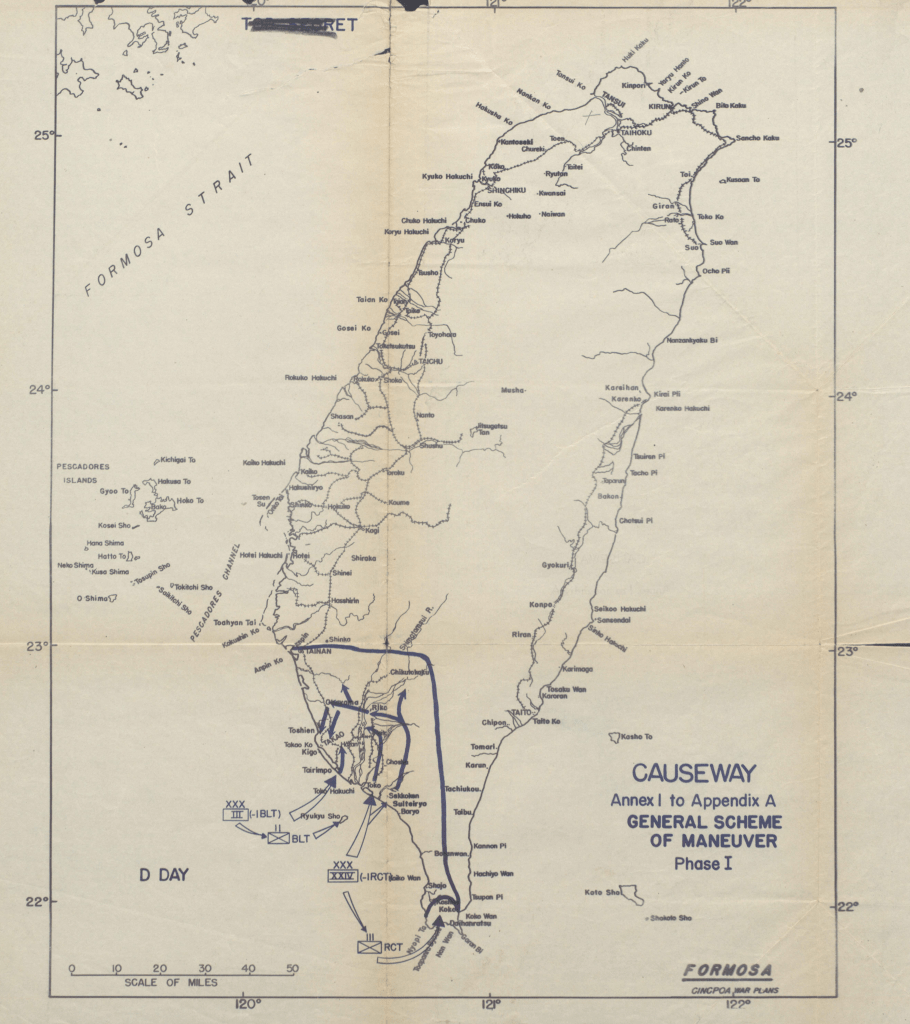
Operation Causeway
Operation Causeway was a proposed plan by the US military in World War II to land on Taiwan. It would have been a massive high risk, high cost, and high reward operation. In actual history, Causeway was shelved in favor of landing in Luzon.

The Causeway documents are useful not just as an alternate historical reference, but also as a general guide to what a large amphibious invasion of Taiwan would entail (something that, for some mysterious reason, has remained relevant postwar).
August 6
Today is August 6, the anniversary of the Hiroshima atomic bombing. What once took a thousand airplanes could now be accomplished with one.
Review: In The Balance
Worldwar: In The Balance
In 1994, Harry Turtledove decided to run with what can rationally and scientifically be called one of the most awesome fictional concepts ever: Aliens invade during World War II. The opening book, In The Balance, starts things off with a bang.
A group of lizard-aliens known only as “The Race” with juuust the right amount of technological balancing to make for a great story attack a humanity that’s stronger and more advanced than anticipated. While the issues Turtledove has with long series (pacing, repetition, etc…) appear even during this book, they’re not deal-breakers. And the weaknesses are more than made up for by the amazing first impression the book makes.
If you like alternate history, science fiction, World War II, or just strange concepts in general, this is worth checking out.
Weird Wargaming: The Axis Contraptions
After World War II, various veterans of the vanquished (to put it that way) offered to design and make various military platforms. Only a few actually entered production. Kurt Tank designed the HF-24 Marut and sputtered-out Pulqui jet fighters. An Italian submachine gun, the TZ-45, found its way into the Burmese Army. Most fell victim to the same culprits: A combination of Cold War military aid and cheap Allied surplus sweeping them aside, while not being high-performance enough to beat them that way.
Yet for alternate historians/wargamers/writers wanting to add various wunderwaffe to their scenarios, it’s not that implausible that a few could slip through here and there. They’d mostly be out of the way unless history moved to that region (for instance, the Willy Messerschmidt-designed HA-300 would undoubtedly see service in the Arab-Israeli Wars if it entered mass production.) But they could still be done.
What would be most interesting would be the really exotic and large Luft 46 aircraft and wunderpanzer tanks. Those would probably need veto-able foreign engines (or other less obvious components) and would be no picnic to design. But they would be the most fun to play.
Review: Parting Shot
Parting Shot
Written by nuclear expert James Kunetka, Parting Shot promised a more grounded, realistic look at the infamous “The Germans have a nuclear bomb” World War II alternate history. When I saw the Sea Lion Press review, I knew I had to get it. So I did.
It’s indeed the most plausible “WWII German nukes” AH out there. In fact, it’s arguably too much so. This is a rare example of the kind of book that’s possibly too realistic for its own good. The Germans go with a gun-type device, because that’s the easiest to build. Although that arguably just shifts the bottleneck from the physics package itself to uranium enrichment-it’s why I’m certain that’s the reason the Iraqis went with a more complex but less U235-hungry implosion design. But then again, having a cheap thriller drag you into plausibility arguments isn’t the best itself.
And make no mistake-the final fight leaves no doubt that this is intended as a thriller. Only the contrivances of that (and other scenes) mixed with the intent to be more realistic leads to an awkward stumble. The very nature of a program that wasn’t even close becoming unrealistically successful is jarring in and of itself. And even the bomb proper didn’t really work for me, being a cheap thriller cliche just short of “HITLER LIVED!”
Finally, the structure of the book works against it being a good thriller. Having stuff told in the past tense and jumping between past and (then) present takes away a lot of the drama. This is still an ambitious book, but it kind of falls apart from that very quality. If it’s too realistic for its own good, it’s also too scattered.
Review: Hitler’s Last Levy
Hitler’s Last Levy
Hans Kissell was chief of operations for the German “Volkssturm” (lit. “People’s Storm”), the infamous last-ditch militia created at the end of World War II. In Hitler’s Last Levy, published in German in the 1960s and translated decades later, he told their story. It’s an interesting look at a horrific footnote.
The Volkssturm was both a desperation formation and Martin Bormann’s attempt at making his own pet army (like the SS was for Himmler or the Luftwaffe ground formations were for Goering). Kissell goes into detail and includes a massive amount of direct primary sources. While this is a work by a German WWII commander, its subject matter makes it at least a little better than the usual “we fought in our unstoppable kitty-tanks until we ran out of ammunition and fought totally cleanly” memoirs. It’s impossible to portray the ragged old men as some kind of super-army, and they had far less opportunity to commit war crimes simply because by that point they were losing. And Kissell doesn’t hesitate to point to their (many) weaknesses.
Because of this, and because of the wealth of primary sources and details (for instance, describing how on paper, some Volkstturm battalions had an organic battery of captured anti-tank guns), I recommend this for anyone wanting to know about them or similar emergency territorial formations. Yes, it’s dated and slanted. But it’s not nearly as bad in those regards as you might think.