Review: Bush vs. The Axis of Evil

Bush vs. The Axis of Evil

Another former internet timeline turned book, Bush vs. The Axis of Evil amounts to “What if World War III broke out in the early 2000s”?

It starts with Hezbollah conducting 9/11 while thinking it’d just be a minor message-sender, which gets it off to a “good” start. All this is told in a long series of blocky exposition posts with the occasional in-universe “book excerpt” that mysteriously resembles a blocky exposition post. Anyway, this leads to a spiraling 200X WWIII against Iraq, Iran, and North Korea at once, with such amazing things as:

  • Millenium Challenge 02 being used as a serious reference for a Battle of Hormuz, which leads to a carrier (the Lincoln) being sunk. This is a “good” benchmark for how militarily plausible all of it is.
  • A copy-pasted Christmas Truce straight out of 1914 pop culture.
  • Divergences into music festivals and pro wrestling pay per views, since every contemporary internet AH timeline MUST have a “what about the thing?” pop culture segment.

There’s some potentially interesting divergences like the Unification Church converting ex-northerners en masse, but it squanders all of them. The bulk is just horrible gore-atrocity descriptions done with all the immediacy and intensity of the instruction manual for a 2009 Mitsubishi Lancer.

Stuff like this has made me a lot more respecting of Larry Bond, because he manages, however imperfectly, to combine storytelling competence with knowledge of military operations. Often you get one, or as in this case, neither.
Review: Tiger Chair

Tiger Chair

The recent Tiger Chair is the Max Brooks short story of the Chinese invasion of the American West Coast. Told in the form of a letter back home from a Chinese, it mentions how all the high-tech contraptions that were supposed to win were countered by know-how.

I’ll be blunt, this is not a good story. It’s told entirely through less-than-ideal exposition, and is loaded with both references that are bound to age like antimatter (mentioning some minor celebrity controversy from four years before this post that a normal person like the narrator would almost certainly not even know about) and older ones (there’s a ton of Iraq War lingo that makes me think at least part of this was originally written back in the 2000s).

But the real problem (at least for a military nerd like myself) is that Brooks’ Pentagon Reformerism is on every page. Obvious from as early as the Zombie Survival Guide (where he praised the AK and scorned the M16), this goes from “there are counters to high-tech contraptions” to “they make high-tech contraptions useless”. This is hammered home in a hamfisted manner continually.

Don’t get this.

The War Thermos

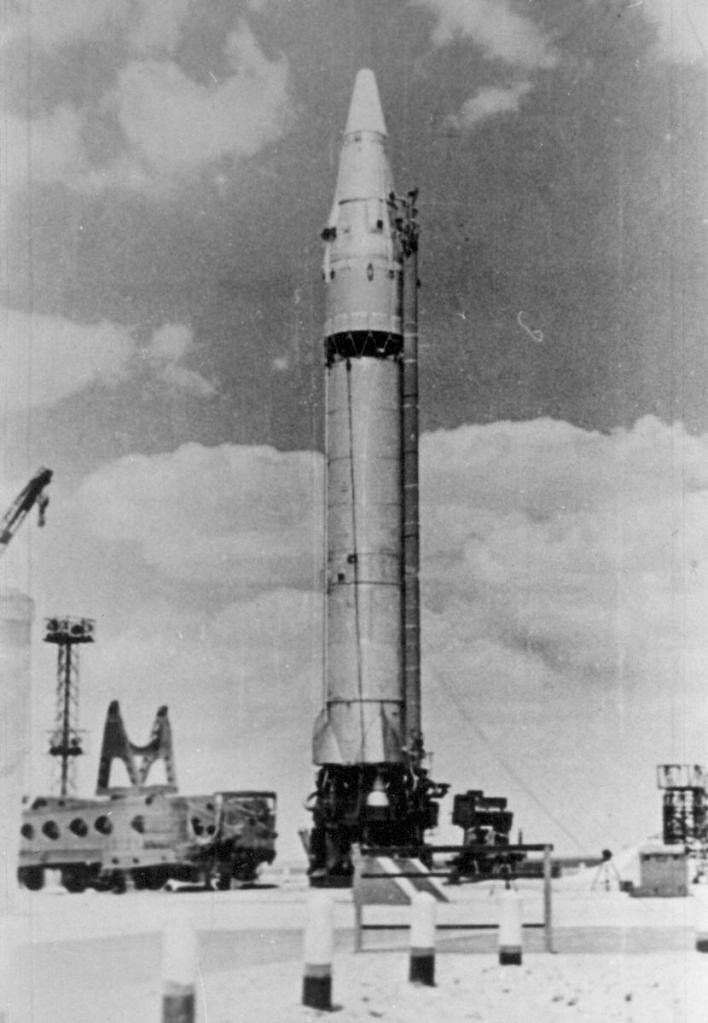
Readiness issues with liquid oxygen rockets historically retired them from the ICBM role once alternatives became practical (be it storable liquid or solid fuels). Yet one technological curiosity was an attempt to work around the issue.

A variant of the R-9/SS-8 ICBM with the typically obtuse Soviet industrial designation of 8K77 had the vacuum flask principle applied to its oxygen tanks. At least in theory, it would keep the liquid oxygen cold long enough for a fueled missile to wait on alert in a crisis. Vacuum flasks are of course better known in the capitalist west by their brand name turned generic name, the thermos.

It would be very cold and then very, very hot.

Squishy WW3 Issues Part 1

So the World War III 1987 blog just posted “The Squishy Problem Facing World War III Writers“. And come on, there’s no way I can not write a post in response to that. Here goes. The original blog is in Italics. I’ll start with the opening.

World War III novels, movies and even blogs are as diverse and imaginative as their authors choose to make them. Even in instances where multiple works of fiction examine the same hypothetical theater or overall conflict there will not be many similarities throughout the bulk of the novels. Different writing styles, plots and points of view are guaranteed to keep the reader fixed on a uniquely original WWIII scenario brought to life in novels.

I would somewhat disagree with this. Yes, on a micro-scale they can be different on paper (ie, it turns out very few involve invading Iceland!). But even by the standards of cheap thrillers, it’s a very small and very narrow genre. This is not an insult. It’s just how it is and how a “normal” reader will look at them.

But when the final chapters and plot conclusions roll around, it’s a totally different ballgame altogether.  And so emerges the root of a squishy problem.

You see, the majority of popular NATO-Warsaw Pact, Cold War World War III novels, movies and other types of fiction end in either nuclear war or the overthrow of the Soviet general secretary and politburo just moments before the Kremlin decides to launch an all-out nuclear strike on the US and Europe. Other novels and fiction incorporate aspects of both options in their concluding chapters, creating an ending that is somewhat different from those above, but lacks the creativity to be considered entirely new and exclusive.

Ok. I’m going to argue that this is the most realistic and sensible part. Because the loser is likely to go nuclear. And if not, some plot contrivance is necessary to stop that. I guess you could have some kind of negotiated surrender, but I can understand why readers wouldn’t find that very satisfying. The alternative is either a Red Army-style clean OPFOR win or just making a horrible squash, the latter of which is not exactly appealing.

The squishy problem facing writers of the World War III genre is similar to what Zombie genre has found itself confronting in recent years: How to make an age old topic fresh and appealing when a good part of the audience or readership already has a good idea of how it is all going to end?

Good question and one that I will definitely come back to.

1000 Posts

Fuldapocalypse has reached a thousand posts in five years. It’s quite the milestone. After Fuldapocalypse, I’ve gotten three full-length and two short novels self-published, and the broadening of my literary horizons has played no small part in that. After all, my SLP Smithtown books are based on the “men’s adventure” cheap thrillers I first saw with the Survivalist, and The Sure Bet King was inspired by the structure of Sidney Sheldon novels-both of which I didn’t get until after the blog started.

The funny thing is that none of them are conventional WW3s. Oh sure, I have the Soviet-Romanian War in All Union, but that’s far closer to the Gulf War than an even Fuldapocalypse. Kind of funny, when it comes down to it.

I’ll be honest, though. I’ve long had this idea kicking around in my brain, just as how I had a Soviet-Romanian War kicking around in my brain. And this does involve a conventional WW3-kinda. It’s more like a conventional World War III interrupted by someone else, hence why I’ve given it the working title Party Crashers. You may note the similarity to Turtledove’s WorldWar, which I’ll admit to being inspired by-and a lot of other things, of course.

But yeah, I may just crash the 198X Fulda Gap Party with some extradimensional invaders…

Review: Black Seas

Black Seas

TK Blackwood’s 199X Fuldapocalypse (or should I say Yugoslavpocalypse) continues in Black Seas. Not surprisingly given the title, it centers around the biggest missile age naval battle ever. The centerpiece is an alternate history classic: The nuclear Ulyanovsk-class carrier (I’m still debating whether to have them be in All Union or not, btw…)

That alone makes it a guilty pleasure for me (I’m definitely including the slightly similar Kherson-class “Ivan Tarawa” large landing ships in that universe, btw…). It’s certainly able to juggle a ton of plot elements as well as any other successful technothriller. Plus it has an Iowa-Kirov showdown! (A sadly realistic Iowa-Kirov showdown, which is all I’ll say about it, but still)

So yeah, this is a worthy successor to the past entries in the series and a fun WW3 naval showdown in its own right. I highly recommend this.

My First Zoom Roundtable

Had a delightful meeting with fellow Fuldapocalypse afficianados on the subject of “Cold War Gone Hot”, and on different points of divergence in particular. It was a great time. The video can be seen below. Topics range from alternate history in general to our books to pondering why all these conventional World War IIIs seem to happen in the 1980s and not earlier.