Review: In The Presence of Mine Enemies

In The Presence of Mine Enemies

Harry Turtledove’s In The Presence of Mine Enemies is an expansion of a previous short story that tells the tale of a secret Jew in an Axis victory world. There’s turmoil in the Reich, and Turtledove’s classic “obvious historical parallel” is to the late USSR with obvious “Gorbachev” and “Yeltsin” figures. This is a very frustrating novel, and it shows both Turtledove’s strengths and weaknesses at full blast.

The obvious strength comes from its set pieces. The story it was based on was widely acclaimed, and in particular the “August Coup” is very well done. It also has an interesting advantage in that it’s one of the Axis victory novels that is the least unintentionally glorifying of them (as described in this post). The only wunderwaffe are the ICBMs the Germans used off-camera to blast the Americans into submission after World War II, and it’s hard to imagine a less romantic setting than the last days of the USSR. Finally it has a sinister tone and unromantic in general. The reformists are still racist (ie we want elections, but only involving “proper Aryans”), and the “August Coup” is foiled not by any fluffy ideals, but by exposing the Jewish heritage of one of the conspirators.

That works. The rest of the novel does not.

It’s long, slow, and padded out with stuff like games of bridge repeated constantly. Much of the book is given over to a lame love triangle drama. While the parallelism is understandable, it can get a little too blatant at times. The good parts of this book are great, but the bad parts dramatically outnumber them. It’s an interesting discussion piece, but I wouldn’t really recommend it for pleasure reading.

Review: White Horizon

White Horizon

TK Blackwood’s 1990s continued Cold War gone conventionally hot series continues in White Horizon, an excellent installment. The Fuldapocalypse not only continues apace but features the powerful but often overlooked country of Sweden as a major setting. Featuring everything that has made the past installments so good, this was a joy to read.

The only real “problem” was teasing a successor. But that’s a good problem to have. This shows that the “cold war gone conventionally hot” subgenre still has quite a bit of life in it.

Review: World War III 1987

World War III 1987 Blog

Now that the main war has finished, I feel comfortable reviewing the World War III 1987 blog. Now, I must admit that I’m benefiting a lot from the context I’ve learned since I’ve started Fuldapocalypse. Part of it is that there are too few 198X Cold War Hot works of fiction instead of the too many. But another part of it is that web serials (which this ultimately is) and traditional books are apples and oranges. Or, to be more accurate, the relationship between them is like that between baseball and cricket, boxing and mixed martial arts, or rugby and American football. All involve hitting a ball with a bat/pileups of burly players/beating one’s opponent up, but anyone with knowledge of both would admit to big differences and often a lack of overlap.

Likewise, writing a book and writing a serial both involve creative writing, but they also have different priorities and require different skillsets to really excel at. And I can say that as a serial, the WWIII87 blog succeeded very. The first thing a serial needs to do-and I mean needs, is be punctual with updates. While there were understandable human slip ups, the update schedule was nonetheless brisk.

The update schedule was good, and so was the content of said updates. I could quibble with a lot of things, but I don’t really have the heart to go “no, the combat power of that division was (X) instead of (Y)” or nitpick minor technical details or circumstances. There are just too many soft factors and confounds in a hypothetical Fuldapocalypse to really call any one outcome plausible, especially given the unlikeliness of a sustained conventional conflict (Cold War era field manuals from both sides are very clear-a third world war is likely to start off conventionally, but highly unlikely to end that way). Let me just say I’ve read substantially worse and leave it at that.

I do have to take issue with the plotnukes, which do the Hackett style of “trade two cities” (Madrid and Gorky/Nizhny Novgorod), and which serve as a Deus ex Atomo at the end. Though even there there isn’t a real good way to do them. I think the least contrived option, which I really haven’t much of in other fiction is to have them deployed tactically against field formations but not strategically against targets in cities or deep beyond the front (kind of like a local version of Arc Light’s skewed extreme counterforce strikes to make a large exchange survivable). Like faster than light travel in science fiction, you just have to try and stay consistent and run with it. And I’ll admit the nuclear ride, when the story goes there, is a little bumpy to me. There’s also a little too much focus, IMO, on detailed actions in the peripheral theaters, which made the pace on the truly important Centfront somewhat slower than I would have liked.

That being said, this is a good effort and my hat’s off to the writer. My personal journey since starting Fuldapocalypse and reading so many books has broadened my mind, and the serial has progressed throughout this blog’s existence. Congratulations and good work!

Review: Spetsnaz The Inside Story

Spetsnaz: The Inside Story

There are few Cold War authors who I have less respect for than defector Viktor Suvorov (pen name), nor are there more who’ve influenced the thought and discourse around Fuldapocalypses in a such a negative way. Since Suvorov was one of the biggest popularizers of the mega-super Spetsnaz , I felt that his Spetsnaz: The Inside Story would be an excellent first book to review.

Now defectors, confidential informants, and the like are generally not the best or most reliable people. Some may be and have been deliberate double agent sneaks to muddle the waters. But more have had mundane issues. Issues like exaggerating their own importance and telling their new handlers what they want to hear. There’s a reason why American military officers in the cold war considered intelligence defectors not noble dissidents but unreliable weasels while having far more respect for enemy field commanders who stayed loyal until December 1991. Suvorov fits this negative stereotype to a T (and I’m not the only one to say this).

The story begins with a description of shovels. Yes, military entrenching tools are important for digging in, other utilities, and make for a good enough melee weapon. Then Suvorov dives deep and talks about how spetsnaz train with their shovels as weapons and that it involves putting one alone with only a shovel against a crazed dog. Woof.

So yeah. If Suvorov says that a bicycle has two wheels, walk around and count them. There’s accurate points here and there, but remember what they say about a broken clock (or that he just grabbed it from an accessible source that others would soon do with less embellishment, or took information that wasn’t that controversial). Suvorov also introduces the “Icebreaker Theory” where he states that Stalin was going to invade west and Germany simply preempted him. (You know who else said that?). The Icebreaker Theory, which he would later expand into a full book, goes from “questionable” to outright uncomfortable in my eyes given how it echoes the Germans own justifications for Barbarossa.

Then there are the psychologically iffy parts. Perhaps the least credible sentence in the book is “In the spetsnaz soldier’s opinion the most dangerous thing he can do is put faith in his comrade, who may at the most critical moment turn out to be a beast.” It’s not like successful war has always relied about trusting one’s colleagues in crisis, and that demanding special operations would demand more of that. I can believe them to be ultra-cynical, cold, and hard-edged (to say nothing of having grown up in an autocratic society), but Suvorov generalizes every single one of them to be those mixed with (in another dubious quote) “A spetsnaz soldier knows that he is invincible.” This strikes me as playing to the crowd, because it’s what an armchair observer with little knowledge of actual battle dynamics would think the ultimate warrior mindset would be like. Even some of the accurate statements come across as being aimed too low: For instance, his (correct) emphasis that a safehouse keeper/secret agent should be someone who blends in and doesn’t have any profile to attract attention is accompanied by a swipe at the likes of James Bond, with Suvorov apparently figuring that most of his audience gets their knowledge of spycraft from that.

Even leaving plausibility issues aside, Suvorov’s writing is rambling, pretentious, and sensationalist to the extreme. This is not aimed at people who would actually have to make a serious plan about dealing with the serious, legitimate threat of opposing special forces. This is giving a general audience the treasured “inside peek” that Bill James recognized and criticized. It’s the Cold War equivalent of someone from the Pakistani intelligence services talking about Osama bin Laden’s giant mountain fortress and his army of countless infiltrators throughout the world in the early 2000s.

The biggest problem is that there’s now basically no point to read this for solid information. In an age where you have western analysis done with much greater access and info (ie, Heavy OPFOR/GENFORCE-Mobile) and translated real primary sources (ie, Voroshilov Lectures), including those on the spetsnaz themselves, having a dated “I WAS THERE” “expose” like this is basically worthless as a practical source. One of my biggest pet peeves is that Suvorov has been cited far too often by Cold War wargamers despite better sources having long been available now.

What it does show is the tone of the times, and of the kind of sensationalist book that appears to stoke every zeitgeist. In this sense, it (and Suvorov’s other books) are surprisingly close to the stereotypical true crime paranoia book. Except with spetsnaz instead of serial killers or whoever.

Review: Advance To Contact 1980 (Ronsone/Aaronson)

Advance To Contact 1980

The time has come to finally return to the starting theme of this blog. A 1980s World War III book is being reviewed here, Advance to Contact by James Ronsone and Alex Aaronson. This is a very Larry Bond-esque book taking place at an unusual time (beginning of the decade, or as I like to call it NATO Hard Mode) and in unusual places like Iran and Central America. Operation Eagle Claw succeeds-and things spiral from there.

Of course, I have an obligatory rivet-counting nitpick. Eagle Claw was more or less completely unworkable and it was probably for the best that it failed as early as it did. Reaching the city itself would just lead to massive collateral damage and the deaths of the hostages. Eagle Claw succeeding is like Operation Sea Lion succeeding in terms of plausibility.

But for the sake of the story, I’ll gladly it slide. Different theaters certainly beats Germany and the North Atlantic. Especially when the geography leads to different types of battles than giant mechanized blasts in the Fulda Gap.

As far as literary quality, this is a little rough but very forgivable. While at times it gets clunky, this is an extremely hard genre to write well. It certainly did not stop me from enjoying this book, and I look forward to the next installment.

The Boss Baby Effect

There’s an internet meme I think is surprisingly profound. This is the “Boss Baby” meme:

I’ve seen the “Boss Baby Vibes” effect in many an insular fandom. It seemed annoying, until I realized that I had fallen for it too with my initial reviews of Fuldapocalyptic fiction. Reading Red Storm Rising and third-tier knockoffs of that first had massively skewed my perception of that subgenre in particular and cheap thrillers in general.

So now I can sympathize with people who are just comparing what they see to what they know.

How Big Would The Mobile Forces Have Been?

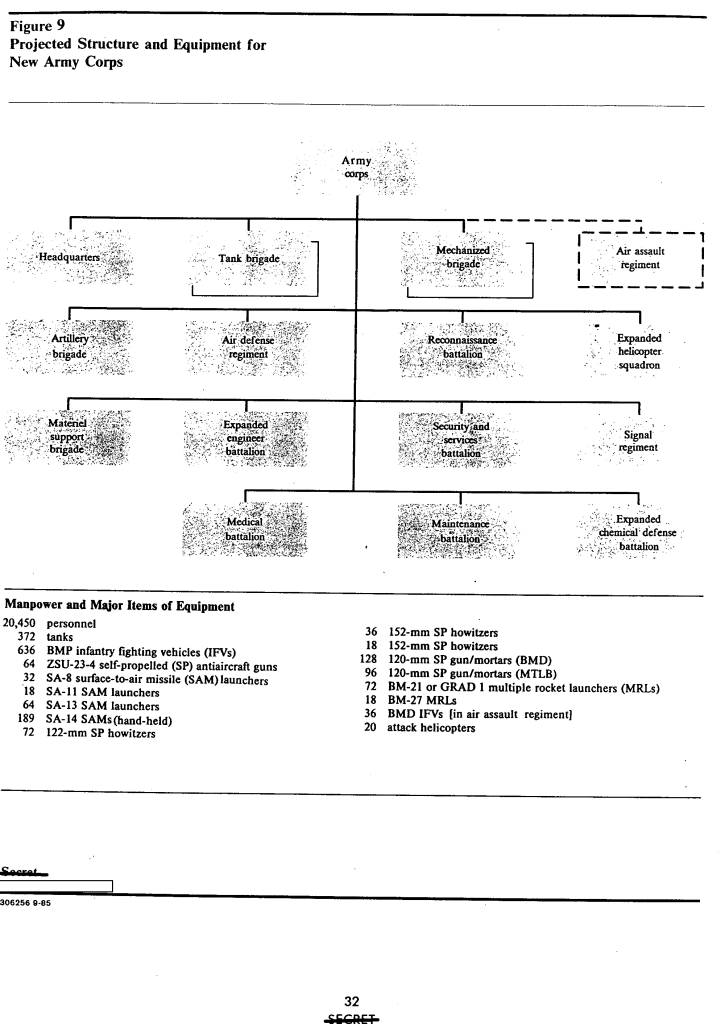
The GENFORCE concept featured an eastern OPFOR divided into legacy “Basic” and more advanced, mixed, “Mobile” forces. Yet how many formations of the latter would plausibly exist in a nation the size of the USSR?

I found a possible answer in a 1985 CIA analysis called “Trends And Developments in Warsaw Pact Theater Forces, 1985-2000” (a great source for a continued Cold War in its own right). The mobile combined arms corps, effectively a big division, is mentioned.

Obviously assuming a surviving USSR and Warsaw Pact, the document estimated that nine such corps would be ready by 2000. Three of these would be in the western theater, two in the southwestern, and one on in the northwest. Two would be in the Far East and one in the south/middle east.

180,000 personnel would be needed from a napkin calc of corps numbers x paper strength of each corps. It’s actually closer to the actual number than most because existing tail assets could be used to support them. However, there will be undoubtedly more people than that necessary, especially to have them achieve their full potential.

The problem isn’t getting that many soldiers. It’s getting that many good soldiers, especially because these mobile corps are specifically designed to be better and more complex tactically than previous line formations. And because they have to compete with the airborne and naval infantry for the best inductees.

Interestingly, the document itself also mentions the possibility of the tank divergences continuing, with the basic forces (word choice deliberate) getting a less exotic model and the mobile corps getting a more out-there one. This would also coincidentally make two bureaus/plants very happy instead of one, so I can see it happening.

It’s an interesting document in any case.

Review: Crimson Star

Crimson Star

The third Maelstrom Rising book, Peter Nealen’s Crimson Star takes the action to the American west. With the collapse into anarchy and invasion underway, the Triarii have their hands full. Having read this, I feel like it is both a lot better and a lot worse than the first two books.

First, the good. It’s written in third person, which is so much more suitable for a work of this nature. So much. Granted, the viewpoints are a little too restricted (try telling pre-Fuldapocalypse me that I’d think that), but it’s still a huge step that makes it so much better to read. And of course the action takes advantage of the larger scope, with lots of vehicle units and large forces. It is as good as anything else Nealen has done.

Now, the bad. The annoying slobbering over the Mary Sue protagonists reaches new heights. Any alternative to them is viewed as a completely incompetent obstacle. The narration does everything but say that their training was a combination of “SEAL, Ranger, Special Forces, and gutter fighting.” It got irritating, and it would be even more so if I hadn’t adjusted my expectations. After all, it sold itself as Larry Bond. By now, it’s actually Jerry Ahern’s The Defender updated to the present with more realistic battle scenes.

Do they balance each other out? My answer is: I still want to read the next book in the series. Make of that what you will.

Review: Holding Action

Holding Action

Peter Nealen’s second installment in the Maelstorm Rising series, Holding Action is an attempt at a bigger-scope war than the small-unit ones that make up a lot of his other books. Here it’s a clash in Poland in a campaign very clearly inspired by Larry Bond’s Cauldron (which was reviewed by the author and read for inspiration). And I’m sad to say I found it somewhat lacking.

The first and biggest problem is that the book is both written in first person perspective and clearly wants to be a big-scope tale. This square peg and round hole do not exactly align properly. And it’s not like the reader gets an excellent character study from it: The biggest trait I remembered in the main character was him being Catholic.

The second is that the Triarii, the “military NGO” that the protagonists serve in, feel like Mary Sues in ways that Brannigan’s Blackhearts never did. The Blackhearts are a bunch of expendable, disposable people doing underground dirty work. These are propped up as the centerpiece of fighting, more so than the bumbling regular American army. And listening to the narrator extol their awesomeness and the regular army’s weakness doesn’t exactly help matters either. The third and least important is that the setting tries to walk a tightrope between “plausible” and “distinct” and doesn’t really stay balanced.

That being said, the actual nuts and bolts action is as good as always, and I don’t fault Nealen at all for trying something very ambitious. It’s just that when you aim high, there’s a greater risk of falling short. This is a definite “uneven 51%” book. And there are worse things I could have called it. Besides, it’s fun to review an actual conventional World War III novel and go back to the blog’s roots.