Cold War Kitona

The Fuldapocalypse has traditionally been opened with a vast set of Soviet special operations that involve varying degrees of risk, realism, and audacity. Red Storm Rising famously had one such jury-rigged gamble resulting in the capture of Iceland. I’ve found another possibility that would involve my two obsessions of past and present: Conventional World War IIIs and commercial airplanes.

While the Second Congo War is about as far in terms of tone and nature from a Fuldapocalypse as it’s possible to get, its opening act nonetheless could have been lifted from the pages of a technothriller. In Operation Kitona, Rwandan and Ugandan troops seized four airliners and flew west to sever the DRC’s links to the outside world. The initial landing worked, but external support for the Congolese government doomed the offensive, plunging central and southern Africa into a long, bloody, and horrific war.

So it’s not too terribly farfetched to imagine planes being filled with “unruly passengers” happening to land at important dual-purpose airports at the worst possible prewar time…

Review: Red Front

Red Front

The conventional Fuldapocalypse begins in earnest with Red Front, the second book in the Iron Crucible series. After the Yugoslav opening act in the previous entry , this follows the war everywhere from the Atlantic to… outer space. Author T. K Blackwood continues a solid Bond/Red Storm Rising style narrative in this installment.

This has the issues that a big perspective WWIII has, but it also has the strengths, and Blackwood succeeds in a genre that’s incredibly difficult to write well. The book ends on a cliffhanger, but it’s not an unsatsifying one. With a ton of varied battles in a type of novel that doesn’t come along very often, I can say that I highly recommend this to fans of the “conventional WW3” genre.

Review: The Gamekeeper’s Night Dog

The Gamekeeper’s Night Dog

David Putnam’s The Gamekeeper’s Night Dog is one of the weirdest alternate history novels I’ve read. And yes, I have read every single Kirov novel. None comes close to this… thing. Really, to talk about it in conventional literary terms is almost beside the point. It’s middling in terms of quality and is a little too bloated, but why talk about that when you have such a befuddling premise?

See, in the 1890s, protagonist David Banner (no relation to the Hulk) has the Judeo-Christian God appear in a dream from His home in the black hole in the center of the Milky Way. A nightmare scenario (aka actual history) awaits if the last of the classic English Bulldogs (always capitalized in the book) goes extinct. There’s exposition where World War I, II, and even III is shown, with animal cruelty activists being portrayed as the equals of history’s worst monsters.

Also, apparently the divine value of a nation comes from the kind of dog that it has. Yes, it’s a weird book. Anyway, man and dog alike uplift the world, fight a very different Boer War, and continue to battle in an ahead-of-its-time World War I. We get loving depictions of bulldogs ripping men and animals to pieces. In fact, most of it is basically just bulldogs in “action”. The question remains: How do you even judge this book? My answer is simple. You can’t. It is not a novel so much as a very bizarre artifact.

The Hungry King

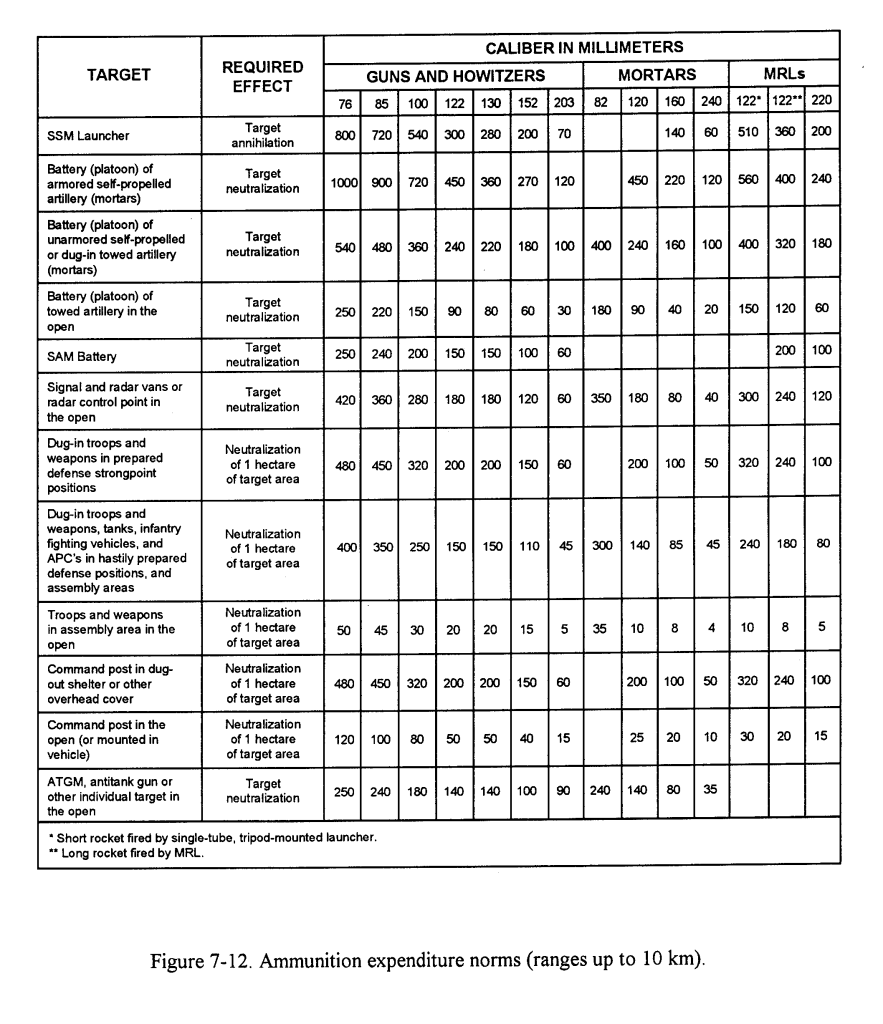
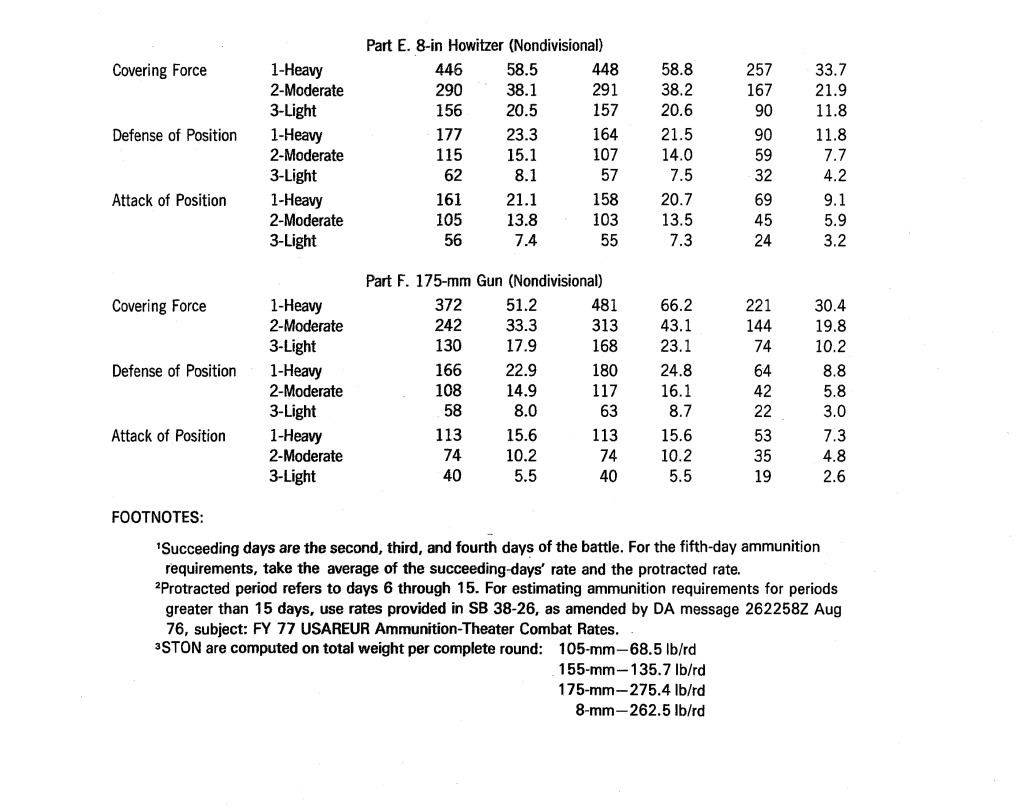
High-intensity warfare uses up a LOT of artillery shells. Like, a lot. How much? Well, these charts from the Light OPFOR Tactical (for eastern calibers) and FM 101-10-1/2, 1987 edition (for western calibers) give a notional example. They’re not identical-the OPFOR norms chart is shells fired towards a target while the FM 101-10-1 one is shells used up by a certain artillery piece per day-but they both show how much metal and explosive is going to fly (the answer: A lot).

Artillery is called the “king of battle”, and the king can get very, very hungry sometimes. Moving large quantities of heavy, highly explosive shells is no small feat, and to succeed or fail with that task means the difference between victory and defeat. A conventional Fuldapocalyptic World War III in the 1980s would have a massive quantity of artillery shells fired every day.

Review: OPLAN Fulda

OPLAN Fulda

Time to return to this blog’s roots with intelligence veteran Leo Barron’s new OPLAN Fulda. It’s a 1989 conventional World War III novel. In other words, what this blog was made to cover. So how is it?

Well, it’s pretty obvious that this was written by a military intelligence veteran. One passage where a Soviet army commander muses on the two difference courses of action his subordinate division commanders have chosen for their attack is the most blatant, but the tone is clear throughout the whole book. This means there’s too little fog of war for my liking and a lot of Melville-esque passages (complete with footnotes in many cases).

There’s also the usual suspects. There’s the contrived excuse for a war, conference room scenes, and jumping viewpoints. However, and this is important to note, the execution of all this is not bad at all. In a hard genre to do right, Barron succeeds.

The action is good and appropriately messy. Nuclear weapons are not handwaved aside (and the escalation makes sense!). The focus is an intricate one on both the Americans and Soviets instead of swerving away to some British or Dutch unit elsewhere at the worst possible moment. Oh, and it gets the tank designations right.

Because of this, I’m delighted to recommend this book to all World War III enthusiasts. Stuff like this doesn’t come along too often. So when it does, I feel great in reviewing it. The best praise I can give this is that it’s helped inspire me to make a “big war thriller” for my next draft after two mostly nonviolent works.

Review: Blue Masquerade

Blue Masquerade

T. K. Blackwood’s Blue Masquerade is a treat I knew I had to read. First, it’s one of those beasts that are as rare as left-handed baseball catchers or male calico cats-the conventional World War III novel that takes place as an alternate history after the Vietnam War. That its premise involves two of my personal tropes I wish got used more often made it even more appealing.

The first premise is that instead of the USSR backsliding after a successful August Coup or something like it, it reforms enough to avert such a thing. This happens here. Don’t expect to see MiG 1.42s or robot-turret supertanks here-it’s just the classic tanks and BTRs/BMPs. Still, it’s heartening to see this gimmick after wanting to for so long. The second is Yugoslavia, the tinderbox of Europe, being the catalyst for the war. This is a lot more plausible than some other World War III novels you may have heard about.

As for the substance of the book, I would call it a “51% World War III big war thriller”. It gets enough of the basics right and never comes across as truly “bad” in any way. That being said, I have seen everything it does being done better in other books. However, I’ll adjust for context, since this subgenre is extremely hard to do well. In that case, a 51% book is quite the accomplishment, like a baseball pitcher having a positive win-loss record while playing for an otherwise bad team.

If you like alternate history, conventional World War IIIs, or both, check this out. For another opinion, see Alexander Wallace at Sea Lion Press.

Another Missing World War III Tale

There’s another type of story that seemingly just doesn’t appear in the conventional World War III niche (as far as I can tell): Stories centered around those with neither political or military capability. And by that I don’t mean the opponents in later Tom Clancy novels. The poor innocents caught up in the heat of war are often used in historical wartime fiction, but seem at best only in parts of conventional Fuldapocalypses (ie, Bannon’s wife in Team Yankee).

I think the biggest reason is well, no real incentive to do so. I don’t really have the best knowledge, but I can speculate that historical fiction writers don’t need to use an inherently contrived “Cold War hot but not that hot” setup to tell such a story. There’s plenty of historical conflicts that readers will understand better, and if a fictional one is needed/wanted, making it small, contemporary, or both can offer more of a hook.

So it’s a catch-22. The subgenre would benefit immensely from outsiders bringing their perspective. But most outsiders, even cheap thriller writers, don’t have much motive to write such a thing.