Review: The Death Merchant

The Death Merchant

Joseph Rosenberger’s Death Merchant is one of the most notorious men’s adventure series of all time. Its reputation is such that I had to check it out, starting with the first volume.

The adventures of psychotic super-assassin Richard Camellion start off on a mixed note. Like the Destroyer series, the Death Merchant (for understandable business reasons) had to start off with a conventional “shoot the mobster” plot that has little in common with the crazed excesses the later books reached.

That being said, Rosenberger’s writing er, “eccentricities” are definitely on display en masse here. Long and weird descriptions of gore, over-detailed action scenes, and more, including an erratic prose style with lots of exclamation points, “grace” the pages of the book as Camellion slaughters his way through.

Rather than sink into the middle of the pack, the initial Death Merchant at least stands out due to its writing style. Whether or not it’s in a good or bad way depends on your tastes.
Invasion Fiction

So, the World War III Blog series on Red Dawn has gotten me to write a piece on invasion literature, especially Anglo-American invasion literature. Now a part of my thoughts on invasion fiction, specifically Anglo-American invasion fiction, stretched back to Jerry Ahern’s Survivalist. There the Americans get the worse of a nuclear exchange and the Soviets invade. Now a part of me was thinking this:

“The 1981 book, not far removed from the infamous ‘Malaise Era’, might illustrate how even in the most star-spangled genre, a sense of American pessimism was still present.”

But another part of me was thinking this:

“You’re overthinking this to a huge degree. All it is is a way to put Russians in the path of John Rourke without that pesky “Army” or “Atlantic Ocean” being in the way.”

The point is that, whatever it was, this was very different-about as different as could be-from Clancy/Bond-style war thrillers. To the point where it basically broke the narrow grading system I’d set up for the blog. And this was before the series turned into science fiction.

It was also a type of invasion novel, Bobby Akart’s Axis of Evil, that took the first step in moving Fuldapocalypse away from a narrowly focused review blog to a general one. And it was the best decision I could have made. So invasion novels are pretty rooted on Fuldapocalypse.

In my eyes and reading, there’s basically two types of invasion novel: Grim invasion (ie, Tomorrow series) and pulpy invasion (ie, early Survivalist). There’s of course overlap, but the categories seem a little clear. The classic pre-WWI invasion novels fall into “grim invasion” (“See the fate that will befall us if we don’t fund the army!”) while many later invasion stories aimed at pure entertainment fall into the latter. In fact, I’d argue that the biggest issue I had with the original Red Dawn was how it sat a little awkwardly between the two, not having the clearest tone.

Review: The Kidnapping Of The President

The Kidnapping Of The President

Charles Templeton lived a long and involved life which involved everything from newspaper editor to author. His debut thriller, The Kidnapping of The President, was  later made into a William Shatner movie.

Adam Scott, the President, goes off to campaign in congressional elections in New York City. A pair of South American revolutionaries with an armored truck are there as well, and…. look at the title. Then the cabinet, a scandal-hit vice president, and the perpetrators all race against time, as the plot twists and turns.

This book wasn’t exactly breaking new ground even at the time, and it has issues. Issues like the grounded and genuinely researched deep infodumps clashing with the inherently strange premise (which is even mentioned in-story). Issues like the few action scenes, when they finally happen, being dry and questionable.

And yet it flows well in spite of the “look how much I researched” exposition, works acceptably as a read to pass the time on a dreary, snowy day, and does what a cheap thriller needs to do. The novelty of a “a prominent Canadian media figure wrote a cheap thriller about the American president being kidnapped” helps it stand out, but this book works even beyond that.

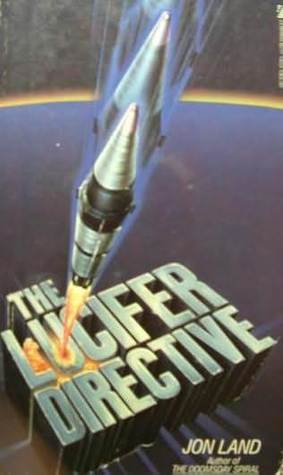
Review: The Lucifer Directive

The Lucifer Directive

jonlandcover

This early Jon Land thriller, his second published novel, has all the hallmarks now familiar to me after reading literally over a dozen of his books. In The Lucifer Directive, a young college student gets a wrong number call that changes the fate of him and the world. What makes this book relevant to the original goal of Fuldapocalypse is that the evil plot involves triggering a (nuclear) World War III.

It’s very hard to review a lot of books by the same author in the same style – even if it’s a style one enjoys. And this book, while a little clunkier than some of Land’s later books, still does his “escalating craziness” gambit very well.

In fact, think one of Land’s biggest strengths as a writer, besides his sheer over-the-topness, is his skill at that kind of plot “buildup”, for lack of a better word. Granted, it’s it’s not done in the most graceful way. Yet it works, and works very well.

Review: Dragon’s Fury

Dragon’s Fury

dragonsfurycover

Jeff Head’s Dragon’s Fury is a very interesting book, and I mean this without any snark. Viewed in one light, it’s just a clunky 800-page self-published book with robotic prose, a “Heroic Eagleland vs. the Alliance Of Evil” (which somehow includes India) plot,  and a lot of axe-grinding, the kind that would seemingly be just forgettable.

But viewed in another light, it’s weirdly impressive how many technothriller cliches it has. They’re all there, even contradictory ones. Take something with…

  • The bloat and diversion into domestic politics for the sake of soapboxing of later Tom Clancy. (Although Dragon’s Fury’s politics make Executive Orders’ seem restrained, tasteful, and left-wing in comparison)
  • The sci-fi excesses of Dale Brown at his most out-there (there’s a battle in Dragon’s Fury featuring space battleships).
  • The “look out, it’s the MacGuffin superweapon” theme of many technothrillers, especially post-1991 ones.
  • Similarly, the “a thousand viewpoint characters and a million technical descriptions” style common to the genre.
  • The robotic “play by play” battle description of books like The War That Never Was.

All these come together into something worse than the sum of their parts. The bloating and tangling keep it from being a  breezy “51% book”, turning it instead into a total clunkfest. The sci-fi and superweapon components aren’t crazy-fun like Blaine McCracken taking one of his periodic trips into outer space, just out-of-place. The battles get uninteresting very fast, especially given the “show everything in every theater” aspect of it. The big, detailed descriptions don’t work in a setting that isn’t grounded.

If it had the same “political manifesto as told by an early, monotone text-to-speech device” prose but was half the length, and had only two or three of those technothriller staples instead of all five, I’d dismiss it as “forgettably bad.” However, by incorporating all of them, by somehow taking every military/technothriller plot device and using them so consistently poorly in a way that not even Patrick Robinson can manage, Dragon’s Fury manages to become something different. It manages to become unforgettably bad. That the book is an audacious, sweeping tale of a multi-year world war (in a time when many technothrillers were lowering their scope and/or stakes) just amplifies everything.

It’s not enjoyably bad. Even I had a hard time getting through this book. But it is indeed unforgettable in its ambition. It’s as if Florence Foster Jenkins tried not only singing but writing an epic Wagnerian opera accompanied by an unironic Portsmouth Symphony Orchestra. I’d put this book, alongside the previously mentioned Patrick Robinson novels, as an example of the depths the technothriller sunk to in the 2000s. Robinson’s works were the “conventional commercial publishing” side, and this is the “self-publishing” side.

Review: The Hunted

The Hunted

huntedcover

Alan Jacobson’s The Hunted is the first entry in his OPSIG Team Black series of thrillers, although the later ones wouldn’t be written for some time after the initial publication date of this in 2001.

Reviewing this book was a little difficult. As I’ve said many times, I’m not the biggest fan of straight-up cloak and dagger books, which this definitely is. That being said, it’s kind of middling and feels (not surprisingly given its nature) like a smoothed-edges “grocery store thriller.” The climax is well-done, but getting there can be a slog.

The only thing that really jumped out for me was the book giving a “secret history” explanation for the death of Vince Foster, making the antagonist responsible. But even that tidbit can’t sustain this sluggish book.