Lee Child’s Persuader was the first Jack Reacher novel I read. It was also one of the first real “action novels” that I read. This wasn’t an adventure novel, or a science fiction novel. No, this was contemporary red blooded action! Because of this, the book has a special place in my heart.
The actual book is still kind of “51%” in the full context-it doesn’t really stand out with hindsight after reading countless other books (including those following a similar formula). But I still think the success of it and the whole series is deserved. It promises action, and it delivers. Who knows how many people got into cheap thrillers after reading a Jack Reacher?
Baseball is a sport full of statistics, and there’s one weird footnote of a stat that was, from 1980 to 1988, elevated to prominence. This was the Game Winning Run Batted In. Defined simply as “The RBI that gives a club the lead it never relinquishes” , it existed but never felt that prominent. The career leader in GWRBIs during this period was Keith Hernandez.
“Normal” RBIs were one of the first stats that sabermetricians slammed, and with good reason. The stat is simply too context-dependent and reliant on how good at getting on base the players batting before the RBI hitter are. Rickey Henderson didn’t have that many RBIs because he was always a leadoff hitter, so the bases were either empty or he appeared after the team’s worst hitters. GWRBIs have that and the same “reliant on the other half off the inning” issue as pitcher wins. And while meant to embody the likes of Bill Mazeroski’s famous home run, the definition of a GWRBI means that a marginal player singling in the first run early in an 11-0 squash is also credited with it.
So few people mourned the stat when it was discontinued. Yet I have a strange affection for it, for while near-useless for evaluating players, it reveals a little about the paths of individual games.
The second volume of My Next Life as a Villainess deals with Katarina now going to the actual academy setting of the game and demonstrating her biggest character trait of absolute obliviousness towards romantic attraction (the fandom joke is that black holes are less dense than her). One of the biggest and best buildups in the first volume was foreshadowing the game’s protagonist, Maria Campbell. The second doesn’t disappoint when she actually appears. Katarina is clueless to the fact that her being actually nice has already butterflied almost all of the original game’s plot away, and equally clueless to how Maria is now attracted to her.
The plot is worse when it tries to go for more genuine danger and drama, simply because it conflicts with the tone of the rest of the story. But even that’s not too bad. While I can understand why that would be included, it’d probably have been more preferable to just focus entirely on its heroine worrying about nonexistent “death flags”.
It also has a good conclusion as Katarina survives the “game” and hears Maria’s confession, which she of course doesn’t get. When I read that this was the original planned ending, it didn’t surprise me at all. Of course, it was successful enough to continue, but just as how The Sum of All Fears serves as a good stopping point for Jack Ryan, so does this for the series (boy, never thought I’d be directly comparing those two).
The structural issues I mentioned in the past volume are still there. But after seeing so much of setting munchkinism, and coming from an online community where this kind of thing is a stereotype, I love the concept of someone who tries to munchkin the setting and it doesn’t work out (well, in this case it does, but not in the way Katarina thought or intended). While I probably won’t read too far beyond the original end, I still enjoyed this series as a break from tanks exploding.
It’s been a while, but I have a new Command: Modern Operations scenario up for testing, 2KW Sub Strike.
I’ve wanted to do a scenario set in a mid-70s Second Korean War where the north smells an opportunity in the immediate aftermath of Vietnam. After much thought, I settled on “do a submarine scenario”, which also plays to one of my favorite strengths of having the player be objectively outmatched and having to manage the best they can.
With a few diesel subs, you have to take on an aircraft carrier shielded by, among others, a hypothetical guided missile battleship and a brand-new Spruance destroyer. Are you up for it?
My love of books of all kinds has led me to Susan Howatch’s Sins of the Fathers. This tale of intrigue in a Wall Street tycoon family puts the “block” in “blockbuster”, both in terms of the whole book and individual paragraphs. It’s not an easy book to get through. Characters talk and monologue in giant, close to unreadable segments. And nearly every one of the characters is unlikable. I get that you’re not supposed to truly “like” them, but they’re unpleasant in a bad rather than a good way.
It’s just a chore to get through yet another man with more money than morals complaining about the “plastic society”, or yet another pregnancy drama. Howatch doesn’t even succeed in making the stakes seem that high. You could take away nearly all of everyone’s assets and make it about store owners in a small town plaza and it wouldn’t feel any different. There’s never the impression, beyond a few luxuries, that these are people who hold the financial world in their hands.
It’s a shame because I love the concept of a giant family saga, an internal struggle of the titans that mixes the personal with the societal. It’s just this is not it. In fact, this might be one of the worst books I’ve read in some time.
One thing I’ve noticed in the admittedly small number of conventional/mostly conventional World War III stories is that the decisive make-or-break battle is fought in the vicinity of Hanover, West Germany. And I have to ponder how much of it is realistic, how much of it is a coincidence (since there’s only so much room and it is in the northern sector) and how much of it is literary license.
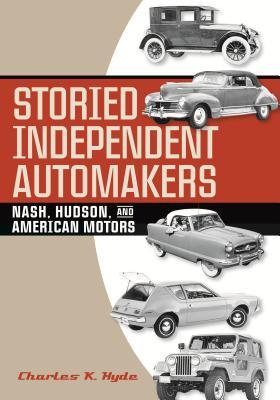
Charles K. Hyde’s Storied Independent Automakers tells the tale of the American-owned car companies that were not the Big Three. It’s a story worth telling, because they illustrated just how ruthless and consolidating the car industry is. These car companies went under or were bought out at the height of the domestic auto industry’s success (one ironic silver lining was that many of their left-hanging dealers turned to import brands and proceeded to make a fortune from them).
They had one brief moment of popularity due to a completely artificial boom when World War II resulted in years of pent-up demand. And now and then they managed to pull an innovation out that gave them a temporary edge (like compacts for AMC) until the big three caught up. But that was mostly it, and other than that it was all uphill. Hyde rightly points out it was impressive that they lasted as long as they did, and gives credit where it was due.
Though written in a history book tone (ie, it’s not exciting for anyone other than me), Hyde’s book is light enough to be readable while still containing lots of well-researched statistics on cars. It tells the story of an overlooked but important part of the auto industry’s history. Any enthusiast should enjoy it.
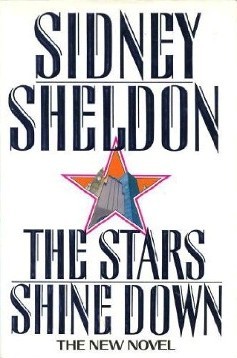
Sidney Sheldon’s The Stars Shine Down is the story of ruthless businesswoman Lara Cameron, her rise and fall as she builds a real estate empire and gets entangled with everyone from mob lawyers to piano players. It’s the type of gilded trash melodrama I know very well after reading so many of his books. This one, released later in his life, feels a little less than his at his best. It’s still a very readable book, and it’s still well ahead of The Other Side of Midnight. Yet there’s just so much that brings it down. And it’s not just the formula being familiar to me by now.
The plot is a little more scattershot than what Sheldon was capable of in some of his other books, and the ending feels a little rushed. There are a few weird choices like the decision to have all the Scottish character dialogue in clunky phonetic writing that subtracts more than it adds. Sheldon focuses too much on the nuts and bolts of Lara’s building development, something he doesn’t write well.
One legitimately good part is its main character, with Lara drawing both opposition and sympathy. As Sheldon at his worst wrote characters as either dumb, naive dopes or ruthless Machiavellian masterminds, having someone who can truly have elements of both strikes me as a solid achievement. The protagonist is arguably Sheldon’s best I’ve read so far. It’s just the book around her isn’t.
Ripley Rawlings’ Assault By Fire is an invasion novel. It’s an invasion novel that features that common staple of video games-the Teleporting Russians. Yes, via some kind of supercomputer (that’s the explanation given), the Russians can conduct a successful amphibious invasion of the US. This is a “pulpy invasion” book. And it is very, very pulpy.
Everything from a main action in Appalachia to WWII weapons to a knockoff of Vasquez from Aliens is there. And it’s somehow amazing. The rational part of my brain could not comprehend or make sense of how the invasion progressed, with me asking such questions as “where are the stated MiGs staging from?”. The part of me that eagerly read every Survivalist loved every page of it.
There’s an underappreciated what-if concerning the business of baseball that I’ve considered worth exploring. Too much sports alternate history simply shuffles players, teams, and outcomes around. It feels both obvious and unsatisfying to me, the equivalent of the Red Sox unloading not just Babe Ruth but the entire core of what would become the 1923 champions on the Yankees or the A’s “Mustache Gang” all leaving in free agency when they got the chance. This is something different and could have changed the entire business model to be more like what’s in our time a vastly different type of sports.
In the 1950s, the Dodgers were intrigued by a company called Skiatron, offering pay-TV services. The technology did exist at the time but was very rudimentary. The possiblities were obvious. After all, even at a dollar per game, a six figure audience could translate to that much every home game, a huge sum at the time.
In OTL, this did not come to pass in this form. Besides the obvious ferocious opposition from the existing broadcasting industry, Skiatron’s technology and finances just weren’t viable at the time. But if something like that could be done (and I don’t know the exact plausibility-I’m not that kind of technical expert), it would be, no pun intended, a game changer. The obvious is that there’d be a big jolt of money, getting the historical broadcast windfall in earlier.
There are easy ramifications. There’d be more money in the sport, which would increase the pressure by players to get more of the growing pie for themselves. A historically unsuccessful team that used this to its advantage would result in the championship races being different. But there’s also more thoughtful ones.
One on-the-field change I could see resulting from this could be in pitcher usage. Here I’m kind of extrapolating from the “overworked for the sake of attendance” policy of Mark “The Bird” Fidrych (which may have contributed to his severe injury). I’m also extrapolating from boxing and MMA, which historically have leaned the most on PPVs. Put simply, more people have been willing to pay to see Connor McGregor than to see Valentina Shevchenko. And I’d bet more people would be more willing to see Sandy Koufax than Ned Garver.
Another, sleazier one is the notion of small-market/poor team owners simply giving up and advertising the players on the opposing team for the PPV spectacle. “Hey, [Small City], do you want to see the Yankees? The Dodgers? The [other good team with an exciting player]?” There are possibilities here.


 Fuldapocalypse Fiction