A Brief History (And Explanation) of Rocket Tossing

Anyone who has recently seen any footage of helicopters in Ukraine has witnessed what I call “Rocket Tossing”. The helicopter lifts its nose, fires off a ton of rockets indirectly, and then peels away. It has the impression of an improvised, ineffective tactic. But it’s not the former and is arguably not the latter.

It’s important to note that doctrine of the 198X Fuldapocalypse era, both western and eastern, details rocket tossing at length. The huge helicopter losses of Vietnam, the precedent of the Iran Iraq War (where the tactic was used constantly), and that air defense wasn’t exactly getting worse all made for sound reasons to know it. So indirect helicopter fire isn’t that surprising.

So how effective is it? Well, it’s basically a light multiple rocket launcher that can fly. Unguided multiple rocket launchers are area weapons, optimized to cover a large piece of land quickly at the expense of long-term rate of fire. (This is why rockets are considered ideal for chemical warfare). Ideal? Not really. Cost-effective? Probably not. But useless? Nah.

A Thousand Words: Battle Circuit

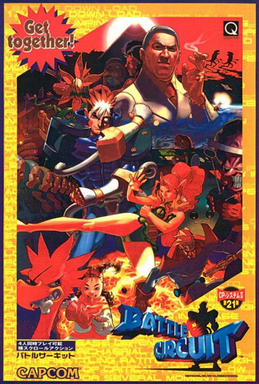
Battle Circuit

One of the last arcade beat em ups that Capcom released in the wake of Final Fight, 1997’s Battle Circuit was obscure for many years until its availability in the Capcom Arcade Stadium collection. This is a shame, because of all the successors to that masterpiece, Battle Circuit is the best I’ve played.

The plot is simple: In a sci fi future, control one of five bounty hunters as they pursue a bunch of colorful villains. The quirkiness and silliness of the genre shows in both the heroes and villains. You can choose between Cyber Blue, a pretty normal anime hero, Captain Silver, a Plastic Man/Mr. Fantastic style stretch-armer, and three goofballs: Catgirl Yellow Iris, walking Venus Flytrap Alien Green, and the weirdest yet: Pink Ostrich, the titular bird with a girl riding on its back (it’s unclear who’s the brains). Similarly, the bosses are just as ridiculous. They start with a disco Elvis impersonator and go through such things as a woman and her giant mandril, an all-female biker gang, and a robot samurai riding some giant beast. The final boss can only be described as looking like an evil Santa Claus.

But what makes the game amazing beyond these characters and their beautiful sprites/animations is how it’s both easy and deep. Sure, it can be played like Final Fight. You can jump around, throw, and do sweep attacks that cost you health. But each character has a lot of moves, and they can be upgraded between levels if you’ve earned enough coins-which you get by landing lots of hits on enemies. Mastering each of these moves makes things a lot more fun. Especially as the characters have their styles, with Alien Green being the slow grappler a la Haggar and Yellow Iris being the rapid “Guy”. All can jump and power up with a special gauge, the effects of which range from gaining more power to recovering health to becoming very durable for a brief time.

There are a few snags. The first is that the characters are not exactly balanced compared to each other. Cyber Blue is the cheap easy mode character. Not only is he intuitive and strong, but his upgraded sweep attack damages everything on the screen. Bosses can be cheesed by just powering up (which increases his strength) and then spamming that move. Meanwhile, Pink Ostrich is very weak normally, only has a flight power of dubious use, and is hard to control. The others fall between those extremes. The worse one, I’d say, is that the segments between the bosses are kind of minimal and forgettable. There’s only a few enemy types and no real engaging set pieces. It’s not really bad, but it doesn’t have the spark the rest of the game does.

Also the third boss is a blander giant robot with very wonky hit detection that’s just frustrating and not fun. But hey, five out of six aren’t bad.

If you like any kind of beat em up, you deserve to check out Battle Circuit. It’s an amazing underappreciated game.

Review: A Killing Truth

A Killing Truth

Author DV Berkom, a self-proclaimed lover of thriller novels, begins her Leine Basso series with A Killing Truth. Short and sweet, the love of its author for the genre shows obviously. The negative side of this love is that this tale of a female assassin doesn’t exactly break much new ground or push any authorial limits. It’s firmly in the 51% middle of books of this nature.

But it’s also positively in the 51% middle. If you want a good cheap thriller, this is the book for you. Everything about this that needs to work does, and I had a great time reading. I look forward to reading more of Berkom’s work, as it’s clear that she knows what makes a thriller good.

And that’s two positives of loving the genre to one negative. I’ll take that.

Ly Rachany Brought To Life

One of the most beautiful things about AI art generators is that it’s given me the change to take characters that I could see in my mind and bring them to life. With this in mind, I was especially delighted to create one of the main characters in The Sure Bet King. Behold Ly Rachany, CEO of Parilor, and lover of bunkers and security systems.

RIP Jim Brown

Jim Brown, former Cleveland Browns football player, activist, actor, and mixed martial arts commentator, has just passed away. RIP to a football legend. Calling him the greatest running back of all time is not particularly controversial, unlike other such claims. He rushed for more yards per game than anyone else at his position and did so in a low-offense era.

Betting on Obscure Sports

I’ve said multiple times that the depths to which sportsbooks scraped the bottom of the barrel in the spring of 2020 was darkly amusing and inspiring at the same time. The thing is, they were doing this before the crunch. And after. Maybe not to the extent of splashing Taiwanese women’s basketball on their front pages, but you still could and can find really weird sports. And the use of obscure sports is a glaring weak point for integrity.

So who actually bets on the Laotian 2nd Floorball League?

Well, from what I’ve gathered, there’s three main categories of bettors. Only one of these is beneficial to the sportsbook, and is probably the reason they keep doing it. None are what would be considered beneficial to society or even the sports betting ecosystem as a whole.

Degenerates

The most innocent group of people to bet on obscure markets consistently (as opposed to the occasional novelty bet that no one expects anything out of) are “degenerates”, the same gambling addicts who will just bet on whatever’s in front of their faces. If it’s the middle of the night and some soccer league halfway around the world is what’s on the screen, they’ll bet it. Everything from table tennis to bizarre half-rink hockey to totally legitimate Indian cricket. This was in fact the reason for those Eastern European ping pong leagues running around the clock and existing at all-it was to ensure that there was something on screen at all times, purely for the purposes of gambling.

Something that greases the skids for a huge and inevitable problem with gambling doesn’t seem like the best thing. But it’s sweet and virtuous compared to the other two.

Line Munchkins

Many of the sharp/plus EV [Expected value] bettors are these, pouncing on whatever mismatch they get. They have little to no handicapping or serious modeling ability (the stereotype is that they’re green lumberjacks who don’t even know the players). After all, obscure sports are the most vulnerable to bad/slow lines. Which of course leads to the cycle of them getting restricted/banned after the book finds out.

I find neither the sportsbooks themselves who blast ads about the road to riches yet restrict successful bettors nor the line munchkins (coming from a tabletop RPG term for players who crudely optimize for maximum power) who act like martyrs to genius instead of people who gamed the system to be very sympathetic. So something that amplifies this sludgy mess does not seem desirable.

Crooks

The smallest, weakest, and most obscure sports are the most vulnerable to manipulation and fixes. So naturally either fixers or people aware of the fix will flock to bet on these crooked games. I don’t think I need to really explain why this is a bad thing.

What Next?

On one hand, the sportsbooks can simply not list the Guinea-Bissau Ferret Legging Third Division, the regulators can forbid it, and the data providers (the biggest, most important, and least visible part of the whole ecosystem), can not provide information about them. On the other, it only takes one offshore data provider and an offshore book wanting to fill that niche to break the restrictions.

So yes, like a lot of sports betting issues, this is not completely solvable. I do think that forbidding bets on the lowest hanging fruit-minor league baseball and tennis or low-division college basketball to use an American example, would still be a wise and prudent thing to do.

Review: US Army Doctrine

US Army Doctrine: From The American Revolution to the War on Terror

In his study of published doctrine, Walter Kretchik embarks on the herculean task of reading multiple centuries worth of field-manualese. He looks at the very first to the then latest manuals (the book was published in 2011) and how they were applied in practice. The result is an excellent nonfiction study for field manual nerds like me.

The book is very readable and understandable. I would advise reading the actual manuals themselves if you wanted to know more (they’re all public domain by their very nature and the age of many of them), but as a starting point for both doctrine and warfare, this book is excellent. It’s expensive and niche, but it’s good in addition to being those two.

Cuban T-72s

I’ve used the term “Cuban T-72s” to refer to a very interesting phenomenon in fiction, especially contemporary fiction. Which is to say, something that’s technically inaccurate but makes an incredible amount of intuitive sense. And it’s technically achievable as well. What is a Cuban T-72?

Well, despite being one of the premier Soviet clients, Cuba has never operated T-72 tanks. T-72s are, of course, a common Soviet export tank. So even though Cuba historically never moved beyond the T-62 despite being actively engaged in Angola, if a thriller novel or alternate timeline had them operating that autoloaded tank, I would let it slide.

So if the rest of the work is pretty good, I can let things like wrong calibers off the hook. Especially if there’s an understandable reason why the author would think that way. Note that this only applies to small things like that-someone like Ian Slater who constantly gets the easiest-to-check facts wrong is not a “Cuban T-72.”