Seleucian Special Forces APC

Stable Diffusion gave me a chance to make something I’ve long imagined: A truck-APC belonging to a Seleucian (one of my OPFOR countries) Motorized Special Forces unit. First, the picture itself.

There are many existing heavy-duty pickup conversions like this: An armored pickup with the bed replaced by a capsule that’s even more fortified.

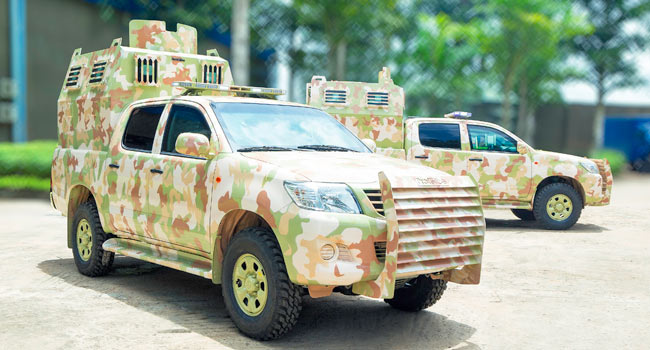
(You get the idea)

Now for their organization: Seleucia’s large “Special Forces” components are motorized to varying degrees. The quotation marks are because few of them are what NATO would consider “special forces”, with many being simply conventional troops with better training and motivation than the other ragged masses of that country’s huge army. Still, Seleucian motorized SF have shown their capability.

A Seleucian motorized SOF battalion is similar to a light infantry one, only with armored personnel carriers. As the mere “transport” capacity is prioritized, motorized SOF often ride in older and/or cheaper vehicles-like armored pickup trucks. APCs frequently hide after dropping off their dismounts. A common defensive tactic for Seleucian commandos is to drive close to an ambush site, conduct the ambush on foot, then scramble back to their carrier and move to another one later on.

However, it is not uncommon for Seleucian motorized SOF to accompany heavy units of tanks and SPGs in conventional operations. Here they fight similarly to Stryker/BTR style infantry in faster wheeled APCs of other countries. In conventional defensive operations, motorized SOF have a somewhat unusual role as mobile antitank detachments. Thanks to their skill, mobility, and flexible organization, SOF battalions with large amounts of of anti-armor weapons can be used similarly to the tank destroyers of other nations.

The Saxon and BTR-152 are examples of the basic style of APCs frequently found in Seleucian motor SOF units. Tracked vehicles, mostly basic ones like M113s and MTLBs, are rarer but not unheard of, especially where the terrain suits them.


The Non-Russian SSRs and nuclear weapons

There is one argument, especially after the 2022 invasion, about Ukraine (and the other non-Russian ex-SSRs) and nuclear weapons. This goes: They gave up their nuclear weapons in exchange for largely meaningless and unenforceable diplomatic agreements, which was a mistake that Ukraine paid for and Kazakhstan might have.

Many informed nuclear commentators have pointed out that the launch codes/infrastructure were still in Russian hands, that Ukraine had no actual control, and that the ICBMs in particular were ill-positioned for deterring their former owners. This is all accurate, as is the staggering cost of making a usable nuclear program during a time of massive political and economic upheaval (Ukraine’s implosion in the 1990s made Russia’s look like a modest recession, and Kazakhstan had effectively no army of its own immediately after independence)

But there is another opposite fallacy, which is that the decision was more or less out of their hands. Because all the nuclear weapons were under Russian control, there was no real choice involved. This is also flawed. The nuclear weapons weren’t immediately usable, but to act like there was a Ward Of Russianism on them is wrong. Ukraine had extensive infrastructure and science on its territory (including a missile plant), while Kazakhstan’s uranium industry meant that it was already over the biggest hump for a usable bomb-the materials.

So it was not technically impossible for the non-Russian SSRs to maintain a nuclear weapons program. You can argue that it was politically and economically so, and probably correctly. But it was not a technical issue. The republics had agency, and they likely prevented a far earlier Russian invasion by relenting.

Review: The Angola Deception

The Angola Deception

Because I’m crazy, I decided to check out a book by an author whose past series I was less than fond of. So I read DC Alden’s The Angola Deception, a cheap thriller about a super-conspiracy that wants to kill the bulk of the world’s population through an engineered germ. I believe there are at least four Jon Land books I’ve read with this exact plot. Blaine McCracken probably stops one bio-conspiracy shadow government in the morning and one in the afternoon each day.

The difference between them is of course that Land writes about monster truck chases and Antarctica exploding, while Alden writes about how one of the worst things about the evil Muslim conquering state is that it’s too feminist. Guess which book is a goofy fun romp and which is an axe-grinding, plodding, mess.

It’s not exactly a difficult question. There is every single New World Order conspiracy played completely straight here, but there are no minotaur-men. On top of that, the ending of The Angola Deception manages to be both too open ended (setting up the later series) and wrapped up too quickly (dealing with the antagonists of that specific book) at the exact same time. How does it manage that? I’m a little awestruck at how it does, but it does.

Suffice to say I don’t recommend this book. I might keep reading the series because I’m crazy and want to see just how crazy it gets (the Invasion series got pretty out-there, but not intentionally). But I don’t recommend it to others.

Review: C3

C3: Nuclear Command, Control, Cooperation

Written by former Strategic Rocket Forces officer Valery Yarynich, 2003’s C3 is an in-depth look at Cold War (and beyond) nuclear war command systems and their hazards. Although having access to then-secret info in Soviet times, Yarynich was no Viktor Suvorov and did not sensationalize (in fact, he provided one of the first detailed and level-headed descriptions of the infamous Perimetr/Dead Hand system). The result is one of the best nonfiction books on nuclear war that I’ve read.

As it is written by a former Soviet officer, you do get waves and waves of charts and equations that attempt to quantify something relating to military technology. But you also get lots of clear, simple explanations that make a layperson able to understand this well. In terms of everything from organizational charts to what the “nuclear briefcase” even is to why scissors were found to be a weak link in the command chain (seriously), it’s incredibly illuminating.

If you have any interest in nuclear war or command systems whatsoever, I highly recommend this book. I’ll also just say that it’s an excellent research resource…

Weird Wargaming: The 185mm artillery

Using a ballistics calculator, I came up with a 185mm artillery piece with the following performance. Why that? Because few/no real guns have the caliber, and I wanted something between 152/155mm and 203mm. When not obtained via the calculator, results are extrapolated from the S-23, the closest real life equivalent, with some enhancements like faster loading and lighter weight to simulate better technology:

185mm Artillery:

Maximum range: 27-41 km, depending on ammunition.

Rate of fire: 2 rounds/minute

Average shell weight: 70-75 kilograms

Approximate Mass: 13,700 kg

The artillery piece is usually self-propelled on a tracked mount, but towed variants do exist. It tends to serve as a corps/army level weapon whose primary goal (and largest shell portion) is counter-battery and other missions where range is more important than size, although it can do anything a big gun can. Advanced users have developed nuclear shells for it, and the usual conventional ammunition types (regular HE, cluster, etc…) have been made.

AI Undertale Portraits

Some Stable Diffusion pseudo-photographs of the Undertale main humans. Chara is the black and white one with the single stripe, Frisk the color one with the two stripes. (The black and white one is partially because I made it in inspiration from a fanfic where Chara fell in 1926, so I chose one that fit the time period.)

Review: The Han Solo Adventures

The Han Solo Adventures

Originally published in three installments from 1979 to 1980, the Han Solo Adventures by Brian Daley were the first books in what would become the Star Wars expanded universe. Star Wars fans tend to love them, and I’m one of them. Without restrictions or a desire to one-up the movies (I’m looking at you, Kevin J. Anderson), the books are a fresh fun romp through the Corporate Sector.

Daley can write everything from prison breaks to starfighter bouts to duelists well, and he does in these books. Every Star Wars fan, science fiction fan, or just fiction fan should read these.