Inputs

The analysts who swung and missed regarding the (initial phase of the) Ukraine War and the Russian performance in it still made reasonable assumptions.

  • It was reasonable to assume that Russia’s modernization was deep and genuine.
  • It was reasonable to assume that, having spent a year moving the forces, that Russia would also spend a year planning.
  • It was reasonable to assume that modern weapons on the Ukrainian side (like the few Georgia had in 2008) and/or any degree of qualitative superiority would just increase Russian casualties slightly without changing the outcome.
  • Finally, it was reasonable to assume that Russia would follow its paper doctrine, like it did in Chechnya, Georgia, and in 2014.

Of course, it was also reasonable to assume that even a smashed-by-the-fire-strike Ukraine would still fight ferociously, and that a conventional “victory” would just mean occupying a large country that loathed them. Yet few expected something that would have a Voroshilov instructor saying this:

Yet the most baffling part is how the Russians struggled with the very areas where they had a reputation for being good: Operational planning, concentration of force, and air defense. It would be like the U.S. going to war, and not just struggling, but struggling with logistics and air power. Goes to show that even the best model or most well-thought out analysis is only as good as its inputs.

And one of those inputs, and one of the hardest to actually measure, is personnel quality. It came to me as an armchair theory that “professionalizing” the military without creating more incentives for the middle class to join meant that its recruit base, centered around the rural poor, would actually be of lower quality. Then I saw a piece from the Organized Crime and Corruption Reporting Project that seemed to reinforce this, containing the explicit quote “‘Contract soldiers are getting worse and worse‘” amidst describing training woes. This would seemingly lead to the worst of both worlds-personnel who are more expensive but not more capable than the previous mass-mobilization system.
A Thousand Words: Money Plane

Money Plane

Adam “Edge” Copeland and Kelsey Grammer’s Money Plane is the story of an attempt to rob a flying super-casino. It fails. Not the heist, the movie. This is an extremely stupid movie. And it’s not even that stupid in a fun way. It’s just inept. Even if one follows the reasonable assumption that action movies do not have to make sense, it’s a failure. Its suspension of disbelief refuses to be followed.

For instance, in-universe, a “master thief” doesn’t seem to know how many people crew the average commercial cockpit. Out of universe, a professional wrestler is squandered by having him spend the bulk of the movie sitting at the controls and talking. In-universe, there are no staff on this supervillain plane and no one goes to check on the cockpit even after the plane shakes and diverts from its original course. Oh, and almost all the resistance comes not from the plane runners but from other gamblers.

The film is very short but still feels overstuffed, not knowing if it wants to be a serious heist movie or a silly heist movie. None of the protagonists are very developed or charming, and even Grammer’s performance is a little too forced. The people behind the titular super-plane are squandered: The actors who play the “concierge” and “bookkeeper” on the plane actually do their supervillain roles well, but the movie bizarrely shifts away from them and towards unfunny “wacky” guests like a cowboy who ends up shooting himself in the head (it’s a long story). I wanted to like this movie, but it really doesn’t work, even as a dumb action movie.

Review: Deep Sleep

Deep Sleep

Steven Konkoly’s Deep Sleep is a tight, excellent spy thriller. When agent Devin Gray finds out that his recently deceased mom has uncovered the mother of all conspiracies, the game is on. I loved this book. I really did love it. I’ll even let its “the action wants to be just a little grounded while the backdrop of the conspiracy could have been written by Jon Land” dissonance slide.

One thing I loved about this book was its personality. For the heroes and villains alike, this felt more personal, close, and intimate than a 51% book where the action hero crushes a ton of faceless goons. Not that I mind such books, but it’s good to have variety.

Combine this with the spectacular set pieces that do exist and you have a rarity. A book that can have its cake and eat it too. I highly recommend reading this.

Weird Wargaming: The Abrams-SPH

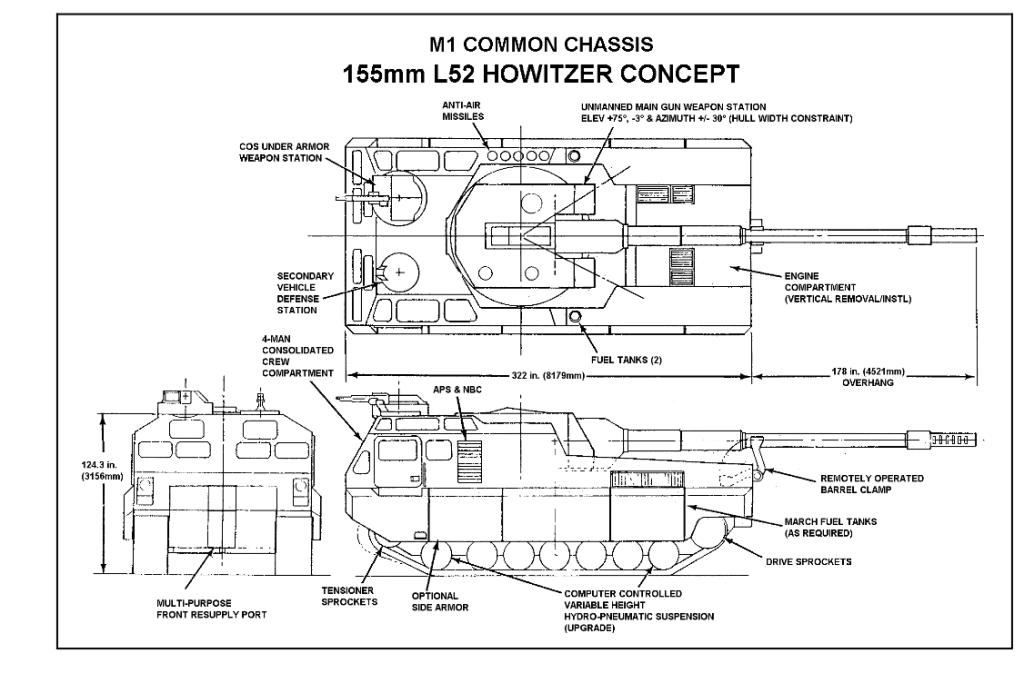
The year is 1995. Faced with either leaping into the unknown with a clean-sheet system or plugging along with legacy platforms, several contributors to Armor Magazine decided to pursue a middle ground. In the November-December edition, they unveiled their contraption: An Abrams-chassis 52-caliber (same as the PzH2000 and Archer) self propelled howitzer with an autoloader and a whopping 80 rounds inside.

The M1-Arty, or AFAS/M1. Of note is the Archer-esque “backwards” layout of the main gun.

AFAS/M1 would fire 4 to 8 rounds in a Simultaneous Impact Mission (SIM) between 6-40 km. All rounds will impact within 4 seconds (first-to-last round). This requirement can be attained with an effective combination of a battle management system, fire control system, global positioning system (GPS) and an autoloader.-claim for its power from the article.

A resupply vehicle on the same chassis would also be designed. The AFAS/M1 had a target weight of 55 tons.

For all the unusual elements about its design, in practice this beast would have been deployed conventionally. In action, it would have served with heavy divisions/brigades in the usual format. It could be simmed by using the offensive stats of the PzH-2000. Yet it still stands out, in appearance if nothing else.

A Thousand Words: Postal 2

Postal 2

Running With Scissors’ 2000s “masterpiece”, Postal 2 is a game about a man in a small Arizona town whose goal is just to complete mundane errands. However, a lot of stuff gets in the way. This game is infamous for its tasteless dumb humor, its gore, and the ability to use cats as silencers.

The humor is either dated, unfunny, or both. It’s very much in the style of the shock-the-oldies Dennis Rodman meets Bart Simpson style of the time. The actual gameplay, especially in the plot missions, combines two of the worst elements of turn-of-the-millenium FPSes: A post-hitscan, pre-regen system where combat is a deterministic exercise in power ups, and wandering through very similar hallways.

And yet, there’s stuff that’s genuinely good about it. Part of it is that, off the beaten path, it provides the opportunity for silly spectacle. This is helped by the open-world element being genuinely good. Almost all buildings are enterable, there are locations that have nothing to do with the main missions, there’s plenty of easter eggs, and a silver lining of the combat is that there’s often legitimate power ups (and hence reasons to explore) in the nooks and crannies. Another small part is that there’s just a hint of slyness in just wanting to do chores but getting confronted by everyone from creepy mascots to Gary Coleman.

This is a stupid, clunky, awkward game. And it’s fun.

Wither The Sharp

In The Sure Bet King, one of the few areas of sports betting that I didn’t cover was genuine sharps, or profitable bettors. Part of it was me not really knowing the most about they operated at the time (after all, those with a sincere edge aren’t keen on advertising it…). Another part was that they wouldn’t really fit the theme of the book. After all, this was far more about the system beating people than it was about people beating the system. The only “sharps” are the people who applied not-so-common sense to the boxing match at the climax of the novel.

In any case, like with almost everything else involved with sports betting, the more I learn of sharps, the less respect I have for most of them. First, there’s the very small number of very secretive modelers who actually can beat the sharpest sources (exchanges and “sharp books” like Pinnacle and Circa Sports) at their own game, costing them a little to shape a better line. These might as well be memetic Area 51 as far as secrecy’s concerned. These sharps are called “originators”, because the proper lines originate with them.

More common are what I like to call the “line vultures”. These don’t model or handicap, they just hit off, slow, or mismatched lines.

This video is one of the best examples of showing how a line vulture works.

I call them “line vultures” because they’re reactive and not proactive. Does it take effort and skill and talent? Yes. Is it exactly “sports betting” and does it involve the modeling acumen people think? Not in my opinion. Are sportsbooks justified in going after the line vultures? Yes. Are more innocent bettors frequently collateral damage in this banning? You bet they are.

Then there are the ones I have (even) less respect for. First are the outright manipulators, the people who don’t just pounce on line moves but (for example) cause them by betting at a sharp “market maker” knowing it’ll move and everyone else will follow. This sort of thing would probably be illegal in financial markets, and is definitely shady. Second are the bonus abusers, the people who take advantage of generous sportsbook promotions for financial gain.

Now that I know more about sharps and “sharps” and have already covered more of the gambling business, I might just include one in my giant brainstorms…

Review: The Russian Way of War

The Russian Way of War

One of the biggest surprises of the initial part of the 2022 Russo-Ukrainian War was that the former did not fight according to its paper doctrine. At all. Lester Grau and Charles Bartles The Russian Way of War is an excellent attempt at explaining said doctrine for a western audience. As anyone who’s studied them knows, they’ve left quite the paper trail. While sources like the VDV Textbooks Collection can provide them online in Russian fairly handily, this translates them to English.

And it translates them to English well. I have a few quibbles. The biggest is the authors taking an overly optimistic view of vehicle adoption, perhaps taking propaganda sources a little too much at face value. But the rest of it is well-done and evenhanded. The only real “problem” I’ve noticed is that I’ve read so many OPFOR documents that much of what they’re saying is already familiar.

But that’s a good “problem” to have, and I was still enlightened by this book. Every wargamer wanting to do missile-age combat involving the Soviets/Russians should read this.

WMMA5 Style Archetypes

One of the best things about WMMA5 is that you can credibly make people from many different styles. True, you can make balanced “mixed martial artists” or “freestyle” fighters, but where’s the fun in that? Meanwhile, those with a background in traditional or kick boxing, to say nothing of grapplers/wrestlers, are pretty self-explanatory. And combat sambo, which is very close to MMA already, just means a balanced fighter. But there are some more exotics that I’ve found fun to use.

  • Sumo wrestling. Not just for male heavyweights, the pushing nature of sumo means MMA fighters with a background in it trend towards what’s derogatorily called “wall and stall”, where they try to win decisions by pushing and trapping their opponent against the cage/ropes.
  • Shootfighting/pro wrestling. These I move up the “creative attacks” (punches/kicks, submissions) up a lot, to symbolize their stylistic, showy background. Otherwise they’re grapplers.
  • “Practical Fighters”. A catch-all term for those who’ve trained in legit military/law enforcement unarmed fighting. The opposite of the shoot wrestlers, these have very low “creative attacks” ratings, to symbolize their focus on boring but practical solutions.
  • Brawlers. Untrained goons, I’ve frequently given them “arm choke” ratings slightly higher than ‘normal’, because basic choke submissions are the most intuitive. Their strength often exceeds their skill.
  • Points fighters. Both people from combat disciplines that punish you for hitting too hard and other ones who just go for the “striking decisions”. Usually highly mobile, points fighters have high skill but (comparably) little strength.
  • Hillbilly fighters. I have one creation whose stated style is “Hillbilly Fighting”. The attributes have him being a balanced fighter with a penchant for kicking his opponents in the head.

Review: OPLAN Fulda

OPLAN Fulda

Time to return to this blog’s roots with intelligence veteran Leo Barron’s new OPLAN Fulda. It’s a 1989 conventional World War III novel. In other words, what this blog was made to cover. So how is it?

Well, it’s pretty obvious that this was written by a military intelligence veteran. One passage where a Soviet army commander muses on the two difference courses of action his subordinate division commanders have chosen for their attack is the most blatant, but the tone is clear throughout the whole book. This means there’s too little fog of war for my liking and a lot of Melville-esque passages (complete with footnotes in many cases).

There’s also the usual suspects. There’s the contrived excuse for a war, conference room scenes, and jumping viewpoints. However, and this is important to note, the execution of all this is not bad at all. In a hard genre to do right, Barron succeeds.

The action is good and appropriately messy. Nuclear weapons are not handwaved aside (and the escalation makes sense!). The focus is an intricate one on both the Americans and Soviets instead of swerving away to some British or Dutch unit elsewhere at the worst possible moment. Oh, and it gets the tank designations right.

Because of this, I’m delighted to recommend this book to all World War III enthusiasts. Stuff like this doesn’t come along too often. So when it does, I feel great in reviewing it. The best praise I can give this is that it’s helped inspire me to make a “big war thriller” for my next draft after two mostly nonviolent works.

Review: The Profession

The Profession

Steven Pressfield is known for his ancient fiction, but in The Profession he moved to contemporary (technically near-future) action. Or, rather, inaction. Because most of the action is in flashbacks and most of the book is just the main character moving around and monologuing about how wonderful and awesome these near-future supermercs are. It’s almost “A combination of Special Forces, Ranger, SEAL, and gutter-fighting” bad.

When I saw the book was written in first-person, I feared that it would be like some of Peter Nealen’s writing: Good but dragged down by an ill-suited format. Here, the book is so shallow that the format is basically beside the point. It’s like Angola running a man defense instead of a zone one (the textbook basketball strategy against individually better players) against the Dream Team. It still doesn’t matter. Even the basic prose is bad with its giant overdescriptive blocks.

The main character is a misogynistic ass of a Mary Sue intended to represent (and appeal to the fanboys of) the dubious Universal Warrior claim the author loves. The setting, well, anyone who knows anything even slightly deeper will have issues with it (for instance, even a casual scholar of Central Asia like myself could spot a lot of flaws with his description of Tajikistan). And the writing just feels so detached, inauthentic, and over-described.

Finally, I felt sort of insulted by the whole slobbering over the central man-on-a-horse, concluding with an “I admire its purity” plot twist. The track record of military strongmen is more like Thieu and Galtieri than Ike and Schwarzkopf. It doesn’t lead to martial virtue over civilian weakness, it leads to tunnel-vision paranoia.