A Thousand Words: People Playground

People Playground

When I was young, one of my favorite games was the Rube Goldberg generator known as The Incredible Machine. Now I’ve been delighted to announce that I’ve found a spiritual successor, People Playground. You can make all sorts of contraptions there in a physics sandbox-that mostly have the end goal of killing people. Or monsters. Or robots. For someone with as frequently twisted a sense of humor as me, I’ve loved it.

Yes, you can manually spawn a weapon and just kill your test subjects, but where’s the fun in that? One example of the breadth of this game is my most satisfying creation. One victim was strapped to a chair while another had an incandescent light bulb wired to him. The light bulb was switched on and given a heat transfer, causing the first victim to burn to death. A heat pipe was then attached to the second victim’s head, leading it to light up like a candle, before the whole body followed suit.

There’s a real sense of satisfaction in making an elaborate deathtrap that finally, actually works, and it’s for that reason that I recommend this game for people who like messing around in sandboxes. It’s very fun.

Soviet-Romanian War: Background

I’ve talked before about a Soviet-Romanian War that’s a kind of “Soviet Gulf War“. There have been many obstacles to me actually writing such a thing, ranging from “what do I do with it” to “it’s a little eerie seeing Russia’s OTL buildup and interventions, including currently off Ukraine…”. But I figure I might as well get the rivet-counting parts of it down now while they’re fresh in my mind.

The Setting

It is the year 199X. The USSR is still intact. The reason isn’t because, as in Northern Fury, the August Coup succeeded. Here, it never happened, and the result is a “Union of Soviet Sovereign Republics” ( Союз Советских Суверенных Республик ), which allows for the continued use of the “USSR”, “Soviet Union”, and “CCCP” abreviations. The resulting semi-decommunized USSR has varying degrees of freedom and business openness, and is best symbolized by a flag: Still red, but with the hammer and sickle replaced with a light green vertical stripe on the left and a darker blue one on the right (to symbolize Central Asia and the Western Slavic republics).

Its economy has also been better improved from the historical collapse, but it retains its gigantic spending on the military. Having a bigger pie and more access to the Asian tech industry helps a lot. The result is that one of my favorite OPFOR models, the “Mobile Forces“, can finally be put into practice.

Meanwhile, to its west, the renegade Romania has clung on. But the time has finally come to eliminate it…

(Yes, I haven’t thought of the casus belli yet. Oh well.)

The Combatants

The USSR is able to deploy the Dniester and Danube Fronts. The Dniester Front is to the north and is composed mainly of national-level deployment forces and local ones in the Ukrainian and Moldovan military areas. The Danube Front stages out of Bulgaria (the most docile Warsaw Pact ally), and consists mainly of Bulgarian units with a smattering of Soviet ones, often in support roles. The only other foreign ally participating in a major role is a by-now-fairly-stabilized Afghanistan, contributing a motor rifle division and various mountain/commando units to the Dniester Front.

Investment has paid off, as the new pride and joy of the Red Army, its “mobile corps” are ready and set to participate in the invasion. A new generation of equipment has entered service. Many of the local participants are less well-equipped (in Bulgaria’s case, sometimes severely less so). The force contains thousands of tanks, artillery pieces, and aircraft, many of them new.

Opposing it is a force long considered the bottom of the Warsaw Pact barrel. Romania has had time to introduce some external and indigenous weapons systems. It has also semi-openly planned for a conventional delaying action followed by irregular resistance since the Ceausescu/Soviet split. But it remains hopelessly outclassed.

The Plan

The Dniester Front will do the bulk of the heavy lifting, sweeping through Romania. The Danube Front’s main goal is to cut off Bucharest and the Yugoslav border to head off reinforcement or escape in that direction. The biggest airborne and special operations since World War II will be conducted to aid the advance, secure the western side of the Carpathian Mountains, and interfere with the Yugoslav crossing.

Romania’s plan is to simply hold off long enough to set up a guerilla oppositions. In addition to all their other problems, an insistence on holding down the more Hungarian northwest, if only with security troops, lingers. (Hungary proper cares little for either side and has almost no intervention ability).

The Outcome and the Story

Ah, now that’s what I want to write about. I have many vignettes in my mind as of now but less of a coherent narrative. Still, I think I’ll have fun trying.

Review: Blood Debt

Blood Debt

Peter Nealen’s Brannigan’s Blackhearts return with a bang in Blood Debt. When I saw the teaser and saw that the book took place in Kyrgyzstan, I was excited. Central Asia is an excellent and underused setting. Reading the actual book, and seeing the series return to its high-powered enemy heights made me even more excited. A lot of the time fiction works best when it’s audacious, and this is definitely that.

If anything, the action is somehow improved. I got a greater sense of a (very plausible and realistic) fog of war in the action scenes without it taking away from the cheap thriller spectacle. There’s this and there’s well, the main villainess (yes, villainess) having an Esperanto-derived name. What’s not to like?

The Camouflage Sweepstakes

For some time after the fall of the USSR, the independent Russian military was known for its huge array of often-mismatched camo patterns. Even after the “digi-flora” standardization, this remains true to a degree (as in other armies-look at the classic “Woodland vest over desert camo” look in the Iraq War.)

For the camo sweepstakes of a surviving Red Army, I see a few options.

  • VSR-93. This pattern historically was in development when the USSR collapsed. There’s no reason why an intact, better-funded USSR wouldn’t be able to standardize.
  • TTSKO. This was an existing camouflage pattern widely continued by ex-Soviet republics.
  • For a more fanciful idea, a type of early digital camo could be adopted. As it stands, one was adopted by an ex-SSR, with Latvia’s “LATPAT” camo. Although not to the degree of the American Dual-Tex, the “pixels” are still significantly bigger than most other digital patterns.
  • Something else. Even in Russia itself, the Interior Troops adopted many patterns that could easily be used for the regular army.
  • Simple legacy pattern uniforms.
  • A combination. The GENFORCE-Mobile concept gives me the idea of the Mobile Corps and Airborne Forces having “fancier” uniforms.

Review: Danger Close

Danger Close

Cameron Curtis’ Danger Close is kind of like seeing a local band play an original love song in a club with iffy acoustics. It’s not exactly ambitious, and you know the quality isn’t the best, but you don’t care. You enjoy the music anyway. Likewise, this ridiculously cliche “shoot the terrorist” story is still enjoyable.

It has a very predictable arc (I basically knew the fate of a certain supporting character because she reminded me of a similar one in Rambo II). It has the big burly macho ex-operator man-bro main character. It has research that somehow gets some basic details wrong. It has the Clancy/Baen-ist politics of a cliche cheap thriller and then some.

I didn’t care. Not everything can be an epic masterpiece, and not everything should be. This is disposable entertainment and should be treated as such.

Review: US Battleships

US Battleships: An Illustrated Design History

Norman Friedman’s US Battleships: An Illustrated Design History was one of the first really big, really crunchy, really technical books on military equipment that I got. It’s obviously not light reading (at least for normal people), but it flows well. And I honestly think battleships are the best suited to a historical chronicle like this.

Since 99% of their history was in the past tense (the sole exception being the Iowa reactivation at the time of the book), it means there’s less sensitive info around. And since battleships are gigantic and awesome (don’t lie), it makes for fascinating reading. In battleships, you can see the US Navy going from its humble beginnings to its World War II juggernaut.

Technical naval warfare fans should definitely get this book. It’s one of the best of its kind.

World War 199X

The Zapad-99 exercise, the first massive maneuver conducted since the fall of the USSR, shows some interesting insight into the conduct of a World War III in the 1990s instead of the classic 1980s. The conduct of the exercise went essentially like this:

  • The OPFOR, or “Hypothetical Enemy”, as is the official Russian term for such things, launched a giant campaign in the Baltic/Belarusian region, overwhelming the overmatched CIS troops with air and missile power.
  • Kaliningrad was overrun by the Blueeaglelanders.
  • In the most famous and controversial part of the exercise, a limited nuclear “escalation by deescalation” after the fall of the exclave was conducted in which bombers attacked several important targets with cruise missiles. Two Tu-95s and two Tu-160s were successfully launched, and the missiles on those are enough to cause monstrous damage. (that’s 36 AS-15s with 200kt warheads. Ouch.)
  • Said targets are likely to be NATO bases in Europe and American bomber and logistics bases in the continental US.

To a degree, this era has already been explored, however imperfectly, in Arc Light and Red Hammer 1994. Northern Fury takes place in the 1990s but assumes a stronger, intact USSR and conventional weapons (at least for now…)

A Thousand Words: Ishtar

Ishtar

The film Ishtar, about a pair of dopey musicians that end up involved in a Middle Eastern revolution, is frequently labeled one of the worst films ever. Is it that bad? Not really. Is it bad, period? Kind of. See, it wants to be smart, but it fails spectacularly at being smart. When it lets itself be dumb, it has some good moments.

The highlight of the film is a scene in a bazaar involving a ton of secret agents with terribly stereotyped disguises. It had me laughing massively, and reminded me of the classic Oktoberfest scene in The Pink Panther Strikes Again. But the attempts at actually providing DEEP POLITICAL COMMENTARY? Not so much. Even some of the dumb comedy moments don’t work-there’s a scene later in the movie that involved arms dealers, natives, and the main characters “translating” by speaking gibberish that came across as contrived, unfunny, and honestly a little offensive.

The acting is iffy. Charles Grodin does a great job as a secret agent. The actor playing the emir of Ishtar is undeniably talented and would have worked well in a serious movie, but fails here where a Chaplin/Baren Cohen-style goofball dictator would have fit a lot better. The main characters are annoying and idiotic, but they’re meant to be annoying and idiotic. Does that help? You can decide.

It’s not the best movie of all time or even really “good”, but it doesn’t deserve to be considered one of the worst films ever.

The Artillery Growth Spurt

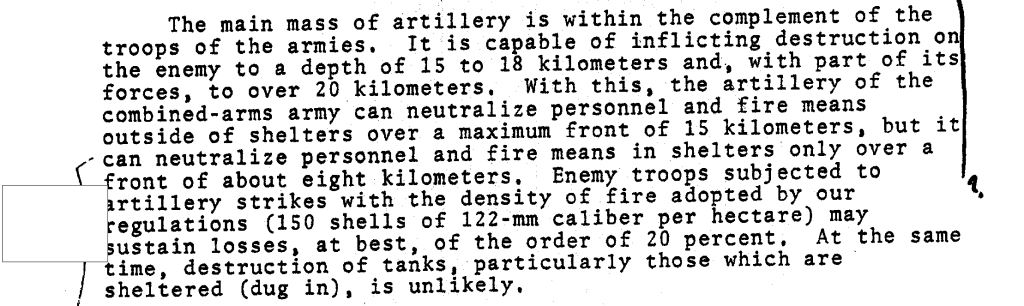
I was looking through my old planning documents and noticed something very interesting. In a 1969 piece on conventional-only operations that was one of the first of its kind, the Soviet planners estimated their artillery could inflict a maximum of 20% enemy losses in the opening fire strike.

By 1974, just five years later, when their conventional balance was arguably at its height, it had grown to the more familiar OPFOR ratio of 30-40% in a similar document.

I’m thinking (pure idle speculation), various combinations of bigger guns, more mobile guns, more accurate guns, better shells (cluster warheads that make conventional SSMs more than just a nuisance are mentioned in the same document), and probably stuff I missed.

What I find extra-fascinating is that the Azeri’s Nagorno-Karabakh opening half-hour mega-strike apparently destroyed 40% of the Armenian artillery-which is in line with the previous estimates, especially if you take into account technical superiority and massive, massive advancements in smart weapons. (Also, though, for all that, the war still lasted a month and a half and claimed around Azeri 3,000 KIA by its own admission.)