Large Special Forces Units

The term “special forces” can have many different meanings. The western definition of “special operations forces” implies the ultimate operators. The Soviet definition of “special purpose forces” just means those trained for a certain role. Thus engineers and chemical personnel technically count as “special troops”, and many “SPF” are mainly recon personnel.

Training Circular 7-100.2 differentiates “SPF” and “commandos”, the former capable of things comparable to western-style SOF like training/leading allied irregulars and the latter capable of more “muscular” missions that require a bigger conventional force (commandos are listed as being able to operate at up to battalion level, something SPF never would even during direction action missions). There is a large amount of overlap, and they are more similar than different.

Then there are the “special forces” that would be considered just larger light infantry formations by the standards of other countries. Or not even that, with Stryker/BTR formations viable for (and sometimes expected to be used in) air assault operations due to their larger dismount size and some “SF” riding in APCs when operating with mechanized forces and/or facing threats that require appropriate protection.

Thus the clearest definition boils down to a vague “units with personnel trained to at least theoretically higher standards and intended to conduct tasks above and beyond those assigned to run of the mill formations”. Interestingly, I’m seeing (with the precedent of Syrian commandos in Lebanon and the proposed TRICAP Ranger/Helicopter formations) certain “special forces” being used an antitank reserve with their increased skill, more and better AT weapons than comparable line infantry formations, and the ability to be deployed quickly.

Review: Postwar AANW

The Anglo American Nazi War: Part 2

The first installment of The Anglo American Nazi War, published as Festung Europa, has been reviewed on this blog before. Because the postwar part is A: different, B: worse, and C: deliberately not included in the published version, I figured it deserved a separate review.

The wartime portion can fit, slightly awkwardly, into a certain form of pseudo-historical fiction. For fans of conventional World War IIIs, it can be compared somewhat to Hackett and The War That Never Was. It’s a description of a conflict that didn’t happen written in the style of recounting one that did. There is thus a tiny connection to fiction in general, albeit with the thread leading to another very small niche. It also fits into “AH as a genre.”

The postwar installment lacks even that connection. It’s a pure example of internet alternate history, and one of the big problems I’ve had when trying to review is that internet AH is an extremely insulated subculture that lacks almost any tie to normal literary storytelling. How can you critique the characters if there are none? I’ve had to strain to explain it, with the best I can give being “The outline of a de facto fanfic that uses ‘history’ as its setting”. If that sounds unusual and bizarre, it is.

Internet AH has a reputation for its installments being extremely short, something that actually sets it apart from other serialized web-fics that have a deserved reputation for often leaving War and Peace and Atlas Shrugged in their dust where length is concerned. The more substantive wartime portion takes up over 86% of the words written in the story. What’s left is a series of short infodumps.

Here’s what happens. In an utterly ruined Eurasia, everything from the Channel-bordering regions of France returning to British semi-rule as crown dependencies to the US annexing the Russian Far East as “Western Alaska”, with it later becoming a state, occurs. There’s both a “Russia” and a “Soviet Union.” The remnants of Germany are divided into many Morgenthau Plan-style restricted microstates. All this is told in blocks of exposition that somehow feel even flatter than the wartime ones. Which is a shame because there’s both comparison to another alternate history (in this specific case) and a huge amount of lost potential.

The world that develops is one where the US builds lots of superweapons the author clearly likes, adopts a full-on might makes right policy, has the path cleared for cakewalks despite its historical postwar advantages and lack of historical rivals, and uses them frequently against totally ineffectual opponents who exist purely to serve as live-fire targets. This is very much like The Big One, except it lacks the utter audacity and, in something you’d never have hear me say earlier, literary skill of that series.

Instead of using the power of Mary Sue project management to get the superweapons into service without breaking the bank, postwar AANW just has the US continue to run what amounts to a total war economy, falling victim to the “nine women can have a baby in a month” fallacy of funding always equaling results. Instead of having immortal manipulators with catlike eyes provide unrealistic policy continuity, postwar AANW just has a lazy unshakeable consensus emerge. Even after the US destroys several German cities with space weapons after their uprising had been conventionally suppressed, the result is not a “you kicked them when they were down” backlash similar to the real one (however fair or not) over the atomic bombings of Japan, but rather the even more hawkish party gaining support.

What should be an audacious, massive divergence that could easily serve as the foundation for a distinctive work instead is summarized in only around two dozen pages worth of actual text. This is a shame because the premise of a superweapon-obsessed US that never truly left the wartime era (and its ugliness and excesses) behind could make for a great “AH as a setting” story. It could be a highbrow book about generational change, with the upheaval making the historical 1960s look tame. It could be a thriller as the nation with a bazooka suddenly faces problems requiring daggers.

Instead it’s just the outline of an even more biased late Tom Clancy novel mixed with map trinkets. Instead of being made into a potentially tasty meal, the ingredients were just placed in a bowl and left there, next to other bowls full of uncooked flour, eggs, and spices.

Review: The Professional

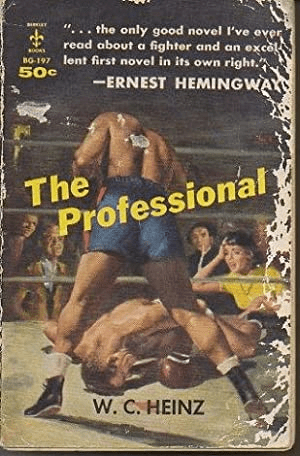
The Professional

A tale of middleweight contender Eddie Brown, The Professional is a novel by legendary sportswriter W. C. Heinz. What’s interesting is comparing it to Malamud’s The Natural, as they take extremely different paths but arrive at the same level of quality. This deserves more explanation.

Malamud did not know much about baseball. Heinz knew boxing inside and out. Book Roy Hobbs is an ass that you’re not supposed to root for. Book Eddie Brown is meant to be a decent, sympathetic figure in a bad sport. The Natural loved making flourish and mysterious performance shifts depending on the plot. The Professional is grounded and realistic to a fault. The Natural is a third-person book. The Professional is a first-person book. The prose is blocky in both, but while Malamud is excessively flowery, Heinz is very Hemingway-esque (not surprisingly, that author loved the book). And yet both come across as being stilted, pretentious, and dated.

Its main characters are not very good. Brown is not a bad protagonist but he can’t make up for the faults of the other two, which are massive. The two other central figures are Brown’s hideous Mary Sue of a trainer/manager and the first person sportswriter narrator, who fits the “character as camera” archetype I’ve seen in other negative reviews of first-person books.

As for the book itself, it consists of realism-as-padding, outright padding, and expects the reader to treat the technical decline of boxing as some great tragedy. I could be a little harsh on it because it would be far more novel and revealing to a 1950s reader who only knew boxing from television and the pulps (not surprisingly, there’s a scene where Heinz, via one of his mouthpieces, swipes at them for their inaccuracies). But to someone much later who’s read a lot of excellent nonfiction on the sport, it just felt plain and empty.

Review: Friday Night Fighter

Friday Night Fighter

Troy Rondinone’s Friday Night Fighter is the story of both a boxer and a time period. It is the story of boxer Gaspar Ortega. It is also the story of a huge-in-its-day sporting event, the time when boxing aired en masse on network television and attracted a viewing share comparable on the low end to the NFL playoffs today. It is the story of a far more unified sport than the later “alphabet belts”.

Rondinone’s writing is excellent and Ortega, a boxer who appeared on television many times, is arguably the perfect figure for this age. On one hand, he was much more than a small journeyman who appeared on television a few times. On the other, he wasn’t the kind of already-immortal figure that everyone already knows about (ie, Marciano, Patterson, Liston). A contender who never got to actually wear the belt, he illustrates the time period exactly.

Another impressive element of this book is that it rarely sinks into Good Old Days nostalgia despite boxing being the one sport where it’s the most viable. It makes it clear that boxing gave up on network TV because network TV gave up on boxing, with viewership substantially down even before Benny Paret’s death. Yes, TV played a role in diluting the talent pool and closing down the old clubs and gyms that served as the fighter pipeline, but so did simple demographic change. And it doesn’t hesitate to tackle the sleaze in the sport.

The best complement I can give to this book is that it truly takes the reader into another time, and that’s something a lot of history books just can’t manage. Friday Night Fighter is one of the best works of sports history that I’ve read, and I highly recommend it.

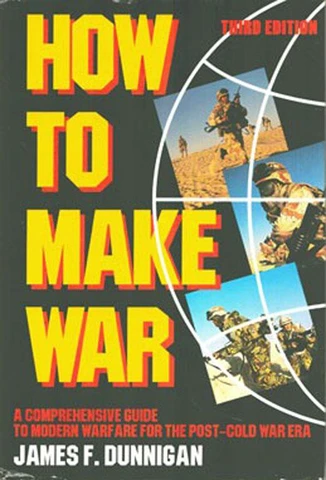
Review: How To Make War

How To Make War

Written by acclaimed and prolific wargame designer James Dunnigan, How To Make War is an impressive one-volume entry on both the basics of military operations and wargaming them. It’s not an easy feat to stuff so much into one book, but he manages it. Every facet of post-WW2 warfare is covered inside, along with simple but generally effective formulas for determining a unit’s “combat power” and stuff like average attrition in personnel and equipment.

Some of the “flaws” are clearly not his fault. For instance, it’s not his fault that (like most aficionados, to say nothing of actual veterans) I already knew most of what he was saying in his basic description of various unit types. It’s also not his fault that some of the book is dated (the latest edition was made in 2003). I’ll even excuse its frequent yet understandable bias, which is exactly what you’d expect from an old western Cold Warrior.

The biggest drawback that I’m not so willing to let slide is how its two central parts don’t really gel. It’s trying to both teach someone to walk (ie, the intro to all parts of the military) and run a marathon (do calculations for exact combat power). It just feels a little awkward to have “here’s the basic differences between infantry-heavy and tank-heavy formations” and “here’s how to calculate the combat power of a Syrian armored division” close to each other in the same book.

Still, this is a very good and very convenient resource for people wanting to learn more about missile-age warfare and/or wargaming. For fictional country simulations/story concepts, I’m already finding his formulas very useful for translating an order of battle into a general feel of its relative strength (which is the most important part). While some specialists may already know its material, you still can’t go wrong with getting this book.

Review: Friendly Fire

Friendly Fire

After an uncomfortably sustained dip in quality, the Jonathan Grave series returns to form in Friendly Fire. While it has all of the contrivances and weaknesses of Gilstrap’s other fiction, it also has the strengths in the form of excellent action. And the latter is far more prominent. It’s a “shoot the terrorist” book, but that’s not necessarily a bad thing if the execution is good.

And it is indeed good here, with Gilstrap leveraging the structure of the series to write powerful set pieces. It’s always a nice thing when a series returns to form after a swoon, and this book is definitely an example of that. It reminds me of the first few Jonathan Grave books, and as an introduction to the series, it’s as good as any.

Review: Gil Thorp

Gil Thorp

Fuldapocalypse now turns its attention to the so-called “funny pages”, the coleacanths that linger in newspapers across the country. One of these living fossils is Gil Thorp, a sports comic that has been running nonstop since 1958. The comic has a simple premise. It follows the title character, a coach/athletic director of the fictional Milford High School, and his students as they play through the seasons and have off-the-field drama. (The name is a combination of real star players Gil Hodges and Jim Thorpe).

One thing in the strip’s favor is that it’s been timed to match each real sport in its real season. So you have baseball/softball in the spring, football in the fall, and basketball in the winter. Of course, this means that the summer, when school’s out, leads to huge segments of nothing but non-athletic filler.

There have been several artists drawing the strip, none of them particularly good. This was an issue in one arc where two characters thirty years apart in age looked almost exactly alike, which drew some confusion-and this was reading the strips in hindsight. Beyond that extreme example, you have tons of barely distinguishable, interchangeable, moving-in-and-out characters.

Which brings me to the next problem, and one that shows why this particular type of comic strip has been mostly destroyed. It turns out that soap-opera style arcs told one three-panel strip at a time are not the most ideal way to tell a story. That the storylines themselves fall into an awkward melodramatic-yet-tame-enough-for-the-mainstream-papers uncanny valley and are frequently repeated can be forgiven/understood, even if it doesn’t help. But no matter the quality of the plots as a whole, the format just does not lend itself to good reading.

This was the first work of fiction I really binge-read in some time. And while I liked the goofy experience, there’s a reason why most other storyline strips like it have sunk into the depths.

Review: North Korean Tactics

North Korean Tactics

One of the best OPFOR manuals I’ve seen, and one of the most recent, is ATP 7-100.2, North Korean Tactics. The manual itself is a good read, and the “Breaking Doctrine” podcast that comes along with does a great job explaining how both it and other OPFOR documents (a long weird guilty pleasure of mine) have come into being.

Thus the manual isn’t a direct “They will do this” the way that some of the more overly rigid Soviet-inspired ones were. But it does show the characteristics of the secretive country (light infantry, high willingness to take casualties, artillery over tanks, etc…) and has to focus on its specific qualities instead of just lumping them in with a generic OPFOR designed for challenge above adherence to any specific country.

It’s not perfect, but it’s intriguing and well-done, showing the seeming contradiction of mass asymmetric warfare in action. Ones for China and Iran are planned, and I’m awaiting them. (There’s one for Russia announced, but it’s kind of in limbo. My hunch is that the need for something so specific is less for a country that’s already studied and already fairly close to the generic OPFOR).

The Tiers of Fighters/Opponents

So, boxing (and to a lesser degree mixed martial arts, though that is an inherently higher-variance sport) has developed a sort of tier system for its numerous fighters. Title Bout Boxing, through its auto-scheduler enabling you to run numerous simulated matches, is good for determining just how good fighters in one tier can fare against those in another. What I’ve found is that cheap thriller opponents can also fit into these categories.

  • Tomato Cans. The bottom of the barrel. They’re set up in deliberate squash matches, most often for the purpose of artificially inflating a fighter’s record. Or providing a spectacle. Tomato cans are always ranked as “0” in Title Bout Boxing, and the only way they can defeat any kind of significant fighter is through an injury/cut/occasional fluke knockout.
  • Journeymen. The middle of the pack. These are the low-tier filler fighters which everyone has to pass through, and which define the median that people diverge from. In Title Bout, they’re ranked 0-2, and aren’t quite as hapless as tomato cans against clearly superior opponents.
  • Gatekeepers/Trial Horses. These are fighters intended to separate the wheat from the chaff, so to speak. Barring the above lucky moments, they aren’t expected to credibly challenge for a title themselves. But they can determine if a prospect is all that or not. In Title Bout, they’re typically ranked 2-4.
  • Fringe Contender. This is where the lines start to blur. In-game, they’re a 5-7 ranked fighter who can occasionally win against superior opponents “legitimately” (I’ve found that being able to win via decision is a mark of legitimacy, as are knockouts/TKOs that aren’t due to cuts). Often they’re genuine champions by national/regional standards.
  • Contender. 7+ ranked fighters in-game who can consistently win legitimately, even at low percentage chances overall, against other contenders. I chose the game’s 7 rating as the line because that’s the in-game rating of Ingemar Johanssen, widely considered one the weakest world champions ever.

As always, perspective is important. Even tomato cans are better at punching than any normal person, and the difference is simply a matter of degree. Someone good by lower standards can still be the equivalent of a tomato can against an all time legend.