Review: Red Army

Red Army

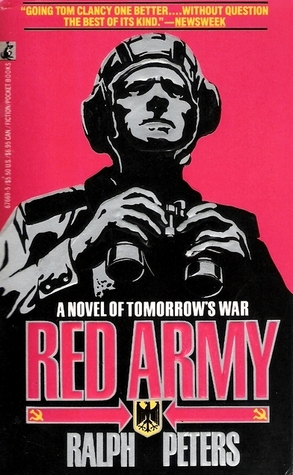
So I actually haven’t done a formal review of Ralph Peters’ masterpiece Red Army on this blog yet. I think I should, because well, it’s my clear choice for “best conventional World War III book of all time.” It has fewer competitors for that title than I originally thought when I first read it, but still manages to stay above them.

The story of a conventional WW3 in 198X, the book jumps between the perspectives of various Soviets as they carry out the war. One of the best “big war thrillers” at managing the viewpoint jumps, it never feels awkward or clunky in that regard. The characterization is very good, especially by the standards of the genre. And it works very well at avoiding an excessive focus on technology.

Of course, Peters has the Soviets win, and thus deserves extra credit for going against the tide. At the time the book was published, there was a (justifiable) sense of increasing triumphalism. Having them win and win handily was a good move. Especially since it doesn’t come across as being done for cheap shock value.

There’s a few sour parts. While the viewpoint jumping is good, the two messages of “humanize the Soviets” and “show how they can beat NATO” sometimes don’t work well, especially as the latter means characters done just to explain things (granted, as someone who’s read the translated Voroshilov Lectures and similar materials for fun, I understand it in ways a casual reader at the time almost certainly wouldn’t). There’s criticism of how the Soviets advance too fast, which is valid but which I consider a mild issue, no worse than Team Yankee’s similar problem with lopsidedness. My biggest complaint is how the situation is set up to let the Americans almost entirely off the hook for NATO’s defeat.

But these are small problems at most. Red Army is an excellent book, and I have no problem considering it my favorite “Conventional WW3” novel of all time. And it has one of my favorite book covers ever.

Review: The Ninth Dominion

The Ninth Dominion

The second, and as of now last book in the Jared Kimberlain series, Jon Land’s The Ninth Dominion is a par-for-the-course crazy ridiculous action-adventure book. By the standards of classic Jon Land novels, it has some issues. While it doesn’t help that its immediate predecessor was arguably his most ridiculous (in a good way) novel yet, there’s issues beyond this.

It’s a little less crazy. Beyond that, the biggest issue is that it doesn’t take full advantage of its almost Batman-esque premise of the craziest and most dangerous serial killers escaping. The prose and pacing are a little below Land’s height.

That being said, it still has all the strengths of a Jon Land thriller, and I still enjoyed it significantly. By the standards of more mundane thrillers, it’s quite goofy indeed. Its flaws are not deal-breakers by any measure, and there’s no shame in falling slightly short of a very high bar.

Review: I Jedi

I, Jedi

Michael Stackpole’s I, Jedi may be my favorite Star Wars novel ever. It’s also a book that has absolutely no business being as good as it is. After all, Stackpole is a writer who isn’t the best prose-wise and tends to take game mechanics literally. Corran Horn, his protagonist, is the ur-example of someone parachuting their own Mary Sue into an existing franchise. The first part of the book uses the same plot as a book by the infamously subpar Kevin J. Anderson.

And yet, it somehow works brilliantly. Part of it is that Stackpole’s writing is in better form than usual, in everything from starfighter battles where Corran fights his old teammates and can sense their thought processes to everyday life on a backwater world. Another part of it is that by being small-scale and comparably low-stakes, it manages to actually make the universe look bigger and more wondrous.

Stackpole’s epic might be helped along by the other books of the time, which tended to have a random ex-Imperial using the superweapon of the week and an inappropiately small number of Star Destroyers to threaten the entire galaxy. But even on its own, it works. It embodies the “distant vista” principle, restores a sense of awe, and just succeeds as a story in its own right.

Review: The Bear Marches West

The Bear Marches West

A short, small, and simple compilation, Russell Phillips’ The Bear Marches West is a list of prospective wargame scenarios made out of the three most iconic 1980s conventional World War III novels: Red Storm Rising, Team Yankee, and Red Army.

The book itself is basic: You get a listing of forces, a listing of the situation, and that’s essentially it. This is so that it doesn’t get tied to any one rules system. For enabling reenactments of scenes in the classics, this book works well enough, although anyone who knows 198X WWIII wargaming (not exactly an underused or underexplored area) should likely be able to do something similar with just a bit of knowledge. Still, it’s an inexpensive novelty, and it would be interesting to see what ruleset generates results closest to what actually transpired in the original novels.

The “Shoot The ___” Genre

Along with “Spacesuit Commando”, one of my derogatory terms I use is “shoot the terrorist”, and its 70s counterpart, “shoot the mobster”. Now, like with “spacesuit commando”, I’ll admit it’s a nebulous term that I use when I feel like it. And there are plenty of books with a formulaic setup but good execution.

That being said, If I had to make a checklist of the usual elements of a book I consider “shoot the ____”…

  • The book doesn’t have the best execution (no pun intended).
  • The book has a trendy enemy (terrorists! mobsters!) as its antagonist, and one not done particularly well.
  • The MacGuffin is something dull and mundane like a nuclear bomb and/or poison gas-if that.
  • The book is too out-there to be truly realistic but too sedate to be truly out-there, in prose and action.
  • The book just doesn’t feel lively.

Review: The Secret Weapon

The Secret Weapon

A thriller in the Alexander King series, Bradley Wright’s The Secret Weapon is an example of how tough it is at the margins. My history with the author is a little strange. I’d read some of his books in the past, where they faded from memory as bland and mediocre. Then I saw this book, felt it was bland and mediocre-and then realized I’d read the same author before.

Anyway, the book isn’t really the worst ever. On-paper, it does what a cheap thriller is supposed to do, and only feels like its slightly below average in every category that matters-the action is slightly less exciting, the pacing slightly less efficient, and so on. Yet it’s that little bit that makes the difference.

Because the “action hero” genre is so big, has so many choices, and is reliant on execution rather than concept, for something to fall behind somewhat means there’s a lot out there that’s better. This isn’t like the much tinier “big war thriller” genre where a flawed entry like Chieftains or Arc Light can still be conceptually interesting enough to recommend. Instead, its flaws means it sadly misses the cut.

A Thousand Words: Revolution X

Revolution X

What happens when you take a pair of has-beens fading rapidly from relevance and merge them together? You get Revolution X, an arcade light-gun shooter starring a past-its-prime Aerosmith. The plot is simple-save Aerosmith from a bunch of people in yellow gas masks who’ve outlawed fun. You do so with a gun that fires CDs as well as bullets. Yes, it’s that kind of game.

The gameplay is mostly simple-fire at the hordes of enemy goons on your screen, put more quarters in when they inevitably kill you, repeat as necessary. Two of the later levels make this worse by trying to be more complicated. One, a maze, is simply annoying. The other, a time-sensitive mission where you have to completely destroy a bus before it reaches its destination, is considerably more aggravating.

By the time of its release, Aerosmith had long since fallen from the heights of their popularity, and with more powerful and smaller consoles just coming out, arcades would soon follow. This game is one of those weird novelties that can only happen at a specific time.

The Case For Flawed Ambition

Of all the literary attitudes I’ve had that have changed since I started blogging, I think none is bigger or more important than how I’ve approached ambition. In the past, I’d had this attitude that if the execution was subpar, the ambition wasn’t worth the effort. It was better to aim for something attainable, so the thinking went.

Now, well, I’ve found myself enjoying works of fiction more when they aim/aimed to be highly ambitious, even when their execution is obviously flawed. Part of this is me now knowing how many “51%” books there are, knowing there’s no shortage of competent but middling fiction. From that perspective, something distinct, or even trying to be distinct, can stand out more. If nothing else, it’s a lot more fun and/or interesting to review. Repeatedly saying “this is formulaic but competent”, even if true, isn’t the most fun.

Another part is that it just felt better to write such out-there stuff when I wrote the two Smithtown books. Previously, I’d wondered why authors who had a good amount of creative control sometimes tended to go more out-there into “Arkansas vs. The Blimps” territory as their series’ progressed. Now, I need not wonder.

Review: The Mongol

The Mongol

The final Casca book credited to Barry Sadler (regardless of its actual authorship-according to some stories I’ve heard, it was a manuscript found after his death), The Mongol is a 51% book in a 51% series. The “which period of history should we put Casca in a theme park version of” wheel stopped at “Genghis Khan” this time.

The good news is that compared to previous flops like The Trench Soldier and The Samurai, this book is significantly better. The bad news is that, like every other Casca book, it’s still melodramatic pulp historical fiction that does almost nothing with its supernatural premise. For a quick read, one could do a lot worse. Yet there isn’t really anything to recommend it ahead of the first two Cascas either.

Thus it’s perhaps fitting that a middling series ended (for a time) on such a middling note.