Weird Wargaming: The All Union US Military, Part 1: Army and USMC

So the conventional forces of the United States in All Union, unlike its superpower counterparts, have not been the most central to any of my drafts (yet…). Therefore I figure I should infodump some of my musings on it right now.

Background

The reformation of the USSR brought about a period of aimlessness among the US Army. With the fall of the Berlin Wall and the former Warsaw Pact states forming an independent de facto buffer, priorities became much lower. Going from all of Germany to the northern tip of Norway and Thrace is somewhat of a downgrade.

That being said, there has been a shift of forces to the south. The US 9th Infantry Division is in Turkish Thrace to, in the event of a Thraciapocalypse, serve as a mobile counterattack force. The lighter 51st Infantry is in Northeastern Greece near the triple border to make sure the rival NATO countries play nice serve as a tripwire for any Soviet-Bulgarian push south.

The need for “Americi-BTRs” that historically was filled by the Strykers came in the form of LAVs, both the LAV-25/Piranha of real life USMC fame for that branch and the unrelated but similarly named LAV-300/600 series for the Army.

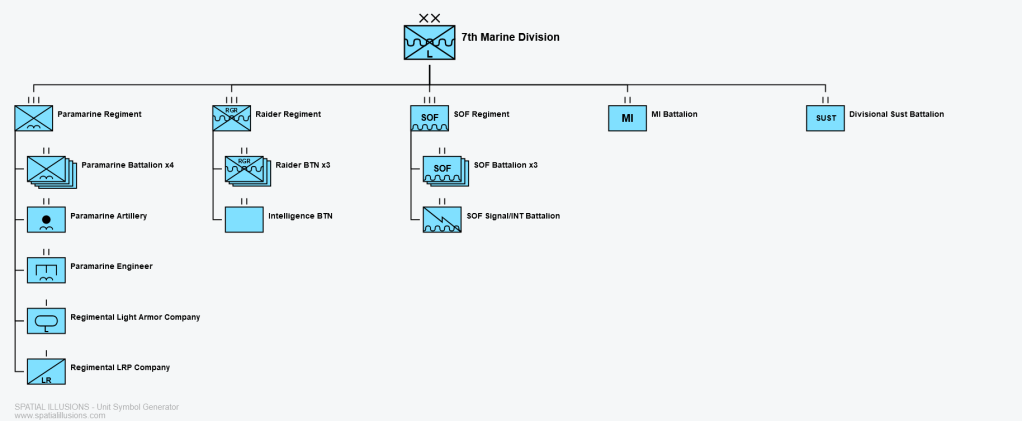
The medium-ization of the Army came as followed: Two brigades in existing heavy divisions with their Bradley mech inf brigades replaced with LAV mech inf brigades ie BMP-BTR mixes, two “medium-heavy” divisions based around LAV-300s with a divisional tank battalion that would stay behind on lower-intensity deployments, and one “medium-light” division with the LAV-300 series, more uparmored HMMVs as the infantry carrier, and no organic tanks. For the USMC, the Seventh Marine Division came into being, along with Combined Arms Regiments (mixes of tanks and LAV-Bisons proposed in real life) for the three active USMC divisions.

More to come…

Wither The Running Back

With NFL season approaching, a hot topic for (some) football fans is-the salary of running backs?

The short answer is that running backs have recently gotten a significantly smaller portion of the pie compared to other players (especially wide receivers). This is due to a decades-long trend towards more passing and also due to a more recent trend where a rookie wage scale was implemented-and almost all running backs burning out in that period before they could theoretically enjoy free agency riches. Because of this and because running backs thrive in the different college game, a team can draft a running back, use him, then draft another one.

It’s hard not to sympathize with someone whose career is short even by athlete standards and who has to be slammed by giants over twenty times a day. But it’s also important to note that the other 45 or so players on an NFL team are also facing physical pressure. There’s no realistic way that the owners and other players are going to give their share to appease players who can be reasonably considered more replaceable. And a certain subset of fan and reporter will always talk about the poor struggling running back and not the players who are earning much more (and not just in absolute terms) than they did in the past.

I do feel like the old “walking tank” running back may be more in vogue. People who otherwise would have trained as Barry Sanders-type “agility running backs” are likely to want to aim for a wealthier, safer receiver position instead. But since you can’t teach size….

Nuclear Terrorism Cont.

Back to my “hypothetical nuclear terrorism” reading, and some of the analyses have given me this impression.

So there are some ifs beyond the norm that actually make it more likely. Besides the usual “if you have the resources and personnel for the job”, there’s two things that make the job of the would-be nuclear terrorist easier and their opponents harder.

  • Being willing to take the hit of large and likely fatal amounts of radiation during transportation and construction. This is pretty self-explanatory, especially when using comparably “fresh” (and thus high radiation) spent power reactor fuel as an input.
  • Being willing to detonate the bomb in a target area closer to the assembly site, even if it’s less damaging and/or prestigious.

However, this narrows the personnel pool even more. It may be a slight narrowing, but it’s still a narrowing. It’s also worth noting that the first point makes a “factory accident” a lot more likely, perhaps countering the advantage of fanaticism.

Hungary’s Humongous Divisions

In the late 1940s, Hungary, fresh off Soviet conquest and the statistical worst hyperinflation ever recorded, was rebuilding its military. Not surprisingly, the plans reportedly called for a force structured along Soviet lines and doctrine. But surprisingly, the centerpiece was on ridiculously large infantry divisions. How large? Paper strength of at least 25,000 people, but that doesn’t describe all of it.

No, comparing the number of infantry battalions ultimately under divisional control draws this insanity into better perspective. The archetypical triangular infantry division has nine (three in each of three regiments/brigades). The square division largely rejected as too big and clunky had twelve (three in each of four regiments). This had sixteen. Four regiments of four battalions each.

There’s a reason why these actually weren’t made and why, even beyond the impact of the 1956 rebellion and short leash, Hungary’s army in actuality remained conventionally Soviet-styled for the rest of the Cold War.

Solving The Madness

Ok, “How many shells were fired in the opening megabarrage of a multi-front offensive operation, such as a Fuldapocalypse or All Union’s invasion of Romania?”

Going with the latter because it’s my book, I finally have an answer that’s easier than a vague “Over a million.” Going with “Sustainability of the Soviet Army In Battle” and “Front Operations 1977” as main sources.

A unit of fire for each artillery piece translates to about 80 for 120-122mm, 60 for 152mm, 160 for BM-21s, and 120 for smaller mortars (sust., pg 68). GENFORCE Mobile has similar numbers but adds 40 for big 203+mm pieces. I’ll just split the difference and say 70.

“Thus, for instance, in armies operating on the axis of the main attack, the expenditure of artillery and mortar ammunition in the first day of combat actions without the use of nuclear weapons may be 2.0 to 2.5 units of fire” (front. pg 309)

A front is described in the same document as having 3,400 to 4,200 artillery pieces (front pg. 12), so a very basic napkin calc for two fronts gives 1,176,000 shells. That’s about 25,000 tons even if you assume “only” the weight of a D-30 round for each shell.

So yeah, 100-150 x the number of total artillery pieces for an extremely basic ballpark figure.

Mobile Corps Emblems

A while ago I did a post on the various Sovereign Union Mobile Corps in All Union, which included their “mascot” animals that appeared on each emblem. Now that Stable Diffusion XL has been released, I’m delighted to say that their logos became a reality. (Note: Some are rougher than others. Goal was general idea)

17th Corps

Starting things off is the 17th Corps that heroine Cholpon Murad-Kyzy served in during the Soviet Romanian War. Its mascot is the Huma Bird, and I chose the output/prompt that didn’t look so much like an eagle. Located in Central Asia, it serves as the de facto strategic reserve corps, being ready to go east, west, or south in equal measure.

5th Corps

The Belarusian 5th Corps is a bison. Historically, it was the only such corps actually made (and not have a bison as its symbol.)

7th Corps

The 7th Corps is an elk. Not much else to say about it.

26th Corps

The Northwestern TVD’s 26th Corps has the Karelian Bear Dog as its mascot animal. It did not participate in the Soviet-Romanian War, but in the event that the All Union and Northern Fury timelines were fused into one combined World War III, it would be the central Soviet force in Norway.

28th Corps

The Lviv-centered 28th Corps is one of the main units opposite new archrival Poland. Its symbol is a fairly plain lion.

64th Corps

The Donbass-garrisoned 64th Corps was in many ways the “pet” unit of legendary reformist president Anton Yatchenko, who happened to come from that area. Its symbol is a nightingale, and it was one of the key units in the Romanian War.

32nd Corps

The Crimea-based 32nd Corps was the only such one to serve in the southern Danube Front, and it only entered the battlefield after the initial Soviet-Bulgarian force had established firm bridgeheads on the northern side of the river. It’s the corps with the most focus on amphibious, airborne, and light infantry operations. Rumor has it that part of it is earmarked for a separate attack on Iceland. Its mascot is a hippocampus, a mythical literal sea horse.

43rd Corps

With its cartoon mosquito being the most whimsical logo of the entire army, the 43rd Corps is the primary mobile corps opposite the old and rising enemy: China. Because of this, it was never even considered being sent west to Romania in 1998.

57th Corps

The leaping lynx that is the 57th is the other Far Eastern mobile corps. Like its “brother” the 43rd, it did not fight in the Romanian War. However, it was on standby along with the 26th in case a second mobilization and major operation needed to be launched (it didn’t).

How To Nuke

How much nuke-metal can you get out of Reactor X? As it turned out, nuclear proliferation scholar David Albright came up with an oversimplified rough formula, which he wrote in a briefing.

You need:

  1. The thermal energy created by the reactor. Note that thermal megawatts are different and greater than electrical megawatts.
  2. The capacity factor. As I’m not any kind of scientist, I would say just go with Albright’s recommendations or make it even lower than 0.5 if you’re using a press-ganged power reactor to simulate the extra work needed.
  3. The conversion factor. This is obvious in the slide for purpose-built production reactors, but for adapted ones, you need to look a little deeper. Fortunately, the same presentation has a comparative slide.

(Again, do not quote me on this. The very presentation says “this is for production not adapted reactors”, but oh well.)

So:

200mw production reactor: 200×0.6x365x.85=37kg of weapons grade plutonium in a year.

Adapted LWR power reactor: 1,400 mwth, wastage: 1400×0.35x365x.51= 91.2 kg of weapons grade plutonium in a year.

A Fat Man-level warhead is estimated to need anything from 6.5 kg (very low technology, used in said bomb itself) to 3kg. See here and here.

The Wargirl

Made in Stable Diffusion

Anyone who’s seen my retweets knows how much I like tacticute. And Stable Diffusion gives me the chance to make tacticute in a variety of styles, clothes, and poses. The styles of these military women trend away from the fluffy model and more towards the semi-practical. I tend to give them shorter hair, and in the more photorealistic models, a rougher, harsh edge to their appearance. They may be tigresses worn down by the horrors of what they serve in, but they still have a kitten on the inside. But I digress..

Anyway, for the sake of fiction (obviously real life policy is complex and depends on so many factors), I must admit towards having my military females tending to be something other than armored infantry grunts. (All Union’s Cholpon is a medic, something women have done in battlefield support for thousands of years). Besides that, there’s vehicle crews, agents, even things like the descendants of the WWII Soviet scout-snipers. It’s not keeping them in the back and it’s definitely still putting them in harms way.

Even if there’s a mitigating factor in-setting (ie power armor,magic,even just the tone of things), I still have this bias. And I don’t mind if it’s done right, nor do I think it’s impossible to do right. I guess it’s just a partially subconcious reaction to the trend of “strong female girlboss who’s 5 foot 2 and scrawny and can do the most stereotypically masculine things better than the men can”.

Claude Larson and Library Music

There lived a German musician named Klaus Netzle who more often went by the stage name Claude Larson. Although Netzle had many more aliases, as befit a stock music composer.

I find his work rather interesting. Meant as disposable background music, he wrote in many genres, and composed and performed many, many songs. Him and others like him made albums that filled vast business libraries but, with few exceptions, were not known to the general public until the internet.

I give you one of my favorite Claude Larson tracks:

The Hard Lesson

The Ukrainian counteroffensive has not gained as much ground as hoped for. It’s important to see, as these respected experts did, that it’s not just a matter of insufficient equipment. Anyway, for a bit of Fuldapocalyptic contemporary commentary.

  • There’s the Russians getting better after their initial swing and a miss. Especially as…
  • There’s the problem that everyone, including the US, would struggle with an offensive against an opponent that has had months to fortify an inevitable and obvious avenue of approach over flat terrain
  • There’s the inherent material issues. After all, the last such offense I can think of that was a huge offensive against an opponent materially better in most ways was… the Battle of the Bulge. Which didn’t go so well for the attacker and devolved into a grindfest pretty quickly.
  • But there’s also the issues with Ukraine’s own military. Again, this isn’t something really to blame. Everyone (just look at Kasserine Pass) would struggle with complex operations after quickly raising an army in a rapid desperate period of total war. Yet mentioning these very real issues and mentioning their struggles as being due to something other than just the poor stingy west not giving them 200000000 tanks and a legion of Imperial Knights attracts a lot of angry criticism.
  • Ukrainians have every reason not to think like this, but from a western perspective, having a Ukraine with NATO/similar committment but without a bombed out strip of land in its east is vastly preferable to a Ukraine with said strip of land but still locked in a conflict.