WMMA5 Style Archetypes

One of the best things about WMMA5 is that you can credibly make people from many different styles. True, you can make balanced “mixed martial artists” or “freestyle” fighters, but where’s the fun in that? Meanwhile, those with a background in traditional or kick boxing, to say nothing of grapplers/wrestlers, are pretty self-explanatory. And combat sambo, which is very close to MMA already, just means a balanced fighter. But there are some more exotics that I’ve found fun to use.

  • Sumo wrestling. Not just for male heavyweights, the pushing nature of sumo means MMA fighters with a background in it trend towards what’s derogatorily called “wall and stall”, where they try to win decisions by pushing and trapping their opponent against the cage/ropes.
  • Shootfighting/pro wrestling. These I move up the “creative attacks” (punches/kicks, submissions) up a lot, to symbolize their stylistic, showy background. Otherwise they’re grapplers.
  • “Practical Fighters”. A catch-all term for those who’ve trained in legit military/law enforcement unarmed fighting. The opposite of the shoot wrestlers, these have very low “creative attacks” ratings, to symbolize their focus on boring but practical solutions.
  • Brawlers. Untrained goons, I’ve frequently given them “arm choke” ratings slightly higher than ‘normal’, because basic choke submissions are the most intuitive. Their strength often exceeds their skill.
  • Points fighters. Both people from combat disciplines that punish you for hitting too hard and other ones who just go for the “striking decisions”. Usually highly mobile, points fighters have high skill but (comparably) little strength.
  • Hillbilly fighters. I have one creation whose stated style is “Hillbilly Fighting”. The attributes have him being a balanced fighter with a penchant for kicking his opponents in the head.

Airfield Construction

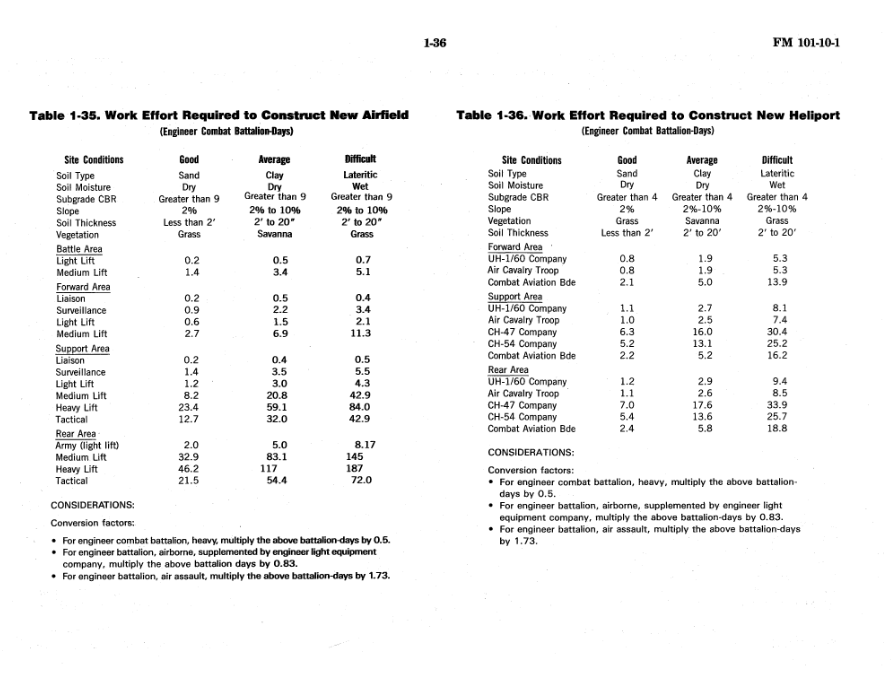
Notional airfield construction times from the 1987 Staff Officer’s Handbook

Although obviously outside the scope of this simple spherical cow chart, I do wonder when the point would come when more engineer battalions would pass the point of diminishing returns. Nine women can’t make a baby in a month, after all.

A Heavy OPFOR army/corps has an organic engineer brigade with heavy equipment that would presumably halve the time required. Fronts will also include at least one engineer brigade. The construction of airfields and other base areas is a stated mission of those high-level assets. (If only the Russians had spent 2021 building and refurbishing better depots right on the borders instead of just piling up the rusty AFVs…)

VTOLs and Airships

Technically speaking, lighter-than-air airships that have the ability to rise vertically just by dropping ballast are VTOLs. But a lot has struck me about how these heavier-than-air contraptions should be, but mostly aren’t, a staple of alternate history the way airships are. Oh, in science fiction they appear in force (see the Orcas from Command and Conquer and Vertibirds from Fallout), but in regular AH, not so much.

VTOL craft run a gamut from simple (conventional helicopters) to ultra-complex. After normal rotorcraft you have so-called “compound helicopters” like the cancelled Cheyenne that have additional horizontal engines to make them go faster. Then you have tilt-rotors/wings like the V-22. After those there are airplanes with dedicated lift engines. Then you have Harrier-style thrust vectored craft. Perhaps the most complex proposal was a giant Beriev seaplane with literally dozens of lift engines.

VTOLs have been technically possible as long as aircraft themselves, but they’ve run into issues. Trading complexity and the problems that come with it, as well as other performance issues, for small advantages (mostly speed for helicopters and takeoff distance) is one problem. Another is stability, with computerized controls being almost necessary. Of course, another design with tradeoffs that has been underused despite being technically possible is…. lighter-than-air airships!

Yet while the presence of airships has become a cliche in alternate history circles, VTOLs have not been. Alternate history is full of Victorian zeppelins, not Vietnamese tilt-wings and jet-copters. If I had to give one reason why, I’d say it’s because of brand appearances. Zeppelins look like something from the past, therefore it’ll be “historic but with zeppelins”, aka alternate history, while VTOLs look futuristic, and therefore writers are more likely to just make a story with them pure science fiction (or sold as such).

Or it could just be genre inertia. But it’s a fascinating subject about fascinating vehicles all the same.

Life Imitates Art

The Kirov novel Eagle Rising, previously reviewed on Fuldapocalypse, has a wargamed out (mostly via the excellent The Operational Art of War) Russian all-out invasion of Ukraine in 2021 with largely realistic OOBs-that ends after a few weeks with the Russians grabbing a chunk of the country but falling short of their objectives and descending into a grinding stalemate. There are of course differences, often erring on the side of spectacle like a brigade-sized air assault into Dnipro at the beginning and, most bizarrely, a counteroffensive crossing the border to hit Belgorod.

It’s described in the book itself after the initial big battles as “All Tyrenkov [the time-traveling Russian leader] has done is buy himself a long war there, and for a lot of blood and steel.”

Like Hector Bywater’s The Great Pacific War, this was strangely prescient in many ways. Even in small details like Ukrainian light infantry succeeding with hit and run strikes. Of course, the background is vastly different, involving a time traveler from the past (Tyrenkov) going forward , seizing control of contemporary Russia, and mistaking a potential future victory for a certain one. But the nuts and bolts are a tribute to both the TOAW simulation and the power of well-designed wargames in general.

Weird Wargaming: The Jeep Compass Army

Using variants of civilian vehicles from Model Ts and Rolls Royces in World War I to the omnipresent Land Cruisers and Hiluxes of today is nothing new. But I saw a proposal from an Indian armoring firm (which also advertised the boxiest armored vehicles ever) for uparmored Jeep Compasses, and my brain sparked. After all, compact crossovers like it are so common now, so why not send them to war? This isn’t like the classic jeep, even in its latest form.

Well, there’s obvious reasons against it. It can barely fit five normal-sized people without wargear. Five big soldier men with all their equipment would probably be a nonstarter. You could use it as a pure weapons carrier-but the disadvantages of that would be obvious as well. There are plenty of off the shelf SUVs far more suitable… but I don’t care.

The Compasses would be used by recon/raiding teams, being too small (regardless of how many people you can stuff inside) to be a line carrier. The least bad option, of gun vehicles, involves a crew of three with extra munitions in the (gulp) trunk/back. Even then, the Compass has a max payload of only around 1,100 pounds/500 kilograms. Which would probably have been eaten up by the armoring, but I’ll let it slide for now.

So, here it goes:

  • Command vehicle: Unit commander, driver, comms equipment, aide, maybe lighter machine gun RWS.
  • Personnel Carrier: Driver, 2-4 additional troops, lighter machine gun RWS.
  • Weapons Carrier: Driver, Gunner, Commander, either light missile or heavy machine gun.

The number of vehicles of each type depends on the exact mission. And the Jeep Compass could be replaced by any light SUV. And I do not recommend actually trying these small light SUVs unless you have no other choice.

Soviet-Romanian War: The Chronology

I finally have a set chronology for the course of the Soviet/Romanian alternate history war I keep posting about. And yes, I’m now running three WIP books simultaneously.

Using the classical best-case 60km a day (on average) rate of advance, the Soviets would cross Romania in a little more than a week. Under their 70-100km guidelines for weaker opponents (which it’d definitely qualify as), it would fall in 5 days (too optimistic)[1] However, the same sources drop their rate to 30 km in mountainous terrain, found in central Romania.

The Bulgarians take an outsize share of the casualties. In part, this is because of the difference in both skill and equipment (in 1989, the Bulgarians historically still had T-34s equipping their reserve formations!). It’s also because of them having to cross the Danube opposed, never an easy task.

Bucharest, with its population of 2 million people, is not initially stormed in full. Instead it’s surrounded, left for the Bulgarians to keep encircled, and squeezed while the rest of the country is overrun. In around two weeks at absolute most, it is.

In a nod to the Gulf War, BARCAPS are placed to keep the doomed RoAF from escaping to Yugoslavia…. but the majority of planes that make it across due so to Hungary, the longtime rival, instead.

The stumbling block I had because of how much it depends on the story is what would happen to Ceausescu. Whether he successfully escapes, tries and fails to escape, gets couped, or killed/captured by the Soviets (keeping in mind he’d be very old and was in terrible health already in 1989). Of course, now I’ve found a solution that I can work into the plot…

Regardless, it ends in considerably less time than the current Russo-Ukrainian War has already been going on for (which is why I feel comfortable posting this now.) Using MCOAT with variables and unit sizes that I feel are close enough, casualties amount to:

  • Union of Soviet Sovereign Republics: Circa 3,500 killed, 14,000 wounded to varying degrees.
  • Bulgaria: Circa 6,500 killed, 26,000 wounded
  • Afghanistan: Circa 640 killed, 2,900 wounded
  • Romania: Circa 47,000 killed, 131,000 wounded [around a quarter of forces deployed at least hurt!]

These calculations assume nine days of high-intensity combat. Bulgarians and the Basic Forces divisions would take a large share compared to Mobile Corps with better armor, equipment, and medicine.

The result is a regime installed made up of local collaborators and those with some ties to Romania. Occupation duty is largely left to the Bulgarians and Afghans. Although prewar Romanian doctrine called for guerilla fighting, there isn’t terribly much stomach for it from the apathetic, shell-shocked population. Much of Romania’s population flees during and after the war, primarily to Hungary and beyond.

And out of it emerges, among other things… a mystery. Or several mysteries….

[1]The coalition managed a rough 45 km a day in the Gulf War, against a weak opponent in open terrain, and 30 km in the conventional phase of the Iraq War, with a pause and while facing the rougher areas of Iraq itself.

Even Cheapies Are Expensive

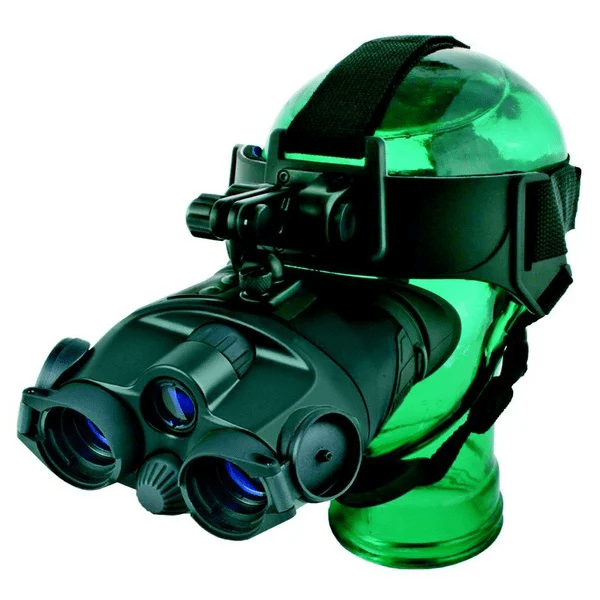
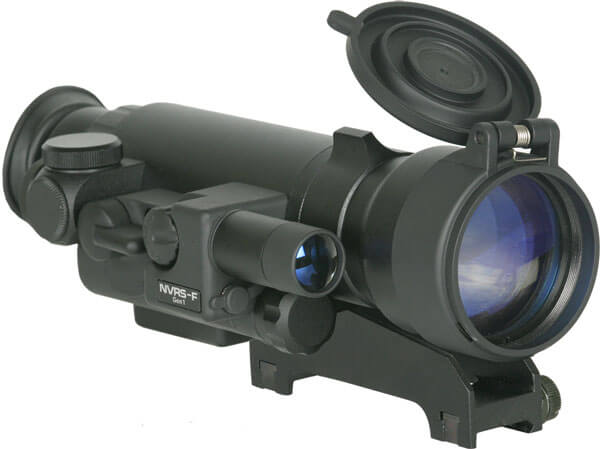
So take these cheapie eastern night vision division devices: Good for a range of 150-200 meters depending on context, around $700 a pop. Both goggles/binoculars and rifle scopes for different contexts.

Yukon Tracker
Yukon NVRS Scope

To equip the line personnel (defined here as those in the actual fighting regiments/brigades) of one small division in the absolute most oversimplified fashion would be around $7-10 million, depending on the exact size. Getting around 5,000 sets, but then there comes the hard part: Maintaining 5,000 sets, keeping track of 5,000 sets, making sure that those 5,000 sets aren’t lost (via honest or dishonest means…), and so on.

Now apply this to almost any even slightly expensive piece of military equipment and you can see why, for instance, Egypt still issues its draftees equipment left over from the Yom Kippur War. That’s an extreme example, but you can see how even the individually “cheap” stuff can be expensive, particularly for less funded armies. And you can see both the political and military advantage of reserving such a thing for “elite” units if one has no choice but to only acquire a limited number of said items.

And you need a lot of stuff, to the point where it’s almost an “I, Pencil” situation. Boots, uniforms, load bearing equipment, helmets, packs, shelters, it all adds up. The bottlenecks can appear where you wouldn’t think they would. For instance, many people know of WWII Germany’s fuel shortages, and historians know of their special alloy shortages, but what a lot of either don’t know is of their cotton shortage resulting in less effective leather load bearing equipment.

Baseball Returns

Major League Baseball, after an owners lockout, has returned to being after a new collective bargaining agreement has finally been agreed upon. It’s very hard to sympathize with either side. The owners are what you’d expect from billionaire sports team owners, and the players have been desperately trying to hold onto a classic seniority cartel that has been eroded by analytics and too many bad megadeals.

Now we can actually talk about the game on the field.

The Airlifters

Airlifters are very interesting to me, especially mega-lifters. But “exotics” are also fun, like tilt-ducted fans, compound helicopters, convertiplanes, flying wings, and much more. I think there’s several reasons why I’ve taken a liking to them, besides some very good sources that I’m eager to review.

  1. They represent an army marching on its stomach, or in this case, flying on its stomach. They’re the behind-the-scenes things that no one can do without.
  2. They’re military but not inherently destructive (unless converted to bombers, of course). Thus they can serve humanitarian and civilian support efforts very well.
  3. Finally, the numbers analyst in me likes seeing, especially for inherently risky airborne drops/landings, what you can accomplish with X number of airlifters with a capacity of Y per unit. Operations researchers with far more resources and far better command of math than me have been studying this since the parachute was invented.
  4. Plus I live fairly close to an airlifter base and see the big grey Globemasters and Galaxies flying overhead fairly frequently.
  5. Paradropping can be used as a way to add drama to the characters in a story, regardless of the overall force balance.
  6. It’s hard not to be impressed by something weird and/or big.

What I’m most interested in at the moment is: “To what extend does having big lifters that can reach the LZ safely remove bottlenecks?”

The Differences

Just as how Hector Bywater’s The Great Pacific War got a lot of specifics from the later conflict off but the general feel of a Japanese-American war completely right, I figured I’d look at my Soviet/Romanian War (which I’ve outlined) and see the differences.

  • First, the absolute biggest. Instead of being against an elected government and earning massive condemnation, this is against the odious regime of Nicolae Ceausescu. The prevailing outside sentiment would be sympathy for Romania’s people, but very little for their government.
  • Second, the force structure of the invaders is different and both stronger and weaker. Belarus has been replaced with Bulgaria, which has mobilized a gargantuan army in and of itself-albeit an army that still uses T-34s (really, there were units with those, as in Romania, up until the very end). Whereas the Union of Soviet Sovereign Republics, for the most part (especially in its Mobile Force units), is a lot deeper than what I’ve seen from the Russians IRL in terms of substantive modernization (where a lot of old equipment, and, more importantly, stuff like few night vision devices and still using unsecure commercial radios beneath their shiny digi-flora uniforms)
  • Third, the invasion is a lot smoother out of the gate (note that I’m not speculating on the ultimate outcome in real life as of now). This is because, if nothing else, Romania is a lot smaller, less populous, and the invasion force is a lot bigger. Oh, and said horrendous Romanian government leading to apathy rather than near-unified disdain.

However, one thing that did appear in fiction and fact is the use of high-risk to the point of questionable VDV (Airborne Forces) operations. Of course, given their prominence, this is of little real surprise. Also, writing this post was tough, as is anything in a fluid, confusing situation.