Back in the day when I was convinced that everywhere was being overrun by bad World War III stories, I made the Iceland Scale as part of my backlash. Now with a sense that I got too angry about it, I figure I should post both the scale itself and commentary on how it did and didn’t hold up.
This is probably going to be the longest post yet on Fuldapocalypse, and it’s been a long time in coming. This is something that I wanted to look back on. Now, with a lot of time on my hands and the last review of a “World War III” book being months old, I think it’s as good a time as any.
I’ve been worrying about how to say what I want to. Regardless, I still think this should be told, for it influenced the formation of this blog.
Here’s the scale itself:
BACKGROUND
-If the Soviets start the war: 1 Iceland
-If the Soviets do so in a way that, to the average reader, makes little sense: 3 Icelands.
-If there’s at least one chapter of “intrigue” leading to the shocking result that yes, in a WW3 book, WW3 starts: 5 Icelands per chapter/update.
-If NATO starts the war: -10000 Icelands
-If the third-person narrator delivers an infodump about forces deployed: 50 Icelands per infodump.
-If there’s a scene where a bunch of generals and leaders stand in a conference room and deliver a joint infodump about forces deployed: 600 Icelands per infodump.
-If the central and obvious protagonist is introduced prior to the fighting started: -20 Icelands
-If the war takes place in the 1970s or earlier: -100 Icelands
-If the war takes place in the 1980s: 1 Iceland
-If the war takes place in the 1990s or beyond, with a surviving/restored USSR: -5 Icelands
CONDUCT OF THE WAR
-If NATO wins: 1 Iceland
-If the USSR wins: -500 Icelands
-If the war ends in a nuclear apocalypse: -200 Icelands
-If the war remains conventional throughout: 1 Iceland
-If nuclear weapons are occasionally used in anger, but the war stays largely conventional: 150 Icelands
-If the Soviets invade Iceland: 1000 Icelands
-If the Soviets invade any part of the United States proper: 15000 Icelands
-If the battles focus around tanks or aircraft: 1 Iceland per battle
-If the battles focus around ships or submarines: 1 Iceland per battle
-if the battles involve gritty, close infantry firefights: -10 Icelands per battle
-If any part of the story takes place in Germany: 100 Icelands
-If any part of the story takes place in the Atlantic Ocean: 200 Icelands
-If any part of the story takes place in a theater other than the two mentioned above: -50 Icelands
CHARACTERIZATION
-If there is one central, total viewpoint character: -25 Icelands.
-Likewise, if the number of viewpoint characters numbers:
-2-5: 10 Icelands
-5-10: 50 Icelands
->10: 1000 Icelands
-If there are no “characters” in a traditional literary sense at all: 500 Icelands.
-If a character’s physical appearance is described: -10 Icelands
-If a character is given an infodump to serve as their sole form of development: 100 Icelands
-If a weapons system is described in more detail than the basic terms (ie, M1A1, T-80BV rather than M1/Abrams or T-80): 15 Icelands
-If a weapons system is given more description or development than a character: 100 Icelands
-If any characters are in a position of utter powerlessness-(civilians, routed soldiers): -25 Icelands
-If any Soviet characters exist as mustache-twirling puppy kickers: 10 Icelands
-If any NATO characters exist as mustache-twirling puppy kickers: -100 Icelands
_ _ _ _ _ _ _ _ _ _
So how did this come into being?
At the time I had read far fewer “cheap thrillers” in general and my exposure came in three places:
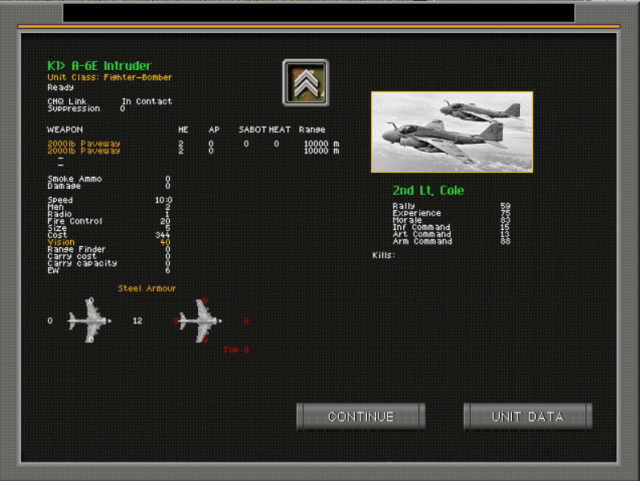
- Wargames, where World War IIIs are over-represented compared to other types of fiction. (A study of scenario locations in Steel Panthers MBT had about 27% of them being “World War III” in some form, a ratio that is definitely not true of fiction in general).
- Red Storm Rising itself and a few of the knockoffs, particularly Harvey Black and Brad Smith.
- A boomlet of conventional World War III TLs/stories on alternatehistory.com.
In hindsight, the knockoff triple-xeroxed fanfiction of Hackett (or Clancy/Bond, or Coyle, or Peters, or Red Dawn) that appeared on AH really wasn’t that good, bad, or representative. It’s like trying to see what crime fiction is like by reading the entries in the Law and Order section of fanfiction.net.
But it’s what I was reading at the time.
What holds up?
I’d say the supervillain Soviets and longer weapons descriptions. That’s pretty much it for just cheap thrillers in general. For technothrillers, the conference room scenes are probably the biggest.
And there are “Icelandic” stories out there. There just aren’t that many. Instead of looking at overbearing cliches, I was accidentally focusing on a very small, very niche type of writing. I was the blind man touching one part of the elephant.
And what doesn’t?
A lot. First, the invasion of Iceland itself isn’t a staple even in World War III stories. It appeared in wargaming and Red Storm Rising. And really not that much else, even in that narrow niche.
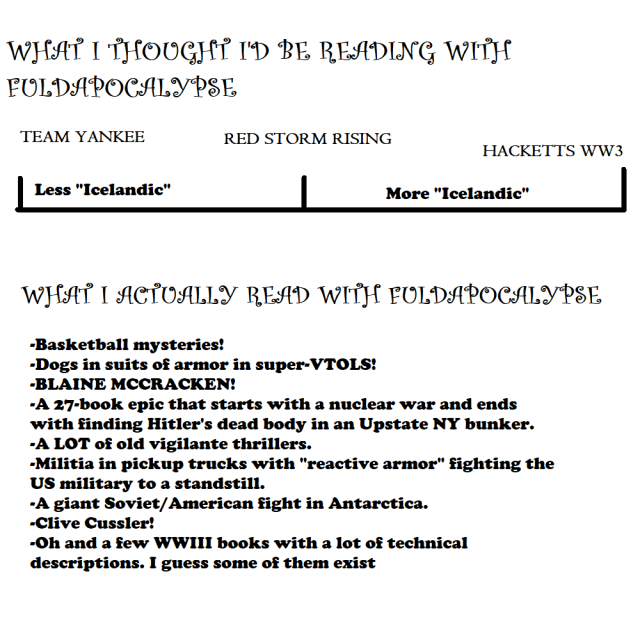
A few instances had stories that were “Icelandic” but not necessarily bad. Team Yankee checks most of the Iceland boxes on paper, but is a smoothly flowing story that’s the exact opposite of the cumbersome “boom boom goes the tank” I’d seen on the internet.
But most of it was simply not “Icelandic” at all. And this includes almost all of the cheap thrillers that were actually written. Nukes aren’t handwaved away, they’re incorporated into the story in some fashion. As a look at the number of “Action Hero” and “Special Forces” tags on this blog shows, shooter fiction with an unambiguous main character leaves “big war thrillers” in its dust. By a gigantic margin.
Why is the “They invade the US” score so high?
This is probably the most personally biased score of them all. It’s not overly representative or even prominent in a few specific pieces the way Iceland was (the exception being Red Dawn). Rather, seeing rote rivet-counting descriptions of Soviet invasions of the continental US flared up one of my frustrations with internet alternate history.
I should note that this is one of the least connected to actual commercial fiction. It could not be further from the special forces raid in Northern Fury (a more workable scenario) or the invasion in the early Survivalist (something that didn’t involve rivet counting).
So why this? Well, internet alternate history has, as it’s grown, sort of shifted in a questionable way. The idea behind simply writing in ways that aren’t conventional narratives was so that writers, unencumbered by the need for plots/characterizations, could fill in a lot of details.
As the community diluted, this became a way to avoid detail, done by people who cared less about “plausibility”. The analogy I’d use is, of all things, car racing. A race car is not a practical car for everyday driving, and the people involved know it. But then people start building race cars. They have one seat and no amenities, but the focus is on that one seat and the shape and not how fast they can go. But at the same time there’s just enough residual race car focus to dull the edges. The cars aren’t in goofy novelty shapes, they’re just race cars that look like race cars but with engines that a stock 1992 Camry could outpace.
As AH’s own wiki states about fictional election results lists, “No offense, but very few people are impressed by your ability to make up fake percentages. For extra cliché points, present them through Wikiboxes. “
Likewise, seeing lists and lists of orders of battle and recitations for something I knew was both implausible and unsuitable for its genre prompted an overreaction in me. I say overreaction because it’s like treating fanfiction that ignores the genre of its base work in favor of sleaze and/or sloppiness as something unique or distinctly bad. Once you know the context, it’s unsurprising and arguably uninteresting.
I guess another analogy is like vs. debates tiering, where it’s something nominally “crunchy”, a field that can bring often unjustified aggravation quickly, and where studying the context of how something that should be technical became lowbrow is a lot more interesting than seeing the end result of questionable infodumps.
Does the Iceland Scale have any retroactive value?
It’s basically one of those fanfic “litmus tests” you see floating around on the internet. After all, the place that motivated it was essentially a fanfiction board, only with “history” as the setting .
And well, especially after writing creative fiction, and especially after seeing much more, I don’t really think so. I’ve been a litmus test skeptic because this kind of fiction tends to have the execution be important. It’s entirely possible to have what should be a rote “shoot the terrorist” premise but succeed with good execution. Likewise, take a “Clive Cussler’s” book that has on paper a goofy premise but is just dull.
Team Yankee has a lot of “Icelandic” elements on paper but is well-done. Even Red Army has a parade of viewpoint characters-and it’s also done well. Northern Fury H-Hour would probably rank very high given that it’s an explicit homage, and its execution was also done effectively.
I mean, this has been a little unpleasant for me to think about, which is why I’ve been holding off on writing this post or something like it for a long time. I got too caught up in board drama (which is a staple of AH.com), and it’s kind of a sign of how narrow-minded I was. As I’ve repeatedly said, the diversification of Fuldapocalypse was something genuinely good in a lot of ways.
Some time ago, I made this silly graphic to show how much my horizons were broadened. It’s true.
What lessons do you think there are from the Iceland Scale?
These are kind of truisms, but…
- Don’t get too caught up in any one fandom. While I think alternate history has some unique hangups, fandom drama is definitely not unique to it.
- Don’t get caught up in something with small sample size, and always look for more perspective.
- Broaden your literary horizons, even in the same basic genre.
When I wrote the Iceland Scale, I was convinced there were too many conventional WW3 stories out there. Now I feel there arguably aren’t enough. There’s certainly very few. A single very long series can outnumber the “conventional WWIII” genre, and a single prolific author can easily outpace the entire “big war thriller” type of book. So upon seeing an “Icelandic” story, my thought is now less “Argh, another WWIII” and more “oh, it’s a niche story that probably isn’t for me”. So this horizon-broadening has been very positive. Not just for enjoyment, but for understanding.
How did this help lead to Fuldapocalypse?
Here’s how. Part of the reason for starting Fuldapocalypse was because I didn’t want to crowd out the Creative Corner. Of course, this ended up doing just that as my interests shifted, but that’s another story.
But another part of starting Fuldapocalypse came from me wanting to give these stories a more fair and critical shake. And I’ll say this flat out-I at first went about it the wrong way. My initial goal was “move past the board drama, look at ‘real’ published World War III books, and use a rigorous scale to see how they differed and what cliches they did and didn’t follow, so that your own emotion and opinions can mostly stay out of it”. It was trying to move towards a narrower slice of fiction, towards a more robotic litmus test.
Thankfully, it worked out. I soon grew tired with my self-imposed limitations and began, slowly at first, reading and reviewing stuff that wasn’t “Icelandic” at all. While it took a little while for me to throw off the shackles entirely, I did. And this is the reason why I made the post-instead of constantly obsessing over something, whatever its (lack of) quality, shouldn’t be obsessed over, this post can stand between whatever non-Icelandic works of fiction strike my fancy.