The Worst Pilot Ever

On May 22, 2020, Pakistan International Airlines Flight 8303 crashed in Karachi, killing 98 people. Its pilot, Sajjad Gul, may have exhibited the worst judgement and skill of any pilot involved in an air disaster ever, and he and almost a hundred other people paid the price.

In written and video form, it’s horrifying to behold. There was good weather, a familiar and established plane, no mechanical issues, no foul play, and nothing save for someone who went in on a crash course, had countless opportunities to step back from the brink, and did not.

Absent pilots who crashed on purpose or otherwise did things like make bets that they could land blindfolded (they couldn’t) or reenact the flight of Icarus, this is the least competent aircrew I’ve seen. By the final too-late moments, Gul and copilot Usman Azam were apparently trying to do two contradictory things (which gives you a sign of how bad the crew resource management was).

Fake Mobile Game Ads

Most video game advertisements naturally show the gameplay at its most exciting, thrilling, and successful. Yet there is one common type that doesn’t. Imagine an ad for a platformer where the character misses an easy jump and falls into a pit, a fighting game where they try and fail to pull off a single special move, and so on. That is the changing but obvious world of fake mobile game ads, where the ‘player’ engages in either simple puzzles or a Space Invaders style descending enemy wave game and almost invariably loses pathetically.

See, there’s a reason for this and that’s because the actual game is nothing like the ads. Most of the games depicted in these commercials are city builders with everything taking forever unless you speed the process up with real money. Not very photogenic. The actual ad mode is relegated to a small minigame so that it’s not technically false advertising.

The Desert Shield Push South

So WW3 1987 talked about a classic counterfactual: “What if Iraq attacked south in August 1991 against Desert Shield”? Actual Gulf War commanders have had differing opinions, and of course the context matters. I’ve done a bit of simming in Command Modern Operations, and have come to the conclusion that, well, it would have only been troublesome for the coalition by the standards of the actual war’s total squash. Why? Three main reasons.

  1. Air power is more powerful and immediately influential. Though I’m an air power skeptic, disrupting an offensive in the open is one of the easiest things for air power to do, especially one that’s trained for a much harder Fuldapocalypse.
  2. Geography and politics. That literally every country from Qatar down to Oman was part of the coalition means that the Iraqis literally can’t move far enough to stop the landing of reinforcements in friendly territory of some kind.
  3. Historical context. The Iraqis who didn’t think the takeover of Kuwait was a big deal historically had no contingency plans to move farther south. So they’d be winging it, and that’s not exactly a recipe for success given the other problems.

What Artillery Mobility Means

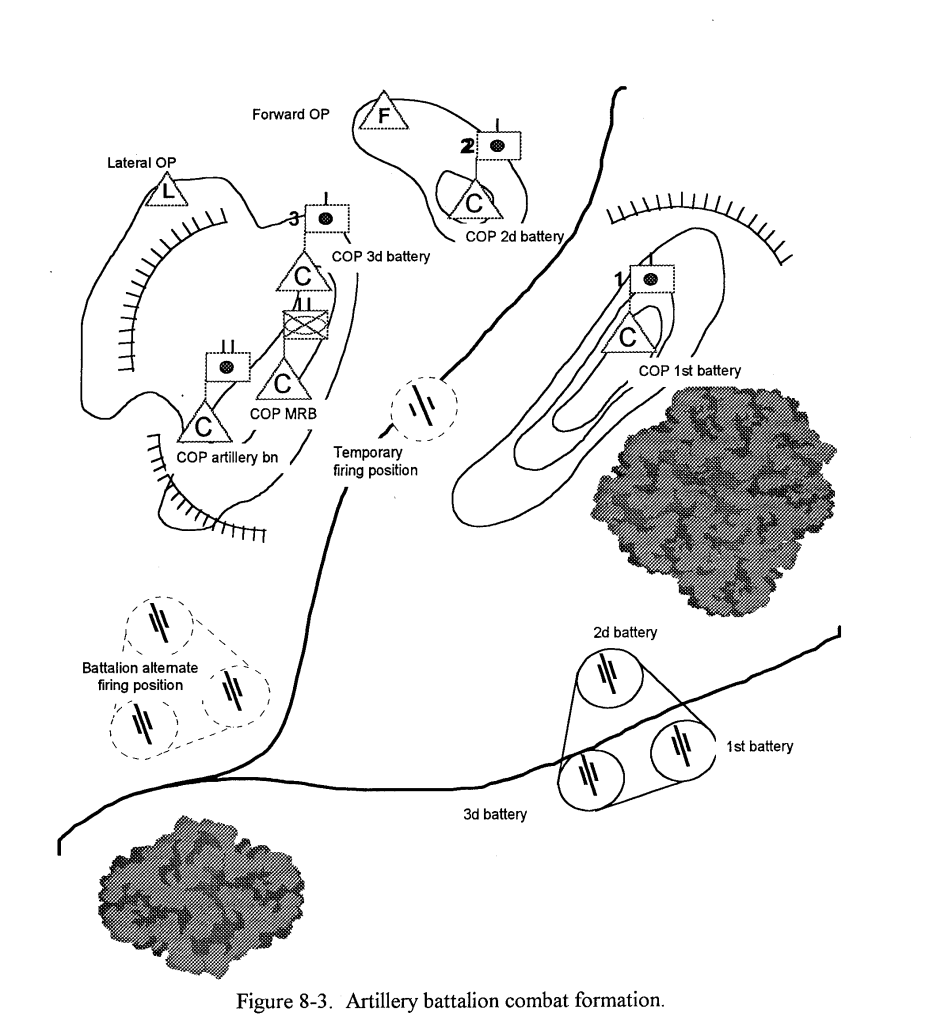
From the Heavy OPFOR Tactical:

Now a 199X Soviet-patterned formation isn’t going to be representative of everything (in particular, the commander is not always going to double as a forward observer), but it’s worth noting that the movement involves narrow movement around different parts of the same observed, prepared area, not wide ranging, sweeping kiting.

Now redeployment is another story, and it’s where the artillery is going to be more inherently vulnerable and varies a lot on the circumstances. IE not so much in a stabilized front like WWI, post-1951 Korea, or contemporary Ukraine, but a lot in a classic Fuldapocalypse, 2003 Iraq, or the Southern African brush. It also depends on how much the artillery has to actually fire (because if it’s forced into moving/hiding, then it’s effectively suppressed).

So for the fictional case study of the Soviet-Romanian War:

  • The northern front is going to be advancing extremely rapidly, close to the best-case paper projections. Deployed artillery will cover the armies when they have to stop, but even the Sovereign Union will struggle to keep their mega-barrages during the rapid advance. Thankfully (for the invaders) enemy counter-artillery capabilities are very weak, especially in the context.
  • The southern front has a lot fewer SPGs (and even less advanced ones) and has to bludgeon its way across a very wide river and through fortified areas. There’s just less room to move and the opponent’s capabilities (due to their better units and C3I on this front) are more dangerous.

Making vehicles in Stable Diffusion

Simple guide to how I bash together vehicles in Stable Diffusion.
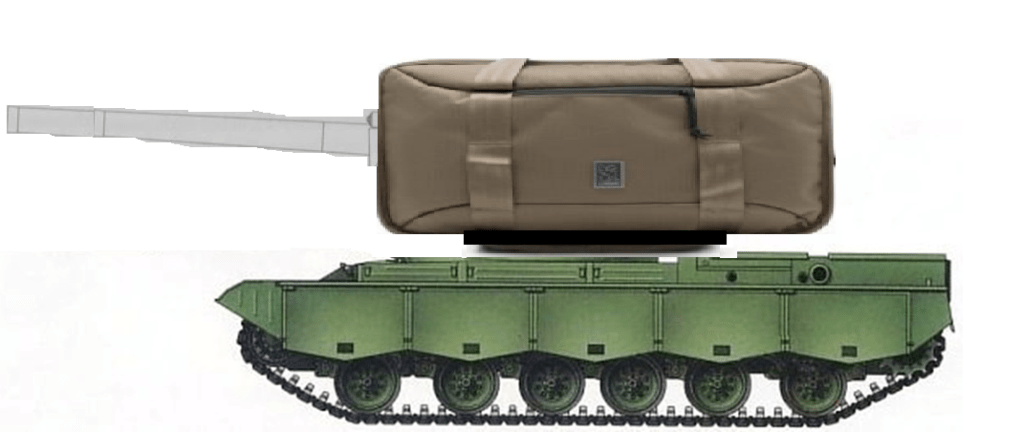
First assemble the shape. In this case it’s the bottom of a tank, a suitcase (!), and a line drawing of a large-caliber field piece.

Then load up Stable Diffusion with a controlnet, in this case, depth.

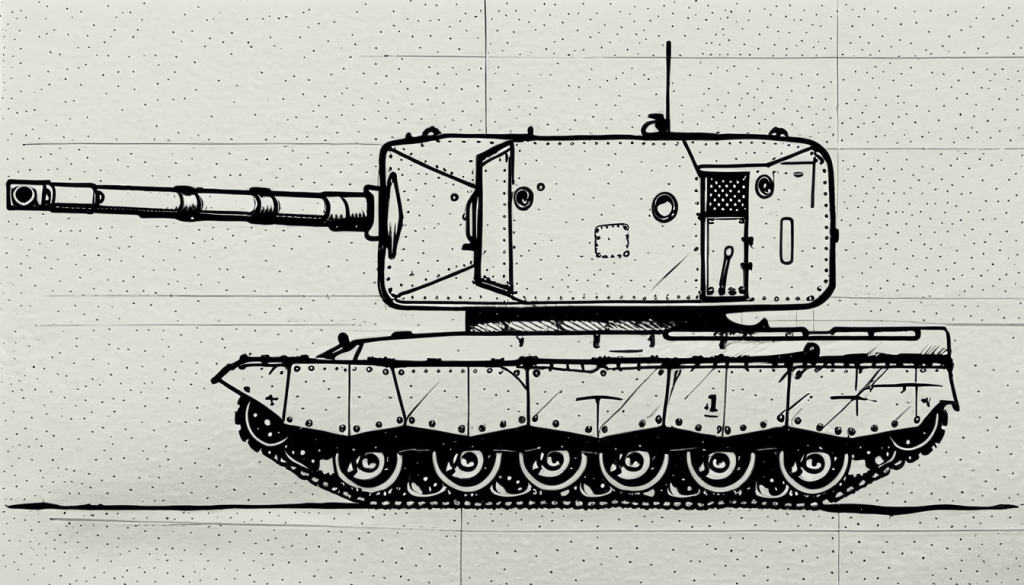
Use the model and prompt (In this case I use Helloworld 6.0), make sure the controlnet is enabled but not too high, and you get…

One self-propelled AH vehicle!

BTR-92 Squad

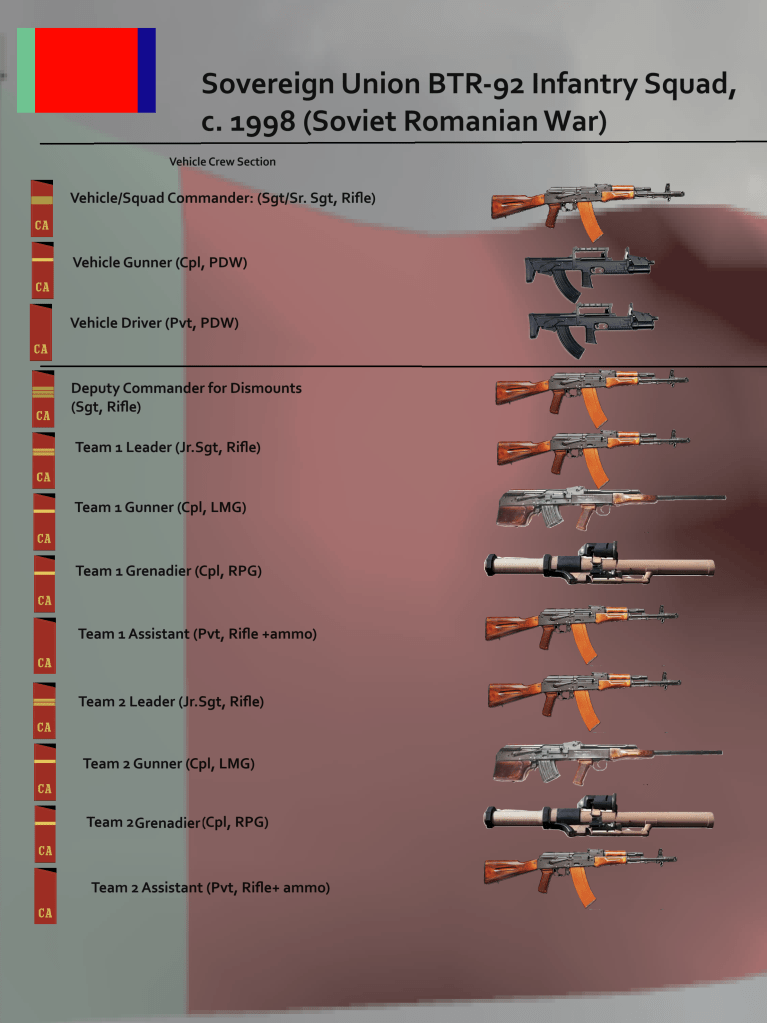
First I did my past piece on Mobile Corps squads, then came the BTR-92. Now the most ahistorically Soviet part of All Union’s military can be made with the two mixed together. In-universe, the creation of this squad was an extremely involved and controversial process.

  • Unlike previous examples, including the mobile corps own BMP/IFV squads, this operates two organizational fireteams. With lots of teeth-gritting, the doctrine emphasizes that “if necessary”, it can operate as a unitary squad or simple overall fire/overall maneuver element. In the Soviet-Romanian War, many did.
  • This has a full-time deputy squad leader for dismounts, whose job is pretty obvious. An emphasis was put on out-of-vehicle operations as these units were designed to spend more time outside.
  • The PDW is the A-91M. The LMG is the “Vepr”, one of many bullpup RPK proposals. The light RPG is in real life the South African (!) Denel FT5 (since a post-apartheid government would be very close to a surviving USSR, and since a post-apartheid arms industry would be very desperate, a license deal for this Goldilocks Rocket Launcher is not impossible).
  • This can be detailed in the Kestrel Publishing entry: Clash: Soviet BTR vs. Romanian TAB . Despite the name, about 80% of that book is just devoted to the Mobile Corps BTR reformation. The pieces on the Romanians basically amounted, cruelly but not inaccurately to “They just followed 196X BTR doctrine, had the equipment to match, and lost”.

How the Fuldapocalypse Skewed Artillery

Fair warning: This is done by an armchair enthusiast with absolutely no practical experience and whose sole experience comes from reading things. I could be totally and completely wrong about many things. Now that that’s out of the way, a look at how a Fuldapocalypse-centric doctrine has skewed perceptions of artillery to the point where Ukraine came as a surprise to many.

To put a long story overly short, the current paradigm in Ukraine is:

  • Largely static front
  • Lots of drones flying around on both sides (which translates to deadlier air power, which in turn makes it a bigger threat)
  • Limited resources

So you can see why smaller, easier to conceal towed guns are liked more.

Now compare this to the Fuldapocalypse:

  • Mobile front
  • Less threat from air but extremely good counterbattery fire
  • Lavish (prewar) spending to afford SPGs.

See the difference?

Now the interesting thing is Caesar-style “truck SPGs”, ie artillery pieces on open wheeled chassis. They have shown the weaknesses of both-ie they’re soft like a towed gun and big like an SPG (and even less maneuverable). However, they’re not really designed for either kind of large-scale war.

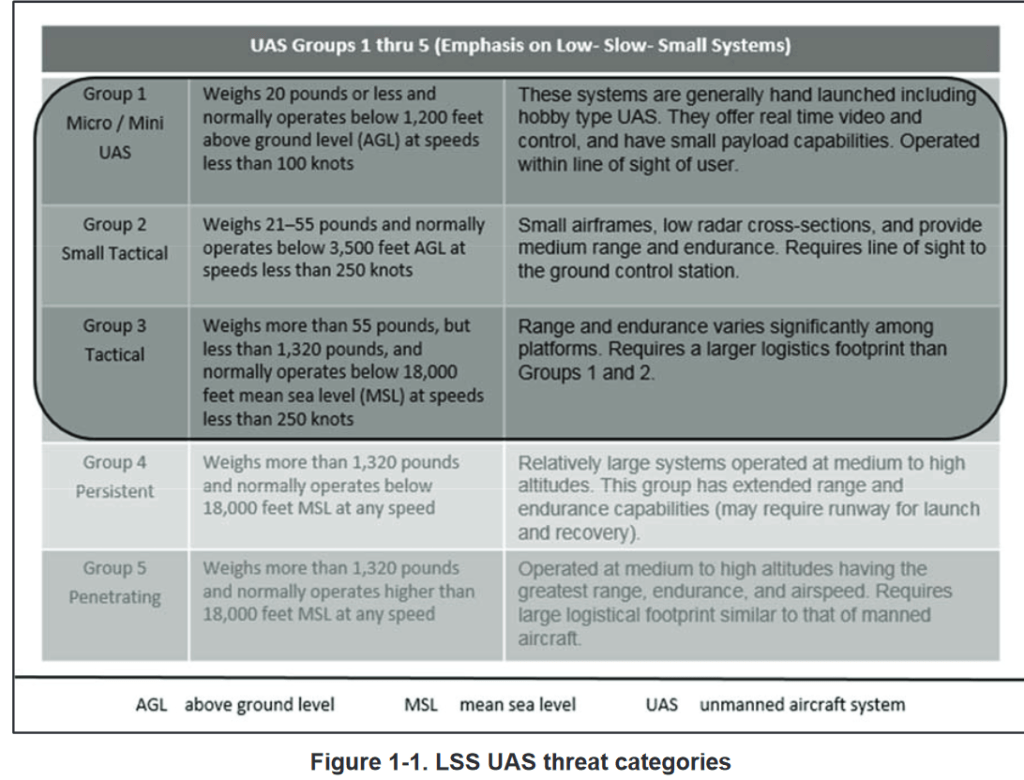
UAV Classes

The US Military has five official group of UAVs/drones.

(from ATP 3-01-81)

The standard hobby drone is a Group 1. Smaller military drones are groups 2 and 3. The ScanEagle is the best American example of a Group 2. The classic Iowa spotter Pioneer is a Group 3, so is the RQ-7 Shadow. Heavy attack drones like the Predator and Bayraktar TB2 are 4, while monsters like the Reaper and Global Hawk are 5.

Coiler’s Culmination Calculator

As a fun side project, I made my first (intentionally abstracted) wargaming tool. The goal is to see the culmination point of an offensive.

Assumptions: The attacker is consistently advancing, however, the defender is fighting back hard throughout. The units of the attacker participating in the campaign are not going to be rotated out, hence they will only receive small and piecemeal reinforcements/replacements throughout.

This simple tool works as follows:

  • The attacker starts with a point total of 100.
  • For each objective, roll 1d10. 1 means the objective is taken unopposed and the force suffers no meaningful losses. 2-6 is a minor engagement where the unit suffers a point loss equal to 1d6 points. 7-10 is a major engagement where the unit suffers a point loss equal to 1d6+10.
  • After every turn, the faction regains 3 points.
  • The offensive will have culminated when the point total reaches zero or less.

Example:

  • Objective 1: 9: 16 points lost. 3 regenerated. 87 points.
  • Objective 2: 8: 12 points lost, 3 regenerated. 78 points.
  • Objective 3: 6: 1 point lost, 3 regenerated. 79 points
  • Objective 4: 6: 6 points lost, 3 regenerated. 76 points.
  • Objective 5: 1: No losses, 3 points regenerated. 79 points.
  • Objective 6: 3: 5 losses, 3 regenerated. 77 points
  • Objective 7: 10: 11 losses, 3 regenerated. 69 points

Etc….

Figures of course can be changed depending on context.

On Star Wars

Now I want to say that I’ve liked a lot of Star Wars stuff. I don’t mind the setting, I’ve seen 2/3s of the official movies. Like any big setting it has its ups and downs. But I definitely don’t hate this.

However, I feel obligated to say one thing about Star Wars that I believe. It is the most overrated work of modern fiction, and this overrating has made it impossible to judge. What you have is first a trio of fun sci-fi pulp movies that get treated as if they were more than fun sci-fi pulp movies, because they were a breath of fresh air in the pretentious dark tone of 1970s science fiction. Then you have a giant franchise.

Next you have the prequels, which are basically what happens when a Dunning-Krugered director gets free reign to run amuck. People nowadays are swinging towards defending the prequels in a dose of inevitable “defend midsize sedan cars the minute they stop being popular” hipsterism. Although I don’t blame them, because…

Then George Lucas cashed out and the Mouse Machine made the sequel trilogy. Now I had little desire to see them in full personally, and everything I saw and heard reinforced that desire. When I finally, recently looked at them in more depth, I was even gladder. At least the first six were works of genuine artistic imagination. These are just rehashed play it too safe mush piles that don’t understand the feel of their setting.

(Not so small side note: Devereaux’s excellent blog has the point in a review of fellow cash grab Rings of Power that authors are obsessed with winning battles via an unrealistic One Neat Trick. That plus “why didn’t they fly in on the eagles” ”’rationalism”’ leads to the infamous hyperspace ram.)