BTR-92 Squad

First I did my past piece on Mobile Corps squads, then came the BTR-92. Now the most ahistorically Soviet part of All Union’s military can be made with the two mixed together. In-universe, the creation of this squad was an extremely involved and controversial process.

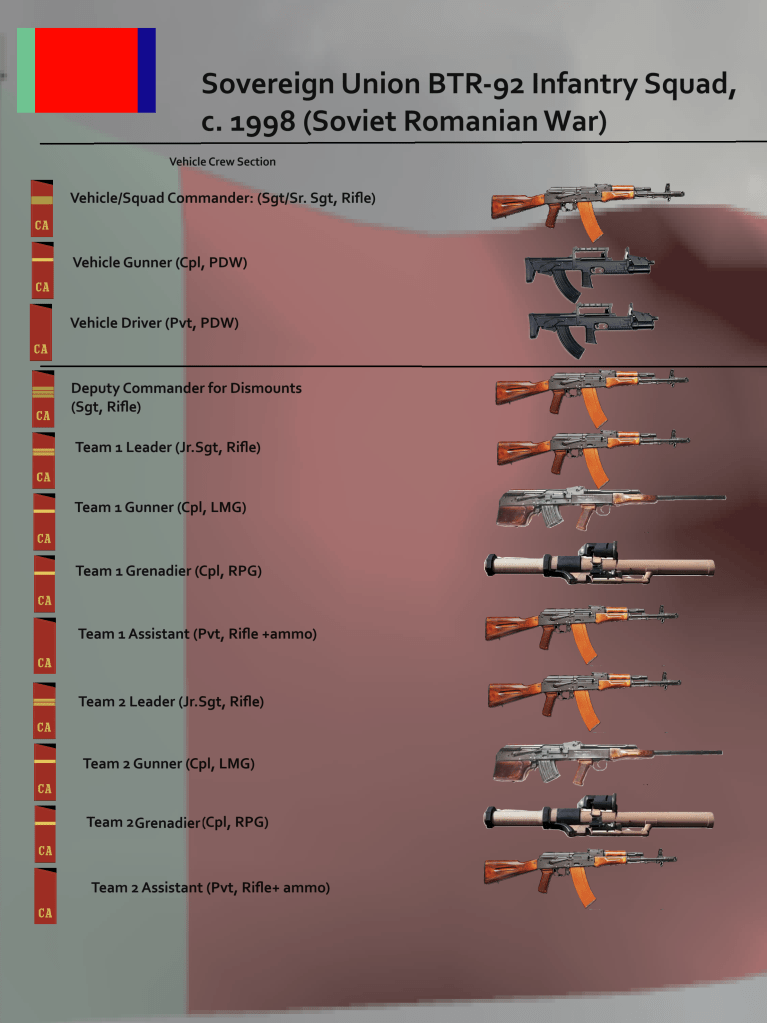
  • Unlike previous examples, including the mobile corps own BMP/IFV squads, this operates two organizational fireteams. With lots of teeth-gritting, the doctrine emphasizes that “if necessary”, it can operate as a unitary squad or simple overall fire/overall maneuver element. In the Soviet-Romanian War, many did.
  • This has a full-time deputy squad leader for dismounts, whose job is pretty obvious. An emphasis was put on out-of-vehicle operations as these units were designed to spend more time outside.
  • The PDW is the A-91M. The LMG is the “Vepr”, one of many bullpup RPK proposals. The light RPG is in real life the South African (!) Denel FT5 (since a post-apartheid government would be very close to a surviving USSR, and since a post-apartheid arms industry would be very desperate, a license deal for this Goldilocks Rocket Launcher is not impossible).
  • This can be detailed in the Kestrel Publishing entry: Clash: Soviet BTR vs. Romanian TAB . Despite the name, about 80% of that book is just devoted to the Mobile Corps BTR reformation. The pieces on the Romanians basically amounted, cruelly but not inaccurately to “They just followed 196X BTR doctrine, had the equipment to match, and lost”.

How the Fuldapocalypse Skewed Artillery

Fair warning: This is done by an armchair enthusiast with absolutely no practical experience and whose sole experience comes from reading things. I could be totally and completely wrong about many things. Now that that’s out of the way, a look at how a Fuldapocalypse-centric doctrine has skewed perceptions of artillery to the point where Ukraine came as a surprise to many.

To put a long story overly short, the current paradigm in Ukraine is:

  • Largely static front
  • Lots of drones flying around on both sides (which translates to deadlier air power, which in turn makes it a bigger threat)
  • Limited resources

So you can see why smaller, easier to conceal towed guns are liked more.

Now compare this to the Fuldapocalypse:

  • Mobile front
  • Less threat from air but extremely good counterbattery fire
  • Lavish (prewar) spending to afford SPGs.

See the difference?

Now the interesting thing is Caesar-style “truck SPGs”, ie artillery pieces on open wheeled chassis. They have shown the weaknesses of both-ie they’re soft like a towed gun and big like an SPG (and even less maneuverable). However, they’re not really designed for either kind of large-scale war.

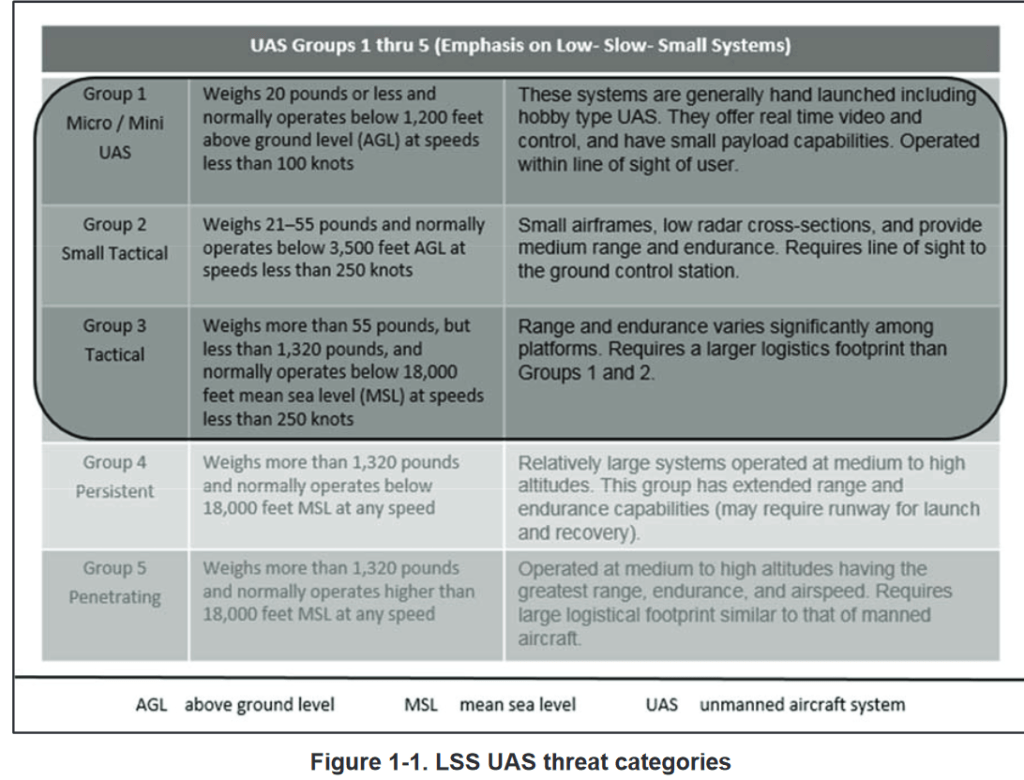
UAV Classes

The US Military has five official group of UAVs/drones.

(from ATP 3-01-81)

The standard hobby drone is a Group 1. Smaller military drones are groups 2 and 3. The ScanEagle is the best American example of a Group 2. The classic Iowa spotter Pioneer is a Group 3, so is the RQ-7 Shadow. Heavy attack drones like the Predator and Bayraktar TB2 are 4, while monsters like the Reaper and Global Hawk are 5.

Coiler’s Culmination Calculator

As a fun side project, I made my first (intentionally abstracted) wargaming tool. The goal is to see the culmination point of an offensive.

Assumptions: The attacker is consistently advancing, however, the defender is fighting back hard throughout. The units of the attacker participating in the campaign are not going to be rotated out, hence they will only receive small and piecemeal reinforcements/replacements throughout.

This simple tool works as follows:

  • The attacker starts with a point total of 100.
  • For each objective, roll 1d10. 1 means the objective is taken unopposed and the force suffers no meaningful losses. 2-6 is a minor engagement where the unit suffers a point loss equal to 1d6 points. 7-10 is a major engagement where the unit suffers a point loss equal to 1d6+10.
  • After every turn, the faction regains 3 points.
  • The offensive will have culminated when the point total reaches zero or less.

Example:

  • Objective 1: 9: 16 points lost. 3 regenerated. 87 points.
  • Objective 2: 8: 12 points lost, 3 regenerated. 78 points.
  • Objective 3: 6: 1 point lost, 3 regenerated. 79 points
  • Objective 4: 6: 6 points lost, 3 regenerated. 76 points.
  • Objective 5: 1: No losses, 3 points regenerated. 79 points.
  • Objective 6: 3: 5 losses, 3 regenerated. 77 points
  • Objective 7: 10: 11 losses, 3 regenerated. 69 points

Etc….

Figures of course can be changed depending on context.

On Star Wars

Now I want to say that I’ve liked a lot of Star Wars stuff. I don’t mind the setting, I’ve seen 2/3s of the official movies. Like any big setting it has its ups and downs. But I definitely don’t hate this.

However, I feel obligated to say one thing about Star Wars that I believe. It is the most overrated work of modern fiction, and this overrating has made it impossible to judge. What you have is first a trio of fun sci-fi pulp movies that get treated as if they were more than fun sci-fi pulp movies, because they were a breath of fresh air in the pretentious dark tone of 1970s science fiction. Then you have a giant franchise.

Next you have the prequels, which are basically what happens when a Dunning-Krugered director gets free reign to run amuck. People nowadays are swinging towards defending the prequels in a dose of inevitable “defend midsize sedan cars the minute they stop being popular” hipsterism. Although I don’t blame them, because…

Then George Lucas cashed out and the Mouse Machine made the sequel trilogy. Now I had little desire to see them in full personally, and everything I saw and heard reinforced that desire. When I finally, recently looked at them in more depth, I was even gladder. At least the first six were works of genuine artistic imagination. These are just rehashed play it too safe mush piles that don’t understand the feel of their setting.

(Not so small side note: Devereaux’s excellent blog has the point in a review of fellow cash grab Rings of Power that authors are obsessed with winning battles via an unrealistic One Neat Trick. That plus “why didn’t they fly in on the eagles” ”’rationalism”’ leads to the infamous hyperspace ram.)

The Cosmic Angels

When it comes to Warhammer 40k, I do not have the highest opinion of or interest in the setting’s mascots. I’ve been an Imperial Guard fanatic (no not that kind) since day one of my interest in the setting, and this also applies to their spacefaring counterparts in their humongous flying cathedrals. However, I have made several fan Space Marine chapters (as every 40k fan is obligated to do), and the one with the most detail is the Cosmic Angels. With the aid of Stable Diffusion and some online “marine coloring tools” I made this infographic on them.

(And yes, it is definitely, totally a coincidence that my interest in Starmada and constant setting crossover battles coincides with me elevating an extreme fleet based chapter. Totally. A. Coincidence.)

Weird Wargaming: The SW40k Project

I’m delighted to announce the initial release of a Starmada project of mine: The Star Wars vs. 40k fleet lists. Based on the fanfic, it aims to bring the battles from said fic to the generalist wargame. So far initial Imperial Navy and Republic fleets have been made. More, including Astartes, Separatists, and whatever else my brain thinks up, is planned.

Notes:

  • Ships are judged based on absolute and not relative size. This means the 40k ships are usually gigantic with the HP to match.
  • The Republic is a swarm fleet whose ships are almost always pound for pound inferior, just like in the fic itself.

Soviet-Romanian Air War

With All Union now on a little cooldown, I figured I’d share my exposition/notes about the Soviet-Romanian air war:

Overall course of the war: Starting on September 8, 1998, the Sovereign Union invaded Romania with two fronts (army groups). The northern Dniester Front was arguably the most advanced and powerful fighting force in history at that time. That combined with good terrain made it sweep south in close to nine days. The southern Danube Front had a more difficult task in the form of more fortifications,more cohesive defense, the daunting task of crossing a massive river opposed, and the bulk of it consisting of forcibly mobilized Bulgarians. Still, after the same nine days they had encircled Bucharest and linked up with the Dniester Front. For the rest of the month they prepared to storm the city, continued bombardment, and tried to push for a surrender that eventually came.

In the end, the USSR lost around 3,500 soldiers and the Bulgarians and other minor allies around 7,000. Romanian casualties are almost literally uncountable with at least 70,000 being essentially confirmed and with estimates as high as 120,000 KIA.

Now for the air:

The USSR’s air force was a curious mixture of everything from the hyper-advanced Su-37 Fermion fighter to dozens of ancient Il-28s. In general, METT-TC was used to allocate things, with older planes doing area strikes with smother/splash damage weapons in the daytime and newer ones using PGMs at night whenever possible. While not perfect, it was extremely devastating.

Romania:

The initial fire strike took out around five hundred Romanian aircraft on the ground, over 80% of its total. This caused a lot of panic in the USAF after the war. A few planes made it through, most notably in the defeat of a Danube Front forward detachment at Alexandria very early on. Otherwise Romanian aircraft were limited to tiny nuisance strikes and suffered very heavy losses while doing so, though surprisingly few to the vaunted SAMs. (Total air superiority+tons of friendly Soviet aircraft = a very short ROE leash and lots of fighter opportunities).

Weird Wargaming: The Realistic Space Warship

In the late 1970s, the BDM Corporation did a study for what a plausible space warship could look like (thanks to the invaluable Atomic Rockets for its analysis).

It has a spin-gravity crew quarters, is powered by nuclear reactors, and its armament consists of a laser in a de facto turret, a forward facing railgun, and a rear-facing particle beam (because the radioactive particles can’t risk hitting the ship).

The Space Shuttle in the picture is for scale-the whole thing is about two hundred meters long!

What’s In A Space Warship Name

(That I’m interested in this topic just as I’ve gotten into Starmada is just a coincidence, I swear.)

Atomic Rockets is a great site for semi-realistic spacecraft design. However, one of their contributors was adamant about not transplanting ship names wholesale from maritime ones, as has happened many times before. Is this a sensible avoidance of tropes or just hipsterism for the sake of being different?

I feel it depends on the setting and tone. IE Warhammer 40k and its broadside space cathedrals and obvious Age of Sail symbolism can adopt naval terminology just fine. But there are understandable reasons to avoid the ‘superdreadnought’.

Names I think could make the cut:

  • Battleship. Pretty self-explanatory.
  • Carrier for anything carrying smaller craft. Also pretty self-explanatory.
  • Gunship/gunboat. I think this has already passed one test in that plenty of real aircraft are called gunships, and an added bonus of being a good literal description for many designs. (IE, big weapon on a spinal mount the rest of the ship is built around).

Cruiser, Destroyer, and Frigate are already a mess and have been for decades if not longer. These smaller ships are probably the best to make up your own terminology for (ie “Dragonship”).