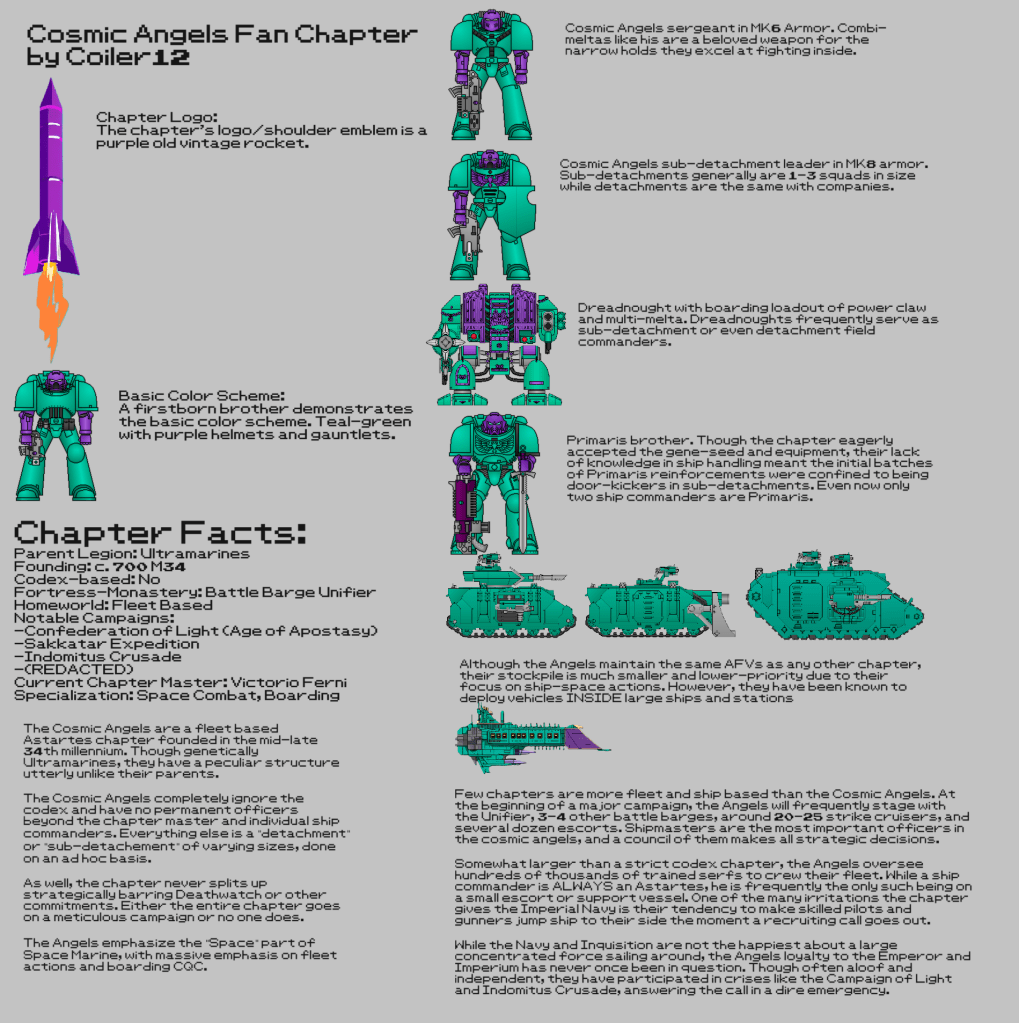
The Cosmic Angels

When it comes to Warhammer 40k, I do not have the highest opinion of or interest in the setting’s mascots. I’ve been an Imperial Guard fanatic (no not that kind) since day one of my interest in the setting, and this also applies to their spacefaring counterparts in their humongous flying cathedrals. However, I have made several fan Space Marine chapters (as every 40k fan is obligated to do), and the one with the most detail is the Cosmic Angels. With the aid of Stable Diffusion and some online “marine coloring tools” I made this infographic on them.

(And yes, it is definitely, totally a coincidence that my interest in Starmada and constant setting crossover battles coincides with me elevating an extreme fleet based chapter. Totally. A. Coincidence.)

Weird Wargaming: The SW40k Project

I’m delighted to announce the initial release of a Starmada project of mine: The Star Wars vs. 40k fleet lists. Based on the fanfic, it aims to bring the battles from said fic to the generalist wargame. So far initial Imperial Navy and Republic fleets have been made. More, including Astartes, Separatists, and whatever else my brain thinks up, is planned.

Notes:

  • Ships are judged based on absolute and not relative size. This means the 40k ships are usually gigantic with the HP to match.
  • The Republic is a swarm fleet whose ships are almost always pound for pound inferior, just like in the fic itself.

Soviet-Romanian Air War

With All Union now on a little cooldown, I figured I’d share my exposition/notes about the Soviet-Romanian air war:

Overall course of the war: Starting on September 8, 1998, the Sovereign Union invaded Romania with two fronts (army groups). The northern Dniester Front was arguably the most advanced and powerful fighting force in history at that time. That combined with good terrain made it sweep south in close to nine days. The southern Danube Front had a more difficult task in the form of more fortifications,more cohesive defense, the daunting task of crossing a massive river opposed, and the bulk of it consisting of forcibly mobilized Bulgarians. Still, after the same nine days they had encircled Bucharest and linked up with the Dniester Front. For the rest of the month they prepared to storm the city, continued bombardment, and tried to push for a surrender that eventually came.

In the end, the USSR lost around 3,500 soldiers and the Bulgarians and other minor allies around 7,000. Romanian casualties are almost literally uncountable with at least 70,000 being essentially confirmed and with estimates as high as 120,000 KIA.

Now for the air:

The USSR’s air force was a curious mixture of everything from the hyper-advanced Su-37 Fermion fighter to dozens of ancient Il-28s. In general, METT-TC was used to allocate things, with older planes doing area strikes with smother/splash damage weapons in the daytime and newer ones using PGMs at night whenever possible. While not perfect, it was extremely devastating.

Romania:

The initial fire strike took out around five hundred Romanian aircraft on the ground, over 80% of its total. This caused a lot of panic in the USAF after the war. A few planes made it through, most notably in the defeat of a Danube Front forward detachment at Alexandria very early on. Otherwise Romanian aircraft were limited to tiny nuisance strikes and suffered very heavy losses while doing so, though surprisingly few to the vaunted SAMs. (Total air superiority+tons of friendly Soviet aircraft = a very short ROE leash and lots of fighter opportunities).

Weird Wargaming: The Realistic Space Warship

In the late 1970s, the BDM Corporation did a study for what a plausible space warship could look like (thanks to the invaluable Atomic Rockets for its analysis).

It has a spin-gravity crew quarters, is powered by nuclear reactors, and its armament consists of a laser in a de facto turret, a forward facing railgun, and a rear-facing particle beam (because the radioactive particles can’t risk hitting the ship).

The Space Shuttle in the picture is for scale-the whole thing is about two hundred meters long!

What’s In A Space Warship Name

(That I’m interested in this topic just as I’ve gotten into Starmada is just a coincidence, I swear.)

Atomic Rockets is a great site for semi-realistic spacecraft design. However, one of their contributors was adamant about not transplanting ship names wholesale from maritime ones, as has happened many times before. Is this a sensible avoidance of tropes or just hipsterism for the sake of being different?

I feel it depends on the setting and tone. IE Warhammer 40k and its broadside space cathedrals and obvious Age of Sail symbolism can adopt naval terminology just fine. But there are understandable reasons to avoid the ‘superdreadnought’.

Names I think could make the cut:

  • Battleship. Pretty self-explanatory.
  • Carrier for anything carrying smaller craft. Also pretty self-explanatory.
  • Gunship/gunboat. I think this has already passed one test in that plenty of real aircraft are called gunships, and an added bonus of being a good literal description for many designs. (IE, big weapon on a spinal mount the rest of the ship is built around).

Cruiser, Destroyer, and Frigate are already a mess and have been for decades if not longer. These smaller ships are probably the best to make up your own terminology for (ie “Dragonship”).

The War Thermos

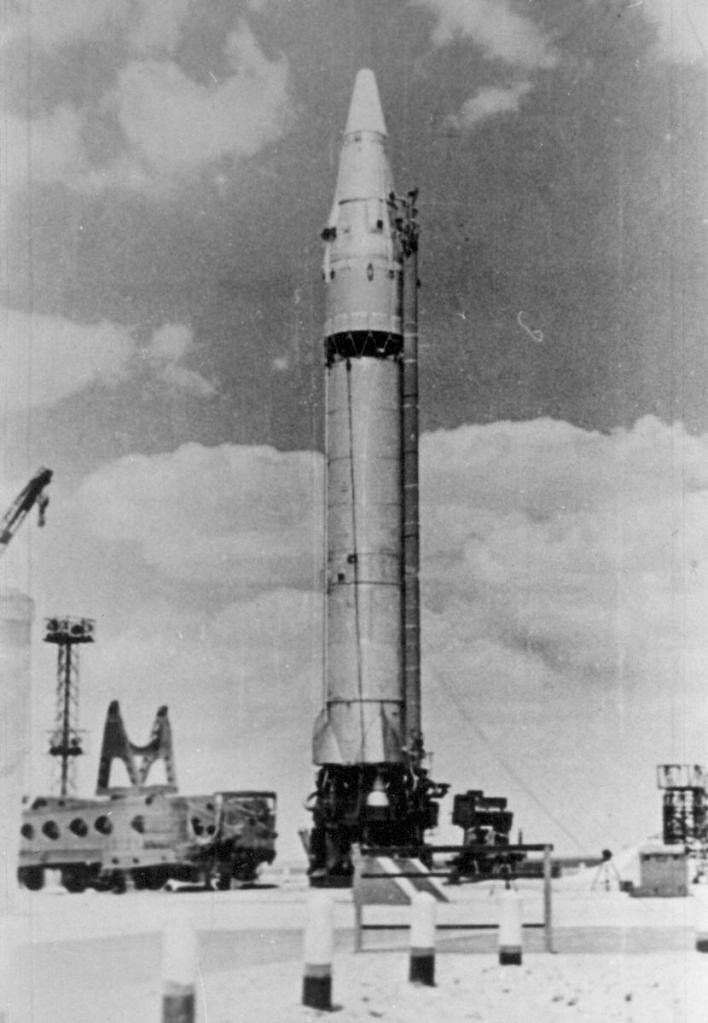
Readiness issues with liquid oxygen rockets historically retired them from the ICBM role once alternatives became practical (be it storable liquid or solid fuels). Yet one technological curiosity was an attempt to work around the issue.

A variant of the R-9/SS-8 ICBM with the typically obtuse Soviet industrial designation of 8K77 had the vacuum flask principle applied to its oxygen tanks. At least in theory, it would keep the liquid oxygen cold long enough for a fueled missile to wait on alert in a crisis. Vacuum flasks are of course better known in the capitalist west by their brand name turned generic name, the thermos.

It would be very cold and then very, very hot.

The Imperium Vs. The Death Star

So the question has to be asked: What about this?

Original source

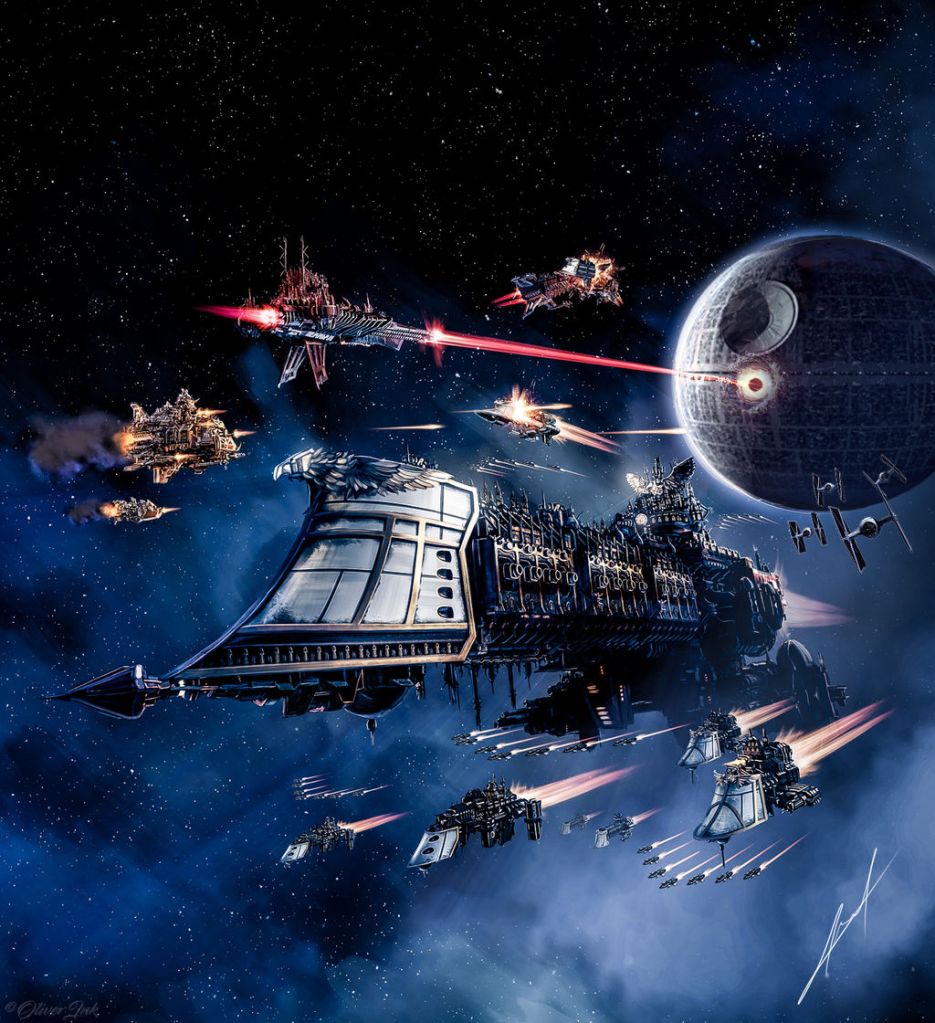
A Star Wars/Warhammer 40k crossover has to include the battles of evil vs. slightly more justified evil and feature a large Imperial Navy cathedral armada going up against the Death Star (presumably with its own array of Star Destroyers). Now I have put some actual thought into this.

  • The Imperium is not likely to be terribly fazed by the Death Star, thanks to confrontations with giant horrific superweapons being known as “Wednesday” over there.
  • If they cannot overpower it via masses of lances, nova cannons, and whatever other exotic tricks they’d undoubtedly pull out (ie psychic lashes, vortex torpedoes to just shunt it into the warp, etc…), for the main Imperial Navy it would be difficult to duplicate what the Rebel Alliance did. The reason simply is because Warhammer 40k space fighters are substantially larger than their Star Wars counterparts, and their ordnance is the same.
  • However, moving in for a pinpoint strike on a difficult but decisive target is the exact thing that Astartes were made for. So trench runs of Thunderhawks, vacuum chainsword fights, and tossing a melta bomb down the port would make for a fitting story.

My Take On The Female Astartes

So time for one of the biggest internet controversies surrounding the Warhammer 40k fandom. Note that I said “internet controversies”, not “controversies”. This post therefore might be controversial itself. Oh well.

This has to do with Female Space Marines. In-game, for basically all of 40ks solidified existence, the gene-seed that produces the super-space-knights who serve as the mascots of the setting only works with men. Games Workshop has been extremely strict and clear with this. Some online advocates have opposed this and wanted a change.

I’m pretty firmly in the the “no female space marines” category, and not just because my Imperial Guard doesn’t have this problem in the slightest.

“No female repre”-I’m sorry, she can’t hear you over the sound of her supertank’s engine.

I think one of my reasons is because a Space Marine has become a very specific thing. I would even argue that if you asked a layperson unfamiliar with the setting to describe one, you’d end up with either a Sister of Battle or a female Tempestus Scion (neither of which has any issue). Those can and do exist without any issue. Female techpriestesses can and do exist without issue, if you like someone so covered in augumentations that their initial number of chromosomes becomes irrelevant. Female Eldar and Tau can and do exist…

In fact, this is the diversity argument I have. If female space marines were adopted, they’d actually make the setting significantly less diverse. It means (even) more of the already pushed setting mascots and (even) less of the factions where this isn’t an issue.

(As for diversity in the setting overall, I have three big takes:

  • It’s still a pulpy sci-fantasy kitchen sink. Like Catachans are not anthropologist-approved examples of life in an inhumanly harsh jungle, they’re 80s action stars en masse. This is the least hard sci-fi setting imaginable.
  • Diversity means something a lot different in 41st millennium terms than it does in 2nd millennium ones.
  • SISTERS DO NOT JUST HAVE WHITE HAIR AND BLACK ARMOR, THEY HAVE AN ENTIRE RAINBOW OF COLORS IN THEIR MANY ORDERS, GW PLEASE REMEMBER THIS. )

Forge-ing ahead

For pretty much my entire Stable Diffusion use, I’ve been using the A1111 web interface. Now Forge, a newer and faster/more efficient version of it, is out. I’ve installed it. The problem is moving over, both literally (ie all my extensions/models) and metaphorically.

Well, you have to start somewhere…

Fictional and Alternate Historical Airlines

Airplane manufacturing is a very tough process. Barring some strange point of divergence, it’s hard to avoid large airplane builders sorting out into a few giants. Yet airlines are another story altogether. It’s interesting how in the “Goldilocks businesses”, airplane builders and airlines fall on opposite disadvantageous ends.

For the manufacturers, it’s the “too many barriers to entry, thus you end up with a oligopoly” issue. For the airlines, where existing planes and even crews are just a few lease deals away, it’s the “too few barriers to entry, which leads to too many participants chasing too small a market”. In many cases both of these are unavoidable. (Novels, sadly, were the latter even before the rise of internet self-publishing).

What this means is that it’s incredibly easy to change the fates of the airlines, and even easier with a point of divergence after the large and successful deregulation of the late 1970s.