Review: ATP 7-100.3 Chinese Tactics

ATP 7-100.3 Chinese Tactics

After seeing the excellent work on North Korea, I eagerly awaited the next installment in the ATP 7-100 series on the most potential opponents. When ATP 7-100.3, Chinese Tactics dropped, I was not disappointed. Well detailed and well laid out, this is the first comprehensive unclassified analysis of the PLA in decades.

In some ways, being a far more advanced opponent that’s far closer to the fictional maximum-challenge “composite OPFOR” than North Korea is means that the tactics shown feel a lot more mundane and slightly less interesting. But showing the (deliberately overcomplicated and confounding) organization is where this shines. The modern PLA is organized a lot like the old “GENFORCE-Mobile” OPFOR with a bunch of brigades and combined arms battalions jumping straight to corps-equivalents with six line brigades each.

This is a great resource and I highly recommend reading it. Besides its topicality, seeing a force structure diverge from the classic Russo-American style is interesting to see and valuable for wargamers.

Review: Our Man On The Hill

Our Man On The Hill

Matthew Kresal’s debut on Sea Lion Press (full disclosure, I’m published there too) is Our Man On The Hill, a story which takes a bit of historical commentary and plays with it. It’s been said that Joe McCarthy was such a blustering bumbler that he actually did damage to legitimate anti-communism. Thus Kresal turns into him being a Soviet agent intended to sabotage the opposition.

Though not exact, this has parallels with Agent Lavender, the book that started SLP in the first place. Both make alternate histories where a conspiracy theory about a huge political figure (Wilson, McCarthy) is treated as true. Both are well researched. And both are excellent reads.

Even though I’m not generally the biggest fan of this kind of political/spy story, Our Man On The Hill is well done enough that I had a blast reading it. I highly recommend this book.

Review: Silent Assassin

Silent Assassin

The second Dan Morgan thriller (albeit the third I’ve actually read), Silent Assassin is an awkward novel. By itself, it’s a decent enough cheap thriller that does decent enough cheap thriller things. The action is never worse than passable, and some of the set pieces, like an ultra-secret facility on Long Island of all places, made me smile. Yes, it’s cheesy and ridiculous, but that’s what cheap thrillers are for.

However, having read two other books in the series, it felt like it was a step up from the first book, but not as good as the third. Reading it gives the impression of an author trying to find a footing that he would get in the next installment. So I would recommend, unless you found you really liked this series, to just start with Black Skies.

Review: Air Battle Central Europe

Air Battle Central Europe

Alfred Price’s Air Battle Central Europe is a magisterial study of aviation plans for a hypothetical conventional World War III. What makes it different from other technical studies? The answer is simple-it looks at the whole and not just the sum of the parts.

In the interviews and discussions, every piece of the NATO air power puzzle is studied, and each role of each aircraft is talked about. The result is a lot of detail, and an important look at how combined arms works in the air. It’s both accessible and comprehensive.

There are a few sour parts. Some aren’t it’s fault, like the book being dated compared to a post-Gulf War understanding. The biggest issue I thought that was its fault was a willingness to talk more about the ideals of what air power would do than a stress-tested analysis that involved a worse case. But the book is still excellent and a must-read for anyone studying a conventional Fuldapocalypse.

Review: Mobile Strike Forces in Vietnam

Mobile Strike Forces in Vietnam: 1966-1970

Gordon Rottman’s Mobile Strike Forces in Vietnam: 1966-1970 is about a frequently understudied and overlooked force in the war-the MIKE (or Mobile StrIKE) forces of the CIDG (Civilian Irregular Defense Group). Comprised mostly of non-Vietnamese minorities (the famous “Montagnards”), they served as essentially a parallel army under US Special Forces command.

The MIKE forces arose from a pair of facts on the ground. The first was that the CIDG needed a mobile action force, especially as nearly all of its rank and file formations were only suitable for local defense around their home villages. The second was that it couldn’t count on the support of the southern government or mainline American/allied forces. So an in-house force had to be created, and it was.

Rottman’s book is, without exaggeration, a masterpiece. First, it’s careful not to exceed its grasp or opine on the war as a whole. Sticking to its subject matter closely, it delivers. And does it deliver. The book succeeds in being both extremely detailed (going into both paper organizations and how the formations inevitably diverged from those organizations in practice) and very readable. There’s only a few big blocky info sections, and those are more than offset by the rest of the book. Even though it’s short, you can get a very clear picture of how these forces trained and fought. This includes everything from the WWII/Korean hand-me down equipment they used to their occasional use of parachutes because of the advantages they offered over helicopters in certain situations (capacity, range, ability to deploy a lot of people quickly).

It’s also very evenhanded. After seeing so many authors whose advocacy for light infantry operations has reached the level of outright fetishism, it was a delight to see the drawbacks of such forces respectfully laid out by a knowledgeable Vietnam veteran with personal experience. The MIKE forces are given both credit and criticism when deserved. This is an excellent book and an excellent study of Vietnam War operations.

A Thousand Words: Valkyrie

Valkyrie

2008’s Valkyrie stars Tom Cruise and depicts the July 20 Plot that tried and failed to kill Hitler. An unusual historical movie for Hollywood, it has both the strengths and weaknesses of a lavish production aimed at a big audience. The strengths are obvious-great production values. The visual style is excellent, and the John Ottman score is nothing short of amazing.

However, it also, in the interest of audience morality, sugar-coats and oversimplifies the plotters. The movie does do a decent job in showing how unlikely it was for the Valkyrie conspirators to actually gain control of the government even if Hitler and his inner circle were killed off. However, it does not dwell on how the actual plotters ranged from “ok, at least a little better than Hitler, but that’s definitely not saying much” to “Really bad, including Einsatzgruppen commanders and mass POW-killers”. It also does not bring up that the Allies would never have accepted the terms the plotters wanted to offer, and would have just viewed it as infighting among thugs. While understandable, this is still a missed opportunity for complexity in addition to an inaccuracy.

Leaving factual issues aside, the acting is a mixed bag. Cruise himself is quite wooden, but a lot of the supporting cast does well. Tom Wilkinson does a great job as the weaselly General Fromm in my favorite role. An underrated performance is David Bamber as Hitler. Not only does he come across as appropriately menacing, but he’s menacing in a soft-spoken way that’s quite different from the usual (including Downfall) bombastic Hitler.

For all its issues, Valkyrie is still worth a watch, especially if you don’t mind historical inaccuracy.

Review: Postwar AANW

The Anglo American Nazi War: Part 2

The first installment of The Anglo American Nazi War, published as Festung Europa, has been reviewed on this blog before. Because the postwar part is A: different, B: worse, and C: deliberately not included in the published version, I figured it deserved a separate review.

The wartime portion can fit, slightly awkwardly, into a certain form of pseudo-historical fiction. For fans of conventional World War IIIs, it can be compared somewhat to Hackett and The War That Never Was. It’s a description of a conflict that didn’t happen written in the style of recounting one that did. There is thus a tiny connection to fiction in general, albeit with the thread leading to another very small niche. It also fits into “AH as a genre.”

The postwar installment lacks even that connection. It’s a pure example of internet alternate history, and one of the big problems I’ve had when trying to review is that internet AH is an extremely insulated subculture that lacks almost any tie to normal literary storytelling. How can you critique the characters if there are none? I’ve had to strain to explain it, with the best I can give being “The outline of a de facto fanfic that uses ‘history’ as its setting”. If that sounds unusual and bizarre, it is.

Internet AH has a reputation for its installments being extremely short, something that actually sets it apart from other serialized web-fics that have a deserved reputation for often leaving War and Peace and Atlas Shrugged in their dust where length is concerned. The more substantive wartime portion takes up over 86% of the words written in the story. What’s left is a series of short infodumps.

Here’s what happens. In an utterly ruined Eurasia, everything from the Channel-bordering regions of France returning to British semi-rule as crown dependencies to the US annexing the Russian Far East as “Western Alaska”, with it later becoming a state, occurs. There’s both a “Russia” and a “Soviet Union.” The remnants of Germany are divided into many Morgenthau Plan-style restricted microstates. All this is told in blocks of exposition that somehow feel even flatter than the wartime ones. Which is a shame because there’s both comparison to another alternate history (in this specific case) and a huge amount of lost potential.

The world that develops is one where the US builds lots of superweapons the author clearly likes, adopts a full-on might makes right policy, has the path cleared for cakewalks despite its historical postwar advantages and lack of historical rivals, and uses them frequently against totally ineffectual opponents who exist purely to serve as live-fire targets. This is very much like The Big One, except it lacks the utter audacity and, in something you’d never have hear me say earlier, literary skill of that series.

Instead of using the power of Mary Sue project management to get the superweapons into service without breaking the bank, postwar AANW just has the US continue to run what amounts to a total war economy, falling victim to the “nine women can have a baby in a month” fallacy of funding always equaling results. Instead of having immortal manipulators with catlike eyes provide unrealistic policy continuity, postwar AANW just has a lazy unshakeable consensus emerge. Even after the US destroys several German cities with space weapons after their uprising had been conventionally suppressed, the result is not a “you kicked them when they were down” backlash similar to the real one (however fair or not) over the atomic bombings of Japan, but rather the even more hawkish party gaining support.

What should be an audacious, massive divergence that could easily serve as the foundation for a distinctive work instead is summarized in only around two dozen pages worth of actual text. This is a shame because the premise of a superweapon-obsessed US that never truly left the wartime era (and its ugliness and excesses) behind could make for a great “AH as a setting” story. It could be a highbrow book about generational change, with the upheaval making the historical 1960s look tame. It could be a thriller as the nation with a bazooka suddenly faces problems requiring daggers.

Instead it’s just the outline of an even more biased late Tom Clancy novel mixed with map trinkets. Instead of being made into a potentially tasty meal, the ingredients were just placed in a bowl and left there, next to other bowls full of uncooked flour, eggs, and spices.

Review: The Professional

The Professional

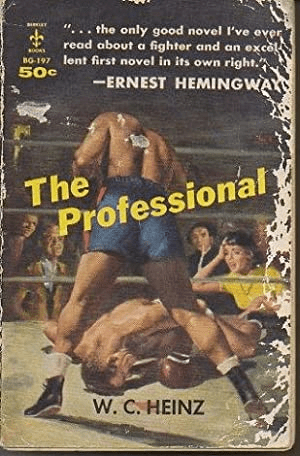
A tale of middleweight contender Eddie Brown, The Professional is a novel by legendary sportswriter W. C. Heinz. What’s interesting is comparing it to Malamud’s The Natural, as they take extremely different paths but arrive at the same level of quality. This deserves more explanation.

Malamud did not know much about baseball. Heinz knew boxing inside and out. Book Roy Hobbs is an ass that you’re not supposed to root for. Book Eddie Brown is meant to be a decent, sympathetic figure in a bad sport. The Natural loved making flourish and mysterious performance shifts depending on the plot. The Professional is grounded and realistic to a fault. The Natural is a third-person book. The Professional is a first-person book. The prose is blocky in both, but while Malamud is excessively flowery, Heinz is very Hemingway-esque (not surprisingly, that author loved the book). And yet both come across as being stilted, pretentious, and dated.

Its main characters are not very good. Brown is not a bad protagonist but he can’t make up for the faults of the other two, which are massive. The two other central figures are Brown’s hideous Mary Sue of a trainer/manager and the first person sportswriter narrator, who fits the “character as camera” archetype I’ve seen in other negative reviews of first-person books.

As for the book itself, it consists of realism-as-padding, outright padding, and expects the reader to treat the technical decline of boxing as some great tragedy. I could be a little harsh on it because it would be far more novel and revealing to a 1950s reader who only knew boxing from television and the pulps (not surprisingly, there’s a scene where Heinz, via one of his mouthpieces, swipes at them for their inaccuracies). But to someone much later who’s read a lot of excellent nonfiction on the sport, it just felt plain and empty.

Review: Friday Night Fighter

Friday Night Fighter

Troy Rondinone’s Friday Night Fighter is the story of both a boxer and a time period. It is the story of boxer Gaspar Ortega. It is also the story of a huge-in-its-day sporting event, the time when boxing aired en masse on network television and attracted a viewing share comparable on the low end to the NFL playoffs today. It is the story of a far more unified sport than the later “alphabet belts”.

Rondinone’s writing is excellent and Ortega, a boxer who appeared on television many times, is arguably the perfect figure for this age. On one hand, he was much more than a small journeyman who appeared on television a few times. On the other, he wasn’t the kind of already-immortal figure that everyone already knows about (ie, Marciano, Patterson, Liston). A contender who never got to actually wear the belt, he illustrates the time period exactly.

Another impressive element of this book is that it rarely sinks into Good Old Days nostalgia despite boxing being the one sport where it’s the most viable. It makes it clear that boxing gave up on network TV because network TV gave up on boxing, with viewership substantially down even before Benny Paret’s death. Yes, TV played a role in diluting the talent pool and closing down the old clubs and gyms that served as the fighter pipeline, but so did simple demographic change. And it doesn’t hesitate to tackle the sleaze in the sport.

The best complement I can give to this book is that it truly takes the reader into another time, and that’s something a lot of history books just can’t manage. Friday Night Fighter is one of the best works of sports history that I’ve read, and I highly recommend it.

Review: How To Make War

How To Make War

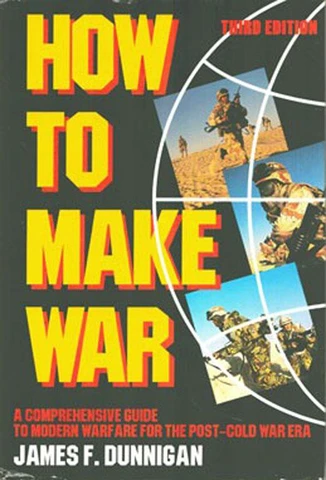
Written by acclaimed and prolific wargame designer James Dunnigan, How To Make War is an impressive one-volume entry on both the basics of military operations and wargaming them. It’s not an easy feat to stuff so much into one book, but he manages it. Every facet of post-WW2 warfare is covered inside, along with simple but generally effective formulas for determining a unit’s “combat power” and stuff like average attrition in personnel and equipment.

Some of the “flaws” are clearly not his fault. For instance, it’s not his fault that (like most aficionados, to say nothing of actual veterans) I already knew most of what he was saying in his basic description of various unit types. It’s also not his fault that some of the book is dated (the latest edition was made in 2003). I’ll even excuse its frequent yet understandable bias, which is exactly what you’d expect from an old western Cold Warrior.

The biggest drawback that I’m not so willing to let slide is how its two central parts don’t really gel. It’s trying to both teach someone to walk (ie, the intro to all parts of the military) and run a marathon (do calculations for exact combat power). It just feels a little awkward to have “here’s the basic differences between infantry-heavy and tank-heavy formations” and “here’s how to calculate the combat power of a Syrian armored division” close to each other in the same book.

Still, this is a very good and very convenient resource for people wanting to learn more about missile-age warfare and/or wargaming. For fictional country simulations/story concepts, I’m already finding his formulas very useful for translating an order of battle into a general feel of its relative strength (which is the most important part). While some specialists may already know its material, you still can’t go wrong with getting this book.