Review: Strategy

Strategy

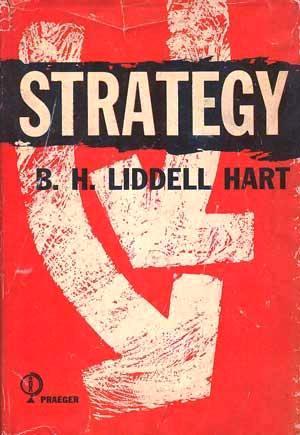
B. H. Liddell Hart’s Strategy will always be a book I remember, although not necessarily for good reasons. It was one of the first history books where I’d become well-read enough to reasonably question its thesis. While Liddell Hart’s life and career has no shortage of controversy around it, I want to focus this review purely on this specific book.

Liddell Hart talks up the “indirect approach” big time, listing a huge number of historical examples. Unfortunately, the history is a cherry-picked list of questionable ones. Even when much younger, I remembered Liddell Hart skipping over several attempted indirect approaches in the American Civil War that failed and brushing off the battle of Guadalcanal (while falsely saying it was a project of MacArthur. It wasn’t.)

As for the theory, well, this kind of “maneuver warfare” talk is the kind of thing that’s uncontroversial in general principles yet doesn’t always translate to specific goals. Sometimes a “direct” approach is desireable. Many more times it’s necessary, for better or worse. What one can see Liddell Hart going for is wishful thinking, where fancy footwork alone can break an enemy without the need for any kind of attritional phase. This is utopian.

Is this book totally bad? No. I’d say it’s useful if you know the context. With that in mind, it’s useful for looking at how one school of thought approaches history and doctrine. But it shouldn’t be anyone’s first book on the subject.

Review: The Sixth Battle

The Sixth Battle

Barrett Tillman’s The Sixth Battle is an interesting book. The 1992 novel of a gigantic combined battle over South Africa can either be considered the last Cold War “big war thriller” or the first post-USSR one. Because of its timing, the plot has to be kind of, er, forced a little, but that’s a small issue.

When I started reading the book, my thoughts turned to Red Phoenix. The similarities are there in that both are big picture thrillers that need to have a certain type of structure (most notably a lot of viewpoint characters and a setup period) to get that wide view across to the reader. For me personally, the perils of this is that since I already know a lot of what the authors are trying to communicate to a less knowledgeable audience, I see more of the downsides to this approach than the upsides.

However, I can also see-and appreciate-how rare a book like this is. “Big war thrillers” with this level of detail and knowledge behind them are and were very hard to come by. The Sixth Battle goes for a distinct setup, thinks it through, and competently executes the action in an evenhanded way.

Taking my biases into account and trying to adjust for them, I still recommend this book. It does feel a little clunkier than the best “big war thrillers”, but it’s never unreadably so. And it offers an all-too-uncommon experience that’s rarely duplicated elsewhere.

Review: Hostage Zero

Hostage Zero

John Gilstrap’s second Jonathon Grave novel and a tale of kidnapping, intrigue, and action, Hostage Zero lives up to the first. It might be a tiny bit “worse” than No Mercy, but that’s probably just me being more familiar with the series now. So I lack the awe at finding a newer, good author. Though the book itself is excellent.

Gilstrap’s action isn’t “realistic” unless benchmarked against the most absolutely ridiculous alternatives (not that I have a problem with that), but it’s as solid as always. There’s the slower middle portion, but even that demonstrates another strength of its author-a great sense of buildup. Stuff is revealed at a just-right pace. Not too quick, and not too slow. Jon Land has been consistently good at buildup, and in these two books, Gilstrap is too.

And this book and its predecessor also succeed in, well, having the cake and eating it too, for lack of a better word. Jonathan Grave has a huge network of resources at his disposal, but they don’t feel like easy victory buttons. He has to get his hands dirty and challenges do appear in his path. I love finding series that are good that I didn’t previously know about, and so far this is one of them.

A Thousand Words: Metal Slug

Metal Slug

SNK’s classic series Metal Slug takes the Contra-type “side scrolling shooter” game and adds an unforgettable art style to it. The excuse plot is you controlling a member of the elite “Peregrine Falcons” against the “Rebel Army”-and more weird enemies.

The art, from the goofy yet legitimately detailed sprites to the lavish backgrounds to the smooth animations, is consistently amazing. The music isn’t as standout (with a few exceptions), but is always at least serviceable. As for the gameplay, it’s both very good and inherently limited.

The action, weapon combinations, and controls are all excellent with the exception of a few clumsy platforming sections. The issue is the games are very short and were originally for arcades. So it’s either “be good enough at this very hard game to avoid deaths or just brute-force your way through with credits”. This probably couldn’t have been avoided, but it’s still a little bitter. That being said, this series is a classic for a reason and the games are well worth playing.

Review: Raider Brigade: Into A Time Warp

Raider Brigade: Into A Time Warp

With the premise of “1980s American armored brigade prepares for World War III, only to get timeshifted back to World War II”, I couldn’t not check out Daniel Gilbert’s Raider Brigade: Into A Time Warp when I saw it. While my reading experience is broad enough that this is strangely not new to me (the Kirov series timeshifted a modern brigade into the past twice), examining it was inevitable.

Unfortunately, this is rather lacking in execution, even compared to the Kirov series. The enthusiasm is there and the concept is still amazing, so I don’t want to sound too hard. But the prose is very rough and there’s as much time spent on the operations order given before the battles as there is on the (predictably one-sided) battles themselves. A too-large portion of the already short book is devoted to pictures and footnotes, giving this near-Richard Rohmer levels of “padding to substantive content”.

Even at the basics, this falls short. Descriptions are either too short or too long in that “I know what all the acronyms mean, and I’ll tell you in a footnote” way. The dialogue well, leaves something to be desired. And a lot of it is just well, incoherent. There’s no other way to put it. So, with a heavy heart, I’d say that this does not live up to its concept and is not recommended.

Review: The Suriname Job

The Suriname Job

Vince Milam’s The Suriname Job is the first book in the Case Lee series of thrillers. In a very crowded field, it only stands out in a few ways. The first is its very format. This is told in a first-person, “hardboiled” narrative style. It’s different than a lot of cheap thrillers, but I’m not sure it’s for the better.

The second is a bigger issue, and that’s that the action isn’t very good. It’s basically flat, which isn’t what you want to feel when you read a cheap thriller. The third is that the plot is a little too mundane, which isn’t necessarily a bad thing in and of itself but drags it down even more when combined with the poor action. With these issues in mind, I’m not exactly eager to read the later books in the series.

Review: The Wildered Quest

Throne of Eldraine: The Wildered Quest

Kate Elliot’s The Wildered Quest is a Magic: The Gathering tie-in ebook that reflects a dramatically different game from the last two I’ve reviewed on this blog.

Since I last looked at Planeswalker, a lot has changed in the lore of Magic: The Gathering. The Urza-vs-Phyrexia conflict concluded at the beginning of the 2000s, and then the wheels sort of spun until Wizards of the Coast made a massive change with the Great Mending, an event that reduced planeswalkers from near-divine immortal superbeings to considerably more “normal” people with the ability to teleport between dimensions.

Maybe this is just nostalgia, but I feel like the Mending has turned the setting from something offbeat and distinct into something more generic. It’s gone from two mad scientists-turned immortal monsters fighting a millenia-long war to superhero-wizards fighting some bland dragon-thingy. One effect of the Mending event was to actually make planeswalkers more prominent in spite of depowering by taking away third-party planar travel. So it’s either planeswalkers or having things take place entirely on one plane. Or, in this case, have planeswalkers drop in on what’s otherwise a one-dimension experience.

The Wildered Quest, taking place on the fairy-tale plane of Eldraine, has a lot going for it. It’s written by a successful author in her own right. It’s not too long. The prose is decent. The story of the Kenrith twins is interesting enough.

Yet it still feels like a merely adequate, phoned-in tie in. Of course, a lot of this might be my own biases-I tend to not be that into fantasy- but it still felt kind of just-good-enough. And that’s a type of book I’ve read a lot of. The glass-half-empty view is that it could have been better. The glass-half-full view is that MTG novels have had a sometimes-deserved reputation for being terrible and thus it could have been worse.

Review: Fire Ice

Fire Ice

The novel Fire Ice holds a great deal of importance to me. It was, without a doubt, the first real “cheap thriller” a young me read. This makes it hard to truly judge its literary quality. After all, young me saw the name Clive Cussler on the cover and didn’t know at the time about how the “co-author” system worked, so I assumed it was all him (which had the thankful effect of leading me to earlier Cussler books that were indeed all his own).

With its big locales, action, and high-stakes plot with a Russian oligarch and a supervillain scheme, this has all the ingredients a Cussler thriller and a cheap thriller in general needs. Certainly, for one’s first cheap thriller, you could do a whole lot worse than that. While my reading habits are such that another cheap thriller probably would have taken its place, I still owe Fire Ice a lot for getting me into them.

Review: Starmageddon

Starmageddon

In 1986’s Starmageddon, Richard Rohmer struck again. By this time, The Hunt For Red October had been out for some time and Red Storm Rising was soon to come. One of my comments about Tom Clancy has been that his success and popularity was more due to being able to tap the trends of the time than any directly superlative writing skill. Well, for Rohmer, that kind of trend-chasing, mixed with inertia, was the sole reason for him being as successful as he was.

I’m reluctant to call anything the “worst ever”. But in terms of the worst World War III book written, Starmageddon is at least up there. Especially in the category of “worst World War III book by a big name author/publisher”. So what is this book?

Basically, take the hot-button issues and events of the day, in this case the KAL007 shootdown, the Strategic Defense Initiative, and trade concerns with Japan and South Korea. It’s okay to wonder what the third has to do with the first two, and that’s because it’s part there to set up the “plot” (which in turn cycles back to just reasons for showing those topics) and more there for just padding.

Shove them into a barely fictionalized form. In Starmageddon’s case, toss it into a lame, low-effort “future” where everything besides one superweapon is still at present-day technology levels. Add in what feels like the outline for a military/technothriller, and tell it completely in the form of conference rooms and scenes so flat they might as well be in conference rooms. Jumble them into an only slightly coherent plot. End on a “cliffhanger”.

This is nothing new for Rohmer, although he has regressed at least a little from the very small “height” of Periscope Red. Combining his writing “quality” with a World War III subject matter (no matter how halfhearted) automatically makes this book one of the worst ever in the small subgenre. This is especially so given the context. By this time, other authors were doing similar themes with far more skill, leaving Rohmer well behind.

Review: British Battleships

British Battleships

Oscar Parkes’ 1957 British Battleships: Warrior to Vanguard is exactly what it says: A gigantic encyclopedia on every large armored warship the Royal Navy operated from 1860 to the then-present. This has been one of the oldest, rarest, biggest, and most expensive books I’ve owned, and it’s amazing. This is a big, comprehensive look at British capital ships, from the famous ones of the World Wars to weird 19th Century contraptions.

The mid/late 1800s are the most interesting time period as battleship design zigzagged around, but every part of the book is effective. There are numerous cutaway drawings, and they’re well done. The writing is descriptive and engaging as well.

Yes, being made in the 1950s means a lot of it is dated now. Yes, it’s a little more broad than it is deep, a consequence of having to cover so much ground. But it is still an amazing, incredible history book. When published, the age of the battleship had just ended, making this book a fitting tribute.