Review: The Eleventh Commandment

The Eleventh Commandment

It’s time for Fuldapocalypse to turn to another author of high sales but low reputation, British writer, politician, and convicted criminal Jeffrey Archer. Even though a lot of Archer’s books, from their descriptions, come across as the type of work I call the “pop epic” (ie, Sidney Sheldon), CIA thriller The Eleventh Commandment looked like a grocery store cheap thriller. In fact, it looked so much like a grocery store cheap thriller that I felt a bit of trepidation-would this be nothing but a Marine Force One with a more well-known author’s name on the cover, forgettable mush?

The answer is “kind of.” Its realism, or lack thereof, comes from simply adopting a different baseline. It wants to be a serious cloak and dagger story, which makes every inaccuracy and contrivance more glaring. Furthermore, the prose is very blocky, the pacing slow, and despite seemingly high stakes on paper, it doesn’t feel that way in practice. At least it’s not too long, but it’s just dry and clunky.

The result is something that feels like it has all the weaknesses of a cliche cheap thriller, but few to none of the strengths. Whatever Archer could write, this kind of novel is not it.

Review: Seven Up

Seven Up

It kind of goes without saying that I’m not in author Janet Evanovich’s target audience, and neither is a Stephanie Plum novel the kind of book I was expecting to review at the beginning of this blog. But Seven Up itself and the story behind how I read it is worth it.

Though the seventh book in the series, this was the first tale of the wacky New Jersey bounty hunter that I read. When I read the back cover blurb, the implication was of a thriller. This was wrong. When I started reading the actual book, it felt like it was going to be a duller one about family drama. This was also wrong. I got one of the biggest pleasant surprises I’d ever read.

When I finished the book, it turned to be a hilarious, fast-moving, laugh-out-loud goofy novel of pure fun. Really, despite its initially slow start, I had a great time with it. To be honest, it reminded me of The Simpsons at its height, which is always something that humorous fiction should aspire to. While I’ve heard the series has grown stale since then, Seven Up itself is extremely fresh and enjoyable.

Review: Generic Enemy: Mobile Forces

Generic Enemy: Mobile Forces

So now it’s time to do a formal review of an OPFOR document. While an unusual choice, this one I believe is the most interesting, as it’s both a description and a sort of prediction. A 1990s British document made available via their version of the FOIA law fairly recently, the Mobile Forces is my favorite OPFOR publication, and not just due to its massive size.

First, I have to say the obvious thing quickly: This is a field manual written in field-manualese, not anything that’s meant to be any kind of literary work. That being said, its comprehensiveness is something.

Like most OPFORs, it’s an idealized Soviet-style opponent. Unlike most OPFORs, especially the American Heavy OPFOR, it doesn’t just present that (even with post-1991 hindsight/sources) but also tries to look ahead, in this case towards a “hybrid” model that Russia at the time tried and, for obvious reasons, largely failed to actually adopt until decades later. A two-tier force exists, the “Basic” and “Mobile” forces.

The Basic Forces are arranged in traditional Soviet style, only with some differences-special premade forward detachments, a few other organizational changes, and, most importantly, many divisions having only three rather than four regiments at paper strength. The Mobile Forces, meant to be the cream of the crop, use the same “Brigade-Corps” organization that the Soviet tank forces in World War II used.

The Mobile Forces have permanent combined-arms battalions (while still eager to make ad hoc task forces if need be). Their brigades have a large number of battalions under their command. The document goes into massive detail as to how these two types of forces are meant to fight and work together.

There’s also a few changes.

  • The intended rate of advance slows down. Whether this is because of better artillery/enemy mobility/etc… or because the original rates were too optimistic is a good question, but it’s there.
  • Tactical use of nuclear and chemical weapons, while obviously not removed, is de-emphasized, simply because “conventional” weapons have gotten better.

As one of the best OPFOR pieces, this is well worth a read to enthusiasts, wargamers, and the like as a study of a “futuristic” yet still recognizably Soviet force. I’ll admit I’ve taken more than a little inspiration from it for my own writing, simply because of the effective, distinctive, two-tier military it portrays.

Review: Undeclared War

The Home Team: Undeclared War

The first book in the Home Team series of thrillers, Undeclared War boasts another one of those amazing cheap thriller hero names. In this case, it’s Ted Reaper, SEAL turned vigilante out to stop a -ready for this?- terrorist. Unfortunately, the main character’s name is the only distinguishing feature about it.

This is one of the most generic “shoot the terrorist” books there is. It wants to have its cake and eat it too concerning realism, which leads to a bizarre situation where the preparations are handled in realistically drudgerous detail, yet the actual action manages to somehow be both out-there and dull. The whole “we’re scrounging vigilantes but hey, we get rare and exotic weapons from our convenient connections” contradiction doesn’t help either.

The lists of weapon descriptions get excessive even by the standards of the genre. I don’t know what I should have expected from a mid-2000s thriller, but this deserves a pass.

A Thousand Words: Red Dawn

Red Dawn

The 1980s classic invasion movie, Red Dawn is a strange beast. While it rightfully ranks up there with Top Gun as one of the most iconic and remembered movies of its generation, I found it had some fundamental issues. And no, it’s not anything dealing with the actual premise.

The production values are very good. The acting is, at the very least, sufficient. Yet the movie’s biggest problem is its conflicting tone. There’s two types of invasion stories, what I call “grim invasion” and “pulpy invasion”. Grim invasion is what most of the original invasion novels were, while pulpy invasion is something out of, well, guess.

Red Dawn sort of awkwardly teeters between elements of both without really settling into one or the other. While not a deal-breaker for the movie, it sours it somewhat and leaves me with the feeling that picking one type, likely pulpy given the concept, would have made for a better story. That being said, the film is still well worth a watch.

Review: Pacific Storm

Pacific Storm

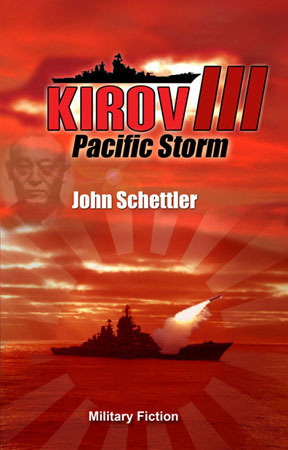
The Kirov series is over fifty books long and counting. But the third entry, Pacific Storm, was planned as a potential stopping point, according to the introduction of a later entry. And while I normally criticize series from Jack Ryan to the Survivalist for passing good opportunities to conclude, it’s for the best that this one sailed right by it.

After having fought through the Mediterranean in the second book, the missile cruiser battles in the Pacific in the third. Besides the issues with the prose, the encounters fall short because the disparity between World War II ships that don’t know what they’re dealing with and a futuristic warship that does means that all the battles have to be contrived in some fashion. Pretty much the only things that work are various surprise gimmicks, close range, and pure numbers, and that’s barely enough to sustain a three-book series.

The ending still involves sequel hooks, but features the ship going back to its present with its crew having realized they started the (nuclear) World War III by firing on an American submarine. When they see the submarine after their “excursion”, they avoid attacking it. Meanwhile, their experiences have changed the “past” significantly. This would be a perfectly good conclusion that still gave room to continue, but it would have concluded three stilted, modestly out-there books. Instead, the series got bigger, more complicated, and, yes, better.

Review: Tiberium Wars

Command And Conquer: Tiberium Wars

The Keith DeCandido novelization of Command and Conquer: Tiberium Wars was widely denounced upon release. I was there on Spacebattles, and I saw the critiques. I read it, and I agreed.

If the book itself was in an original setting, it would be forgettable and bland, a spacesuit commando Marine Force One with a Mary Sue protagonist. The only real quibble would be extremely rapid procurement of new rifles. But as it stands, it doesn’t gel well with the Command and Conquer game. At all.

There might be a mitigating factor in that I’ve also heard that DeCandido got background material for “Tiberium”, the cancelled C&C FPS project and based the book of of that, which would explain some things like the abundance of rifles. However, whatever the circumstances, this is a book to avoid.

Review: Lethal Tribute

Lethal Tribute

A 2000s SuperBolan, Lethal Tribute tells the story of the Executioner as he fights a group of Hindu cultists with cloaking devices and their stolen nuclear weapons. By this point, Mack Bolan plots had long since devolved into “cheap thriller mad libs”. With the books being published at such a fast pace, it’s hard to imagine how they couldn’t have ended up that way.

That being said, this book is one of the better ones, by later Bolan standards-which may not be saying much. It still amounts to little but an overstuffed jumble of action scenes and very much feels (understandably) rushed. It still has the issue of its plot being so shallow (even by cheap thriller standards) that it needs filler. It still has the strange generic feeling that managed to last across different authors in the series. And it still manages to be both over-descriptive of weapons and sometimes inaccurate, listing two different calibers for the same helicopter gun on one page.

But the premise here is at least more out-there than just a plain “shoot the terrorist” novel. Some of the set pieces, from tank attacks to hallucinations, get crazier than usual, a silver lining of a weird “cheap thriller mad libs” result. The filler isn’t quite as obvious or clumsy as it’s been in some other Mack Bolans. Finally and most importantly, the Executioner himself is portrayed as a lot more vulnerable than he is in some other installments. The Gold Eagle Bolans are not what I’d recommend to action readers-they’re very smooth, disposable, mass-produced, measured and forgettable artificial thrillers from the Harlequin assembly line. But in comparison to some of the others, Lethal Tribute still looks just a little better.

Review: ParaMilitary Action-Adventure Fiction, A History

Paramilitary Action-Adventure Fiction: A History

I have loved and respected Nader Elhefnawy’s analyses of fiction. So it’s with a heavy heart that I say that his Paramilitary Action-Adventure Fiction, A History doesn’t live up to his other work on the technothriller.

I saw one big technical error, claiming the SEAL Team Seven series was issued in the 2010s by “Keith Douglass.” In fact, it was reissued from its original run in the 1990s and 2000s after the bin Laden raid and “Keith Douglass” was a pen name used by at least two different people (William Keith and Chet Cunningham) and possibly a third or even more. But a bigger problem is structural.

My biggest criticism is the overly long amount of time spent on the socio-political context of the times, which while obviously relevant at times (such as the crime increase of the 1960s that paved the way for the vigilante novels or the Vietnam War MIA obsession that did the same for action novels in the 1980s), sometimes doesn’t feel like that. It flows a lot worse than the techno-thriller piece does and, worse, zooms out too much. There’s a saying of missing the forest for the trees. This misses the trees for the forest. It’s okay enough when talking about non-print items, but misses the mark when talking about books.

Far more important than what effects the economy had on the national mood were just the simple economics of dealing with anything low-margin, which is what these novels were. The sad, harsh, boring reality is that the kind of disposable paperbacks that the work covers are/were the most expendable bottom feeders of commercial literature. The slightest dip in the economy and/or change in customer tastes could knock out all but the most popular. I don’t blame Elhefnawy for taking the approach he did, but think he was looking in the wrong place.

Review: If It Bleeds

If It Bleeds

A collection of short stories featuring the infamous Predator alien hunters, If It Bleeds is the first anthology I’ve reviewed on Fuldapocalypse. From ancient history to futuristic fighting rings, the Predators come to hunt.

In many ways, these aliens are ideal crossover/setting shifters. A combination of a sense of (comparative) self-restraint and a desire for (by their standards) a “fair” fight mean they can be put almost anywhere, and they are. Compare this with the other half of the “Alien vs. Predator” franchise. The xenomorphs are one-dimensional and will inevitably either devour everything or get crushed themselves.

The various writers take advantage of this to bring about various “prey”. For the most part, they’re successful. However, there’s a few small issues. The first is that the stories that go for some kind of mystery don’t work because you know what the anthology features. The second is that there is no story where Theodore Roosevelt fights a Predator.

Otherwise, this is a very fun group of stories that any science fiction or action fan should enjoy.